The confusion between affect vs effect is one of the most common grammar challenges in English. Many students, bloggers, and professionals stop while writing and ask: “Should I use affect or effect?” This happens because both words look similar, sound alike, and are closely related in meaning.
People search for terms like “when to use affect vs effect,” “is it going to affect me or effect me,” and “are you affected or effected?” because they want a clear and simple rule. Using the wrong word can make your writing look unprofessional, confusing, or unclear.
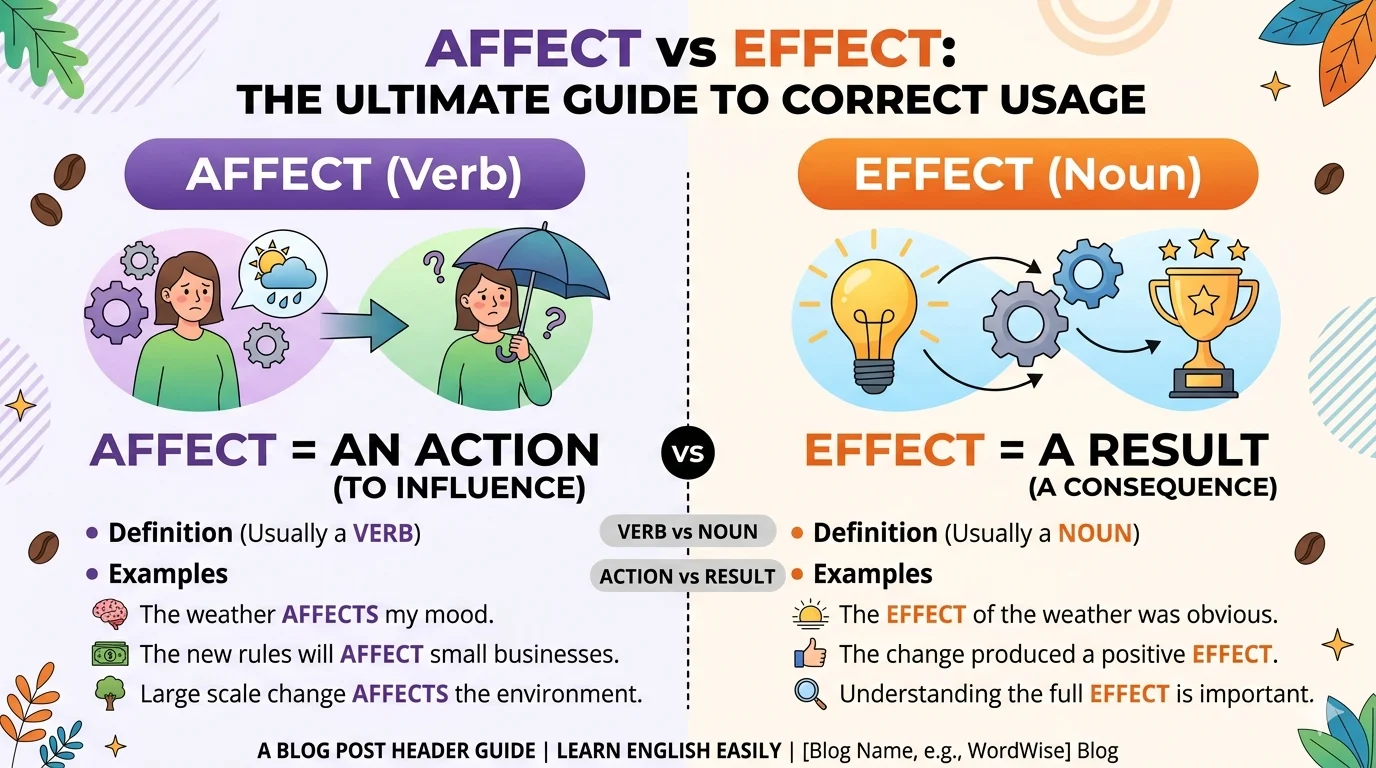
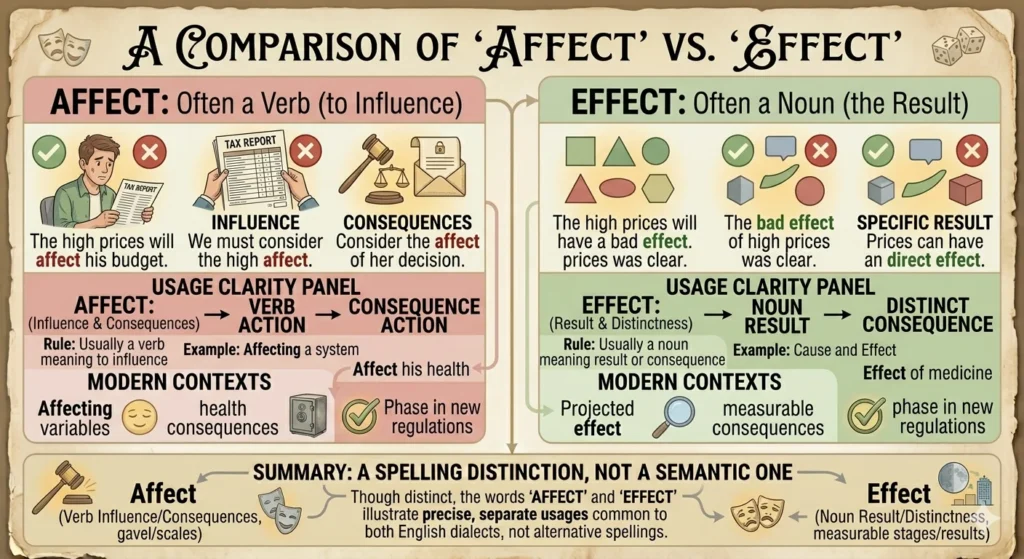
According to Oxford and Cambridge grammar rules, affect is a verb (an action), and effect is a noun (a result). Understanding this difference improves your writing, whether in academic, professional, or casual communication. This guide will explain everything: rules, examples, psychology usage, medical meaning, pronunciation, affect vs effect in Urdu, and expert tips. By the end, you’ll never confuse these words again.
Affect vs Effect
Affect = Verb (Action)
Effect = Noun (Result)
👉 Affect means to influence something, while effect means the result of that influence.
Examples:
- This will affect your results. ✅
- This will effect your results. ❌
- The medicine had a strong effect. ✅
- The medicine had a strong affect. ❌
Memory Trick
- A = Action → Affect
- E = End Result → Effect
Most professional editors recommend this simple trick to avoid confusion.
The Origin of Affect vs Effect
- Affect → Latin afficere (to influence)
- Effect → Latin effectus (result)
In modern English:
- Affect became a verb
- Effect became a noun
According to grammar authorities, this distinction has remained consistent in formal writing for centuries.
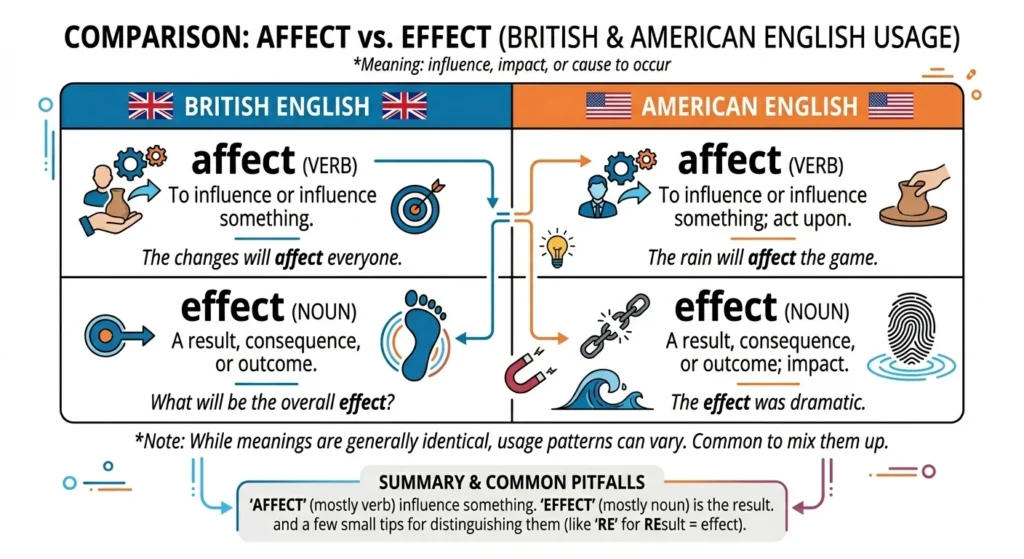
British English vs American English Spelling
The spelling of affect and effect is the same in both British and American English. Only usage differs.
| Usage | Word | Example |
|---|---|---|
| Verb | Affect | Stress affects health |
| Noun | Effect | Stress has a bad effect |
✅ Same spelling worldwide
✅ Only the grammatical role changes
Which Spelling Should You Use?
Use Affect When:
- You need a verb
- You describe influence
Example:
- This decision will affect your career.
Use Effect When:
- You need a noun
- You describe a result
Example:
- This decision had a strong effect on my career.
Advanced Grammar (Expert Tips)
- Effect as a verb (rare): The new policy will effect change (means “create change”)
- Affect as a noun (psychology): The patient showed flat affect
These advanced uses appear in academic and professional writing.
Common Mistakes with Affect vs Effect
| Mistake | Correct Usage |
|---|---|
| Is it going to effect me? | affect me |
| Are you effected by something? | affected |
| Side affect of medicine | side effect |
| The weather had a big affect | effect |
Real-Life Case Study:
A student writes in an email: “This change will effect my grades.”
❌ Incorrect → effect is rarely used as a verb
✔ Correct → “This change will affect my grades.”
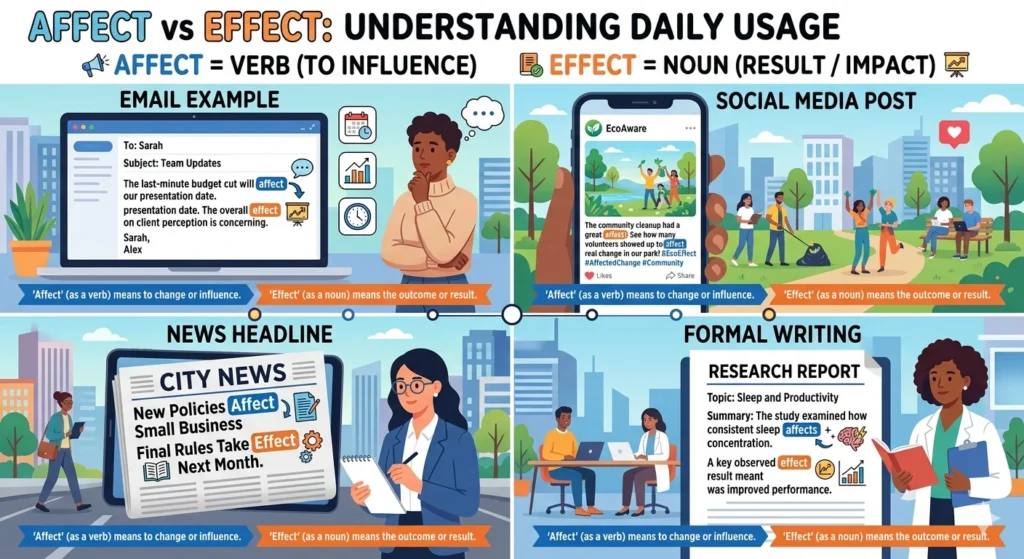
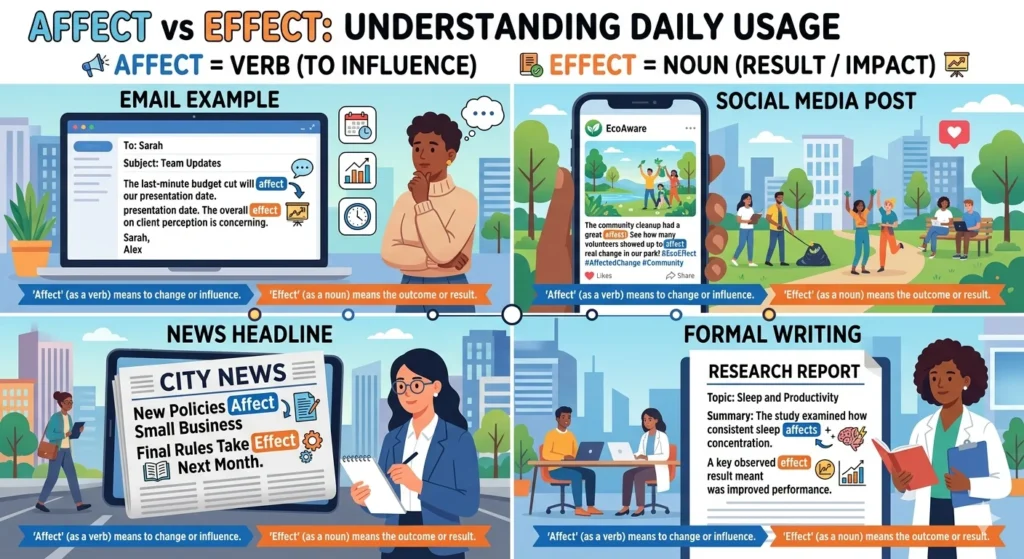
Affect vs Effect in Everyday Examples
Emails:
- Delay may affect your order
- The update had a positive effect
News:
- Inflation affects millions
- The effect is rising prices
Social Media:
- This trend affects users
- The effect is viral growth
Formal Writing:
- Policy changes affect the economy
- The effect is long-term impact
Affect vs Effect in Urdu
- Affect (اثر ڈالنا) → influence karna
- Effect (نتیجہ / اثر) → result
Examples:
- Yeh mujhe affect karega
- Iska acha effect hua
Affect vs Effect in Psychology
- Affect = emotional expression → flat affect
- Effect = result of behavior
This distinction is important in clinical and academic contexts.
Affect vs Effect in Medical Use
- Always use effect for results
Examples:
- Side effect of medicine
- Positive effect on health
❌ Never say: side affect
Affect vs Effect Pronunciation
- Affect → uh-FEKT
- Effect → ih-FEKT
They sound similar, which causes confusion.
Affect vs Effect Synonym Guide
Affect Synonyms: Influence, Impact, Change
Effect Synonyms: Result, Outcome, Consequence
Affect vs Effect Checker
Use tools like Grammarly, Hemingway Editor, or Google Docs to automatically correct mistakes.
Comparison Table
| Feature | Affect | Effect |
|---|---|---|
| Type | Verb | Noun |
| Meaning | Influence | Result |
| Example | It affects me | It has an effect |
| Urdu | اثر ڈالنا | نتیجہ |
| Synonym | Impact | Outcome |
Google Trends & Usage Data
- The keyword affect vs effect is searched globally
- Popular among students, bloggers, and ESL learners
- Confusion arises due to:
- Similar pronunciation
- Similar spelling
- Related meaning
Reddit Insight:
- Users often remember: “A = action, E = effect (result)”
Practice Section
Choose the correct word:
- This will (affect / effect) your life
- The medicine had a strong (affect / effect)
- Are you (affected / effected)?
- This may (affect / effect) results
- The new law will (affect / effect) change
- This noise affects my (mood / effect)
- The effect of stress (is / affects) health
- This will directly (affect / effect) you
- The side (affect / effect) was mild
- This decision had a big (affect / effect)
Answers:
- affect | 2. effect | 3. affected | 4. affect | 5. effect | 6. mood | 7. is | 8. affect | 9. effect | 10. effect
FAQs
1. When should I use affect vs effect?
- Answer: Use affect as a verb when you describe influence or action. Use effect as a noun when you describe the result or outcome of an action.
- Example: Stress can affect your health. The medicine had a positive effect.
2. Are you affected or effected by something?
- Answer: The correct word is affected when describing someone influenced by something.
- Example: I was deeply affected by the news.
- Tip: Remember, “affected” = influence on a person or thing; “effected” = caused or created something (rare).
3. Is it “affect me” or “effect me”?
- Answer: Correct usage is affect me because it shows influence or impact.
- Example: Will this change affect me at work?
4. How do I use affect vs effect in the UK vs US English?
- Answer: The grammar rule is the same in both British and American English. Only the context matters: verb = affect, noun = effect.
- Example (UK & US): The decision will affect your results. The effect of the decision was immediate.
5. What is affect vs effect in Urdu?
- Answer:
- Affect = اثر ڈالنا (influence)
- Effect = نتیجہ / اثر (result)
- Example: Yeh mujhe affect karega. Iska acha effect hua.
6. Can effect ever be used as a verb?
- Answer: Yes, but rarely. It means to cause or bring about a change.
- Example: The new law will effect positive changes in the education system.
7. What is the difference between side effect and side affect?
- Answer: Correct is side effect, which means a secondary result of a drug, medicine, or action.
- Tip: “Side affect” is incorrect in English grammar.
8. How can I remember the difference between affect vs effect?
- Answer: Use this simple memory trick:
- Affect = Action → Verb
- Effect = End Result → Noun
9. Where can I check if I used affect or effect correctly?
- Answer: Use grammar checking tools like:
- Grammarly
- Hemingway Editor
- Google Docs spell & grammar suggestions
Conclusion
The confusion between affect vs effect can be solved with one rule: affect = action, effect = result. This simple rule helps in almost every situation. We covered examples, psychology, medical usage, common mistakes, practice exercises, and expert tips.
Using correct grammar improves clarity, credibility, and communication. Always ask: Does this show influence (affect) or result (effect)?
With this guide and practice, you will confidently use affect vs effect in writing and speech.

Scott Thornbury is a respected English language educator and author, known for practical grammar insights, teacher training, and clear learner-focused explanations.