Do you ever wonder: Is it compliment or complement? You’re not alone. Thousands of learners, bloggers, and students search for “compliment vs complement” because these two words look the same and sound the same—but their meanings are completely different.
This confusion often leads to mistakes in emails, articles, exams, and professional writing. For example, writing “your outfit compliments you” instead of “complements you” changes the meaning.
So, what is the difference between complement and compliment? This guide gives you a quick answer, clear explanation, and real examples so you never make this mistake again.
In this complete guide, you’ll learn:
- Compliment vs complement meaning
- The difference between compliment and complement with examples
- Real-life usage in sentences
- Common mistakes and how to fix them
- Memory tricks to remember forever
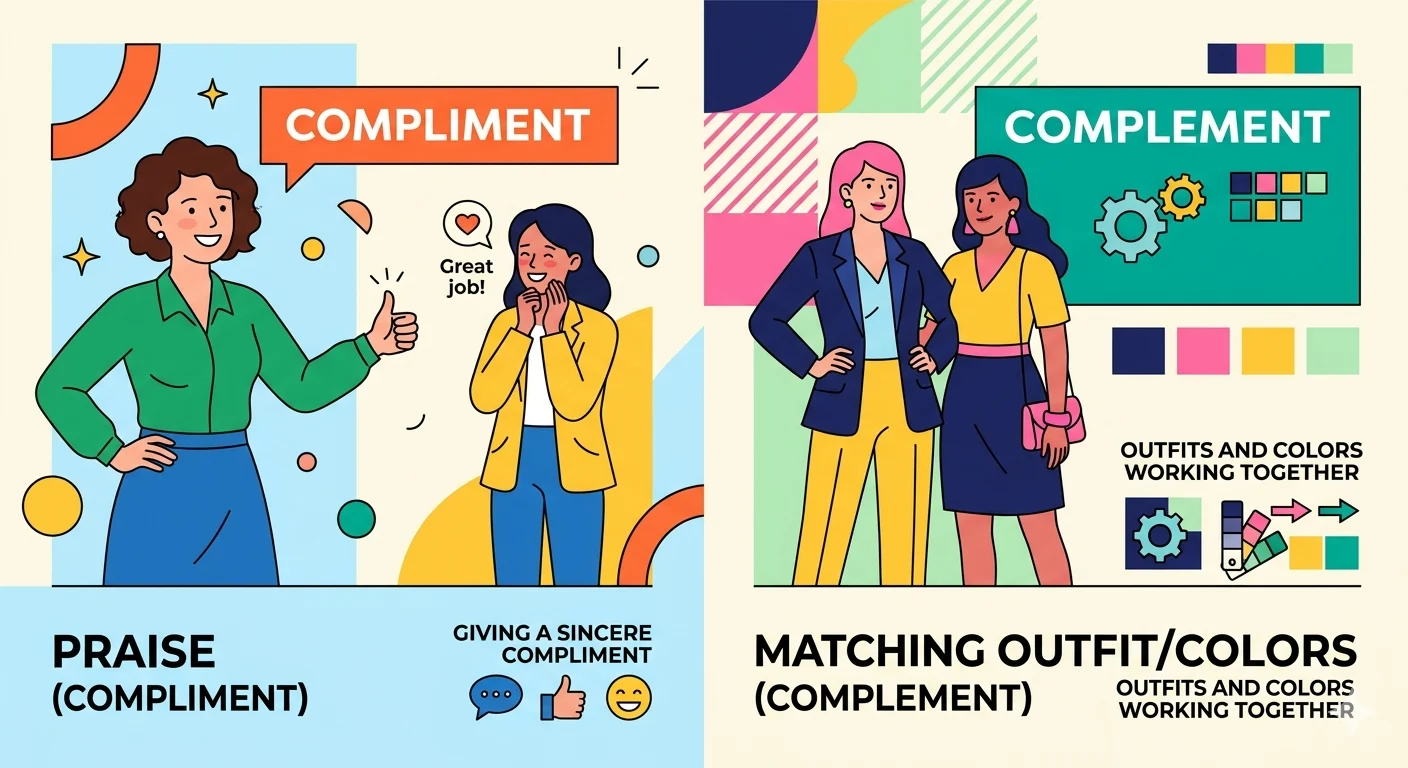
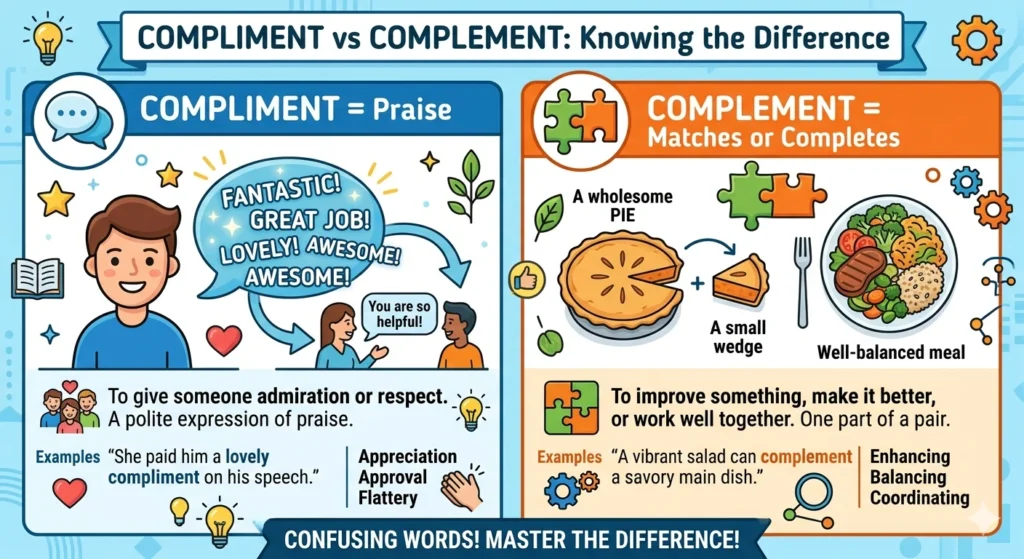
Compliment vs Complement
👉 Compliment = Praise or kind words
👉 Complement = Something that completes or matches
Featured Snippet Definition:
Compliment means praise or a nice remark. Complement means to complete, match, or improve something.
Examples:
- She gave me a compliment. ✅
- This color complements your dress. ✅
Memory Trick:
- Compliment = “I say something nice”
- Complement = “It fits or completes”
What is the Difference Between Complement and Compliment?
👉 Compliment
- Meaning: Praise or admiration
- Used for: People and feelings
✔ Example:
- He gave me a nice compliment.
👉 Complement
- Meaning: To complete or improve something
- Used for: Things and functions
✔ Example:
- This sauce complements the dish.
Comparison Table:
| Feature | Compliment | Complement |
|---|---|---|
| Meaning | Praise | Complete or match |
| Usage | Social | Functional |
| Example | She gave a compliment | This complements the outfit |
The Origin of Compliment vs Complement
Both words come from the Latin word complere, meaning “to fill” or “to complete.”
- Compliment evolved through French and came to mean polite praise
- Complement kept its original meaning: to complete or enhance
👉 One is about kind words, the other is about perfect match

British English vs American English Spelling
There is no difference in spelling.
| Word | Meaning | US Spelling | UK Spelling |
|---|---|---|---|
| Compliment | Praise | Same | Same |
| Complement | Complete or match | Same | Same |
Which Spelling Should You Use in Compliment vs Complement?
Use the correct word based on meaning.
Use “Compliment” when:
- You are praising someone
✔ Example:
- Thank you for your compliment.
Use “Complement” when:
- Something matches or improves something
✔ Example:
- This color complements your style.
🌍 Expert Tip
This rule is widely taught in English grammar courses and supported by major dictionaries and style guides. Using the correct word improves clarity, credibility, and professional writing.
Common Mistakes with Compliment vs Complement
❌ Wrong:
- This color compliments your dress.
✅ Correct:
- This color complements your dress.
❌ Wrong:
- He complemented me on my work.
✅ Correct:
- He complimented me on my work.
Compliment vs Complement Means Free
Many people search: “compliment vs complement means free”
👉 Correct:
- Complimentary = Free
- Comes from compliment
✔ Examples:
- Complimentary breakfast
- Complimentary drinks
Compliment vs Complement Colors
✔ Correct: Complementary colors
- Colors that match well
- Example: Blue and orange
❌ Not “complimentary colors”
Broach vs Brooch: Which One Is Actually Correct?
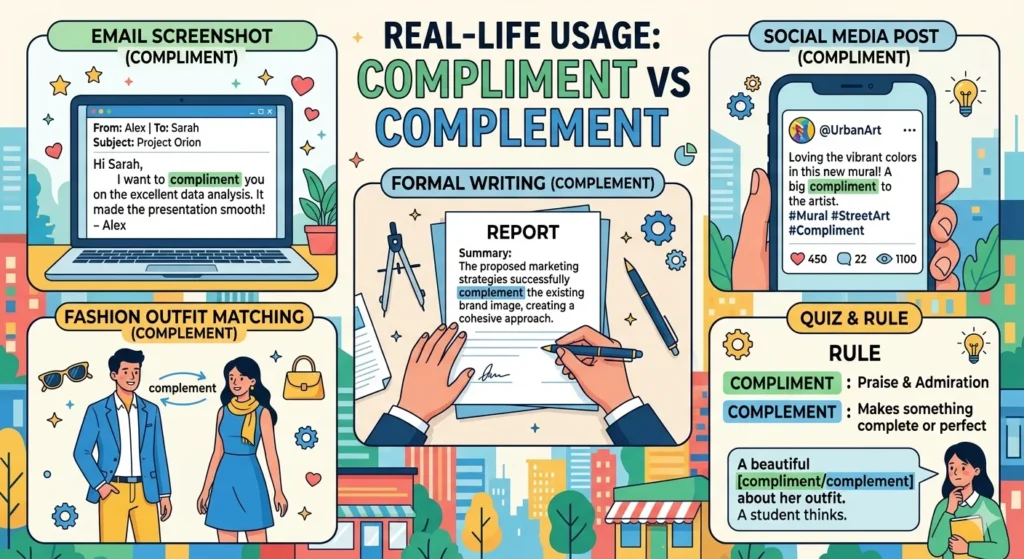
Compliment vs Complement in Daily Use
📧 Emails:
- Thank you for your kind compliment.
- This feature complements our system.
📱 Social Media:
- She complimented my post.
- These filters complement the image.
📰 News:
- The actor received many compliments.
- The design complements modern buildings.
🧾 Formal Writing:
- His skills complement the team.
- She appreciated the compliment.
Difference between Compliment and Complement with Examples
| Feature | Compliment | Complement |
|---|---|---|
| Meaning | Praise | Complete or match |
| Example | Nice compliment | Complements outfit |
| Use Case | People | Things |
Compliment vs Complement Pronunciation
Both words sound the same:
- Compliment → /ˈkɒm.plɪ.mənt/
- Complement → /ˈkɒm.plɪ.mənt/
👉 This is why confusion happens.
Complement vs Complete
- Complete = Finish something
- Complement = Improve something
✔ Example:
- Complete the task.
- This feature complements the design.
What is an Example of Complement?
- This tie complements your suit.
- The sauce complements the dish.
- Her skills complement his.
What Does Complement Mean?
Complement means:
- To complete
- To improve
- To match
👉 Simple: It makes something better
Compliment vs Complement Reddit Insights
Online discussions show:
- Same pronunciation causes confusion
- “Complementary colors” is the most common mistake
- Many people think “complementary” means free
👉 Even advanced users get confused.
Compliment vs Complement – Google Trends & Usage Data
📊 Why people search this:
- Similar spelling
- Same pronunciation
- Writing mistakes
📈 Search insights:
- Searches increase during exams
- Students and bloggers search most
🌍 Countries:
- USA, UK, Canada
- India & Pakistan growing fast
Common Confusion in Exams and Writing Tests
Students often lose marks due to this mistake.
Example:
- ❌ The teacher complemented the student.
- ✅ The teacher complimented the student.
👉 Grammar exams and writing guides clearly teach this rule.
Memory Tricks to Never Forget
✔ Compliment = “I like you”
✔ Complement = “It matches you”
Bonus Trick:
- Compliment → “I” = I say nice words
- Complement → “E” = Enhance
FAQs
1. What is the difference between complement and compliment?
👉 Compliment = praise
👉 Complement = match
2. Is free food complimentary or complementary?
👉 Complimentary (free)
3. What is an example of complement?
- This color complements your dress.
4. What does complement mean?
👉 To complete or improve something
5. Why are these words confusing?
👉 Same pronunciation and spelling similarity
6. Are complimentary colors correct?
❌ No
✔ Complementary colors
7. How do I remember the difference?
👉 Compliment = nice words
👉 Complement = perfect match
Conclusion
The confusion between compliment vs complement is common, but now you understand it clearly.
- Compliment = praise and kind words
- Complement = match and complete
Even though they sound the same, their meanings are very different. Using the correct word improves your writing and communication.
The easiest way to remember:
- Compliment = Say something nice
- Complement = Things that fit together
This rule is supported by grammar experts and widely used in academic and professional writing. Now you can confidently use both words correctly in any situation.

David Crystal is a renowned English linguist and author, known for making English grammar, linguistics, and language history clear and engaging.