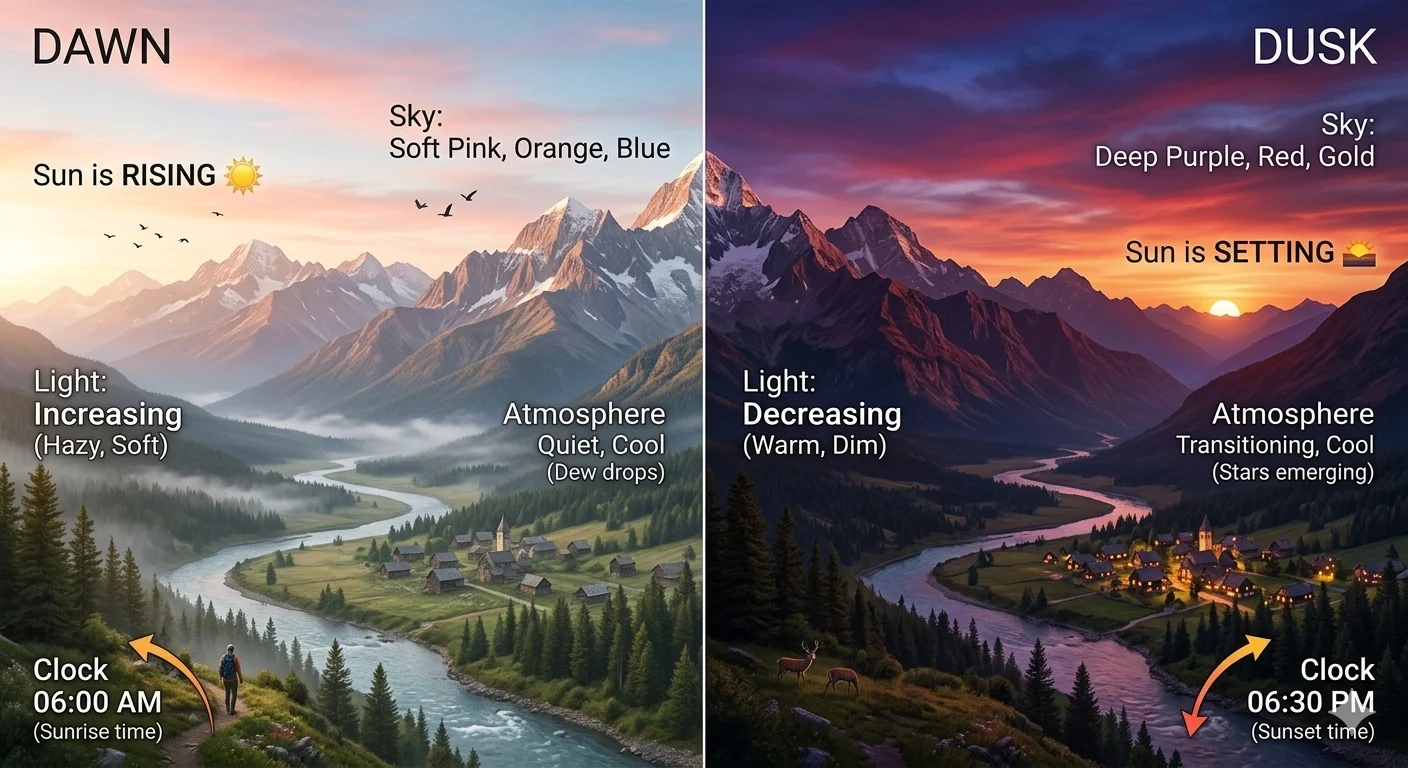
The sky changes in beautiful ways during the early morning and late evening. Soft colors appear, the light shifts slowly, and the horizon looks peaceful. These two moments are called dawn and dusk. Because both happen when the sun is near the horizon, many people search for dawn vs dusk to understand the difference.
People often ask questions like “Is dawn the same as dusk?”, “Is sunrise dawn or dusk?”, or “Is dusk just after sunset?”. Others compare dawn vs dusk vs twilight to understand how the sky changes during the day.
The confusion happens because dawn and dusk both occur during twilight, when the sun is just below the horizon but still lights the sky. At these times, the sky shows beautiful shades of orange, pink, and purple. Photographers especially love the dawn vs dusk colors because the light is soft and dramatic.
Understanding the difference helps in many situations. Travelers check dawn vs dusk time before hiking, photographers plan shoots around sunrise and sunset, and writers use these words to describe scenes in stories and news reports.
In this guide, you will learn what dusk and dawn mean, how they relate to sunrise and sunset, and how they connect with twilight and evening. By the end, the difference between dawn and dusk will be clear and easy to remember.
Dawn vs Dusk
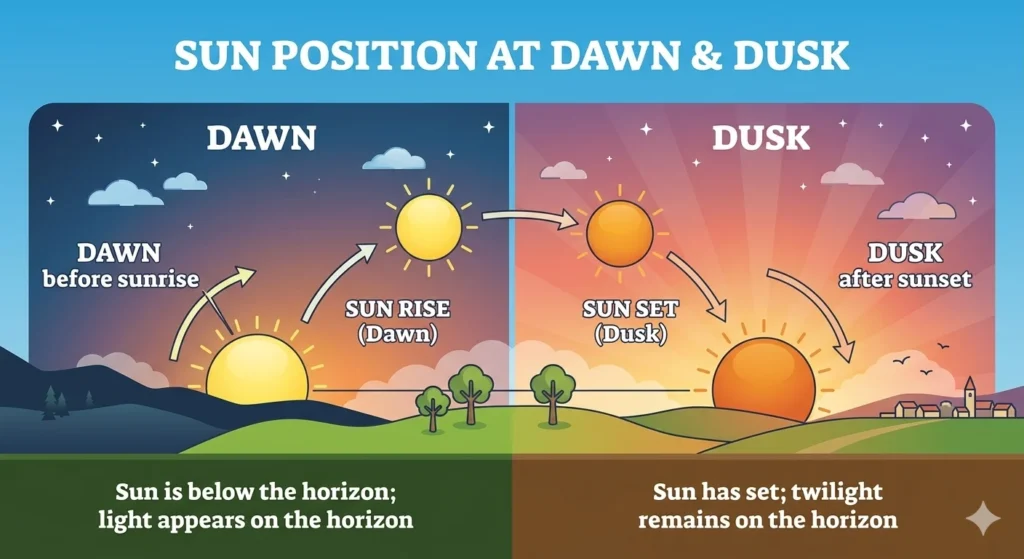
Dawn is the time before sunrise when the sky begins to brighten. Dusk is the time after sunset when daylight fades and night begins.
| Term | Meaning | Time |
|---|---|---|
| Dawn | Light appears before sunrise | Morning |
| Dusk | Light fades after sunset | Evening |
Example:
- “Birds begin singing at dawn.”
- “Street lights turn on at dusk.”
Dawn vs Dusk – Key Differences Explained
| Feature | Dawn | Dusk |
|---|---|---|
| Time | Before sunrise | After sunset |
| Sky direction | Eastern sky brightens | Western sky darkens |
| Meaning | Beginning of the day | Beginning of night |
| Light level | Light increases | Light decreases |
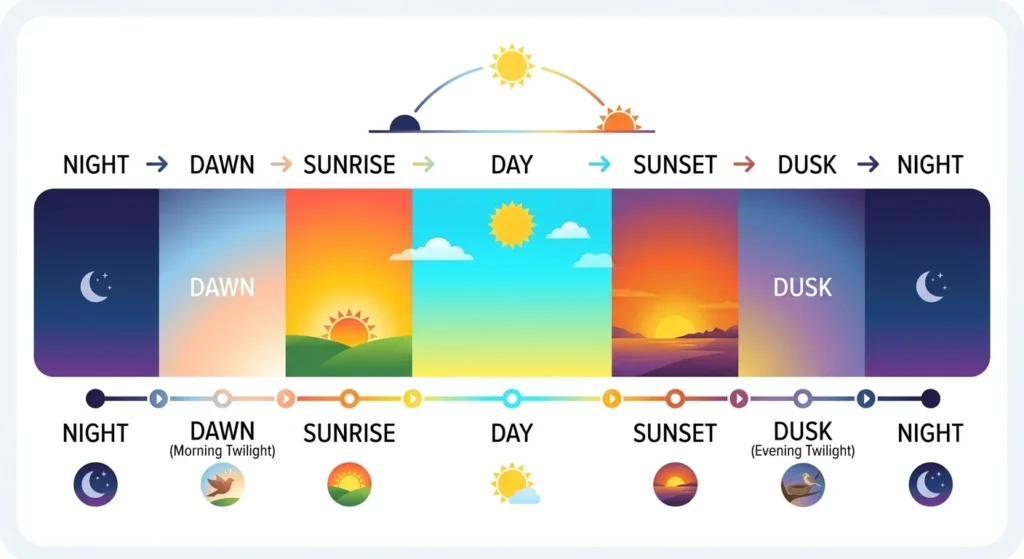
Simple Timeline
Night → Dawn → Sunrise → Day → Sunset → Dusk → Night
A simple rule to remember:
Dawn starts the day, while dusk ends it.
The Origin of Dawn vs Dusk
Origin of Dawn
The word dawn comes from the Old English word “dagian,” which means “to become day.” It describes the moment when darkness slowly changes into daylight.
Writers often use dawn to symbolize:
- hope
- renewal
- a new beginning
Example:
“Farmers began working at dawn.”
Origin of Dusk
The word dusk comes from an old English root connected to darkness or shadow. It later became the word used to describe the fading light at the end of the day.
Example:
“The village became quiet at dusk.”
Many discussions online, including dawn vs dusk Reddit conversations, show that people often confuse these terms because both occur during twilight.
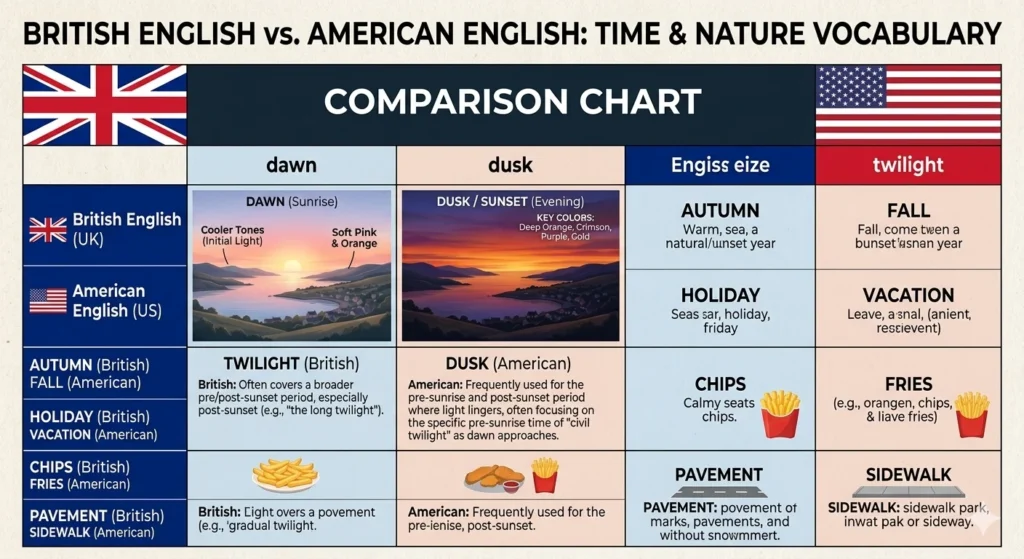
British English vs American English Spelling
Unlike many English words, dawn and dusk have identical spelling in both British and American English.
| Word | British English | American English | Meaning |
|---|---|---|---|
| Dawn | Dawn | Dawn | Morning light before sunrise |
| Dusk | Dusk | Dusk | Evening light after sunset |
| Twilight | Twilight | Twilight | Light between day and night |
Example sentences:
British English:
- “The sky turned pink at dawn.”
American English:
- “Mosquitoes come out at dusk.”
Which Spelling or Term Should You Use?
Both words are universal in English.
Use Dawn When
- describing early morning light
- referring to the time before sunrise
- discussing the beginning of the day
Example:
“The fishermen left the harbor at dawn.”
Use Dusk When
- describing evening light
- referring to the time after sunset
- explaining when night begins
Example:
“The park closes at dusk.”
Common Mistakes with Dawn vs Dusk
Mistake 1: Mixing Morning and Evening
Incorrect:
“Stars appear at dawn.”
Correct:
“Stars appear at dusk.”
Mistake 2: Confusing Dawn with Sunrise
Incorrect:
“Dawn is when the sun rises.”
Correct:
Sunrise happens after dawn.
Mistake 3: Confusing Dusk with Sunset
Incorrect:
“Dusk is when the sun disappears.”
Correct:
Sunset is when the sun disappears, and dusk follows afterward.
Mistake 4: Dusk vs Evening
People also search dusk vs evening.
- Evening: the period between afternoon and night
- Dusk: the darker moment near the end of evening
Dawn vs Dusk in Everyday Examples
These words appear in daily communication.
Email Example
“Please return to the campsite before dusk.”
News Example
“Search teams worked from dawn until afternoon.”
Social Media Example
“Beautiful dawn colors over the mountains today.”
Photography
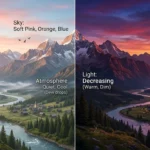
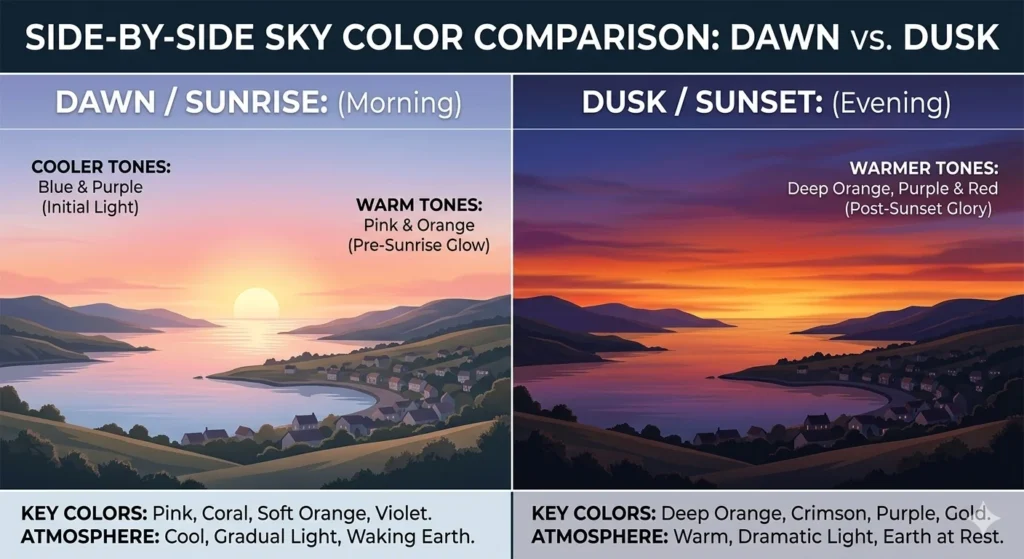
Photographers often take pictures during dawn or dusk because the sunlight becomes softer. These moments create beautiful dawn vs dusk colors such as:
- orange
- pink
- purple
- soft blue
This light is often called the golden hour.
Dawn vs Dusk vs Twilight
Many people compare dawn vs dusk vs twilight.
| Term | Meaning | Time |
|---|---|---|
| Dawn | Morning light before sunrise | Morning |
| Sunrise | Sun appears above horizon | Morning |
| Sunset | Sun disappears below horizon | Evening |
| Dusk | Darkness after sunset | Evening |
| Twilight | Soft light when the sun is below horizon | Morning and evening |
According to the National Weather Service, twilight occurs when the sun is below the horizon but still illuminates the sky.
Astronomers divide twilight into three stages:
- Civil twilight
- Nautical twilight
- Astronomical twilight
Dawn and dusk occur within these twilight stages.
Dawn vs Dusk Colors
One reason people love these times is the dramatic sky colors.
Dawn Colors
- pink
- light orange
- pale purple
- soft blue
Dusk Colors
- deep orange
- red
- purple
- dark blue
These colors appear because sunlight travels through more of Earth’s atmosphere when the sun is near the horizon.
Dawn vs Dusk Time
The exact dawn vs dusk time changes depending on:
- location
- season
- latitude
- atmospheric conditions
Example:
| City | Dawn | Sunrise | Sunset | Dusk |
|---|---|---|---|---|
| London | 5:30 AM | 6:00 AM | 7:45 PM | 8:10 PM |
| New York | 5:45 AM | 6:15 AM | 7:50 PM | 8:20 PM |
Weather apps usually show civil dawn and civil dusk, which help travelers and photographers plan activities.
Dawn vs Dusk – Google Trends & Usage Data
Search interest in dawn vs dusk remains high worldwide.
Popular searches include:
- dawn vs sunrise
- sunset vs dusk
- sunset vs dusk vs twilight
- dawn vs dusk time
- is dawn the same as dusk
Countries with high search interest include:
- United States
- United Kingdom
- Canada
- Australia
- India
Online communities such as dawn vs dusk Reddit discussions also show people asking about these differences.
Frequently Asked Questions
Is dawn the same as dusk?
No. Dawn occurs before sunrise, while dusk occurs after sunset.
What is dusk and dawn?
Dawn is the early morning light before sunrise.
Dusk is the fading evening light after sunset.
Is sunrise dawn or dusk?
Sunrise happens after dawn.
Is dusk just after sunset?
Yes, dusk begins shortly after sunset.
What comes first, dawn or sunrise?
Dawn comes first. Sunrise follows when the sun appears above the horizon.
What comes after sunset?
Dusk happens after sunset as the sky becomes darker.
Is dusk the same as twilight?
Dusk is the final stage of twilight before night begins.
Conclusion
Understanding dawn vs dusk becomes easy once you know when each moment occurs. Dawn is the early morning light that appears before sunrise, while dusk is the fading evening light that happens after sunset.
Many people confuse these terms because both occur during twilight, when the sky shows beautiful colors and gentle lighting. However, their timing is opposite. Dawn begins the day, while dusk signals the arrival of night.
It also helps to understand related comparisons such as dawn vs sunrise and sunset vs dusk. Sunrise and sunset describe the exact moment the sun appears or disappears, while dawn and dusk describe the light before and after those events.
These moments are important for photography, travel, science, and everyday communication. People enjoy the stunning dawn vs dusk colors and often plan outdoor activities according to dawn vs dusk time.
Remember the simple rule:
Dawn starts the day, and dusk ends it.