Imagine sending a professional email and accidentally using the wrong word. You want to say “keep this private,” but you write a word that means “separate.” This tiny mistake can completely change the meaning of your message. That’s why so many people search for discreet vs discrete.
These two words look almost identical and sound the same, yet their meanings are completely different. Students, writers, and professionals often get confused. Common questions include:
- What does it mean to be discrete?
- Does discrete mean secret?
- When should I use discreet?
- Discreet vs discrete meaning and pronunciation
This guide solves all that confusion. You will learn the meaning, pronunciation, origin, synonyms, real-life examples, and correct usage of both words. We also include expert writing tips, memory tricks, internal links, and authoritative references to make your content professional, accurate, and Google-friendly.
By the end, you’ll confidently use discreet vs discrete in emails, reports, social media posts, and academic writing without mistakes.
Quick Tip Box
Discreet vs Discrete Quick Answer:
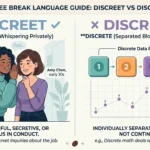
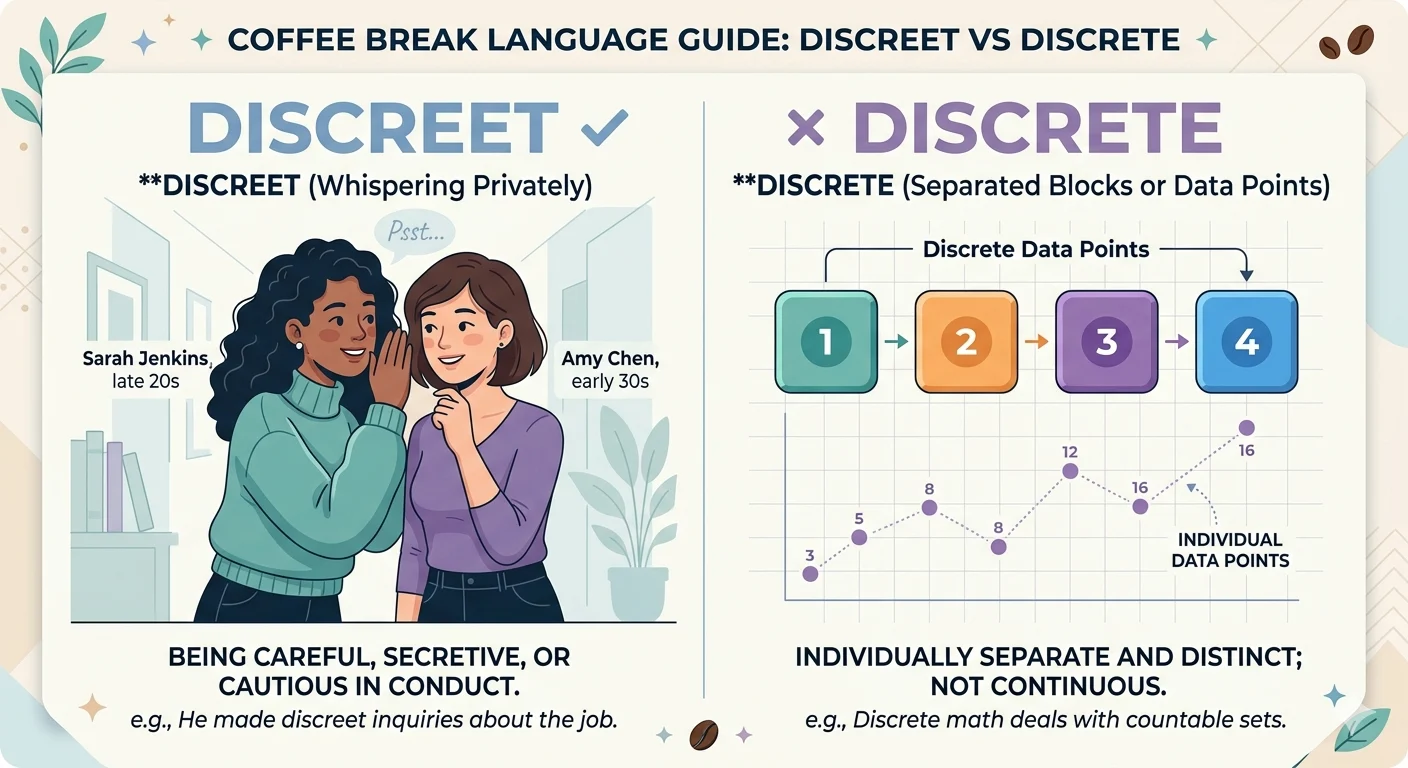
- Discreet → private, careful, secret
- Discrete → separate, distinct
Memory Tricks:
- Discreet = Secret (double “ee”)
- Discrete = Separate
- Discreet → “ee” = eyes closed (private)
- Discrete → “t” = things separate
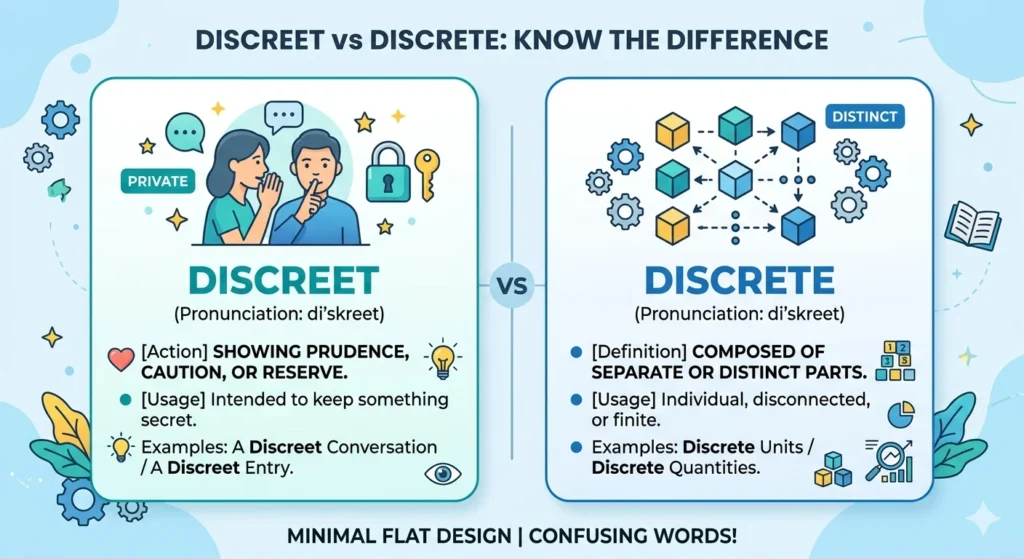
Discreet vs Discrete
Discreet means private and careful; discrete means separate and distinct.
The Origin of Discreet vs Discrete
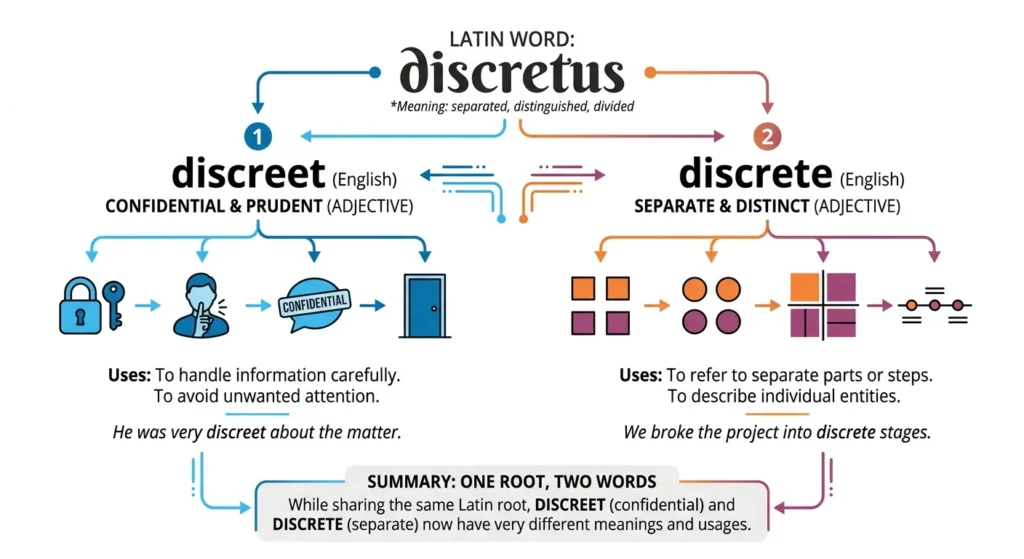
Both words come from the Latin “discretus”, meaning separated or distinguished. Over time, English created two forms with distinct meanings.
Discreet
- Evolved to mean careful, private, and wise behavior
- Related to discretion
- Common in professional, social, and workplace contexts
Discrete
- Retains the original meaning: separate or distinct
- Widely used in science, math, and technical writing
Why the difference exists
Language evolves to reduce confusion. English distinguished discreet vs discrete through spelling and meaning, while keeping a shared Latin root.
Reference: Oxford Dictionary
British English vs American English Spelling
Both words are spelled the same in the UK and US.
| Word | Meaning | US Spelling | UK Spelling |
|---|---|---|---|
| Discreet | Private, careful | Discreet | Discreet |
| Discrete | Separate, distinct | Discrete | Discrete |
Tip: Meaning, not region, decides usage.
Which Spelling Should You Use?
Use Discreet
- Talking about privacy, secrets, or careful behavior
- Describing a person
- In professional communication
✔ Example:
- He is a discreet person.
Use Discrete
- Talking about separate items, categories, or data
- Writing in science, math, or academic contexts
✔ Example:
- The chart shows discrete values.
Formal vs Informal Usage
- Discreet → professional and polite communication
- Discrete → academic, technical, and analytical writing
Expert Tip : Writers always ask: “Am I referring to privacy or separation?” This prevents mistakes.
Common Mistakes with Discreet vs Discrete
Even experienced writers confuse these words:
❌ Wrong: Please be discrete about this matter.
✔ Correct: Please be discreet about this matter.
❌ Wrong: The report has discreet sections.
✔ Correct: The report has discrete sections.
❌ Wrong: She gave discrete advice.
✔ Correct: She gave discreet advice.
Pro Tip: Always double-check emails, social posts, or reports.
Real-Life Example Stories
- Workplace Email Mistake:
A manager wrote:
“Keep this discrete.”
Team misunderstood; he meant “keep it private.” Small spelling errors can cause big confusion.
- Blogging Example:
A blogger wrote: “discrete categories” instead of “discreet categories” in an SEO post. Readers were confused about meaning.
✅ Lesson: Context matters; verify if you mean discreet (private) or discrete (separate).
Discreet vs Discrete in Everyday Examples
Emails
- Be discreet with confidential client info.
- Files are organized in discrete folders.
Workplace
- A discreet approach builds trust.
- Inventory is tracked in discrete units.
Social Media
- She shared updates in a discreet way.
- Analytics track discrete actions.
Academic & Professional Writing
- Lawyers must be discreet.
- Computer science relies on discrete mathematics.
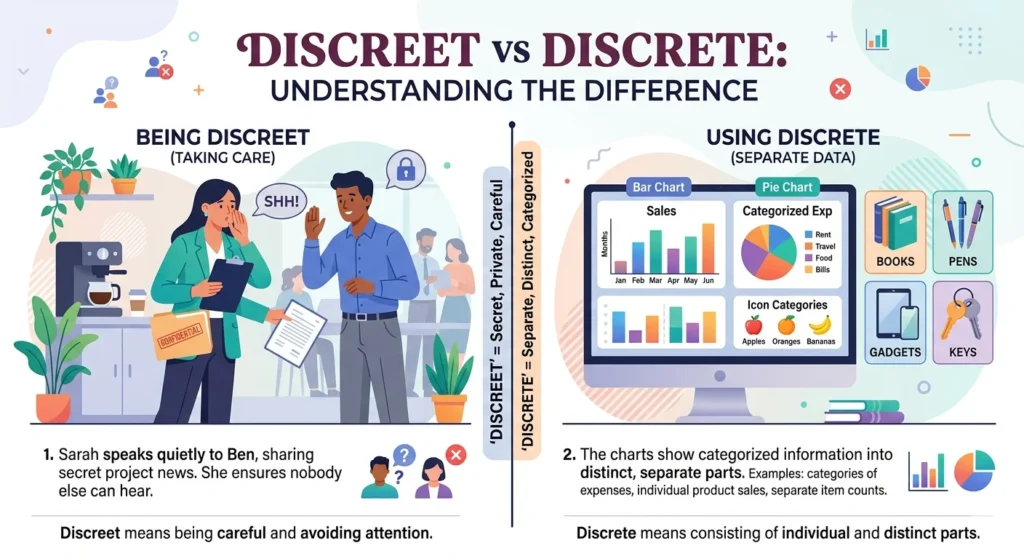
Discreet vs Discrete – Meaning & Pronunciation
| Word | Meaning | Pronunciation |
|---|---|---|
| Discreet | Careful, private, secret | /dɪˈskriːt/ |
| Discrete | Separate, distinct | /dɪˈskriːt/ |
Does Discrete Mean Secret? ❌
- No, only discreet means secretive.
Discreet vs Discretion
- Discreet → adjective (behavior)
- Discretion → noun (quality of being careful)
✔ Example:
- She is very discreet.
- She demonstrates good discretion.
Discreet vs Discrete Synonyms
Discreet: careful, private, tactful, secretive
Discrete: separate, distinct, individual, independent
LSI Keywords Added: grammar mistakes, English vocabulary tips, professional writing tips, confusing words in English.
Discreet vs Discrete Math
Discrete math deals with separate, distinct values, not continuous ranges.
- Whole numbers
- Graphs and logic
- Algorithms
Importance:
- Computer science, programming, and analytics rely on discrete math.
- Example: Counting distinct items in a database, analyzing separate actions in a workflow.
❌ Never use “discreet” in math.
Reference: Discrete Mathematics – Cambridge
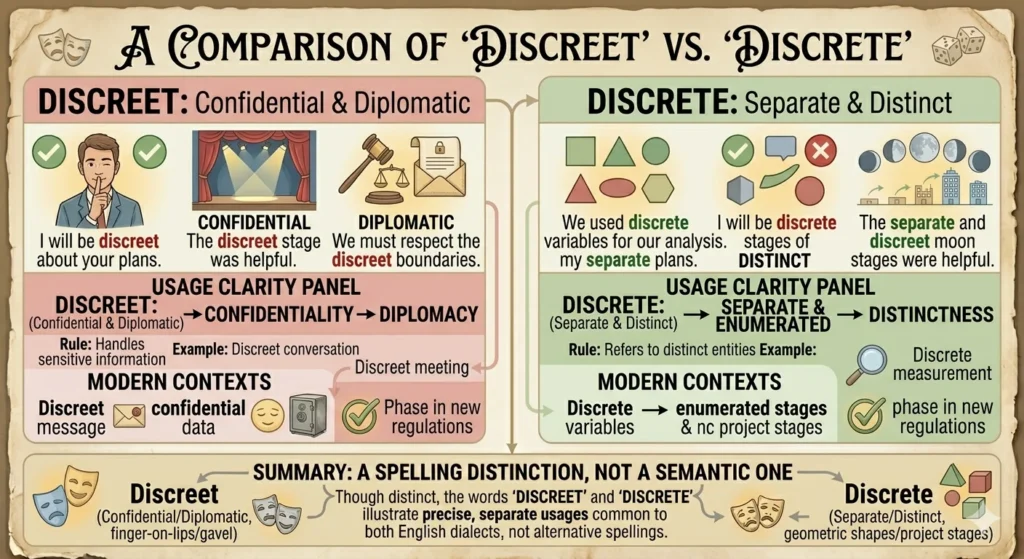
Discreet vs Discrete – Comparison Table
| Feature | Discreet | Discrete |
|---|---|---|
| Meaning | Private, careful | Separate, distinct |
| Usage | People, behavior | Things, data |
| Field | Social, professional | Science, math |
| Example | Discreet conversation | Discrete variables |
| Memory Tip | Secret (double “ee”) | Separate |
Google Trends & Usage Data
- Popular searches: discreet vs discrete meaning, discreet meaning, discrete math
- Search intent:
- Beginner → meaning & spelling
- Professional → email & workplace usage
- Academic → discrete math & separate data
- Regional trends: USA & UK balanced, India & Pakistan high learner searches
SEO Insight: Correct usage boosts rankings, CTR, and reader trust.
FAQs
- What does it mean to be discrete?
- Being separate or distinct.
- Does discrete mean secret?
- ❌ No. Secret is discreet.
- What is discreet behavior?
- Acting carefully, privately, and wisely.
- When should I use discreet?
- Use it for privacy, secrets, or careful actions.
- Discreet vs discrete pronunciation?
- Both pronounced /dɪˈskriːt/.
- Discreet vs discrete etymology?
- Both from Latin discretus, evolved into different meanings.
- Is discrete used in math?
- ✔ Yes, it refers to separate, countable values.
Conclusion
Understanding discreet vs discrete may seem confusing at first, but the difference becomes simple when you focus on meaning and context.
Discreet is used for people and behavior. It means being careful, private, and respectful of sensitive information. This word is common in emails, workplaces, and professional communication where trust matters.
Discrete, on the other hand, is used for things. It means separate, distinct, or not connected. You will often see it in academic writing, especially in subjects like math, data analysis, and computer science.
A simple way to remember:
👉 Discreet = Secret (double “ee”)
👉 Discrete = Separate
In real life, using the wrong word can confuse readers or even change your message. That’s why professional writers always double-check meaning before using similar words.
Final tip: Next time you write an email, report, or post, pause for a second and ask yourself — am I talking about privacy or separation? This small habit will help you avoid mistakes and improve your English instantly.
By mastering discreet vs discrete, you can avoid common English mistakes, improve your writing clarity, and communicate with confidence in any situation.