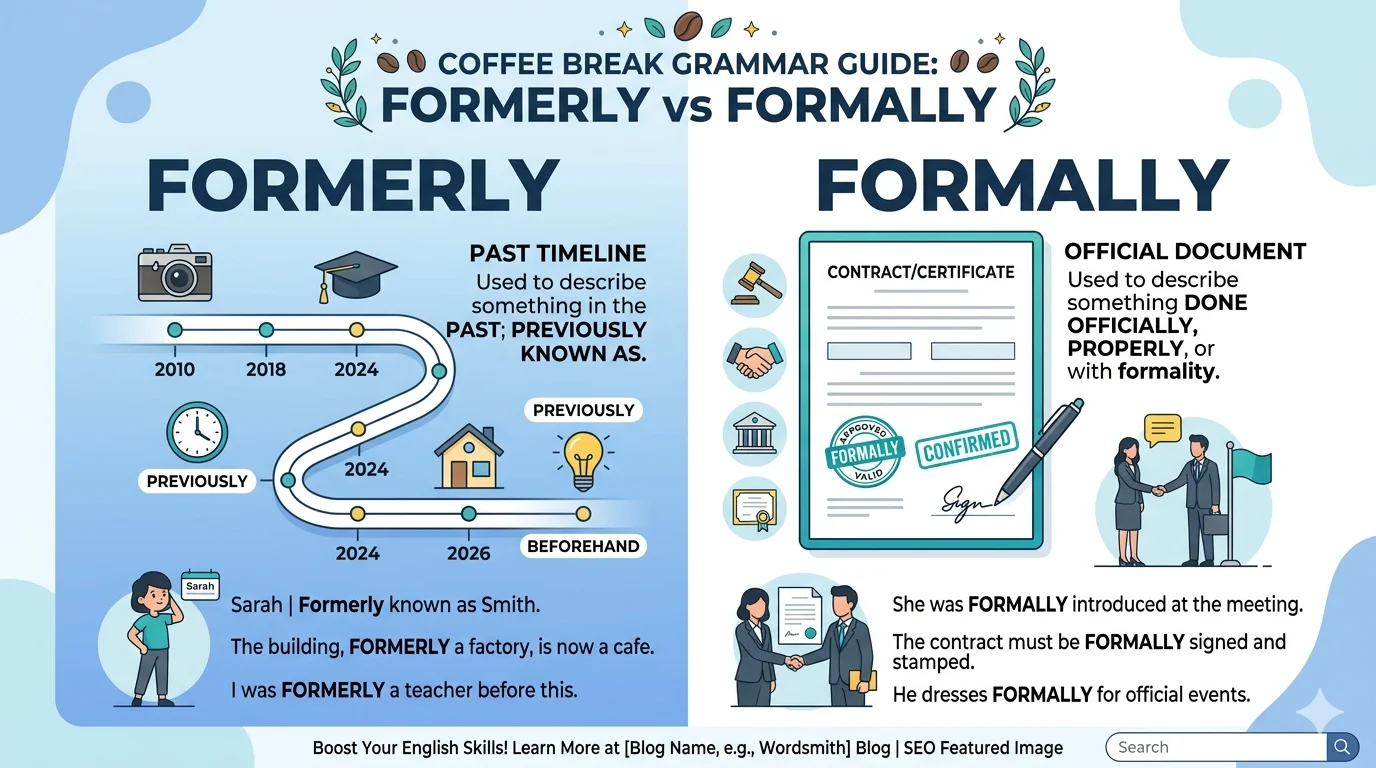
English learners often confuse “formerly” and “formally” because both words look similar but have completely different meanings. This small spelling difference creates a big grammar mistake in writing, especially in IELTS exams, job applications, emails, and academic content. That is why people frequently search for formerly vs formally meaning, formerly or formally known as, and when to use formerly or formally.
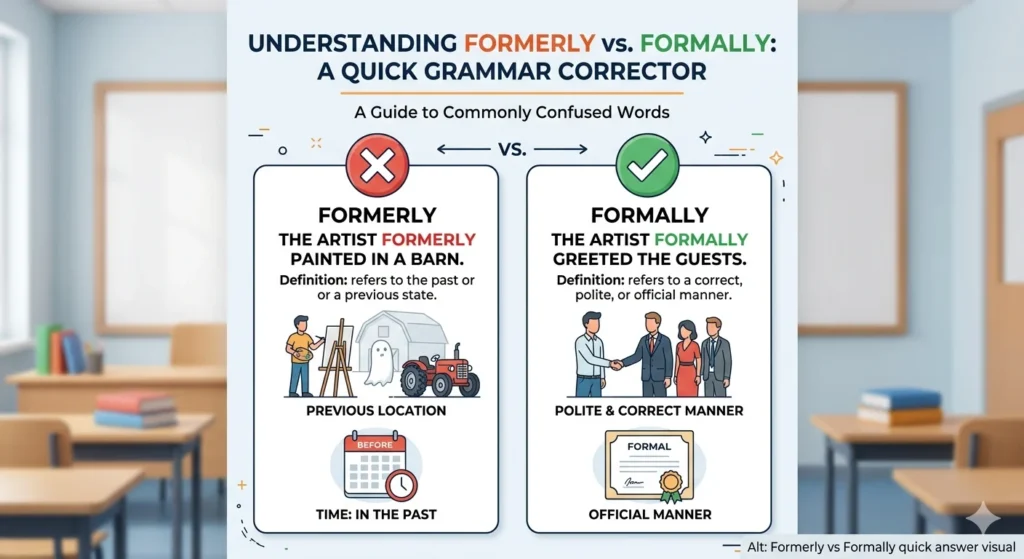
In English grammar, formerly refers to something that existed in the past, while formally refers to something done in an official, correct, or proper way. For example, “She was formerly a teacher” means she worked as a teacher before. But “She was formally invited” means she received an official invitation.
The confusion happens because both words are adverbs and have similar spelling patterns. However, their usage is completely different in meaning and context.
Now you fully understand the complete difference between formerly vs formally, including meaning, usage, examples, synonyms, and grammar rules. With regular practice, you can use both words confidently in writing and speaking.
Formerly vs Formally
Formerly means previously or in the past.
Formally means officially, properly, or in an organized way.
👉 Simple rule:
- Formerly = Past time
- Formally = Official manner
Examples:
- The city was formerly called Bombay.
- The agreement was formally approved by the board.
Formerly vs Formally Meaning
✔ Formerly Meaning (Adverb of Time)
In English grammar, formerly is an adverb of time. It is used to describe something that existed before now but not anymore.
Examples:
- He was formerly a banker.
- The country was formerly part of a larger empire.
- The company was formerly known as Google BackRub.
👉 Meaning: previously / earlier / in the past
✔ Formally Meaning (Adverb of Manner)
In English grammar, formally is an adverb of manner. It describes something done in an official, proper, or structured way.
Examples:
- The manager was formally introduced.
- The contract was formally signed.
- The complaint was formally submitted.
👉 Meaning: officially / properly / in a legal or correct way
Origin of Formerly vs Formally
✔ Formerly
- Derived from the word “former”
- Old English origin
- Connected to time and history
👉 Focus: past identity or previous state
✔ Formally
- Derived from “formal”
- Latin root formalis (order, structure)
- Connected to rules and official systems
👉 Focus: official procedures and correctness
British vs American English Usage
There is no difference in spelling or meaning between British and American English for these words.
Both use:
- Formerly ✔
- Formally ✔
Comparison Table
| Word | Grammar Type | Meaning | Example |
|---|---|---|---|
| Formerly | Adverb of time | Previously / past | He was formerly CEO |
| Formally | Adverb of manner | Officially / properly | He was formally appointed |
Pealing vs Peeling: Which One Is Actually Correct?
When to Use Formerly vs Formally
✔ Use “Formerly” when:
- Talking about past names
- Previous jobs or roles
- Historical identity
Example:
- Instagram was formerly called Burbn.
✔ Use “Formally” when:
- Writing official emails
- Legal or business communication
- Structured actions
Example:
- The proposal was formally approved.
Common Mistakes with Formerly vs Formally
❌ Incorrect:
She was formally a doctor
✔ Correct: She was formerly a doctor
❌ Incorrect:
He was formerly invited to the meeting
✔ Correct: He was formally invited to the meeting
❌ Incorrect:
The company was formally known as Google
✔ Correct: The company was formerly known as Google
Why mistakes happen:
- Similar spelling
- Fast typing errors
- Lack of grammar understanding
Formerly vs Formally in Real-Life English
✔ Emails:
- We are formally requesting approval.
- The company was formerly a startup.
✔ Business Writing:
- He was formerly head of marketing.
- The agreement was formally signed.
✔ News Writing:
- The city, formerly known as Madras, changed its name.
- The decision was formally announced today.
✔ Legal Writing:
- The treaty was formally ratified by both governments.
- The region was formerly under colonial rule.
Affect vs Effect: The Common Confusion Explained
Google Trends & Search Intent Analysis
Search data shows:
- “Formerly known as” is highly used in:
- business rebranding
- celebrity names
- Wikipedia-style content
- “Formerly vs formally” is mostly searched by:
- IELTS students
- English learners
- bloggers and writers
High search countries:
- Pakistan
- India
- UK
- Philippines
Memory Trick
🔥 Simple Trick:
- Formerly = Former = Past
- Formally = Formal = Official
👉 This trick removes confusion instantly.
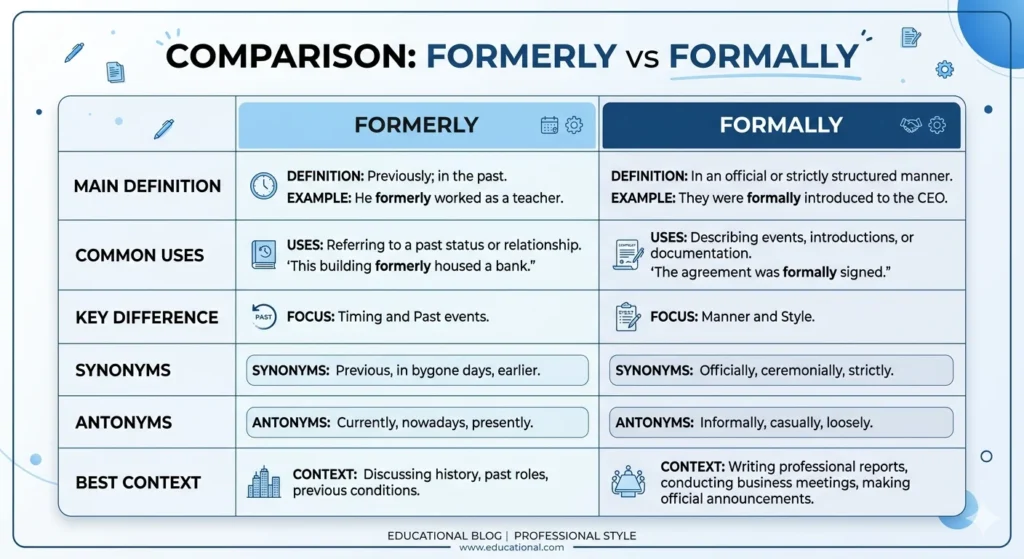
Comparison Table
| Feature | Formerly | Formally |
|---|---|---|
| Type | Adverb of time | Adverb of manner |
| Meaning | Previously | Officially |
| Context | History / past | Business / law |
| Usage | Old identity | Formal action |
| Example | Formerly CEO | Formally approved |
FAQs
1. What is the difference between formerly and formally?
Formerly means past, while formally means officially or properly.
2. Is it formerly known or formally known?
✔ Correct: formerly known as
3. When should I use formerly or formally?
Use formerly for past identity and formally for official actions.
4. What is formerly in a sentence?
It means something existed in the past.
5. Can formally replace formerly?
No, both have different meanings.
6. What are formerly synonyms?
Previously, earlier, in the past.
7. Why do people confuse them?
Because both words look similar but have different grammar roles.
Conclusion
The difference between formerly and formally is simple but very important in English grammar. Formerly is used when talking about something that existed in the past, such as old names, jobs, or identities. On the other hand, formally is used when something is done in an official, proper, or structured way.
This confusion is very common among students, especially in IELTS exams, professional writing, and online content creation. However, once you remember the simple rule—former = past and formal = official—you will never confuse these words again.
Now you fully understand the complete difference between formerly vs formally, including meaning, usage, examples, synonyms, and grammar rules. With regular practice, you can use both words confidently in writing and speaking.

David Crystal is a renowned English linguist and author, known for making English grammar, linguistics, and language history clear and engaging.