Many people feel confused about your vs you’re because both words sound exactly the same. This small difference often leads to mistakes in writing. You may have seen sentences like “your amazing” or “you’re book”, which are incorrect.
This confusion happens because these words are homophones, meaning they sound alike but have different meanings and spellings. Even simple writing like messages, emails, or school work can look unclear if the wrong word is used.
In this guide, you will learn the your vs you re meaning, see clear examples, and understand when to use each word correctly. You will also find common mistakes, simple rules, and practice exercises to help you improve.
By the end, you will feel confident using both words without confusion.
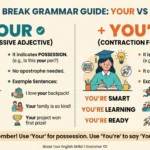
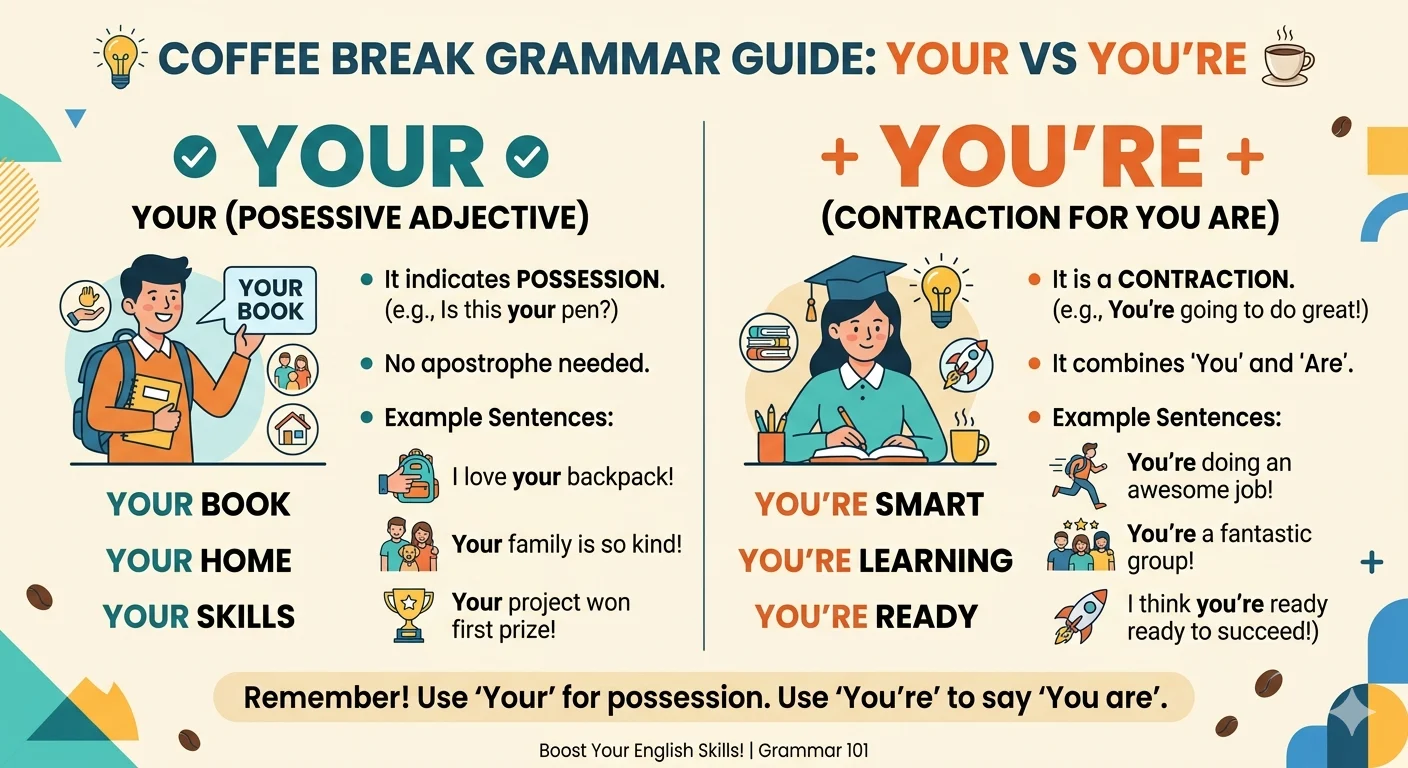
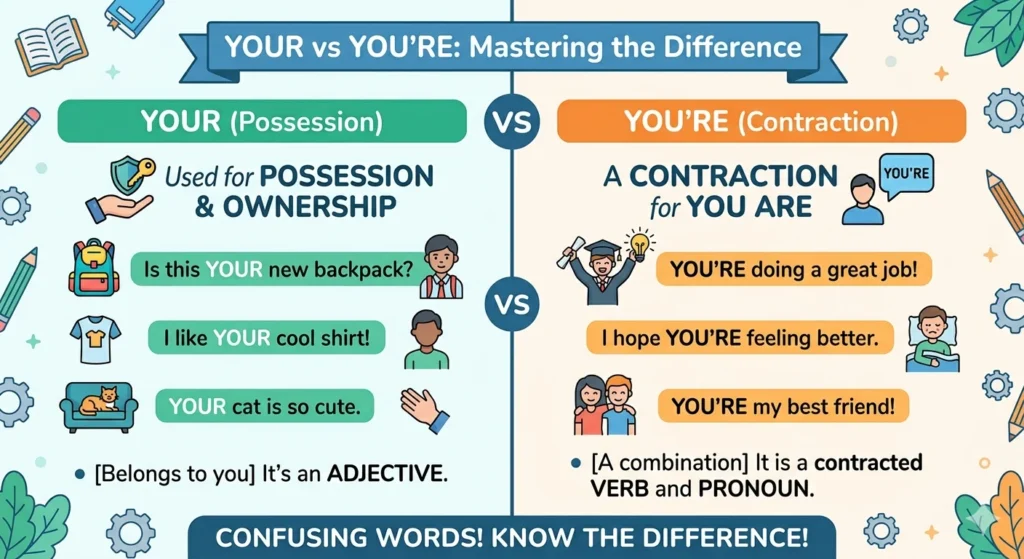
Your vs You’re
- Your → shows possession (something belongs to you)
- You’re → means you are
Examples:
- Your book is on the table
- You’re learning English
👉 Quick Trick: Replace you’re with you are. If it fits, it’s correct.
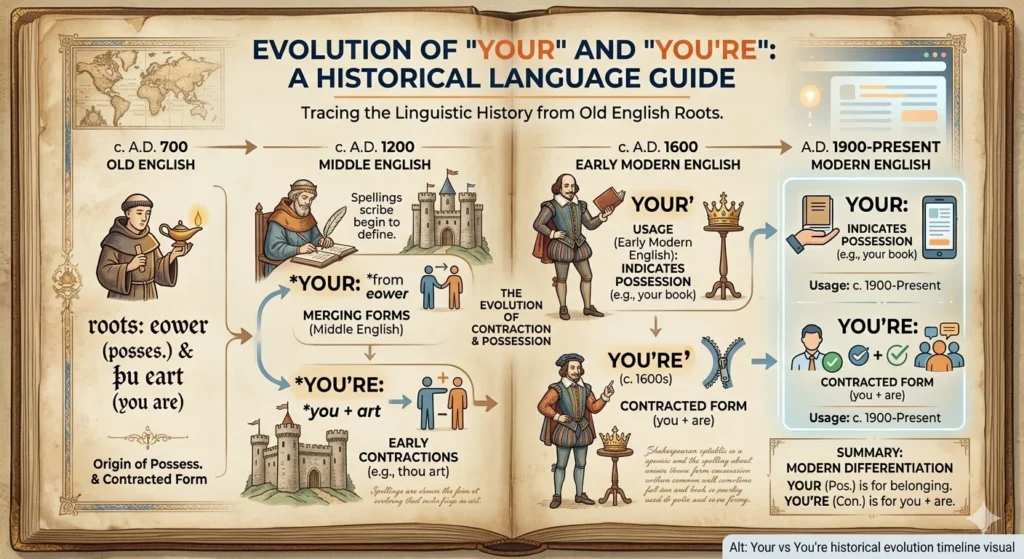
The Origin of Your vs You’re
Your:
- Comes from Old English ēower
- Used to show possession
- Example: your phone, your house
You’re:
- A short form of you are
- The apostrophe replaces the missing letter
- Example: you’re happy
👉 This is why your and you’re homophones often confuse people.
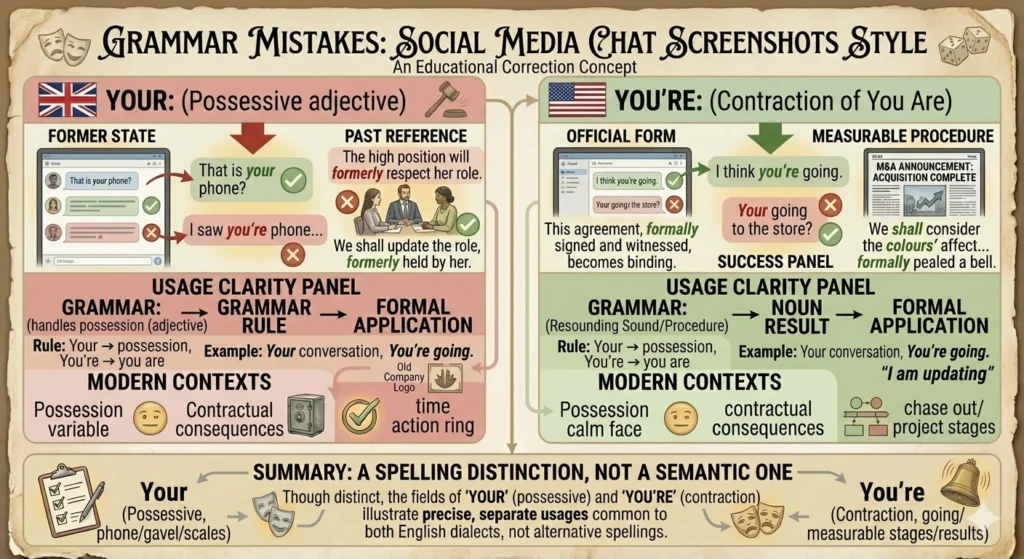
British English vs American English Spelling
There is no difference between British and American English.
Comparison Table:
| Word | Meaning | Example |
|---|---|---|
| Your | Belongs to you | Your book is here |
| You’re | You are | You’re late |
Formerly vs Formally: The Hidden Difference Most Miss
Which Spelling Should You Use?
Use Your when:
- Talking about something that belongs to someone
Example:
- Your dress looks nice
Use You’re when:
- You mean you are
Example:
- You’re very smart
👉 Simple rule:
If you can say you are, then use you’re.
Common Mistakes with Your vs You’re
❌ Wrong:
Your going to win
✅ Correct:
You’re going to win
❌ Wrong:
I like you’re style
✅ Correct:
I like your style
❌ Wrong:
Your so pretty
✅ Correct:
You’re so pretty
👉 Answer:
Is it your so pretty or you’re?
✔ Correct: You’re so pretty
Is your vs you’re a grammar mistake?
Yes. Using the wrong one is a common grammar mistake.
Your vs You’re in Everyday Examples
Emails:
- Your report is ready
- You’re invited
Social Media:
- You’re amazing
- Check your messages
Formal Writing:
- Your application is approved
- You’re required to attend
You’re in a sentence:
- You’re learning fast
- You’re my friend
Your vs you’re welcome:
✔ You’re welcome
❌ Your welcome
Your vs you’re meme:
Many jokes show mistakes like:
- “Your awesome” ❌
- “You’re awesome” ✔
These help people remember the correct form.
Pealing vs Peeling: Which One Is Actually Correct?
Comparison Table: Your vs You’re
| Feature | Your | You’re |
|---|---|---|
| Meaning | Belongs to you | You are |
| Example | Your bag | You’re late |
| Easy Check | Ownership | Replace with “you are” |
Your vs You’re vs Other Similar Words
You may also see similar confusion with:
- Their / There / They’re
- Its / It’s
These are also words that sound the same but have different meanings.
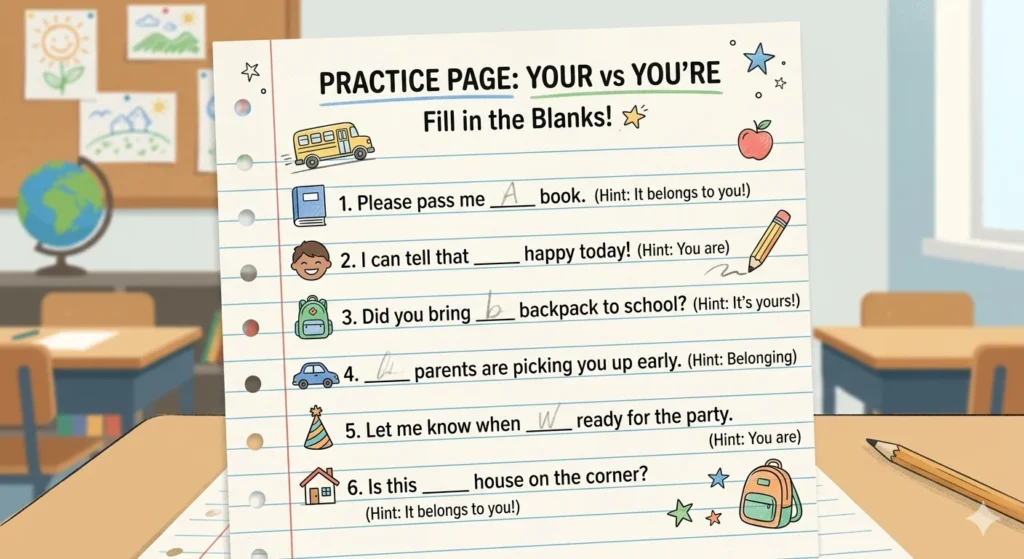
✍️ Quick Practice Exercise
Fill in the blanks:
- ___ going to love this
- This is ___ book
- ___ very kind
Answers:
- You’re
- Your
- You’re
More Real-Life Examples
In School:
- Your homework is complete
- You’re doing well
At Work:
- Your report looks good
- You’re improving
In Messages:
- You’re late today
- Where is your phone?
FAQs About Your vs You’re
1. What is the difference between your and you’re?
Your shows ownership. You’re means “you are”.
2. When to use your vs you re?
Use your for things that belong to someone. Use you’re for “you are”.
3. What does * you’re mean?
It means “you are”.
4. Is your vs you’re a grammar mistake?
Yes, using the wrong one is incorrect.
5. Is it your so pretty or you’re?
Correct: You’re so pretty
6. Why do people confuse these words?
Because they sound the same.
7. Can I use your instead of you’re?
No, they have different meanings.
Conclusion
Understanding your vs you’re is simple when you know the rule. Your shows that something belongs to someone, while you’re means “you are.” Even though they sound the same, their meanings are different.
The easiest way to check is to replace you’re with “you are.” If the sentence still makes sense, then you’re using it correctly. If not, use your.
Using the correct word makes your writing clear and easy to understand. It also helps you avoid common mistakes in daily writing, whether in school, work, or online messages.
Practice these examples and use the rule often. Soon, choosing between your and you’re will feel natural.