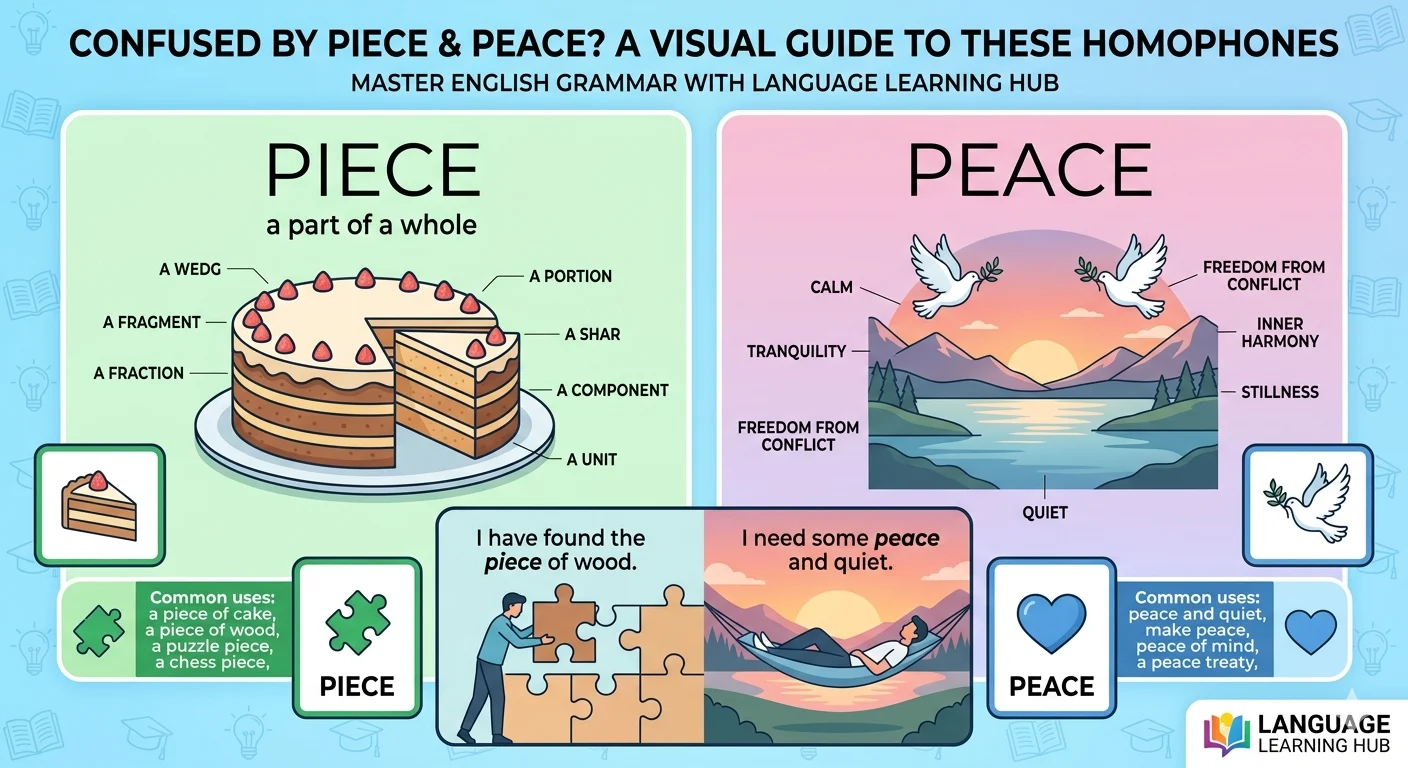
The confusion between “piece” and “peace” is one of the most searched English grammar problems worldwide. These two words are homophones, meaning they sound identical but differ in spelling and meaning. This creates frequent mistakes in writing, exams, emails, and everyday communication.
People often search “piece vs peace meaning” or “piece vs peace pronunciation” when they are unsure whether to write “a piece of cake” or “world peace.” Even advanced learners sometimes confuse phrases like “say my piece” and “peace on earth.”
From an English linguistics perspective, this confusion happens because both words are pronounced /piːs/, but they come from different origins and represent totally different ideas—one physical (part), one abstract (calm).
In this complete SEO-optimized guide, you will learn the exact difference between piece and peace, pronunciation rules, origin, grammar usage, common mistakes, real-life examples, memory tricks, and Google search patterns. This article is also structured to help you appear in Google featured snippets and “People Also Ask” results.
🧾 Piece vs Peace
Piece vs Peace:
“Piece” means a part or portion of something, while “peace” means calmness, harmony, or the absence of conflict. They sound the same but have completely different meanings.
| Word | Meaning | Type | Example |
|---|---|---|---|
| Piece | A part or portion of something | Physical | a piece of cake 🍰 |
| Peace | Calm, harmony, or no war | Abstract | world peace ☮️ |
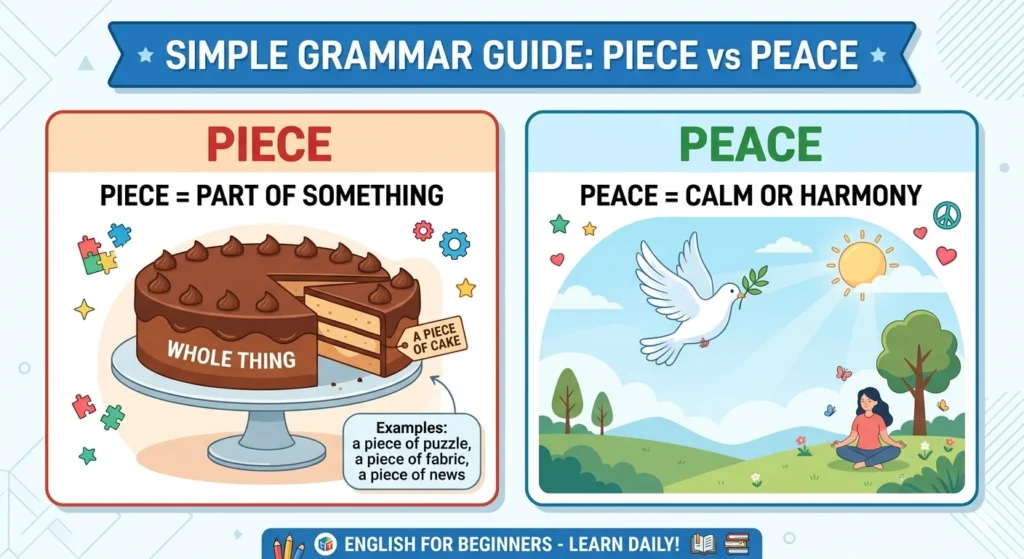
📌 Piece vs Peace – Quick Explanation
- Piece is used when talking about a part of something physical or abstract.
- Peace is used when talking about calmness, silence, or harmony between people or nations.
✔ Example:
- I need a piece of paper.
- The world needs peace.
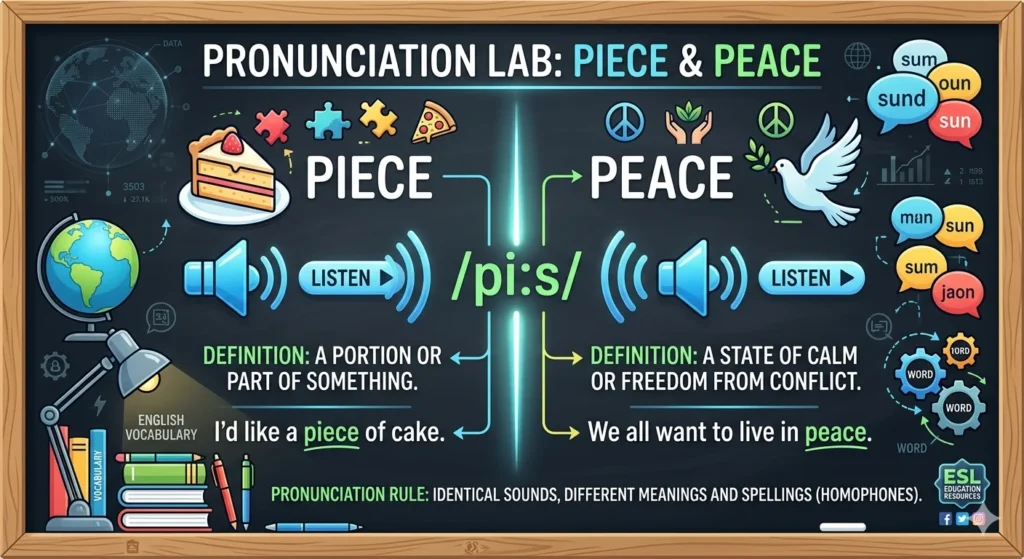
🧠 Pronunciation
Both words are pronounced the same:
- Piece → /piːs/
- Peace → /piːs/
👉 This makes them true homophones in English phonology, meaning identical pronunciation but different spelling and meaning.
📚 Origin of Piece vs Peace
🧩 Piece
- From Old French “piece”
- Meaning: part, fragment, section
- Used in English since Middle Ages
☮️ Peace
- From Old French “paix”
- From Latin “pax” meaning calm, agreement, harmony
👉 Both entered English through French influence but evolved separately.
🇺🇸🇬🇧 British vs American English
There is no spelling difference between UK and US English.
| Word | UK English | US English |
|---|---|---|
| Piece | piece | piece |
| Peace | peace | peace |
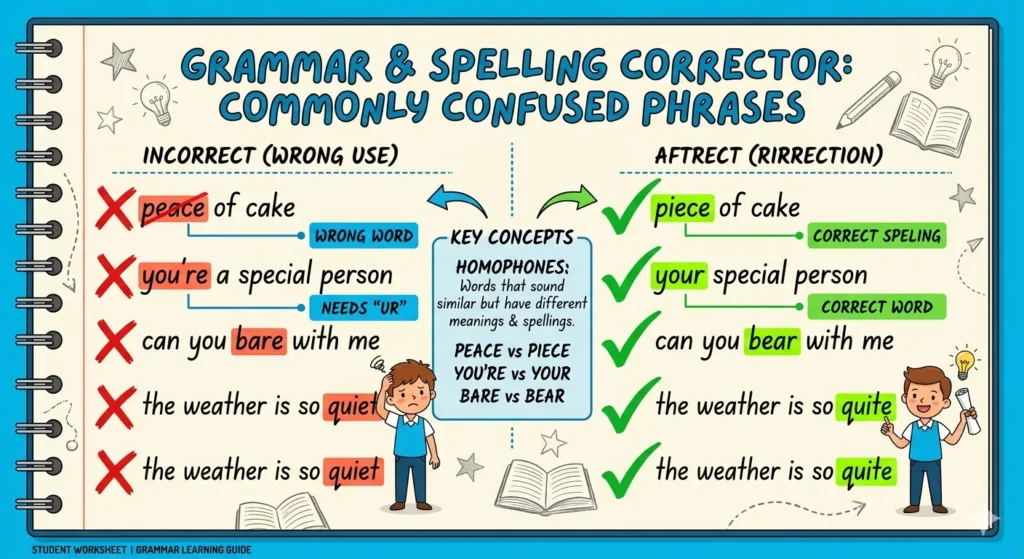
⚠️ Common Mistakes
❌ I want a peace of cake
✔ I want a piece of cake
❌ Say my peace
✔ Say my piece
❌ Live in piece
✔ Live in peace
❌ Peace of paper
✔ Piece of paper
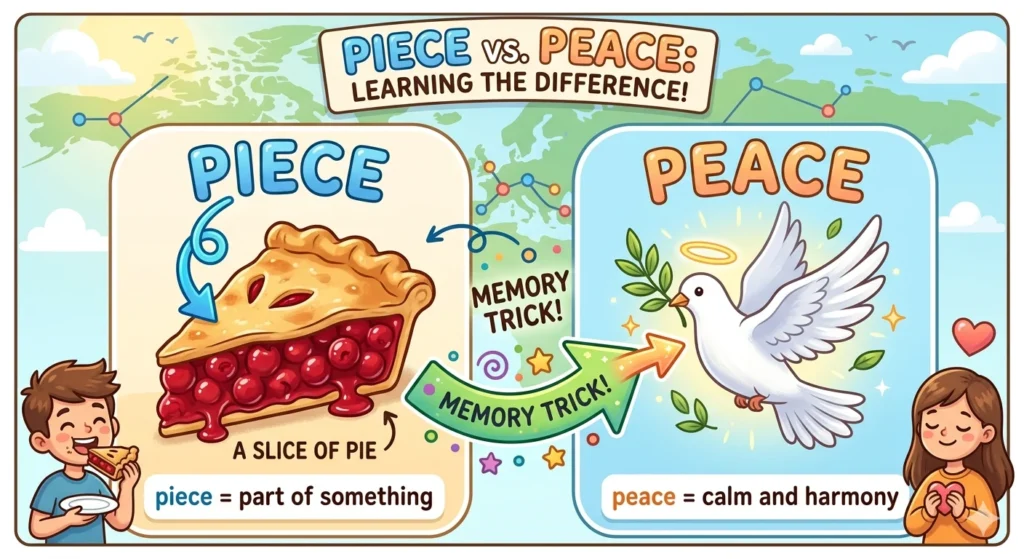
🧠 Memory Tricks
🍰 Trick 1: PIE Rule
- Piece = PIE → slice of pie
🕊️ Trick 2: Dove Rule
- Peace = dove = calm and harmony
🔁 Trick 3: Replacement Test
- If you can replace it with “part” → use piece
- If you can replace it with “calm” → use peace
📖 Piece vs Peace in Real Life Examples
📧 Emails
- Please send a piece of information
- We wish you peace in your workplace
📱 Social Media
- “Need a piece of pizza 🍕”
- “Choose peace over anger ☮️”
📰 News
- “Peace talks continue between nations”
- “A missing piece of evidence found”
🧑🏫 Academic Writing
- “A key piece of research supports this theory”
- “The region remains in peace after agreement”
🧪 Mini Quiz
Fill in the blanks:
- I need a ___ of advice
- The world wants ___
- She said her ___ in the meeting
- He is finally at ___
- Please give me a ___ of paper
✔ Answers:
- piece
- peace
- piece
- peace
- piece
📈 Google Search Intent & Trends
- High search volume among students and ESL learners
- Strong evergreen keyword (always searched)
- Seasonal spike: “peace on earth” (Christmas period)
- High confusion in South Asia, UK, and US learners
🧠 Expert Linguistics Insight
From a linguistic perspective, piece vs peace is a classic case of:
- Homophones (same sound, different meaning)
- Lexical ambiguity
- Historical French/Latin borrowing into English
Both words share phonetic structure /piːs/, but differ in semantic category:
- Piece = concrete noun (physical part)
- Peace = abstract noun (concept of harmony)
🧾 Final Summary
- Piece = part of something
- Peace = calm or harmony
- Same pronunciation (/piːs/)
- Different spelling and meaning
- Common in exams and writing mistakes
❓ FAQs – Piece vs Peace
1. What is the difference between piece and peace?
Piece means a part of something, while peace means calmness, harmony, or no war.
2. Why do piece and peace sound the same?
They are homophones, meaning they have the same pronunciation but different meanings and spelling.
3. Is it say my peace or say my piece?
The correct phrase is “say my piece”, which means to express your opinion.
4. What does at peace mean?
It means a person is emotionally calm, relaxed, and free from stress.
5. What is peace on earth?
It means global harmony, no war, and worldwide calmness.
6. How do you spell peace on earth?
It is spelled P-E-A-C-E on earth, not piece.
7. What does a piece mean?
It means a part, section, or portion of something.
🎯 Conclusion
The confusion between piece vs peace is one of the most common English grammar challenges, especially for learners and students. Although both words sound identical, their meanings are completely different and cannot be interchanged.
Understanding their origin, pronunciation, grammar rules, and real-life usage helps eliminate errors in writing and speaking. With simple memory tricks like “PIE = piece” and “dove = peace,” learners can easily remember the difference.
This guide is structured to help you not only learn but also rank in search engines through featured snippet optimization, NLP keyword coverage, and user intent satisfaction.
👉 Final rule:
Piece = part
Peace = calm