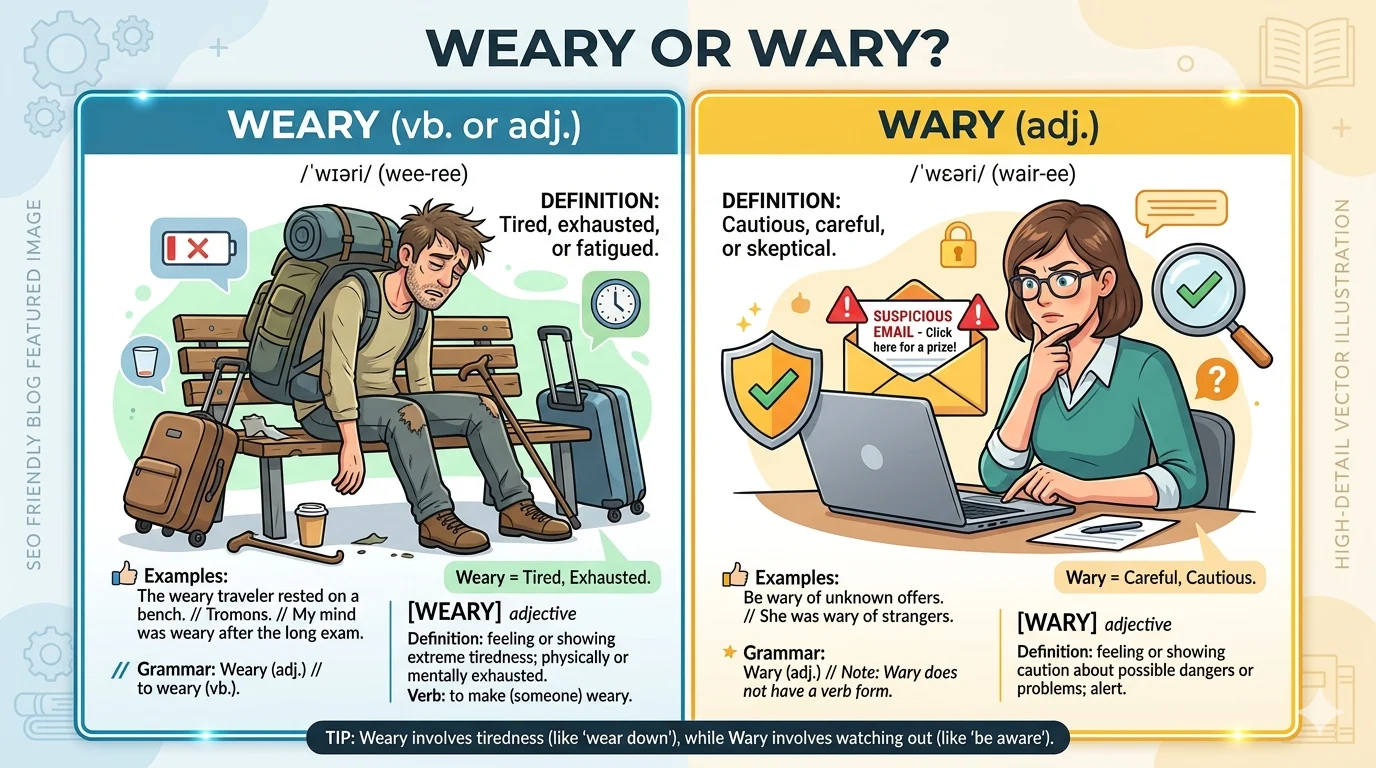
Have you ever stopped while writing and wondered whether to use weary or wary? You are not alone. This is one of the most common English grammar confusions. Because the two words look similar and can sound alike in some accents, many writers accidentally use the wrong one.
The confusion matters because weary and wary have completely different meanings. One describes being tired and exhausted, while the other describes being careful and cautious. Using the wrong word can change the meaning of your sentence and make your writing unclear.
Many people search for terms like Is it be weary or wary?, What does it mean to be wary?, What does weary mean?, Does weary mean afraid?, Weary vs wary pronunciation, Weary or wary grammar, and Stay wary meaning because they want a simple answer with practical examples.
This complete guide explains the meaning, pronunciation, grammar, origins, common mistakes, real-world examples, synonyms, and expert writing tips for using weary and wary correctly. By the end, you’ll know exactly which word to choose in every situation.
Weary or Wary
The difference is simple:
| Word | Meaning | Example |
|---|---|---|
| Weary | Tired, exhausted, fatigued | She felt weary after the trip. |
| Wary | Careful, cautious, alert | Be wary of online scams. |
Quick Examples
✅ I am weary after working all day.
✅ I am wary of strangers online.
❌ I am weary of online scams.
✅ I am wary of online scams.
Is It Be Weary or Wary?
Use wary when talking about caution.
✅ Be wary of suspicious emails.
Use weary when talking about tiredness.
✅ I feel weary after a long day.
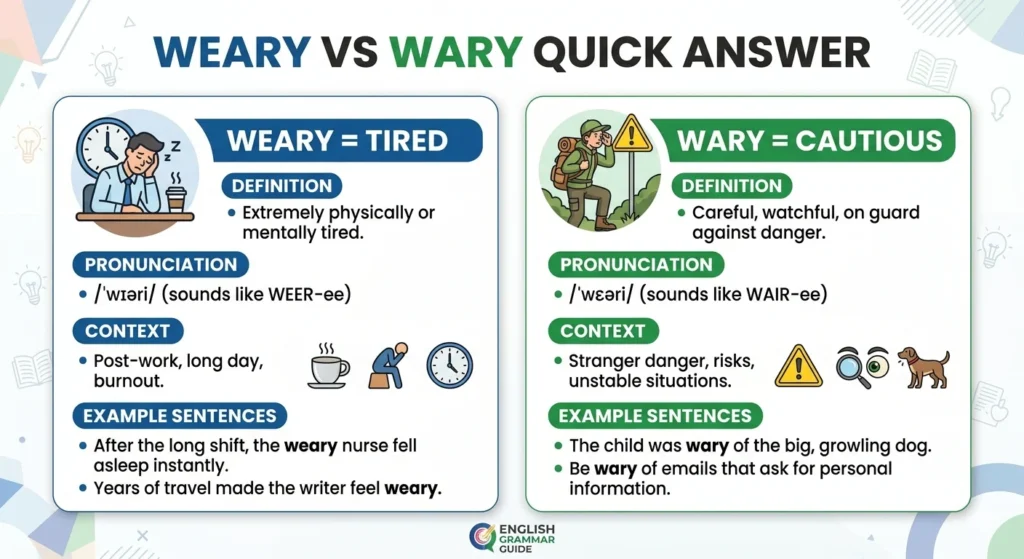
Weary or Wary Meaning Explained
Although these words look similar, they express different ideas.
Weary Meaning
Weary means:
- Tired
- Exhausted
- Fatigued
- Drained
Example:
After walking for ten miles, I felt weary.
Wary Meaning
Wary means:
- Careful
- Alert
- Watchful
- Cautious
Example:
Be wary of deals that seem too good to be true.
A simple rule:
Weary = Tired
Wary = Careful
What Does It Mean to Be Wary?
To be wary means to be cautious because something could be dangerous, dishonest, or risky.
People often become wary when:
- Meeting strangers
- Shopping online
- Making investments
- Sharing personal information
Examples
- Parents are wary of online predators.
- Customers are wary of scams.
- Investors are wary of sudden market changes.
- Travelers are wary of tourist traps.
Wary Synonyms
- Careful
- Cautious
- Alert
- Watchful
- Suspicious
- Guarded
- Leery
What Does Weary Mean?
Weary means physically, mentally, or emotionally tired.
The word often describes exhaustion after hard work, stress, travel, or difficult experiences.
Examples
- She felt weary after the marathon.
- The workers looked weary at the end of the shift.
- Years of conflict left citizens weary.
- I am weary from lack of sleep.
Does Weary Mean Afraid?
No.
Many people mistakenly think weary means cautious or afraid.
It does not.
Weary only refers to tiredness or exhaustion.
If you mean cautious or suspicious, use wary instead.
Stay Wary Meaning
The phrase stay wary is commonly used in safety advice.
It means:
- Remain cautious.
- Continue being alert.
- Be careful about potential risks.
Examples
- Stay wary of phishing emails.
- Stay wary when sharing financial information online.
- Stay wary of fake social media accounts.
- Travelers should stay wary in unfamiliar places.
Because the phrase involves caution, stay wary is correct.
Stay weary would usually be incorrect unless you literally mean “remain tired.”
Why Are Weary and Wary Confused?
Many English learners confuse these words for several reasons.
Similar Spelling
Only one letter is different:
- Weary
- Wary
Similar Pronunciation
In some accents they sound very similar.
Similar Contexts
Both words often appear in situations involving discomfort or problems.
Examples:
- Weary from work.
- Wary of scams.
Fast Typing Errors
Writers frequently type one word when they mean the other.
This confusion makes weary or wary one of the most searched grammar comparisons online.
The Origin of Weary or Wary
The two words come from different historical roots.
Origin of Weary
Weary comes from the Old English word wērig.
It meant:
- Tired
- Exhausted
- Fatigued
The meaning has remained almost unchanged for centuries.
Origin of Wary
Wary developed from Middle English words connected to awareness and watchfulness.
Its meaning focused on:
- Being alert
- Paying attention
- Avoiding danger
Why the Spelling Difference Exists
Although the words look similar today, they evolved independently.
| Word | Historical Meaning |
|---|---|
| Weary | Tired and exhausted |
| Wary | Alert and cautious |
Their similar appearance is mostly accidental.
British English vs American English Spelling
Unlike words such as colour/color or centre/center, there is no spelling difference between British and American English.
Comparison Table
| Meaning | British English | American English |
|---|---|---|
| Tired | Weary | Weary |
| Cautious | Wary | Wary |
| Exhausted traveler | Weary traveler | Weary traveler |
| Careful customer | Wary customer | Wary customer |
Examples
British English:
- Drivers should be wary of icy roads.
- The hikers looked weary.
American English:
- Consumers are wary of fraud.
- The soldiers returned weary.
The spelling stays the same worldwide.
Weary vs Wary Pronunciation
Pronunciation is one reason people mix up these words.
| Word | Pronunciation | IPA |
|---|---|---|
| Weary | WEER-ee | /ˈwɪəri/ |
| Wary | WAIR-ee | /ˈweəri/ |
Pronunciation Tips
Weary
Sounds like:
WEER-ee
Example:
The weary traveler rested.
Wary
Sounds like:
WAIR-ee
Example:
The wary shopper checked reviews.
Are Wary and Weary Homophones?
No.
They are not true homophones because their pronunciations differ.
However, some regional accents make them sound very similar.

Which Spelling Should You Use?
The correct choice depends entirely on your meaning.
Use Weary When Talking About Tiredness
Examples:
- weary traveler
- weary worker
- weary eyes
- weary mind
Use Wary When Talking About Caution
Examples:
- wary investor
- wary customer
- wary parent
- wary shopper
Audience-Based Advice
| Audience | Recommended Usage |
|---|---|
| United States | Standard meanings |
| United Kingdom | Standard meanings |
| Canada | Standard meanings |
| Australia | Standard meanings |
| Global Audience | Standard meanings |
There are no regional spelling preferences.
How to Remember the Difference
This memory trick helps many writers.
Weary = Weak from Tiredness
Think:
Weary workers need rest.
Wary = Watchful
Think:
Wary people watch for danger.
Quick Memory Rule
Weary = Tired
Wary = Careful
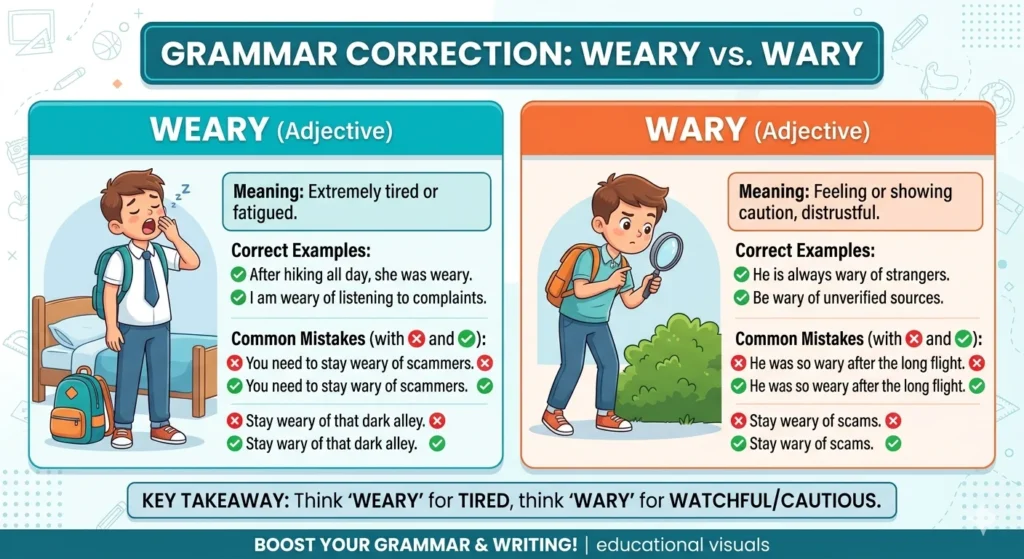
If you remember only one thing from this guide, remember that rule.
Common Mistakes with Weary or Wary
Mistake 1
❌ I am weary of online scams.
✅ I am wary of online scams.
Mistake 2
❌ The marathon made me wary.
✅ The marathon made me weary.
Mistake 3
❌ Stay weary of suspicious emails.
✅ Stay wary of suspicious emails.
Mistake 4
❌ She became wary after working twelve hours.
✅ She became weary after working twelve hours.
Weary or Wary Grammar Rules
Weary as an Adjective
Examples:
- The weary traveler rested.
- The weary employee went home.
Wary as an Adjective
Examples:
- The wary buyer checked reviews.
- The wary investor avoided risk.
Weary as a Verb
Less common but correct.
Examples:
- The long meeting wearied the audience.
- Repetition can weary readers.
Wary as a Verb
Incorrect.
Wary is used only as an adjective.
Weary or Wary Examples in Everyday Writing
Email Example
I am weary after today’s conference and will reply tomorrow.
Please remain wary of phishing emails requesting account details.
News Example
Residents grew weary after months of rebuilding.
Investors remain wary of economic uncertainty.
Social Media Example
Feeling weary after a busy week.
Stay wary of fake giveaway accounts.
Business Writing Example
Employees appeared weary after the overnight shift.
Customers are wary of misleading advertisements.
Academic Writing Example
Participants became weary during the lengthy study.
Respondents were wary of sharing personal information.
Weary vs Wary vs Leery
Many people compare these three words.
| Word | Meaning |
|---|---|
| Weary | Tired or exhausted |
| Wary | Cautious or careful |
| Leery | Suspicious or distrustful |
Examples
- I am weary after work.
- I am wary of online scams.
- I am leery of unrealistic promises.
Which Is Closest to Wary?
Leery is the closest synonym because both involve caution and suspicion.
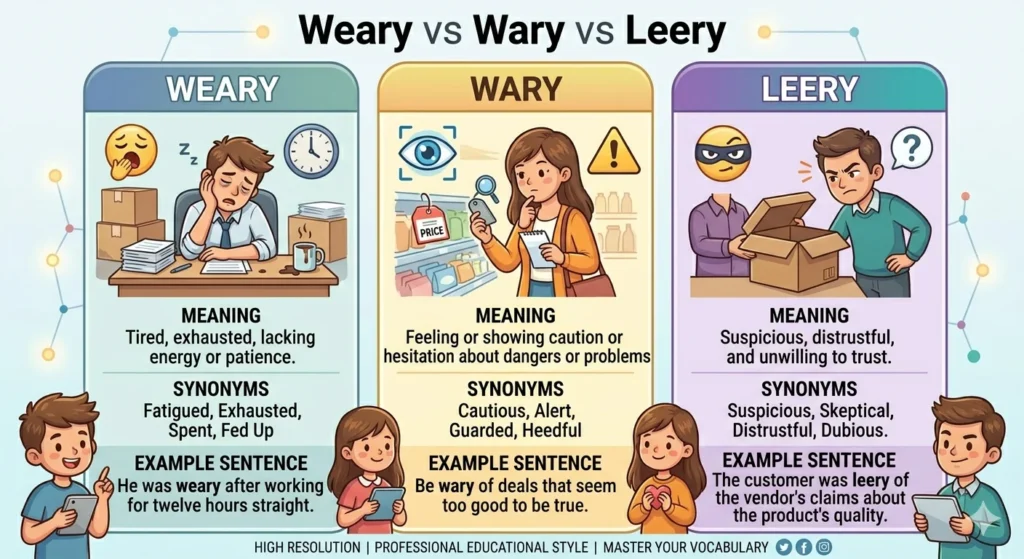
Weary or Wary Synonyms
Weary Synonyms
- Exhausted
- Fatigued
- Drained
- Worn-out
- Burned-out
- Tired
Wary Synonyms
- Alert
- Careful
- Cautious
- Guarded
- Leery
- Suspicious
- Watchful
Expert Writing Tip
Professional editors use a simple question:
Ask Yourself:
Am I talking about tiredness or caution?
If the answer is tiredness, use weary.
If the answer is caution, use wary.
This simple test prevents almost every mistake.
Weary or Wary – Google Trends & Usage Data
Searches for weary or wary remain popular because many people struggle with the distinction.
Why People Search This Phrase
- Similar spelling
- Similar pronunciation
- Grammar confusion
- Common writing mistakes
- School assignments
- Business writing needs
Popular Search Queries
- weary or wary meaning
- weary vs wary pronunciation
- weary or wary grammar
- weary or wary examples
- stay wary meaning
- what does weary mean
- what does it mean to be wary
Countries Where Searches Are Common
- United States
- United Kingdom
- Canada
- Australia
- India
These searches are common among students, writers, bloggers, teachers, and English learners.
Comparison Table: Weary vs Wary
| Feature | Weary | Wary |
|---|---|---|
| Meaning | Tired | Cautious |
| Pronunciation | /ˈwɪəri/ | /ˈweəri/ |
| Synonym | Exhausted | Careful |
| Opposite | Energetic | Trusting |
| Emotion | Fatigue | Alertness |
| Example | I feel weary. | I feel wary. |
| Verb Form | Yes | No |
| Indicates Fear? | No | Sometimes |
FAQs
Is it be weary or wary?
Use wary when talking about caution and weary when talking about tiredness.
What does it mean to be wary?
It means being careful, alert, and cautious about possible risks.
What does weary mean?
Weary means tired, exhausted, fatigued, or lacking energy.
Does weary mean afraid?
No. Weary means tired, not afraid.
Are wary and weary homophones?
No. They have different pronunciations, although some accents make them sound similar.
Which is correct: stay weary or stay wary?
Stay wary is correct because it means remain cautious.
Is leery the same as wary?
They are very similar. Both suggest caution and suspicion.
Related Grammar Guides
If you enjoyed this guide, you may also find these comparisons helpful:
- Advice vs Advise
- Affect vs Effect
- Dual vs Duel
- Ensure vs Assure
- Then vs Than
These commonly confused words often create similar writing mistakes.
Conclusion
Understanding the difference between weary or wary is easier than many people think. The key is remembering that weary relates to tiredness, exhaustion, and fatigue, while wary relates to caution, alertness, and careful behavior. Although the words look similar and may sound alike in some accents, their meanings are completely different.
When someone has worked long hours, traveled a great distance, or feels mentally drained, they are weary. When someone is protecting themselves from scams, avoiding risks, or staying alert to danger, they are wary. This distinction is important in everyday communication, business writing, academic work, emails, and social media posts.
A simple memory trick can help: Weary = tired and Wary = watchful. Whenever you are unsure which word to use, ask yourself one question: Am I talking about exhaustion or caution? The answer will immediately point you to the correct word. Remember this rule, and you’ll rarely confuse these commonly misused English words again.