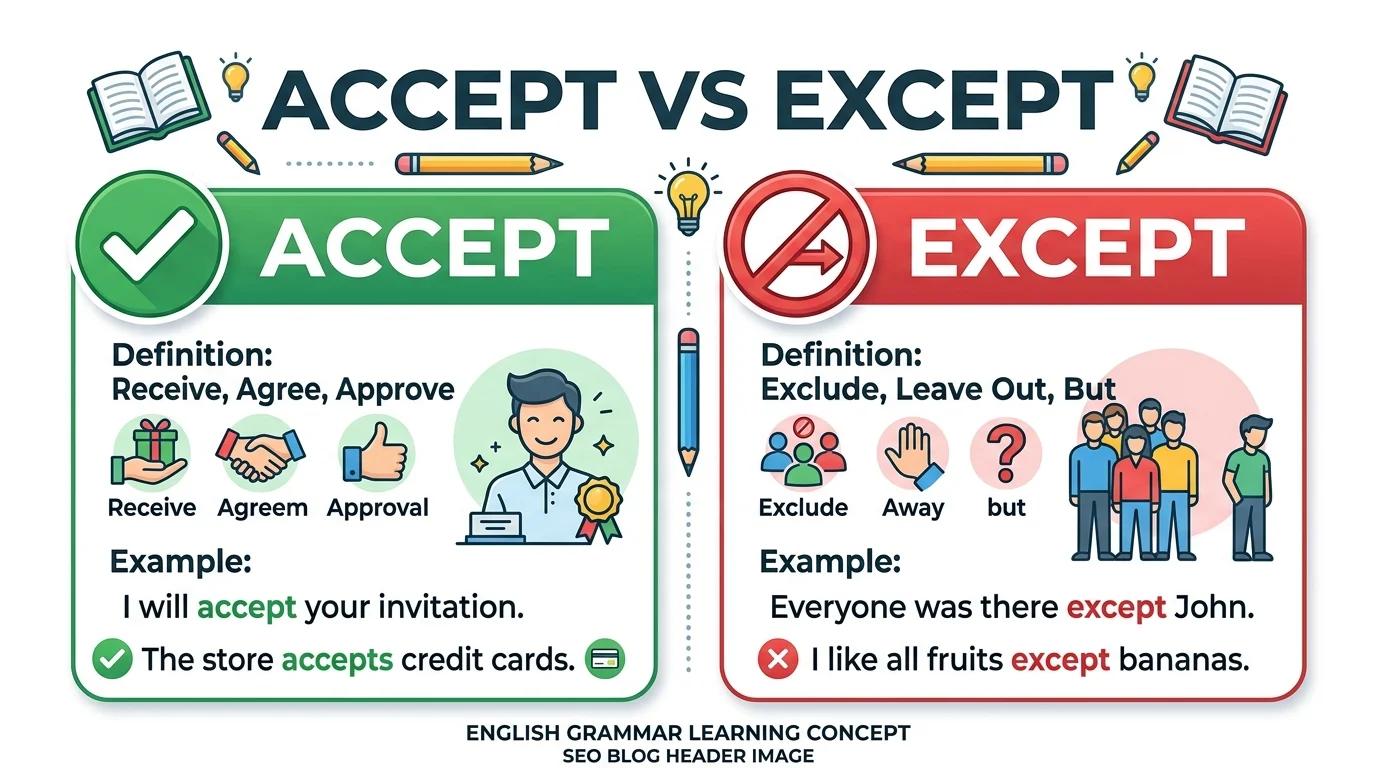
Have you ever written a sentence and stopped to wonder whether you should use accept or except? You’re not alone. The confusion between accept vs except is one of the most common English grammar mistakes made by students, professionals, and even native speakers. Since these words look similar and sound somewhat alike, many people accidentally use the wrong one in emails, essays, social media posts, and everyday conversations.
People often search questions like “What is the difference between except and accept?”, “Is it accept or except my apology?”, and “How is except different from accept?” because they want a quick and clear answer. Using the wrong word can change the meaning of an entire sentence, making your writing confusing or incorrect.
The good news is that the difference is easy to understand. In this complete guide, you’ll learn the accept vs except meaning, pronunciation, grammar rules, origins, examples, common mistakes, memory tricks, worksheets, and expert tips. By the end of this article, you’ll know exactly when to use each word and how to avoid this common English grammar error.
Accept vs Except
The difference between accept and except is simple:
- Accept means to receive, agree to, approve, or welcome something.
- Except means to exclude, leave out, or not include someone or something.
Examples
✅ I accept your invitation.
✅ She accepted the award.
✅ Everyone attended the meeting except John.
✅ All items are included except shipping costs.
Quick Memory Trick
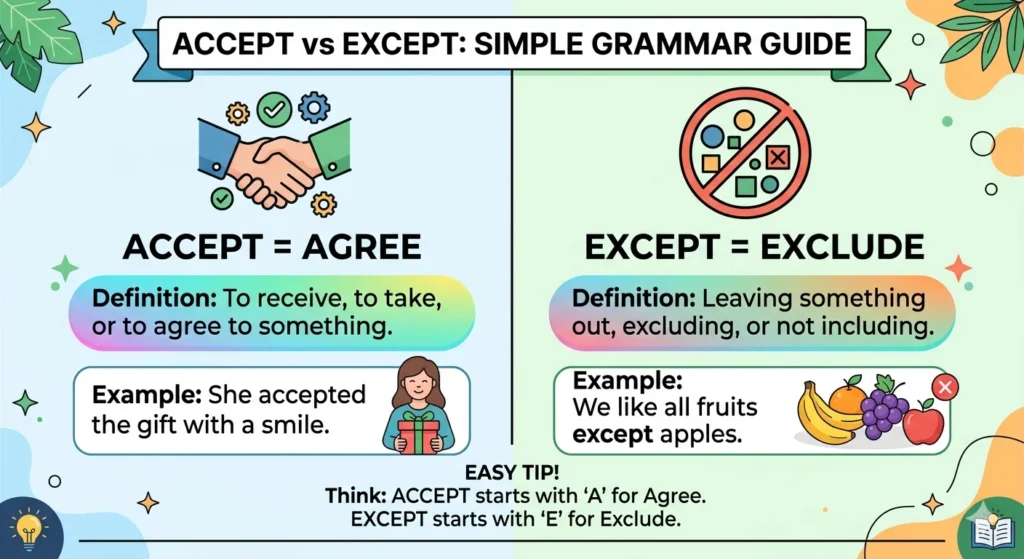
- Accept = A = Agree
- Except = E = Exclude
If you can replace the word with agree, use accept.
If you can replace the word with excluding, use except.
Accept and Except Meaning Explained
Understanding the meaning of each word is the easiest way to avoid confusion.
Accept Meaning
Accept is a verb that means:
- To receive something
- To agree to something
- To approve something
- To believe something is true
Accept Examples
- I accept your offer.
- They accepted the proposal.
- She accepted the prize with gratitude.
- We accept online payments.
Except Meaning
Except means:
- To exclude
- To leave out
- To not include
It is usually used as a preposition or conjunction.
Except Examples
- Everyone came except Sarah.
- All students passed except one.
- I like every fruit except bananas.
- The store is open every day except Sunday.
The key difference is that accept involves receiving, while except involves excluding.
Is It Accept or Except My Apology?
One of the most searched grammar questions is:
Is it accept or except my apology?
✅ Correct: I accept your apology.
❌ Incorrect: I except your apology.
Why?
Because when someone apologizes, you are receiving or agreeing to that apology. The verb accept is required.
More Examples
✅ Please accept my apology.
✅ She accepted his apology immediately.
✅ Thank you. I accept your apology.
❌ Please except my apology.
❌ He excepted her apology.
Whenever an apology is involved, the correct word is accept.
The Origin of Accept vs Except
Learning word origins can make them easier to remember.
Origin of Accept
The word accept comes from the Latin word acceptare, which means “to receive willingly.”
Over time, it entered Old French and then English, keeping the meaning of receiving or agreeing.
Origin of Except
The word except comes from the Latin word excipere, which means “to take out” or “remove.”
This meaning later became the modern English idea of excluding something.
Why Are They Confused?
Both words share the ending -cept, which comes from Latin roots related to taking or receiving.
However:
- Ac- points toward receiving.
- Ex- points toward taking out.
This small prefix change creates completely different meanings.

Accept vs Except Pronunciation
Many learners confuse these words because their pronunciation is similar.
| Word | Pronunciation | Phonetic Form |
|---|---|---|
| Accept | ak-SEPT | /əkˈsept/ |
| Except | ik-SEPT | /ɪkˈsept/ |
Pronunciation Tip
The stress falls on the second syllable in both words:
- ac-CEPT
- ex-CEPT
Listening carefully to the first sound helps distinguish them.
Accept vs Except Grammar Rules
Grammar plays an important role in choosing the correct word.
| Word | Part of Speech | Function |
|---|---|---|
| Accept | Verb | Shows receiving or agreeing |
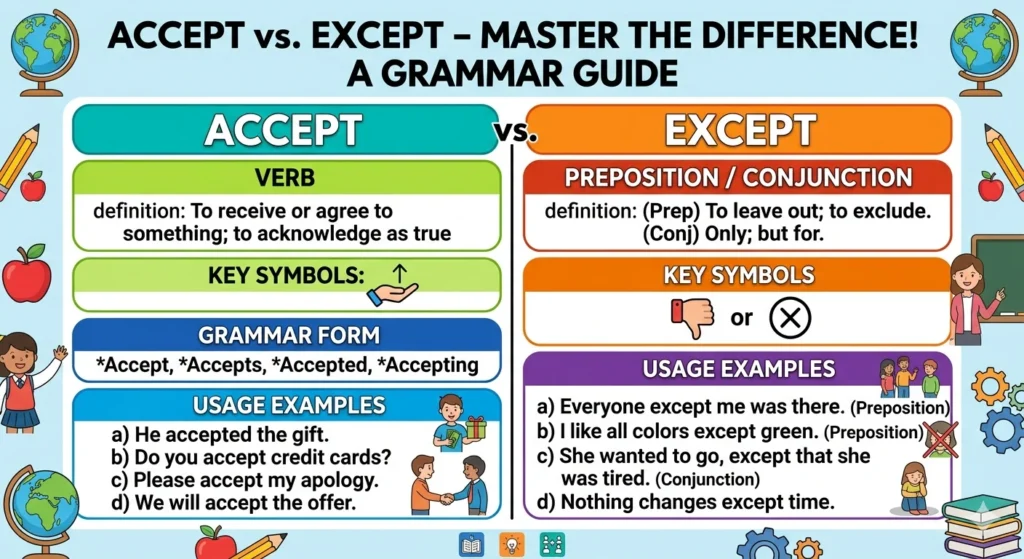
| Except | Preposition, Conjunction | Shows exclusion |
Accept as a Verb
Examples:
- I accept your offer.
- They accepted our request.
- She accepts responsibility.
Except as a Preposition
Examples:
- Everyone came except Ali.
- All rooms are occupied except one.
Except as a Conjunction
Examples:
- I would go except I am busy.
- She would join except she is sick.
Understanding these grammar roles helps prevent mistakes.
British English vs American English Usage
Unlike words such as colour and color, there is no spelling difference between accept and except in British and American English.
Comparison Table
| English Type | Accept | Except |
|---|---|---|
| American English | Accept | Except |
| British English | Accept | Except |
| Australian English | Accept | Except |
| Canadian English | Accept | Except |
The spelling remains identical worldwide.
Only writing style and sentence structure may vary slightly between regions.
Which Spelling Should You Use?
Since both spellings are standard worldwide, your choice depends entirely on meaning.
Use Accept When:
- Agreeing
- Receiving
- Approving
- Acknowledging
Examples:
- I accept the invitation.
- She accepted the award.
Use Except When:
- Excluding
- Leaving out
- Creating an exception
Examples:
- Everyone passed except Tom.
- All documents are complete except page three.
The meaning determines the correct choice.
Accept vs Except vs Expect
Many learners also confuse expect with accept and except.
Comparison Table
| Word | Meaning | Example |
|---|---|---|
| Accept | Receive or agree | I accept the offer. |
| Except | Exclude | Everyone came except John. |
| Expect | Think something will happen | I expect good results. |
Examples
Accept
- I accept your proposal.
Except
- Everyone attended except Mark.
Expect
- I expect the package tomorrow.
Remember:
- Accept = Agree
- Except = Exclude
- Expect = Anticipate
Common Mistakes with Accept vs Except
These mistakes appear frequently in writing.
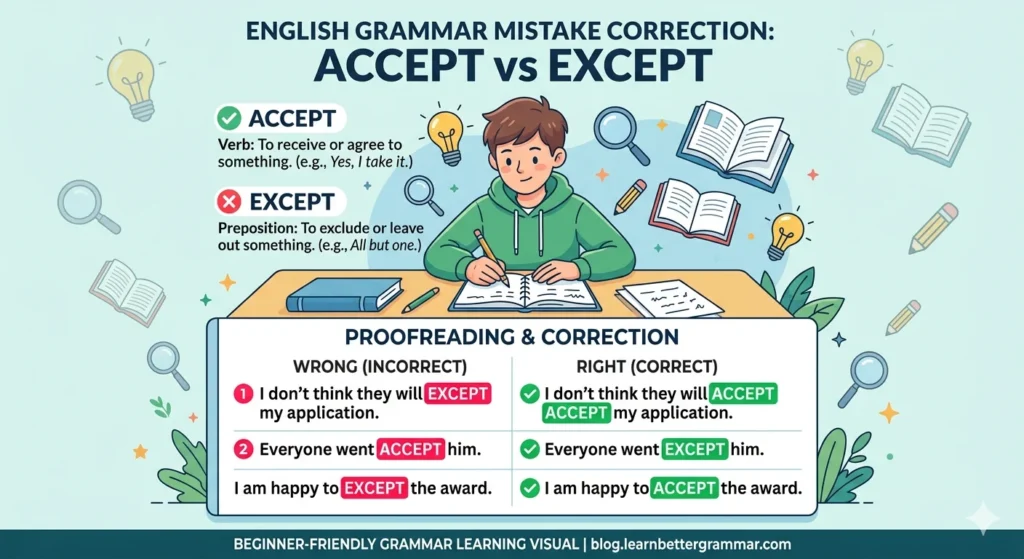
Incorrect Sentences
❌ I except your invitation.
❌ Everyone accept Ali attended.
❌ Please except my apology.
❌ We except online payments.
Correct Sentences
✅ I accept your invitation.
✅ Everyone except Ali attended.
✅ Please accept my apology.
✅ We accept online payments.
Always check whether the sentence involves agreement or exclusion.
Ground vs Grinded: Which Word Is Actually Correct?
Accept vs Except in Everyday Examples
In Emails
- We accept your request.
- All files are attached except the final report.
In Business Writing
- The company accepts credit cards.
- Every department agreed except marketing.
In Social Media
- I accept your challenge!
- Everyone loved the movie except me.
In News Writing
- The committee accepted the recommendation.
- All regions reported growth except one.
In Academic Writing
- Researchers accepted the findings.
- All samples were tested except the damaged specimen.
Why Is “Accept vs Except” So Commonly Searched?
The keyword accept vs except remains popular because it involves two commonly confused words.
People search this topic because:
- The words look similar.
- The words sound similar.
- They have completely different meanings.
- They often appear in exams.
- They are common in formal writing.
Search interest is particularly high among:
- English learners
- Students
- IELTS candidates
- TOEFL candidates
- Professional writers
- Job applicants
This confusion has existed for decades, making it an evergreen grammar topic.
Expert Grammar Tip
Professional editors use a simple test.
Test 1: Replace with “Agree”
Example:
- I accept the offer.
- I agree to the offer.
The sentence still works.
✅ Use accept.
Test 2: Replace with “Excluding”
Example:
- Everyone except Sarah attended.
- Everyone excluding Sarah attended.
The sentence still works.
✅ Use except.
This method works in almost every situation.
Powerful Memory Tricks
Trick #1: A = Agree
Accept starts with A.
Agree starts with A.
Therefore:
Accept = Agree
Trick #2: E = Exclude
Except starts with E.
Exclude starts with E.
Therefore:
Except = Exclude
Trick #3: Visual Method
👍 Accept = Receive
❌ Except = Leave Out
These simple memory aids help learners remember the difference quickly.
Accept vs Except Worksheet
Fill in the Blanks
- I _____ your apology.
- Everyone _____ Ali attended.
- She _____ the job offer.
- All rooms are available _____ Room 7.
- We happily _____ the invitation.
Answers
- accept
- except
- accepted
- except
- accepted
Accept vs Except Comparison Table
| Feature | Accept | Except |
|---|---|---|
| Meaning | Receive or agree | Exclude |
| Part of Speech | Verb | Preposition / Conjunction |
| Purpose | Acceptance | Exclusion |
| Common Usage | Offers, invitations, apologies | Exceptions, exclusions |
| Example | I accept your offer. | Everyone came except John. |
| Memory Trick | A = Agree | E = Exclude |
FAQs
What is the difference between except and accept?
Accept means to receive or agree, while except means to exclude or leave out.
Is it accept or except my apology?
The correct phrase is accept my apology.
How is except different from accept?
Accept shows agreement. Except shows exclusion.
What is the difference between accept, except, and expect?
Accept means agree, except means exclude, and expect means anticipate.
What is the meaning of accept?
Accept means to receive, approve, or agree to something.
Is except a verb?
It can be a verb in rare situations, but it is usually a preposition or conjunction.
Can accept and except be used interchangeably?
No. They have completely different meanings.
What is the easiest way to remember accept vs except?
Remember:
- Accept = Agree
- Except = Exclude
Conclusion
Understanding accept vs except becomes easy once you focus on their meanings. Although the words look similar and share the ending -cept, they perform very different functions in English grammar. Accept is used when receiving, agreeing to, approving, or acknowledging something. Except is used when excluding or leaving something out.
A simple memory trick can help: Accept = Agree and Except = Exclude. This method works in everyday conversations, academic writing, professional communication, emails, and exams. You can also use the replacement test—if “agree” fits, choose accept; if “excluding” fits, choose except.
Whether you’re a student preparing for an exam, a professional writing emails, or an English learner improving vocabulary, mastering these commonly confused words will strengthen your grammar and communication skills. With the examples, pronunciation guide, worksheet, grammar rules, and expert tips covered in this article, you can now confidently use accept and except correctly in any situation.

Pam Peters is a linguist and grammar expert, known for clear explanations of modern English usage, style, and practical language rules.