You are writing an email, article, or report when suddenly spellcheck highlights a word: caliber or calibre. Which one is correct? If you’ve ever searched “caliber vs calibre”, you’re not alone. Thousands of writers, students, professionals, and English learners ask this question because both spellings appear in books, dictionaries, news articles, and online content.
The confusion comes from the differences between American English and British English spelling conventions. While the two words look different, they have the same meaning and pronunciation. They can describe the diameter of a firearm barrel, the size of a bullet, or the quality and ability of a person or thing. However, choosing the wrong spelling for your audience can make your writing look inconsistent.
This expert guide follows standard English dictionary definitions and style-guide conventions to explain the difference between caliber vs calibre meaning, when to use each spelling, common mistakes to avoid, real-world examples, and usage trends around the world. By the end, you’ll know exactly which version fits your audience and writing style.
Caliber vs Calibre
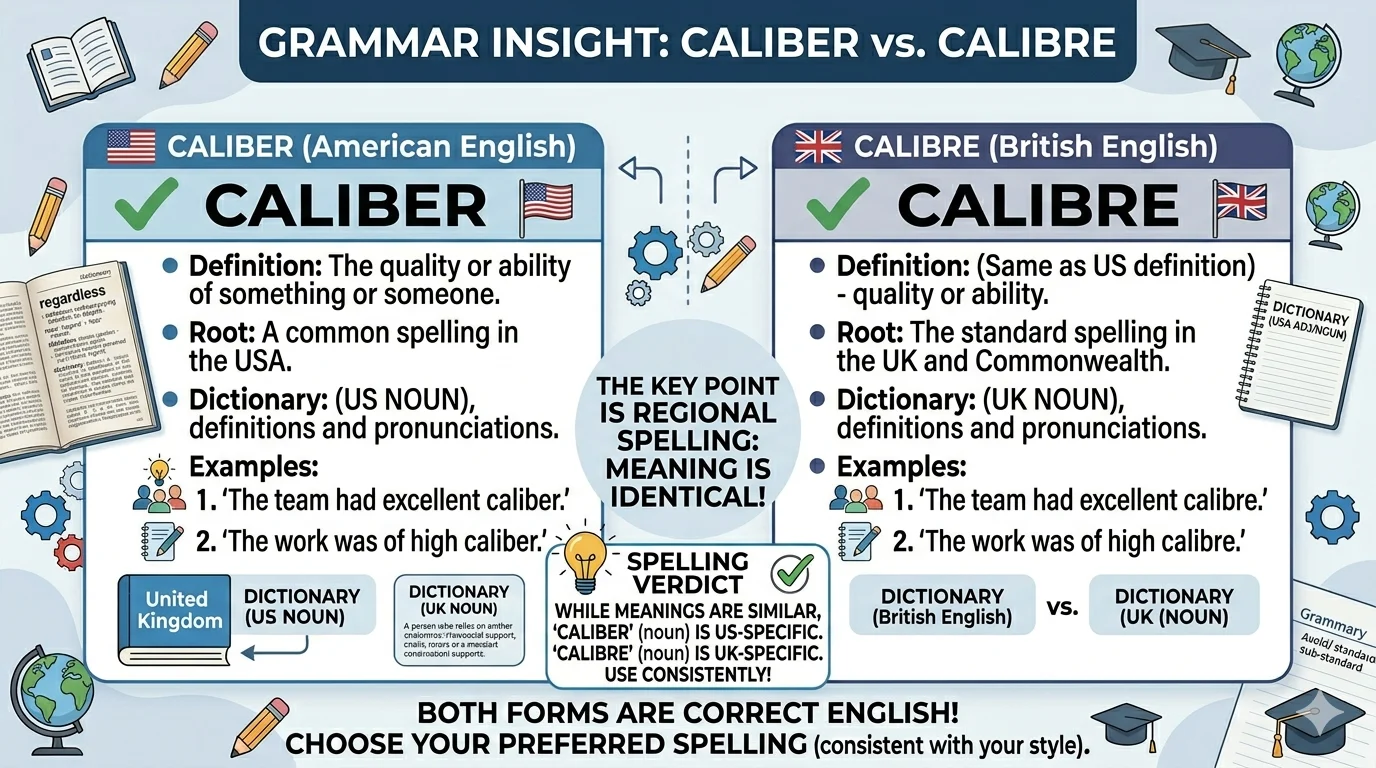
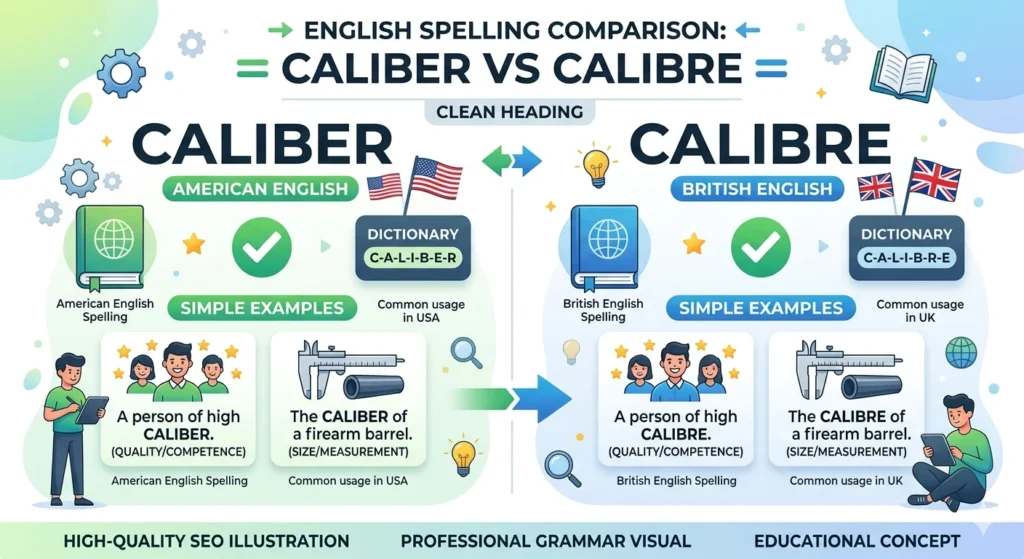
Caliber and calibre are the same word. The only difference is spelling.
- Caliber = American English spelling
- Calibre = British English spelling
Both words can refer to:
- The diameter of a firearm barrel or bullet.
- The quality, skill, or ability of a person or thing.
Examples
American English:
- The university attracts students of exceptional caliber.
- The rifle uses a .30 caliber cartridge.
British English:
- The university attracts students of exceptional calibre.
- The rifle uses a .30 calibre cartridge.
Quick Tip: If your audience is in the United States, use caliber. For the UK and most Commonwealth countries, use calibre.
The Origin of Caliber vs Calibre
The word originally came from the French word calibre, which referred to the diameter of a gun barrel. English adopted the term in the 16th century, and it gradually gained additional meanings.
Over time, the word expanded beyond firearm terminology and became a way to describe the quality, skill, character, or standard of a person or thing.
As American English developed, many words ending in -re changed to -er, creating spelling differences that remain today.
Examples include:
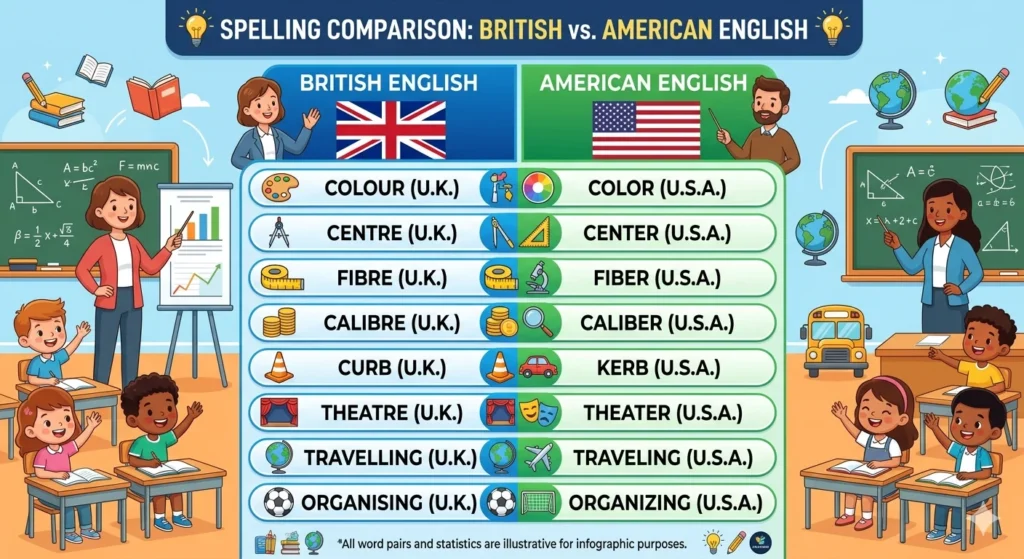
| British English | American English |
|---|---|
| Centre | Center |
| Theatre | Theater |
| Fibre | Fiber |
| Metre | Meter |
| Calibre | Caliber |
The spelling changed, but the meaning stayed the same.
Calibre Meaning
Many users specifically search for calibre meaning.
Dictionary Definition
Calibre (or caliber) means:
- The internal diameter of a firearm barrel or bullet.
- The quality, ability, importance, or standard of a person, organization, or object.
Examples
- The pistol has a .45 calibre barrel.
- She is a manager of exceptional calibre.
- The company is known for the calibre of its employees.
- We need people of this caliber to lead the project.
In modern writing, the quality-related meaning is often more common than the firearm meaning.
British English vs American English Spelling
The difference between caliber and calibre follows a common English spelling pattern.
Comparison Table
| Feature | Caliber | Calibre |
|---|---|---|
| Meaning | Same | Same |
| Pronunciation | Same | Same |
| American English | ✓ | ✗ |
| British English | ✗ | ✓ |
| Formal Writing | ✓ | ✓ |
| Informal Writing | ✓ | ✓ |
| Firearm Terminology | ✓ | ✓ |
| Describing Quality | ✓ | ✓ |
Similar Spelling Differences
| American English | British English |
|---|---|
| Color | Colour |
| Favor | Favour |
| Center | Centre |
| Fiber | Fibre |
| Caliber | Calibre |
These spelling differences are standard and accepted by major dictionaries worldwide.
Which Spelling Should You Use?
The best spelling depends on your audience.
Use “Caliber” If:
- You write for American readers.
- Your website targets US traffic.
- You follow American style guides.
- You publish content for US businesses.
Use “Calibre” If:
- You write for readers in the UK.
- Your audience is in Australia, New Zealand, Ireland, or South Africa.
- Your publication follows British English.
For International Websites
Either spelling is acceptable. The important rule is consistency.
Choose one version and use it throughout your article, website, email, or report.
Common Mistakes with Caliber vs Calibre
Mistake #1: Assuming They Have Different Meanings
❌ Caliber and calibre mean different things.
✅ They are the same word with different regional spellings.
Mistake #2: Mixing Spellings
❌ The calibre of this product shows its high caliber.
✅ Use only one spelling style in a single document.
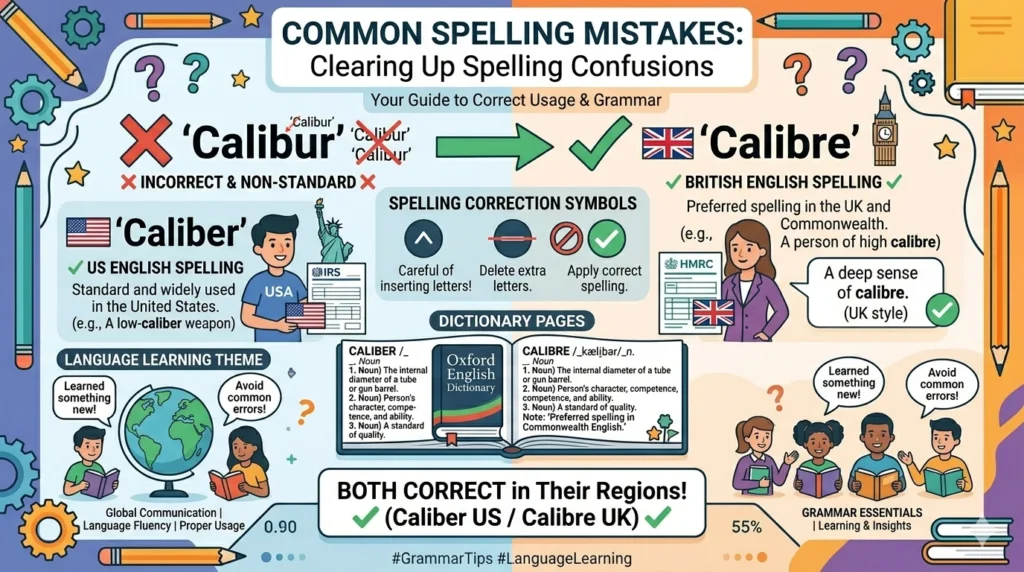
Mistake #3: Writing “Calibur”
Many users search for caliber vs calibur.
❌ Calibur
✅ Caliber
✅ Calibre
Calibur is not a standard English spelling.
Mistake #4: Ignoring Your Audience
Using the wrong regional spelling can make professional writing appear inconsistent.
Caliber vs Calibre in Everyday Examples
In Emails
American:
- We are looking for candidates of the highest caliber.
British:
- We are looking for candidates of the highest calibre.
In News Articles
American:
- The university attracts students of exceptional caliber from around the world.
British:
- The university attracts students of exceptional calibre from around the world.
On Social Media
- This athlete is a world-class caliber player.
- This athlete is a world-class calibre player.
In Formal Business Writing
- The company hires professionals of the highest caliber to lead international projects.
- The organization is known for the calibre of its leadership team.

What Is a Calibre Person?
A calibre person or caliber person is someone with exceptional talent, skill, intelligence, or character.
Examples
- She is a leader of remarkable calibre.
- We need people of this caliber on our management team.
- The organization attracts individuals of high calibre.
Caliber of Person Meaning
The phrase caliber of person often refers to:
- Leadership ability
- Professional skill
- Character
- Talent
- Expertise
- Work ethic
What Caliber Is an AK-47?
One of the most common firearm-related searches is:
What caliber is an AK-47?
The traditional AK-47 is chambered for the 7.62×39mm cartridge.
In firearm terminology:
- Caliber refers to the diameter of the barrel or bullet.
- Millimeters (mm) describe metric measurements.
- Cartridge refers to the complete ammunition unit.
Understanding these differences helps explain related searches such as caliber vs mm and caliber vs cartridge.
Caliber vs Gauge
Although both terms relate to firearms, they are not the same.
| Caliber | Gauge |
|---|---|
| Used for rifles and handguns | Used mainly for shotguns |
| Measures bore diameter | Measures shotgun bore size |
| Example: .22 caliber | Example: 12 gauge |
| Uses decimal or metric measurements | Uses gauge system |
Caliber vs mm
Firearms may use imperial or metric measurements.
| Caliber | Approximate Metric Size |
|---|---|
| .22 caliber | 5.6 mm |
| .30 caliber | 7.62 mm |
| .45 caliber | 11.43 mm |
Key Difference
- Caliber = Inches
- mm = Metric system
Caliber vs Cartridge
These terms are often confused.
Caliber
Refers to:
- Bore diameter
- Bullet diameter
Cartridge
Refers to:
- Bullet
- Primer
- Powder
- Case
Example
- 9mm is the caliber.
- 9mm Luger is the cartridge.
A cartridge includes multiple components, while caliber is simply a measurement.
Caliber vs Calibre Examples
American English
- The company employs professionals of the highest caliber.
- This is a .22 caliber rifle.
- The project required experts of exceptional caliber.
British English
- The company employs professionals of the highest calibre.
- This is a .22 calibre rifle.
- The project required experts of exceptional calibre.
Caliber vs Calibre – Google Trends & Usage Data
Search behavior shows clear regional preferences.
Countries That Prefer “Caliber”
- United States
- American publications
- US firearm and military websites
Countries That Prefer “Calibre”
- United Kingdom
- Australia
- New Zealand
- South Africa
- Ireland
Usage Trends
- “Caliber” receives significantly more searches in the United States.
- “Calibre” dominates searches in British English regions.
- Both terms maintain steady search demand due to grammar, writing, and firearm-related searches.
For SEO purposes, use the spelling that matches your target audience and geographic market.
FAQs
Are caliber and calibre the same?
Yes. They have identical meanings and pronunciations. The difference is regional spelling.
Which spelling is correct: caliber or calibre?
Both are correct. Use caliber in American English and calibre in British English.
What is a calibre person?
A calibre person is someone with high ability, talent, skill, or character.
Is it calibur or caliber?
Calibur is incorrect. The correct spellings are caliber and calibre.
What caliber is an AK-47?
The traditional AK-47 uses a 7.62×39mm cartridge.
What is the difference between caliber and gauge?
Caliber measures bore diameter, while gauge is mainly used for shotgun bore size.
What is the difference between caliber and cartridge?
Caliber refers to diameter, while a cartridge is the complete ammunition unit.
Conclusion
Understanding caliber vs calibre is simple once you know the rule: both words have the same meaning, pronunciation, and usage. The only difference is regional spelling. American English uses caliber, while British English and most Commonwealth countries use calibre.
The word can describe firearm measurements, ammunition dimensions, or the quality and ability of a person, organization, or object. Whether you are discussing firearm terminology, professional standards, or everyday writing, choosing the correct spelling for your audience helps maintain consistency and credibility.
For US readers, use caliber. For UK and Commonwealth readers, use calibre. If your audience is global, either spelling works as long as you stay consistent throughout your content. By understanding the meaning, history, examples, and usage differences, you can confidently use either version in formal writing, business communication, academic work, and online publishing.

Pam Peters is a linguist and grammar expert, known for clear explanations of modern English usage, style, and practical language rules.