Have you ever wondered, “Do I use lies or lays?” You’re not alone. The confusion between lies vs lays is one of the most common grammar mistakes in English because the words sound similar but come from two different verbs: lie and lay. Many people also ask, “Do I lay in bed or lie in bed?” or “Is it where the problem lies or lays?” when trying to choose the correct word.
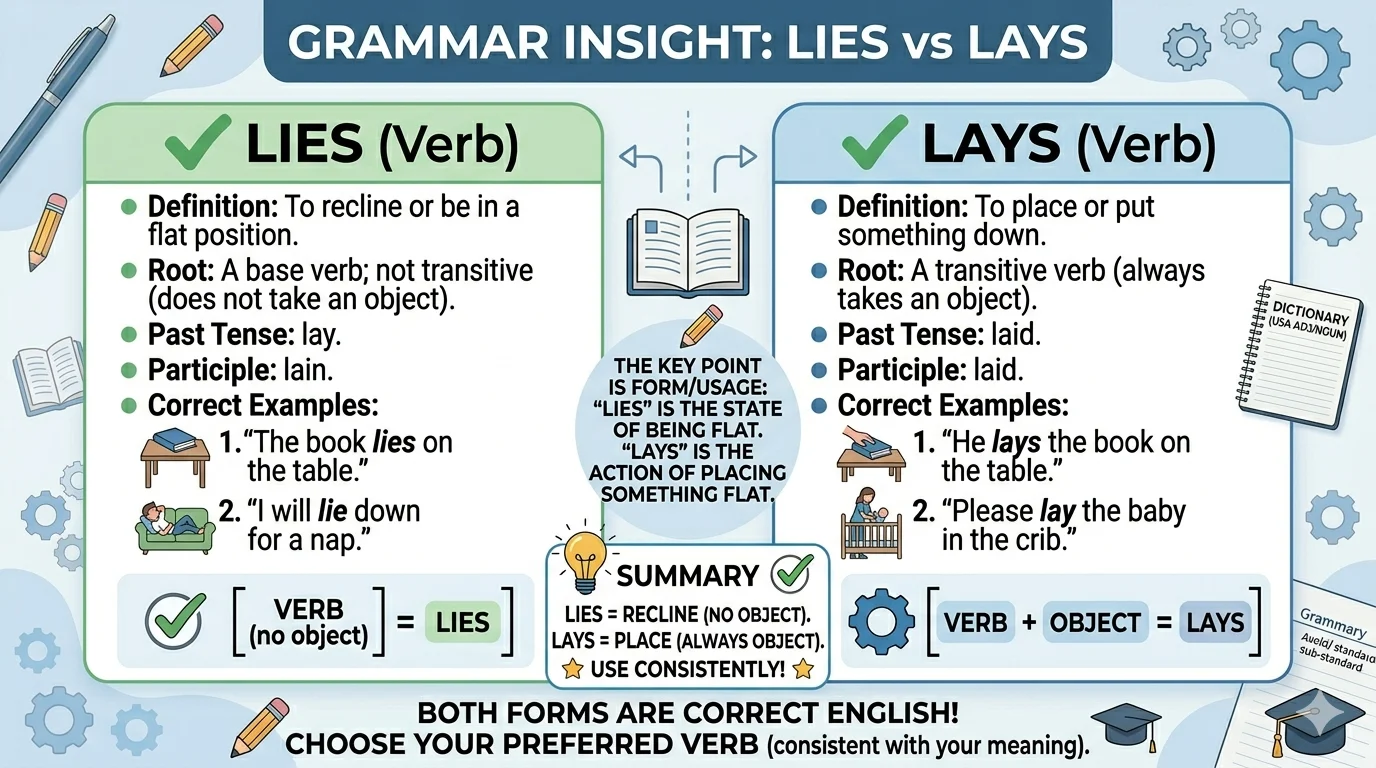
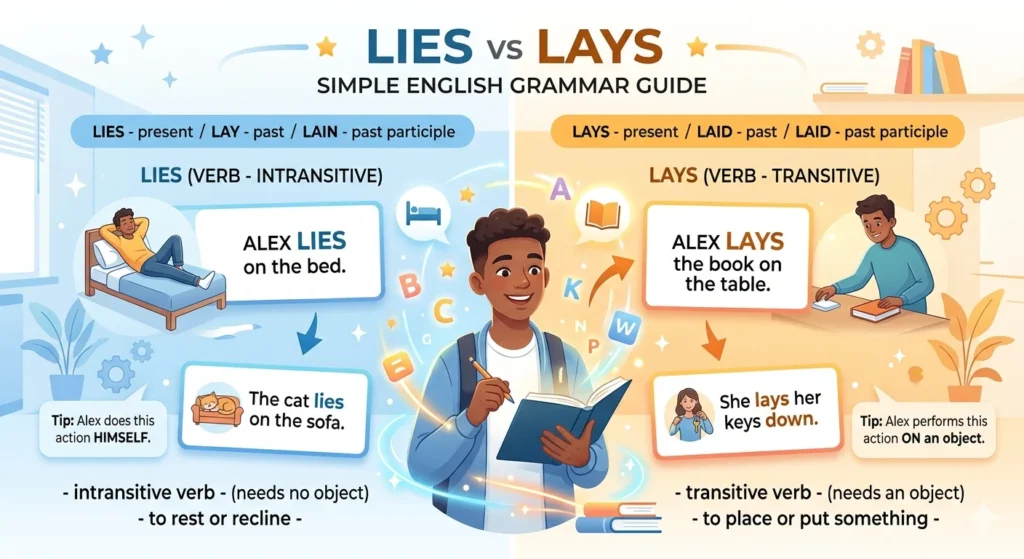
The word lies comes from the verb lie, which means to rest, recline, or exist in a particular place. For example: “The book lies on the table.” On the other hand, lays comes from the verb lay, which means to place or put something down. For example: “She lays her keys on the counter every evening.”
A simple way to remember the difference is: lies = rests or exists, while lays = places something down. If an object is receiving the action, lays is usually the correct choice.
Understanding the difference between lies vs lays will help you avoid common grammar mistakes and write with greater confidence. In this guide, you’ll learn when to use each word, why the confusion happens, and how to remember the correct form every time.
What Is the Difference Between Lies and Lays?
Quick Answer
- Lies = rests, reclines, exists, or is located somewhere.
- Lays = places or puts something down.
Examples
✅ The dog lies on the floor.
✅ The answer lies in the details.
✅ She lays the book on the table.
✅ He lays the tools in the garage.
The Key Rule
Lies does not need an object.
Lays needs an object.
Compare:
- The cat lies on the couch. ✅
- The cat lays on the couch. ❌
- She lays the blanket on the couch. ✅
- She lies the blanket on the couch. ❌
Easy Memory Trick for Lies vs Lays
If you remember only one rule, remember this:
People lie. People lay things.
Another easy trick:
If you can replace the word with put, use lay.
Examples:
- I lay the phone on the desk.
- I put the phone on the desk.
Both work.
Now look at this:
- I lie on the sofa.
You cannot say:
- I put on the sofa.
So lie is correct.
The Origin of Lies vs Lays
The words come from different Old English verbs.
Lie
The verb lie comes from the Old English word licgan, which means “to rest” or “to recline.”
Lay
The verb lay comes from the Old English word lecgan, which means “to place” or “to put down.”
Although the words sound similar today, they started as separate verbs with different meanings.
Over time, English speakers began confusing them because the lie past tense is lay, which creates one of the most confusing verb patterns in English grammar.

Lies vs Lays Grammar Explained
Understanding the grammar behind these verbs makes everything easier.
Lie vs Lay vs Laid
| Verb Form | Lie | Lay |
|---|---|---|
| Base Form | Lie | Lay |
| Third Person | Lies | Lays |
| Past Tense | Lay | Laid |
| Past Participle | Lain | Laid |
| Present Participle | Lying | Laying |
Examples
Lie
- Today I lie down.
- Yesterday I lay down.
- I have lain down all afternoon.
Lay
- Today I lay the book down.
- Yesterday I laid the book down.
- I have laid the book down already.
British English vs American English Spelling
Many users wonder whether lies vs lays is a British and American spelling issue.
The answer is no.
Unlike words such as:
- Colour vs Color
- Organise vs Organize
- Traveller vs Traveler
The words lies and lays are not spelling variations.
They are completely different grammatical forms.
Comparison Table
| Sentence | American English | British English |
|---|---|---|
| The cat lies here. | ✅ | ✅ |
| She lays the book down. | ✅ | ✅ |
| The answer lies within. | ✅ | ✅ |
| He lays on the sofa. | ❌ | ❌ |
The grammar rule is exactly the same worldwide.
Which Spelling Should You Use?
The correct choice depends on your meaning.
Use “Lies” When
Something is:
- Resting
- Reclining
- Existing
- Located somewhere
Examples:
- The cat lies on the bed.
- The problem lies in communication.
- The solution lies ahead.
Use “Lays” When
Someone is placing something.
Examples:
- She lays the notebook on the desk.
- He lays the keys on the shelf.
- The farmer lays fresh straw in the barn.
Grammar Chart
| Action | Correct Verb |
|---|---|
| Resting | Lie |
| Reclining | Lie |
| Existing | Lie |
| Being Located | Lie |
| Putting Something Down | Lay |
| Placing an Object | Lay |
Common Mistakes with Lies vs Lays
Mistake #1
❌ He lays on the couch every day.
✅ He lies on the couch every day.
Mistake #2
❌ The answer lays in the report.
✅ The answer lies in the report.
Mistake #3
❌ I have laid in bed all morning.
✅ I have lain in bed all morning.
Mistake #4
❌ Yesterday I laid down for a nap.
✅ Yesterday I lay down for a nap.
Mistake #5
❌ She lies the book on the table.
✅ She lays the book on the table.
Do I Use Lies or Lays?
This is one of the most searched grammar questions online.
Ask yourself:
Is something being placed somewhere?
If yes, use lays.
If no, use lies.
Examples:
✅ The truth lies beneath the surface.
✅ She lays her bag on the chair.
Do I Lay in Bed or Lie in Bed?
Correct:
✅ I lie in bed every Sunday morning.
Correct Past Tense:
✅ Yesterday I lay in bed until noon.
Correct Present Participle:
✅ I am lying in bed right now.
Incorrect:
❌ I am laying in bed.
This mistake is extremely common in everyday speech.
Is It “Where the Problem Lies” or “Where the Problem Lays”?
Correct:
✅ Where the problem lies.
Incorrect:
❌ Where the problem lays.
Reason:
The problem is not placing something.
It is existing somewhere.
Therefore, lies is always correct.
Examples:
- The problem lies in poor planning.
- The issue lies within the system.
- The answer lies in the data.
Lies vs Lays in Everyday Examples
In Emails
✅ The issue lies with the software update.
✅ She lays out the project timeline clearly.
In News Writing
✅ The challenge lies in rising costs.
✅ The company lays the foundation for future growth.
In Social Media
✅ Happiness lies in simple moments.
✅ She lays everything out perfectly.
In Formal Writing
✅ Responsibility lies with management.
✅ The architect lays the plans before the committee.
In Daily Conversation
✅ My dog lies beside me every evening.
✅ Mom lays the table before dinner.

Lies vs Lays – Google Trends & Usage Data
Searches for lies vs lays grammar remain popular because many English learners struggle with these irregular verbs.
Countries showing strong interest include:
- United States
- United Kingdom
- Canada
- Australia
- India
- Pakistan
Popular searches include:
- Do I use lies or lays?
- Do I lay in bed or lie in bed?
- What is the meaning of lies?
- Lies vs lays examples
- Lies vs lays grammar
- Lie past tense
- Laying or lying in bed
- Lie vs lay vs laid
- Past tense of lie down
- Lie past tense and past participle
- Lies vs lays reddit
Grammar discussions on Reddit frequently debate the correct use of lying or laying in bed, making lies vs lays reddit a commonly searched phrase.
Search volume often increases during school semesters when students and writers need grammar help.
Lies vs Lays Comparison Table
| Feature | Lies | Lays |
|---|---|---|
| Verb Type | Lie | Lay |
| Meaning | Rests or reclines | Places something |
| Needs Object | No | Yes |
| Example | She lies down. | She lays the book down. |
| Grammar Type | Intransitive | Transitive |
| Common Usage | Resting or existing | Putting something somewhere |
Frequently Asked Questions
What is the meaning of lies?
Lies means rests, reclines, exists, or is located somewhere.
Do I use lies or lays?
Use lies for resting or existing. Use lays for placing something.
Do I lay in bed or lie in bed?
The correct phrase is lie in bed.
Is it where the problem lies or lays?
The correct phrase is where the problem lies.
What is the lie past tense?
The past tense of lie is lay.
What is the lie past tense and past participle?
- Past Tense = Lay
- Past Participle = Lain
What is the past tense of lie down?
The past tense of lie down is lay down.
What is the difference between lying and laying in bed?
Lying in bed means resting.
Laying in bed usually means placing something while in bed.
Why do people confuse lie vs lay vs laid?
Because the past tense of lie is lay, while the past tense of lay is laid.
Is “The answer lays here” correct?
No.
The correct sentence is:
✅ The answer lies here.
Conclusion
The difference between lies vs lays may seem confusing at first, but the rule is actually simple. Use lies when someone or something is resting, reclining, existing, or located somewhere. Use lays when someone places an object somewhere. The easiest way to remember this grammar rule is that people lie, but people lay things down.
Understanding lie vs lay vs laid, lie past tense, past tense of lie down, and lie past tense and past participle will help you avoid common grammar mistakes in emails, academic writing, business communication, and everyday conversations.
Whether you are asking “Do I use lies or lays?”, “Do I lay in bed or lie in bed?”, or “Is it where the problem lies or lays?”, the answer becomes clear once you know whether an object is involved. Mastering this small grammar rule can make your writing more accurate, professional, and confident.
If you remember only one rule, remember this: people lie, but people lay things down.

Scott Thornbury is a respected English language educator and author, known for practical grammar insights, teacher training, and clear learner-focused explanations.