Have you ever stood in a supermarket line and noticed a sign saying “10 items or less”? Many people wonder if that sentence is actually correct. This small grammar question has confused students, bloggers, teachers, writers, and even native English speakers for years.
The debate around less vs fewer is one of the most searched English grammar topics online. People search for phrases like “What is the difference between fewer and less?”, “Is it 3 or fewer or less?”, and “Is it fewer money or less money?” because the answer is not always obvious in daily conversation.
The confusion becomes bigger because social media posts, advertisements, TV shows, and casual English often break the grammar rule. One famous example is the internet discussion around less vs fewer Game of Thrones, where viewers debated whether certain phrases used in the show were grammatically correct.
According to grammar experts and dictionaries like Cambridge University Press and Merriam-Webster, the difference depends on whether the noun is countable or uncountable. Once you understand this simple grammar rule, using the correct word becomes much easier.
In this complete guide, you will learn:
- Simple grammar rules
- Real-life examples
- Common grammar mistakes
- Exceptions to the rule
- Exercises and FAQs
- Professional writing tips
- SEO-friendly English usage advice
By the end, you will confidently know when to use less and when to use fewer in formal English and everyday writing.
What Is the Difference Between Less and Fewer?
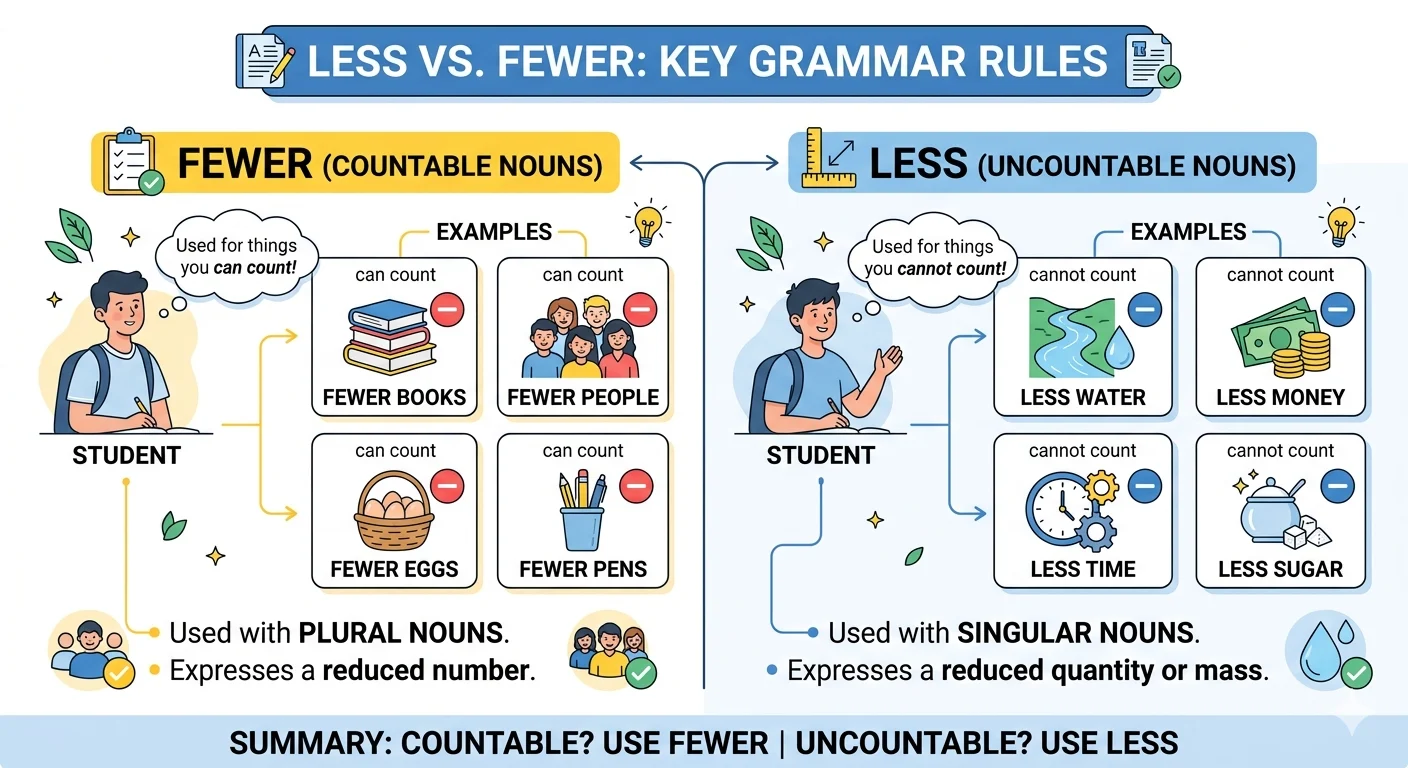
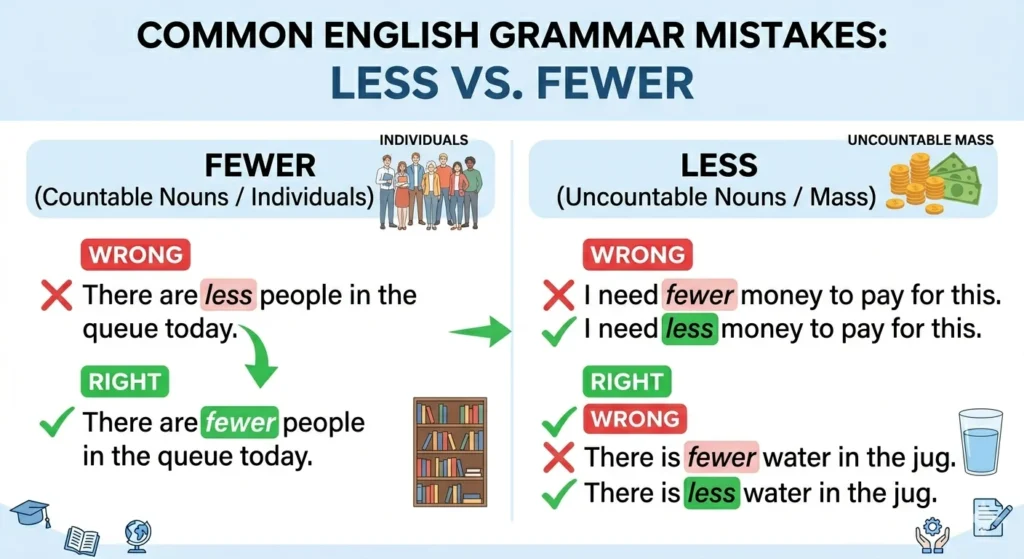
Fewer is used with countable nouns like books, students, people, and hours.
Less is used with uncountable nouns like water, money, time, and stress.
Examples:
- Fewer cars
- Fewer people
- Less water
- Less money
👉 Quick rule:
- Count it → fewer
- Measure it → less
This is the easiest way to remember the difference.
Less vs Fewer
The grammar rule is simple:
- Use fewer for count nouns.
- Use less for mass nouns or uncountable nouns.
Use “Fewer” with Countable Nouns
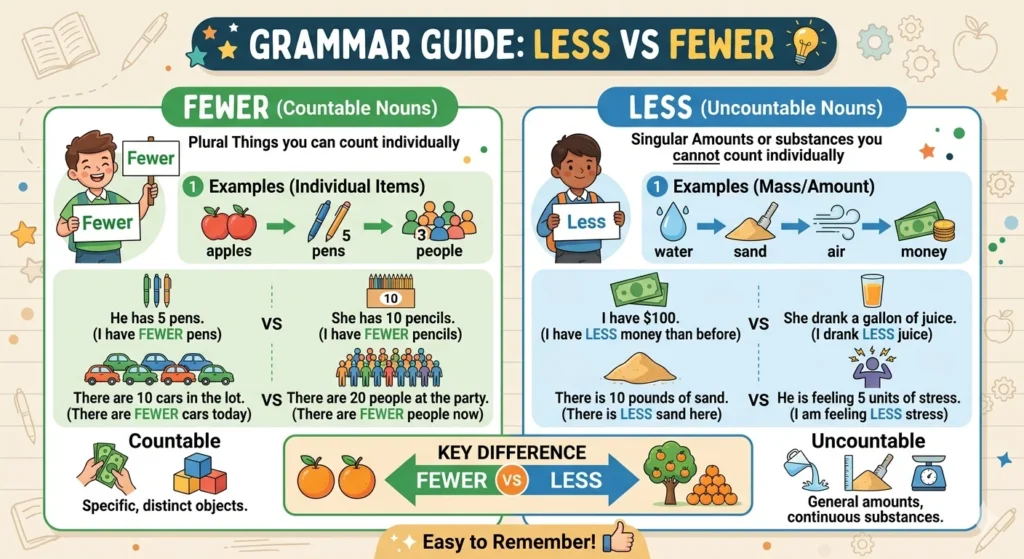
Countable nouns can be counted individually.
Examples:
- Fewer books
- Fewer students
- Fewer rules
- Fewer hours
- Fewer opportunities
✅ Example:
“There were fewer people at the concert this year.”
Use “Less” with Uncountable Nouns
Uncountable nouns describe things measured as a whole amount.
Examples:
- Less water
- Less money
- Less stress
- Less equipment
- Less confidence
✅ Example:
“She spent less money this month.”
Grammar Expert Tip
Grammar Tip:
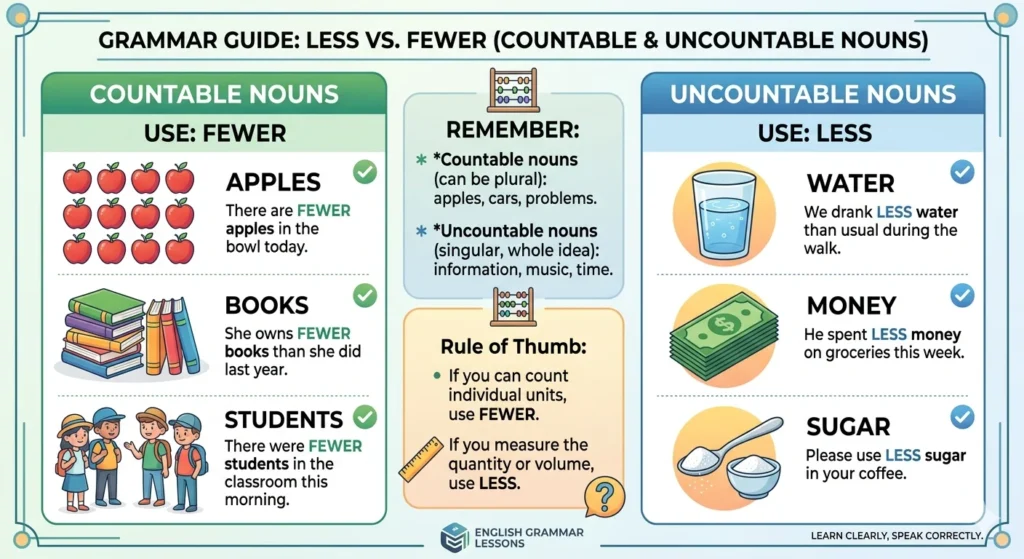
If you can count the item one by one, use fewer. If it is measured as a whole amount, use less.
This simple writing tip helps avoid common grammar mistakes in everyday English and formal writing.
The Origin of Less vs Fewer
The words less and fewer both come from Old English, but their meanings developed differently over time.
- Less came from the Old English word lǣssa, meaning “smaller in amount.”
- Fewer came from fēawer, meaning “not as many.”
In early English, writers often used less for both countable and uncountable nouns. However, grammar experts later created clearer grammar rules to improve formal English usage.
By the 18th century, grammar books strongly recommended:
- Fewer for count nouns
- Less for mass nouns
Today, this rule is widely accepted in:
- Schools
- Academic writing
- Journalism
- Blogging
- Professional communication
British English vs American English Usage
There is no spelling difference between British English and American English for less and fewer. Both countries use the same spellings.
However, English usage differs slightly in casual speech.
British English
British English usually follows the grammar rule carefully in newspapers, exams, and professional writing.
✅ Example:
“Fewer than 20 students passed the test.”
American English
American English also follows the rule in formal English, but casual conversation often uses less with count nouns.
Example heard in everyday English:
- “Less than 10 items”
Grammar experts still prefer:
- “Fewer than 10 items”
Comparison Table
| Feature | British English | American English |
|---|---|---|
| Spelling | Less / Fewer | Less / Fewer |
| Formal writing | Strict grammar rule | Strict grammar rule |
| Casual speech | Slightly flexible | More flexible |
| Academic writing | Uses fewer carefully | Uses fewer carefully |
| Everyday English | Mostly formal | More informal |
Why Do Stores Say “10 Items or Less”?
This is one of the most famous grammar debates in English usage.
Because “items” are countable, grammar experts say the correct phrase should be:
✅ “10 items or fewer”
However, “10 items or less” became popular because it sounds shorter and more natural in spoken English.
Even today, this grammar topic creates debates online.
Which Usage Should You Follow?
The best choice depends on your audience and writing style.
Use “Fewer” When:
- Writing essays
- Creating SEO articles
- Writing professional emails
- Taking English exams
- Using formal English
✅ Example:
“Fewer mistakes improve readability.”
Use “Less” When:
- Talking about quantity
- Discussing time or money
- Speaking casually
- Describing uncountable nouns
✅ Example:
“We need less stress at work.”
Best Advice for Global English
If your audience includes international readers, always follow the standard grammar rule:
- Count nouns → fewer
- Uncountable nouns → less
This makes your writing:
- Clearer
- More professional
- More trustworthy
- Easier to understand
Why This Grammar Rule Matters
Some people think the difference between less and fewer is small, but correct English usage matters in many situations.
Using the right word improves:
- Professional writing
- Academic assignments
- Blog quality
- Communication clarity
- Reader trust
Correct grammar also helps writers sound more confident and professional.
For students and bloggers, avoiding common grammar mistakes can improve writing quality significantly.
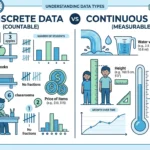
Countable vs Uncountable Nouns
To fully understand less vs fewer, you must understand noun types.
Countable Nouns
These nouns can be counted individually.
Examples:
- Cars
- Books
- Students
- Rules
- Hours
- Resources
- Opportunities
✅ Correct usage:
- Fewer books
- Fewer students
- Fewer opportunities
Uncountable Nouns
These nouns describe things measured as one whole amount.
Examples:
- Water
- Money
- Sugar
- Advice
- Information
- Equipment
- Confidence
✅ Correct usage:
- Less water
- Less advice
- Less equipment
Farther vs Further: The Hidden Rule Most Miss
Important Note About Money
Many English learners ask:
👉 “Is it fewer money or less money?”
The correct phrase is:
✅ Less money
Money is generally treated as an uncountable noun, even though individual dollars, coins, or notes can be counted separately.
Example:
- “I have less money this month.”
Common Mistakes with Less vs Fewer
Many English learners make the same grammar mistakes repeatedly.
Here are common errors and corrections.
| Incorrect | Correct |
|---|---|
| Less people | Fewer people |
| Less books | Fewer books |
| Less cars | Fewer cars |
| Fewer money | Less money |
| Fewer water | Less water |
Quick Summary
- Countable nouns → fewer
- Uncountable nouns → less
Remembering this simple rule prevents most grammar mistakes.
Common Exceptions to the Less vs Fewer Rule
Sometimes less is correct even with numbers.
These are important grammar exceptions.
Time
✅ Less than 5 hours
Money
✅ Less than 100 dollars
Distance
✅ Less than 10 kilometers
Weight
✅ Less than 50 kilograms
Percentages
✅ Less than 30% of the water was clean.
In these examples, the quantity acts as one whole amount instead of separate countable units.
Less vs Fewer Examples in Everyday English
Understanding real-world usage helps improve writing skills faster.
Many people search phrases like less vs fewer people, less vs fewer hours, and less vs fewer money because English grammar rules can feel confusing in everyday situations.
Emails
- “We received fewer complaints this month.”
- “The team spent less time fixing errors.”
News Writing
- “Fewer people traveled during the storm.”
- “The country has less clean water available.”
Social Media
- “I want fewer distractions today.”
- “Less drama, more peace.”
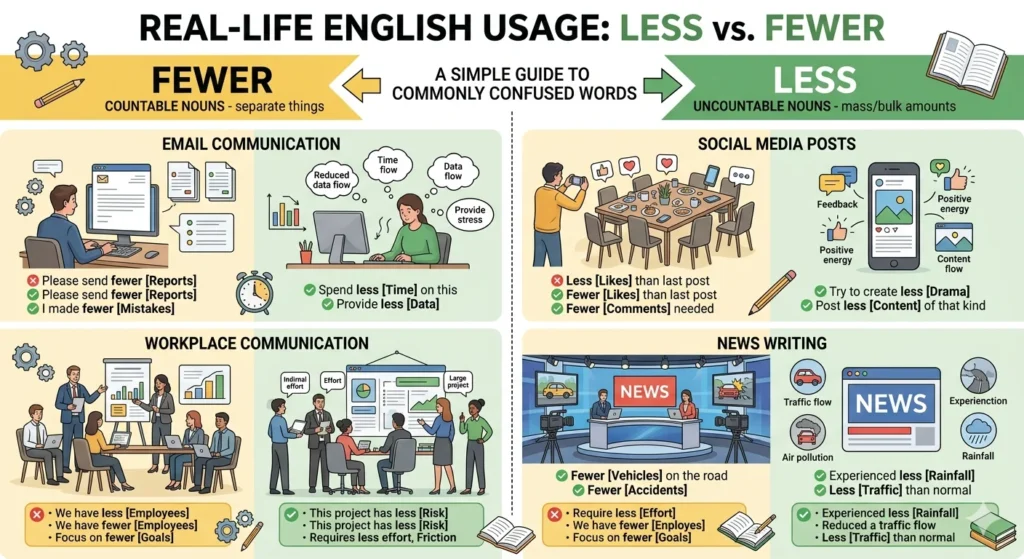
Workplace Communication
- “Fewer meetings improve productivity.”
- “Less stress helps employees focus.”
Less vs Fewer People
One of the most searched grammar questions online is less vs fewer people.
Because people are countable, the correct phrase is:
✅ Fewer people
❌ Less people
Example:
“Fewer people attended the event this year.”
Less vs Fewer Hours
Hours are countable units of time, so formal English recommends:
✅ Fewer hours
Example:
“She worked fewer hours this week.”
However, casual English sometimes says:
- “less hours”
This is common in speech but not recommended in professional writing.
Less vs Fewer Rules
Rules are countable because each rule is separate.
✅ Fewer rules
Example:
“The new policy includes fewer rules.”
Less vs Fewer vs More
Understanding opposite words also improves grammar accuracy.
| Word | Meaning |
|---|---|
| Fewer | Smaller number |
| Less | Smaller amount |
| More | Larger amount or number |
Examples:
- Fewer students
- Less water
- More information
Less vs Fewer Game of Thrones
The phrase less vs fewer Game of Thrones became popular online after viewers debated grammar mistakes used in the show.
This internet discussion helped many English learners understand the difference between count nouns and mass nouns.
It also showed how grammar conversations can become part of modern pop culture.
Fill in the blanks
- There are ___ students in the classroom.
- We need ___ sugar in this recipe.
- She worked ___ hours this week.
- The company earned ___ money this year.
- There were ___ people at the meeting.
- The school has ___ rules now.
- I spent ___ time online yesterday.
- The office bought ___ computers this year.
Answers
- Fewer
- Less
- Fewer
- Less
- Fewer
- Fewer
- Less
- Fewer
Less vs Fewer – Google Trends & Usage Data
Search data shows that less vs fewer remains one of the most searched grammar rules worldwide.
Countries with High Search Interest
- United States
- United Kingdom
- India
- Pakistan
- Canada
Why People Search This Keyword
People search this topic because they want:
- Better English usage
- Correct grammar rules
- Help with assignments
- Clear professional communication
- Fewer grammar mistakes
Popular Related Searches
- What is the difference between fewer and less?
- Is it 3 or less or 3 or fewer?
- Is it 2 or less or 2 or fewer?
- Is it fewer money or less money?
- Less vs fewer examples
- Less vs fewer exercises
These searches show strong interest in practical grammar explanations and writing tips.
Full Comparison Table: Less vs Fewer
| Feature | Less | Fewer |
|---|---|---|
| Used with | Uncountable nouns | Countable nouns |
| Grammar type | Mass nouns | Count nouns |
| Meaning | Smaller amount | Smaller number |
| Examples | Less water | Fewer bottles |
| Formal English | Correct for quantity | Correct for numbers |
| Common mistake | Less people ❌ | Fewer money ❌ |
| Correct usage | Less stress | Fewer hours |
FAQs
What is the difference between fewer and less?
Fewer is used with countable nouns like books, students, and people. Less is used with uncountable nouns like water, money, and time. This is one of the most important English grammar rules.
Is it 3 or less or 3 or fewer?
The correct phrase is “3 or fewer” because the items are countable. Formal English grammar recommends fewer whenever things can be counted individually.
Is it 2 or less or 2 or fewer?
“2 or fewer” is grammatically correct because the items are countable nouns. Casual speech sometimes uses “less,” but formal writing prefers “fewer.”
Is it fewer money or less money?
The correct phrase is “less money.” Money is usually treated as an uncountable noun, even though individual dollars or coins can be counted separately.
Why do people say “less people”?
Many people use “less people” in everyday speech because it sounds natural in conversation. However, standard grammar rules recommend “fewer people.”
Can less be used with numbers?
Yes. Less is commonly used with:
- Time
- Money
- Distance
- Weight
- Measurements
Examples:
- Less than 5 hours
- Less than 20 dollars
Which word sounds more professional?
Using the correct grammar rule sounds more professional and improves writing quality. In formal English, fewer is used for count nouns and less is used for uncountable nouns.
Conclusion
Understanding less vs fewer becomes easy once you learn the difference between countable and uncountable nouns. Use fewer for things you can count individually, such as students, books, people, rules, and hours. Use less for quantities measured as a whole, like water, money, stress, and information.
Many common grammar mistakes happen because casual English often ignores the rule. You may hear phrases like “less people” in conversations, advertisements, or social media posts, but formal English still follows standard grammar guidelines recommended by grammar experts and dictionaries.
You also learned important exceptions. Time, money, distance, weight, and percentages often use less even when numbers appear because they describe one complete amount rather than separate countable units.
The best way to master this grammar topic is through practice. Read examples, complete exercises, and notice how English is used in everyday life.
Remember this simple rule forever:
👉 Count it? Use fewer.
👉 Measure it? Use less.

David Crystal is a renowned English linguist and author, known for making English grammar, linguistics, and language history clear and engaging.