The difference between good vs well is one of the most confusing grammar topics in English. Millions of learners search every month for phrases like “I’m doing good vs well,” “I feel good or well,” and “it went good or well” because both words are widely used in everyday speech but follow different grammar rules.
The confusion happens because good vs well grammar rules are simple in theory but often broken in spoken English. In grammar, good is an adjective that describes nouns, while well is an adverb that describes actions. However, in real-life American English, people often say “I’m doing good,” which makes learners more confused.
You will also clearly understand:
- Are good and well the same thing?
- Do you say I slept well or good?
- Which is correct: I feel good or I feel well?
- Why do Americans say good instead of well?
By the end, you will master good vs well usage in speaking, writing, exams, and professional English.
Good vs Well
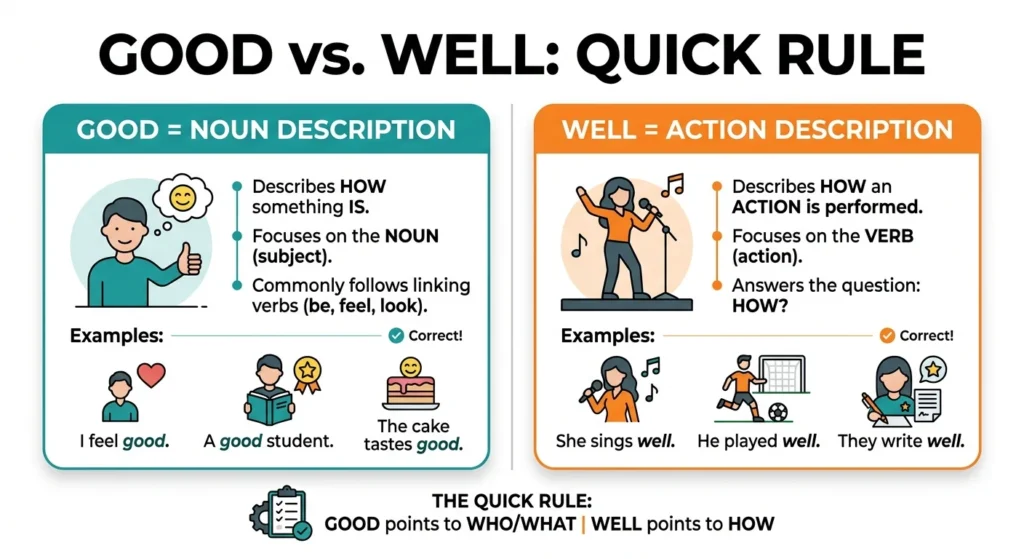
Good vs Well (Simple Rule):
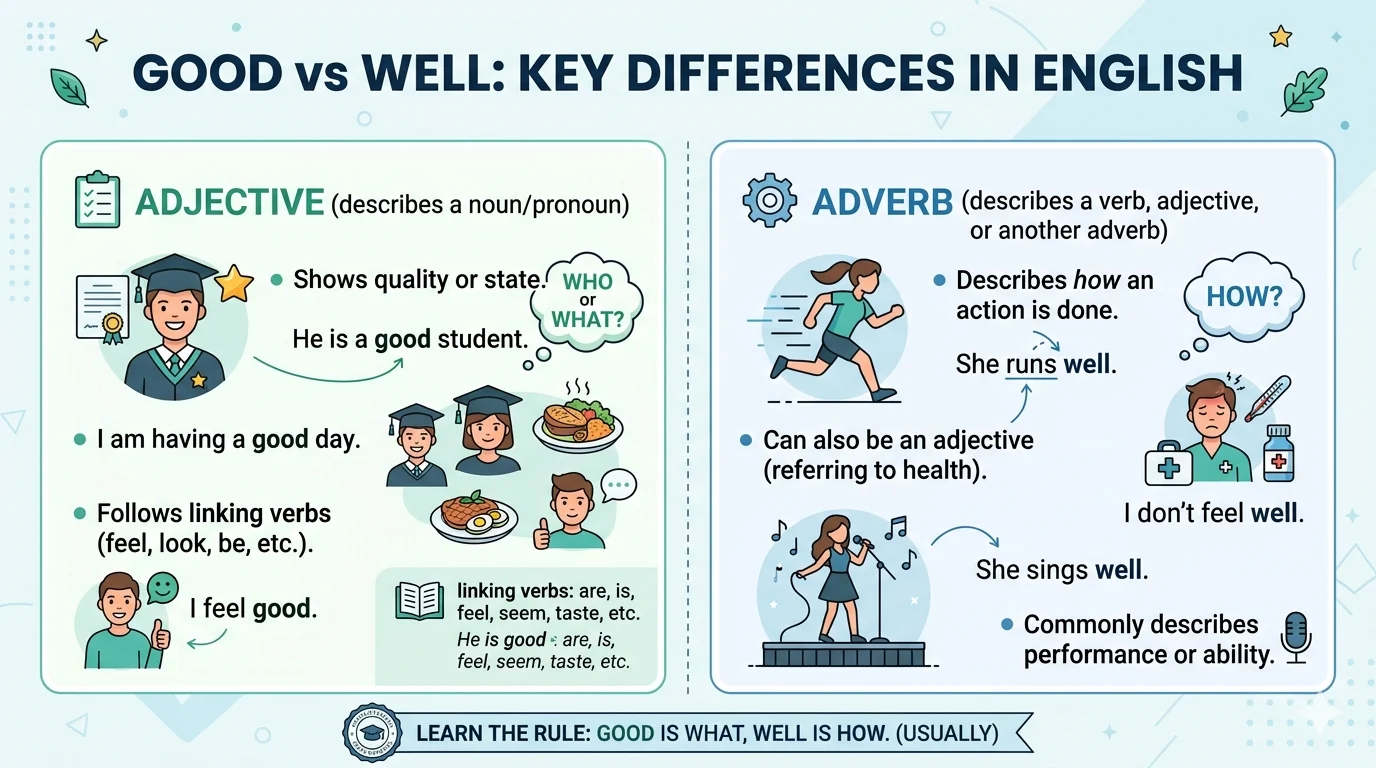
“Good is an adjective used to describe nouns, while well is an adverb used to describe verbs or actions.”
✔ Grammar Rule:
- Good = Adjective (noun description)
- Well = Adverb (action description)
✔ Examples:
- She is a good student.
- She performs well.
- I feel good today.
- He played well in the match.
🔥 Memory Trick:
👉 Good = What something is
👉 Well = How something is done
📚 Grammar Explanation
In English grammar:
- Adjectives modify nouns (good book, good student)
- Adverbs modify verbs (runs well, speaks well)
This is a fixed structural rule in English syntax. That is why well cannot replace good in formal grammar, except in emotional or linking verb cases.
📖 Origin of Good vs Well
- Good comes from Old English gōd meaning positive or beneficial
- Well comes from Old English wel meaning in a proper manner
Historically, English strictly separated adjectives and adverbs. Over time, spoken English (especially American English) became flexible, leading to informal usage like “I’m doing good.”
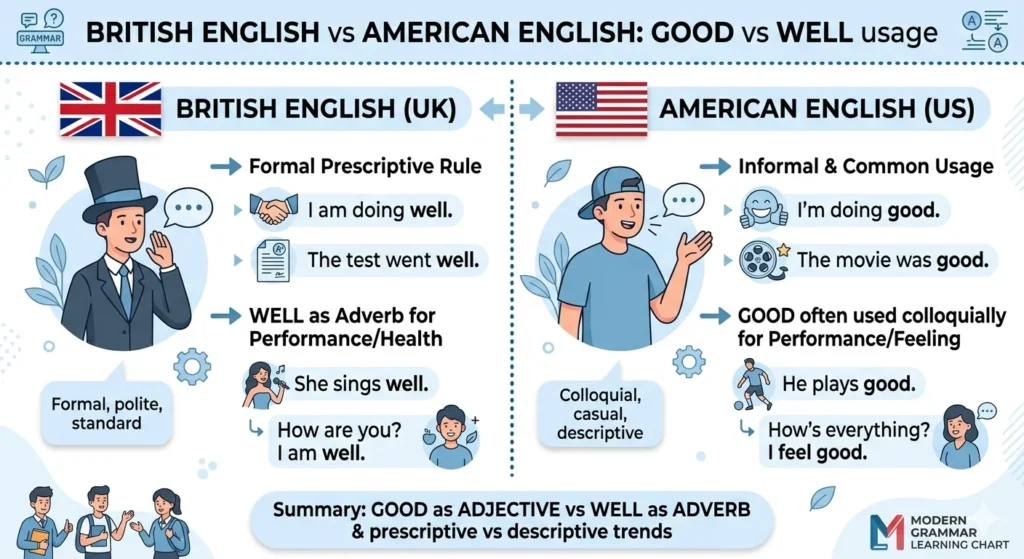
British vs American English Usage
| Context | British English | American English |
|---|---|---|
| Formal writing | I am doing well | I am doing well |
| Casual speech | I am doing well | I’m doing good |
| Exams | He performed well | He performed well |
| Health | I feel well | I feel good |
👉 Key insight: difference is usage, not spelling
🧠 Spoken vs Written English
| Type | Correct Usage |
|---|---|
| Formal writing | I am doing well |
| Spoken English | I’m doing good |
| Exams | Always “well” |
| Casual chat | Good is acceptable |
👉 This is why learners get confused between spoken English vs grammar rules
❌ Common Mistakes with Good vs Well
❌ Wrong → ✔ Correct
- I am doing good → I am doing well
- She sings good → She sings well
- He played good → He played well
- I slept good → I slept well
⚠ Important Exception:
✔ “I feel good” = emotion
✔ “I feel well” = health condition

📌 Good vs Well in Real Life Usage
📧 Emails:
- I hope you are doing well
- The meeting went well
📱 Social Media:
- Feeling good today 😊
- That post performed well
📰 News Writing:
- The economy is doing well
- The team played well
📊 Google Search Intent Analysis
Popular searches include:
- good vs well sentences
- good vs well quiz
- good vs well exercises
- I’m doing good vs well
- feeling good vs well
- it went well or good
👉 Search intent = grammar correction + exam + speaking improvement
📊 Comparison Table
| Keyword | Correct Usage | Example |
|---|---|---|
| good vs well | Grammar rule | Good = adjective, Well = adverb |
| I’m doing good vs well | Well | I’m doing well |
| feeling good vs well | Both | I feel good (emotion) |
| it went well or good | Well | It went well |
| good vs well sentences | Both | She speaks well |
| good vs well quiz | Practice | Choose correct answer |
| good vs well exercises | Learning | Fill in blanks |
🧠 Good vs Well Trick
👉 Ask “HOW?” → use WELL
👉 Ask “WHAT?” → use GOOD
Examples:
- She sings well (how?)
- She is a good singer (what?)
✍ Good vs Well Sentences
- She is a good teacher
- He speaks English well
- I feel good today
- The project went well
- She writes well
🧪 Good vs Well Quiz
- She plays piano very (good / well)
- I feel (good / well) today
- He did (good / well) in exams
- The movie was (good / well)
✔ Answers: 1-well, 2-good, 3-well, 4-good
🧩 Good vs Well Exercises
- She sings very ___
- I am feeling ___ today
- He performed ___ in school
- This is a ___ idea
✔ Answers: well, good, well, good
🇺🇸 Why Americans Say “Good” Instead of “Well”
In spoken American English, people often say:
- “I’m doing good”
This is informal language. It is widely accepted in conversation but not recommended in:
- exams
- academic writing
- professional emails
✔ Correct formal version: “I’m doing well”
💬 Good and Well Phrase Examples
- All is well
- As well as
- Feeling good vibes
- Doing well in life
❓ FAQs
1. Are good and well the same thing?
No, good is adjective and well is adverb.
2. Do you say I slept well or good?
Correct: I slept well.
3. I feel good or I feel well?
Both are correct depending on meaning.
4. It went well or good?
Correct: It went well.
5. I’m doing good vs well?
Correct grammar: I’m doing well.
6. Why do Americans say good instead of well?
Because spoken English is more informal.
7. What is good vs well trick?
Good = noun, Well = action.
🧾 Conclusion
The difference between good vs well grammar usage is simple once you understand the core rule: good describes nouns, while well describes actions. The confusion mainly comes from spoken English, especially American usage, where informal speech often replaces correct grammar.
In formal English, exams, and professional writing, “well” is always the correct choice for actions, while “good” is used for nouns and feelings. Understanding this rule improves your speaking accuracy, writing quality, and grammar confidence.
You also learned real-life examples, mistakes, quizzes, exercises, and comparisons covering good vs well sentences, feeling good vs well, and it went well or good usage. These practical patterns help you apply grammar correctly in daily communication.
Mastering this small rule significantly improves your English fluency and makes your communication more natural and professional. If you consistently practice these rules, the confusion between good vs well usage will completely disappear.

Betty Azar is a respected English language educator and author, known for clear grammar explanations and practical resources for learners worldwide.