Many English learners get confused between which vs that. At first, both words seem similar, but they actually serve different purposes in a sentence. This confusion is very common in students, bloggers, and even native writers.
People often search for “which vs that grammar,” “which vs that examples,” and “what is the rule for using that or which” because they want a simple, clear answer. But different sources explain the rule differently, which creates more confusion.
The truth is simple: there is one clear rule that can make your writing more correct and professional. This rule is widely used in academic writing, business English, and content writing because it improves clarity.
In this guide, you will learn the correct rule, real examples, common mistakes, exercises, and easy memory tips. After reading this, you will never feel confused about which vs that again.
Which vs That
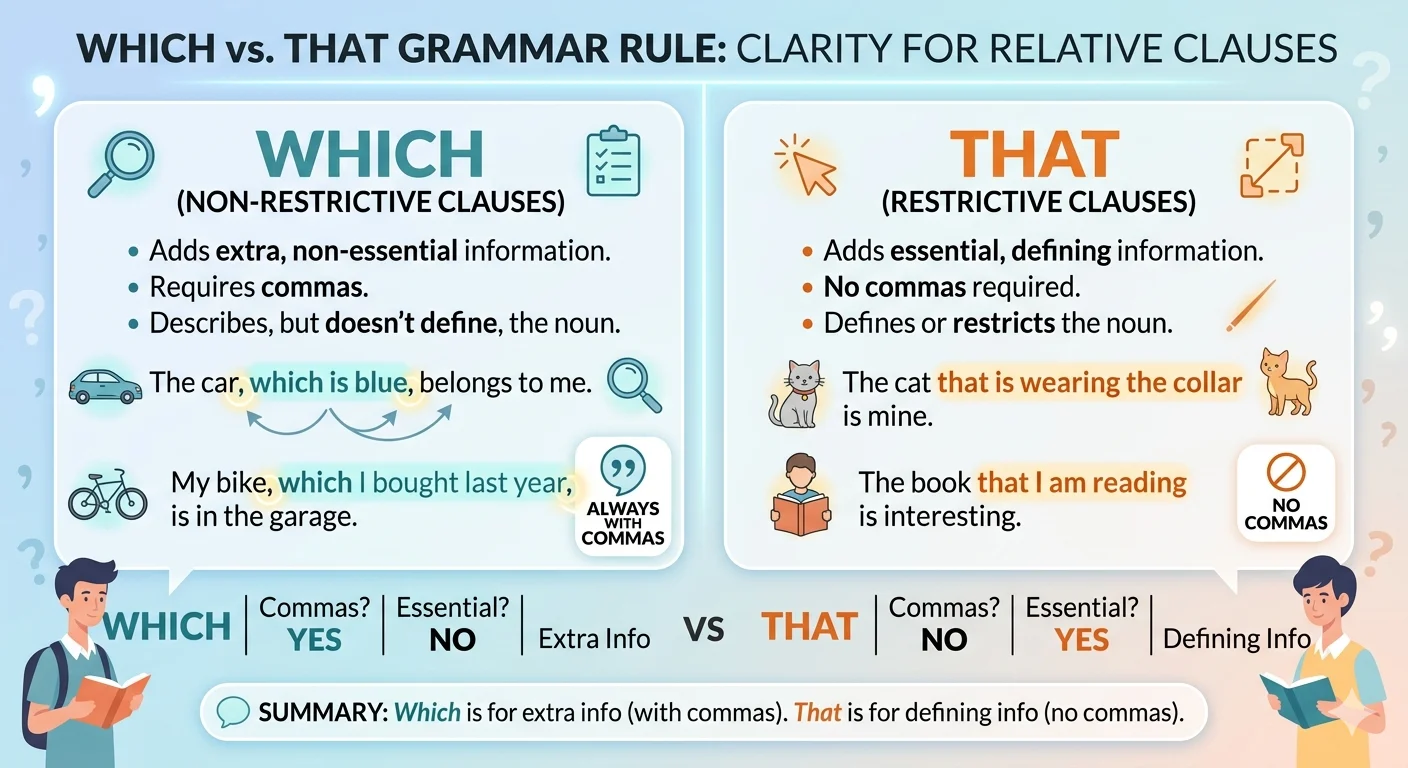
The rule is very simple:
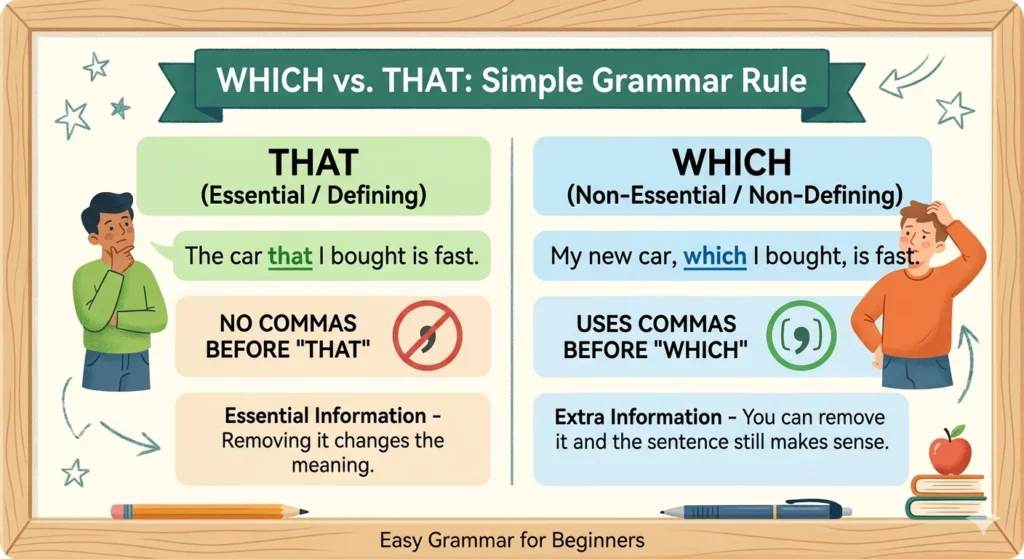
- “That” is used for important (essential) information – no commas
- “Which” is used for extra (non-essential) information – with commas
Easy Rule to Remember:
No comma → that
Comma → which
Examples:
✔ The car that I bought is new.
👉 (Essential information – without it, you don’t know which car)
✔ The car, which I bought yesterday, is new.
👉 (Extra information – the main sentence “The car is new” is complete without it)
Why We Use Which vs That
We use these words to add more information about a noun.
- That = gives necessary meaning
- Which = gives additional detail
👉 The difference is important because it can slightly change the meaning of a sentence.
Which vs That Grammar Rule Explained
1. “That” (Defining Clause)
Used when the sentence needs the information to be clear.
✔ The book that I read was helpful.
👉 Without “that I read,” we don’t know which book.
✔ The phone that is on the table is mine.
👉 Without the clause, we don’t know which phone.
2. “Which” (Non-Defining Clause)
Used when the sentence already has complete meaning without the extra information.
✔ My phone, which I bought last year, is still working.
👉 “My phone is still working” is a complete sentence. The “which” part is just extra.
✔ The law, which was passed last week, is debated.
👉 The main meaning is “The law is debated.”
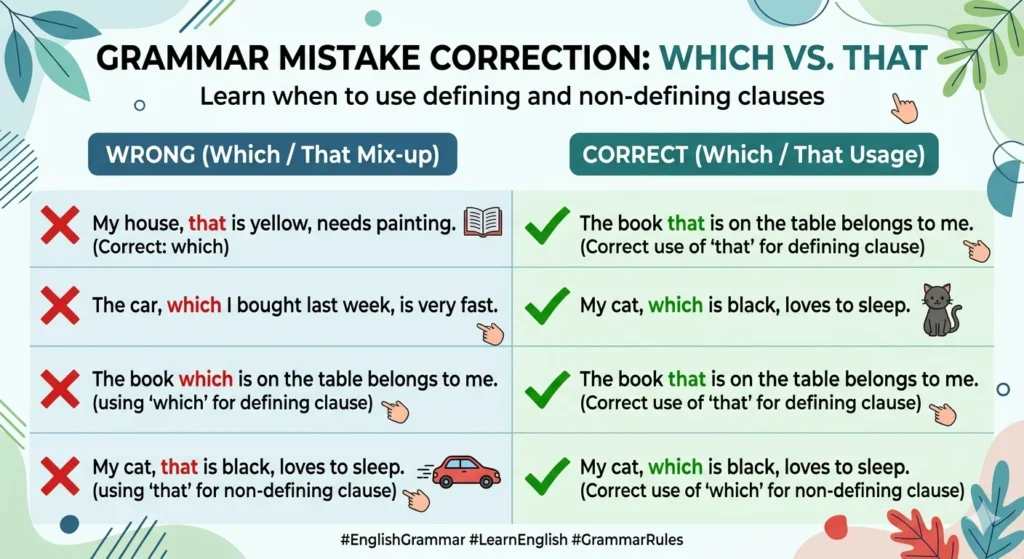
Common Mistakes
❌ The movie which I watched was good.
✔ The movie that I watched was good. (essential info – use that)
❌ My phone which I bought last year is working. (missing commas)
✔ My phone, which I bought last year, is working. (extra info – use commas + which)
❌ The car, which I bought yesterday is fast. (missing second comma)
✔ The car, which I bought yesterday, is fast.
❌ The house which is big is mine.
✔ The house that is big is mine. (essential info – use that)
Which vs That vs Who
| Word | Used For | Example |
|---|---|---|
| Who | People (preferred) | The teacher who helped me is kind. |
| That | People or things (essential info) | The person that called you is here. / The car that I bought is new. |
| Which | Things only (extra info) | The book, which I read yesterday, is useful. |
Important Note:
- Who is preferred for people, but that is also acceptable in essential clauses.
- Example: The person that helped me (acceptable) vs The person who helped me (better)
Simple Memory Trick
👉 If removing the clause changes the meaning → use “that”
👉 If removing the clause does NOT change the meaning → use “which”
Examples:
The phone that is on the table (important – which phone? The one on the table)
The phone, which is new, is expensive (extra info – the phone is already identified)
Which vs That in Real Life Examples
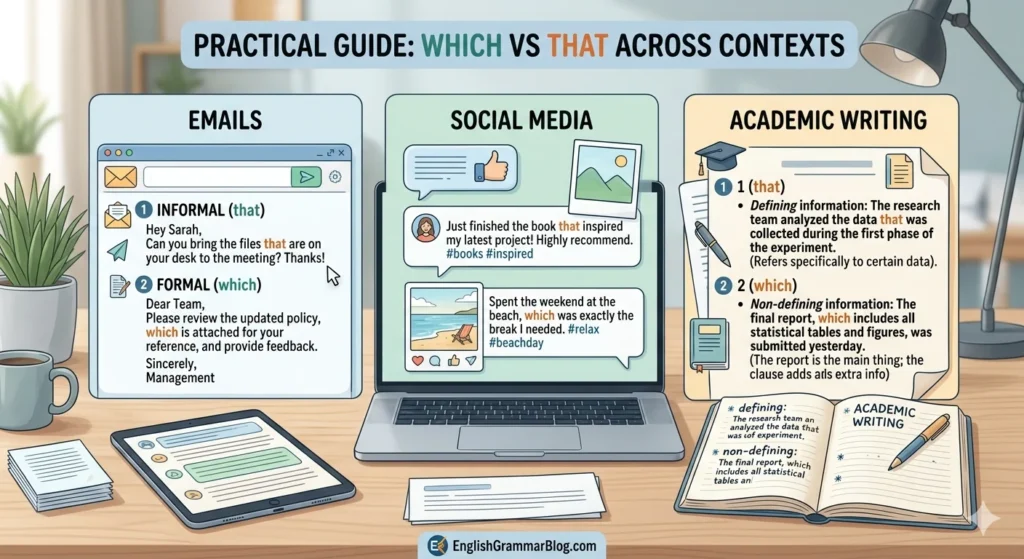
Emails:
✔ The file that you sent is correct.
✔ The file, which you sent yesterday, is helpful.
News:
✔ The law that was passed affects workers.
✔ The law, which was passed last week, is debated.
Social Media:
✔ The phone that I bought is amazing.
✔ My phone, which I bought last year, still works.
Which vs That Exercises
Fill in the blanks:
- The car ___ I bought is fast.
- The car, ___ I bought yesterday, is fast.
- The book ___ is on the table is mine.
- The book, ___ I read last night, was interesting.
- The teacher ___ helped me is kind.
Answers:
- that
- which
- that
- which
- who
Advanced Tip
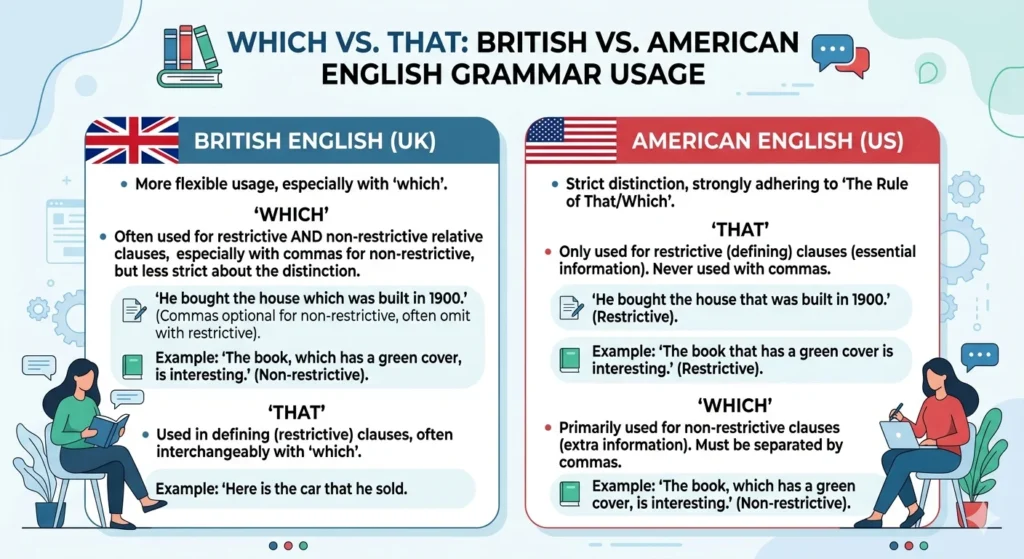
American English (US):
- Use “that” for essential information
- Use “which” only for non-essential information (with commas)
- Avoid using “which” in defining sentences
British English (UK):
- Some writers use “which” without commas for essential clauses
- Example: The car which I bought is fast. (acceptable in UK, but not in formal US writing)
Safe Rule for Exams and Blogging
Always follow the US rule: that (no comma) for essential, which (with commas) for non-essential.
Which vs That – Key Difference Table
| Feature | That | Which |
|---|---|---|
| Meaning type | Essential information | Extra information |
| Commas | No | Yes |
| Sentence type | Defining clause | Non-defining clause |
| Example | The car that I bought | The car, which I bought, |
FAQs
1. What is the rule for using that or which?
Use that for essential information (no commas) and which for extra information (with commas).
2. How do I remember the rule easily?
That = no comma, Which = comma.
3. When should I use “which is” or “that is”?
Use “that is” for necessary meaning and “which is” for extra detail.
4. Can I use which instead of that?
Only in British English sometimes, but not recommended in formal or American English writing.
5. Can “that” be used for people?
Yes, in essential clauses. Example: The person that called you (acceptable, but who is better).
6. Why is this rule important?
It improves clarity, grammar accuracy, and professional writing quality.
Conclusion
Understanding which vs that is very important for clear and correct English writing. The rule is simple: use “that” for essential information (no commas) and “which” for extra information (with commas). This small difference can change the clarity of your sentence.
Although British English is more flexible, American English and formal writing strongly follow this rule. That is why students, writers, and bloggers should always use it correctly to avoid mistakes.
Most confusion happens because both words look similar, but once you understand the logic, it becomes very easy. Just remember: if the meaning changes without the clause, use “that.” If it does not change, use “which.”
With practice, this rule will become natural, and your writing will look more professional and clear.

Scott Thornbury is a respected English language educator and author, known for practical grammar insights, teacher training, and clear learner-focused explanations.