If you’ve ever stopped and wondered, “Do I lay in bed or lie in bed?”—you’re not alone. Even advanced English users make this mistake without realizing it. This small grammar mistake confuses millions of people every day. Whether you’re writing emails, ब्लॉग posts, or social media captions, mixing up lay vs lie vs laid can make your English unclear and less professional.
This confusion happens because these verbs look similar and share forms. For example, the past tense of lie is lay, which is also the present tense of lay. This creates a common grammar problem, especially for ESL learners.
In this complete guide, you’ll get a quick answer, expert explanations, real-life examples, pro tips, and practice questions. By the end, you’ll use lay, lie, and laid correctly and confidently.
Lay vs Lie vs Laid
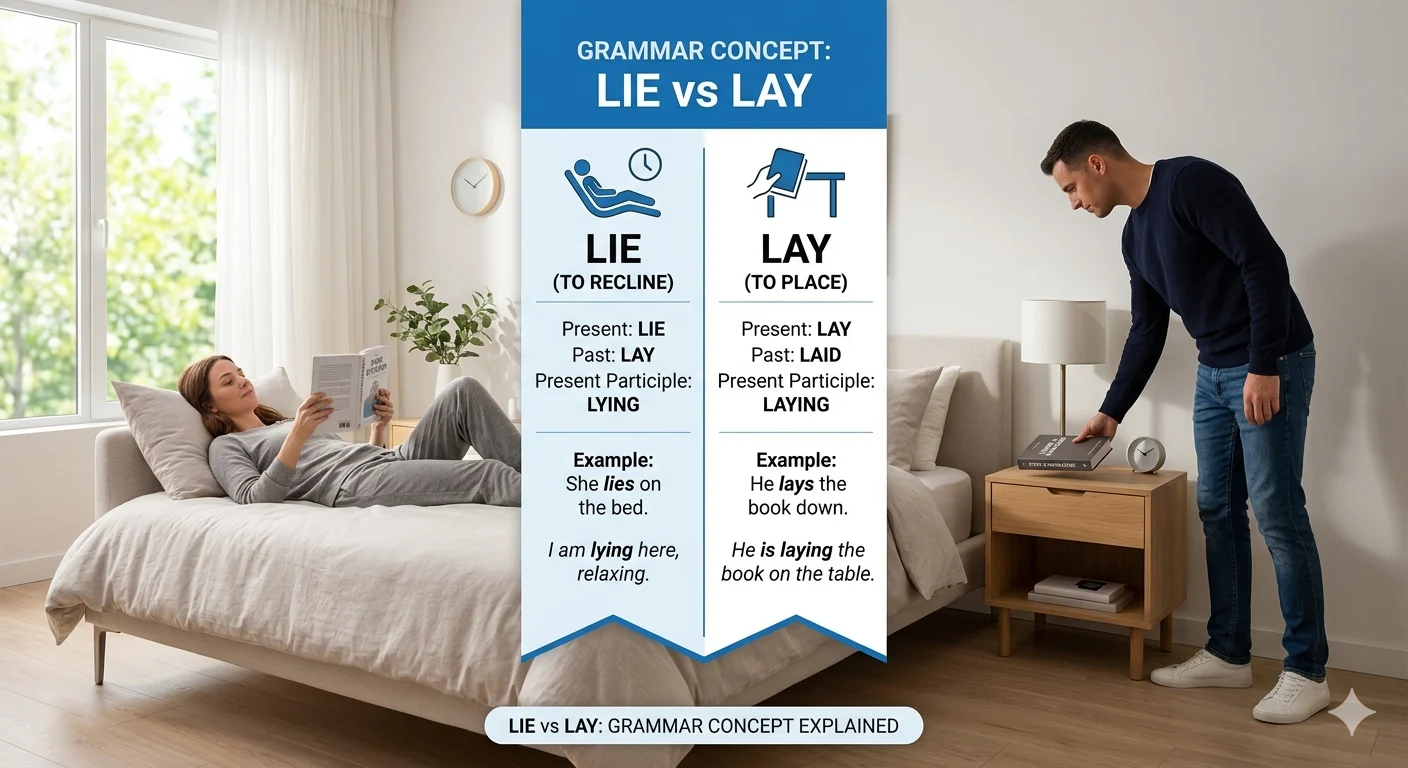
This is the easiest way to remember lay vs lie vs laid:
- Lie = to rest (no object)
- Lay = to put something (needs an object)
- Laid = past tense of lay
Examples:
- I lie on the bed. ✅
- I lay the book on the table. ✅
- Yesterday, I laid the book there. ✅
Quick Trick:
- Replace with “put” → use lay
- No object → use lie
Common Questions:
- Do I lay in bed or lie in bed? → Lie in bed ✅
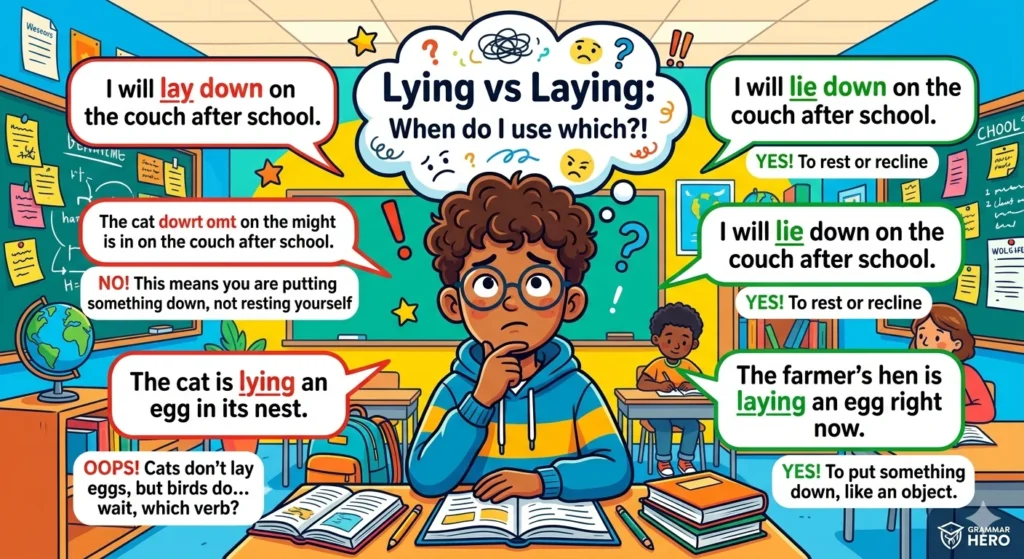
- Is the cat lying or laying? → Lying ✅
- Is it laying or lying on my bed? → Lying on my bed ✅
The Origin of Lay vs Lie vs Laid
The confusion in lay vs lie vs laid grammar comes from Old English:
- Lie → from licgan (to rest)
- Lay → from lecgan (to place something)
Their forms evolved but remained similar:
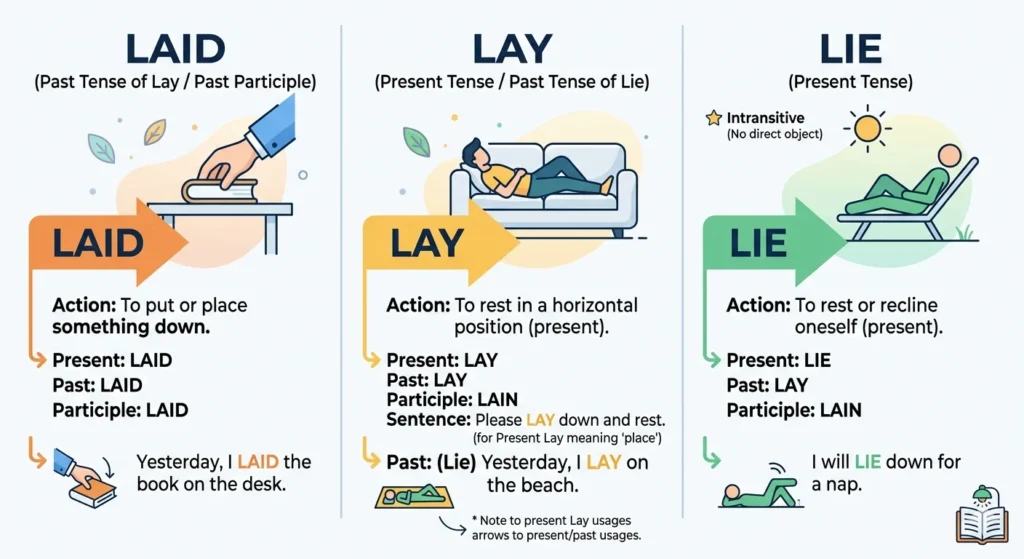
- Lie → lay → lain
- Lay → laid → laid
Why This Matters
According to standard grammar rules:
- Lie is intransitive (no object)
- Lay is transitive (needs an object)
Example:
- Today I lie down
- Yesterday I lay down
- I have lain down
Compare:
- Today I lay the keys down
- Yesterday I laid the keys down
👉 This explains searches like:
- lie past tense
- lie lay lain
- lain vs laid
British English vs American English Spelling Differences
There is no spelling difference between US and UK English, but usage differs in speech.
Spoken vs Written Difference:
- Informal speech: ❌ “I’m laying on the bed”
- Correct writing: ✅ “I’m lying on the bed”
Style Insight:
- American English → stricter in writing
- British English → slightly flexible in casual speech
Table:
| Form | Meaning | Example |
|---|---|---|
| Lie | Rest | She lies down |
| Lay | Put something | She lays the phone |
| Laid | Past | She laid it there |
| Lain | Past participle | She has lain there |
Which Form Should You Use in Lay vs Lie vs Laid Grammar?
The spelling stays the same, but correct usage depends on your sentence.
Best Practice:
- Use lie for resting
- Use lay for placing something
- Use laid for past actions
✅ Pro Tip:
If you can replace the verb with “put”, use lay.
✅ Pro Tip:
If your sentence answers “what?”, use lay.
Common Mistakes in Lay vs Lie vs Laid Grammar
1. Wrong verb
- ❌ I lay in bed every day
- ✅ I lie in bed every day
2. Past tense confusion
- ❌ Yesterday I laid down (no object)
- ✅ Yesterday I lay down
3. Continuous form error
- ❌ The cat is laying
- ✅ The cat is lying
4. Lain vs Laid
- ❌ I have laid there
- ✅ I have lain there
5. Missing object
- ❌ I lie the book
- ✅ I lay the book
Lay vs Lie vs Laid in Everyday Examples
Emails
- I will lay the files on your desk
- I need to lie down
Social Media
- Just lying in bed
- She laid her phone down
News Writing
- The man was lying on the ground
- Workers laid cables
Formal Writing
- The report was laid before the board
- He had lain there for hours
Good vs Well: The Simple Rule You’ll Remember
Advanced Examples
- The documents were laid before the court
- He had lain awake all night
- The workers carefully laid the foundation
- She lay on the grass and watched the sky
Lay vs Lie vs Laid – Google Trends & Usage Data
Popular Searches:
- Lie vs lay
- Lay vs lie vs laid examples
- Is it laying or lying
Why This Confusion Happens
This confusion happens because:
- Many languages do not separate verb types
- ESL learners struggle with grammar rules
- Spoken English includes incorrect usage
Regional Trends:
- USA & UK → grammar-focused searches
- India & Pakistan → spoken confusion
- Global → example-based learning
Comparison Table: Lay vs Lie vs Laid
| Word | Type | Meaning | Example |
|---|---|---|---|
| Lie | Verb | Rest | I lie down |
| Lay | Verb | Put something | I lay the book |
| Laid | Past | Placed | I laid it there |
| Lain | Past participle | Rested | I have lain here |

Practice Section
Fill in the blanks:
- I am ___ on the bed
- She ___ the keys yesterday
- The dog is ___ on the floor
Answers:
- lying
- laid
- lying
FAQs
1. Do I lay in bed or lie in bed?
You lie in bed.
2. When to use lay or lie or laid?
- Lie = rest
- Lay = put
- Laid = past
3. Is the cat lying or laying?
Correct: lying
4. What is lie past tense?
Lay (past), lain (past participle)
5. Lain vs laid?
Lain = rest, Laid = put
6. Is it laying or lying on my bed?
Correct: lying
7. What is lie vs lies?
Lie = base, Lies = present
8. Why do people confuse lay and lie?
Because their forms overlap and sound similar.
9. Is “laying in bed” ever correct?
No, correct form is lying in bed.
🔁 Quick Recap
- Lie = rest (no object)
- Lay = put something (needs object)
- Laid = past of lay
👉 If there is no object → use lie
👉 If you can say “put” → use lay
Conclusion
The difference between lay vs lie vs laid becomes easy when you remember one simple rule: lie means to rest, and lay means to place something. From there, everything becomes clear.
The confusion happens because of overlapping forms like lie → lay → lain and lay → laid → laid. But by checking whether your sentence has an object, you can avoid most mistakes.
Using correct grammar improves your writing, builds trust, and makes your communication more professional. Practice regularly, and soon you will use these verbs naturally without confusion.

Scott Thornbury is a respected English language educator and author, known for practical grammar insights, teacher training, and clear learner-focused explanations.