Is it much money or many money? This small question confuses many English learners. Both words talk about quantity, but they follow different grammar rules. If you use the wrong one, your sentence can sound incorrect or unnatural.
People often search for much vs many because they want a quick answer and clear examples. Students need it for exams. Writers need it for correct sentences. You may also ask: Do I say how much or how many? or What is the difference between too much and too many?
This guide gives you everything in one place:
✔ Simple rules
✔ Clear examples
✔ Real-life usage
✔ Exercises and answers
✔ Expert tips
By the end, you will understand much vs many grammar clearly and use it with confidence.
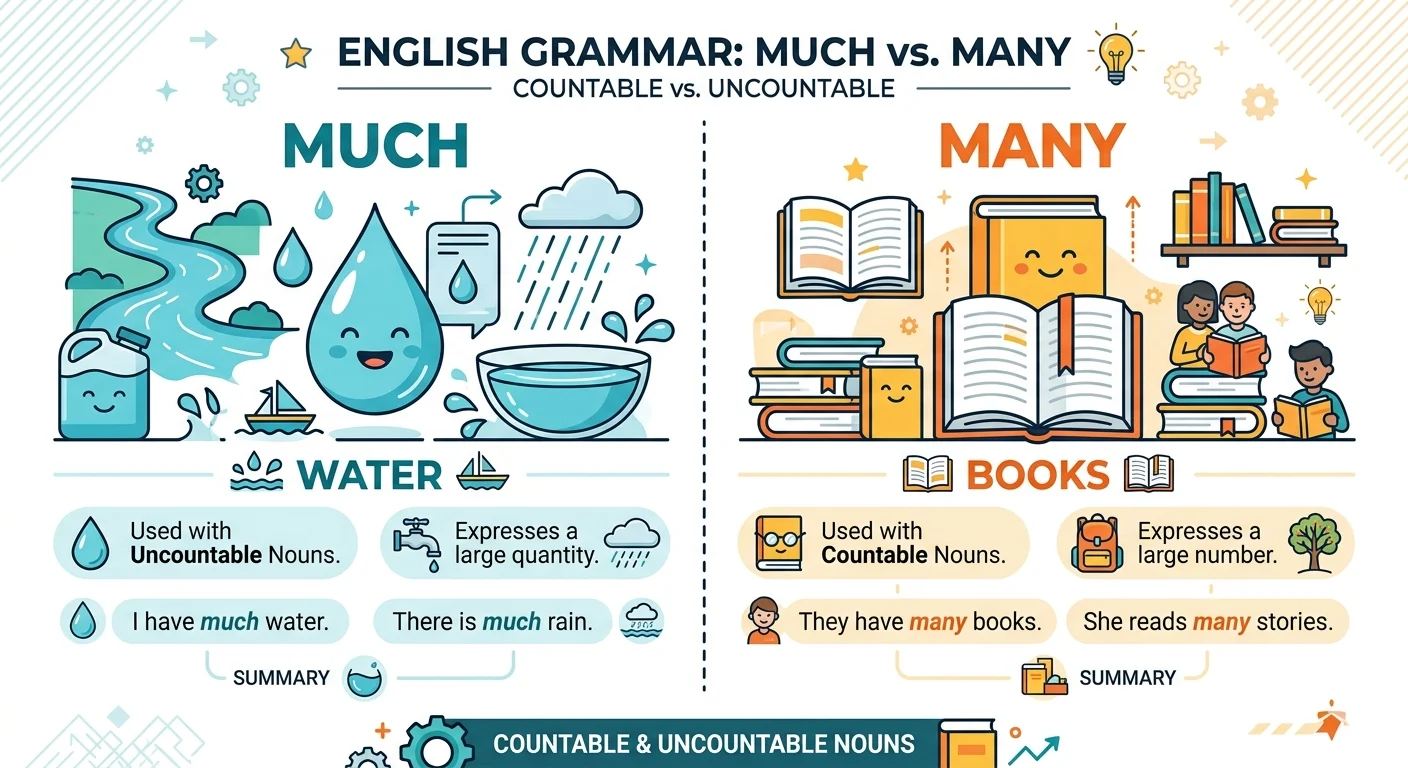
Much vs Many
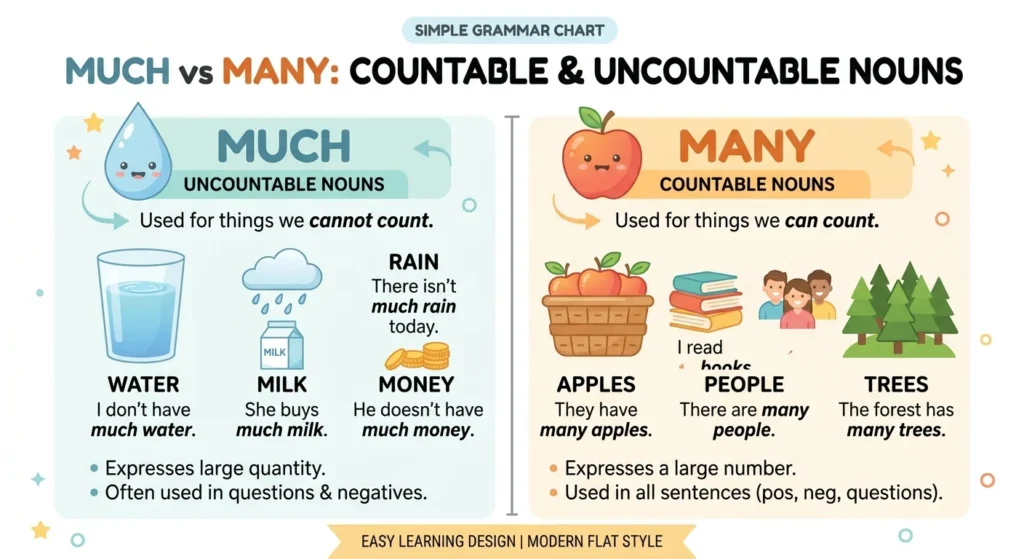
- Much = uncountable nouns
- Many = countable nouns
Examples:
- Much water ✔️
- Much information ✔️
- Many books ✔️
- Many ideas ✔️
Question Form:
- How much + uncountable noun
- How many + countable noun
👉 Example:
- How much sugar do you need?
- How many students are there?
📊 Quick Comparison Table
| Type | Use | Example |
|---|---|---|
| Much | Uncountable nouns | Much water |
| Many | Countable nouns | Many books |
🔑 Quick Tip:
👉 Much = you cannot count it
👉 Many = you can count it
The Origin of Much vs Many
The words come from Old English:
- Much → micel (large amount)
- Many → manig (numerous)
Language Development:
- Old English → flexible grammar
- Middle English → clearer rules
- Modern English → strict difference
Historical Examples:
- “Much gold was found”
- “Many soldiers fought”
👉 Why this rule exists:
English separates:
- Mass (uncountable) → much
- Number (countable) → many
This makes meaning clear and avoids confusion.
British vs American English Usage
There is no spelling difference. Both use the same rules.
Small Style Difference:
| Feature | British English | American English |
|---|---|---|
| Much (positive sentences) | More common | Less common |
| Informal speech | a lot of | a lot of |
Example:
- UK: There is much importance
- US: There is a lot of importance
Which Should You Use?
✔ Use much → for uncountable nouns
✔ Use many → for countable nouns
💡 Expert Tip:
- Much is mostly used in negative and question sentences
- Many works in all sentence types
- In daily English, people often use a lot of
Is It Much or Many Money?
✔ Correct: Much money
❌ Wrong: Many money
👉 “Money” is an uncountable noun
Examples:
- I don’t have much money
- How much money do you need?
Do I Say How Many or How Much?
✔ How much → uncountable
✔ How many → countable
Examples:
- How much water is left?
- How many students are there?
Too Much vs Too Many
✔ Too much → uncountable
✔ Too many → countable
Examples:
- Too much traffic
- Too many cars
Where Can I Use Many?
Use many when you can count things.
Examples:
- Many books
- Many ideas
- Many opportunities
👉 If you can count it → use many
Common Mistakes
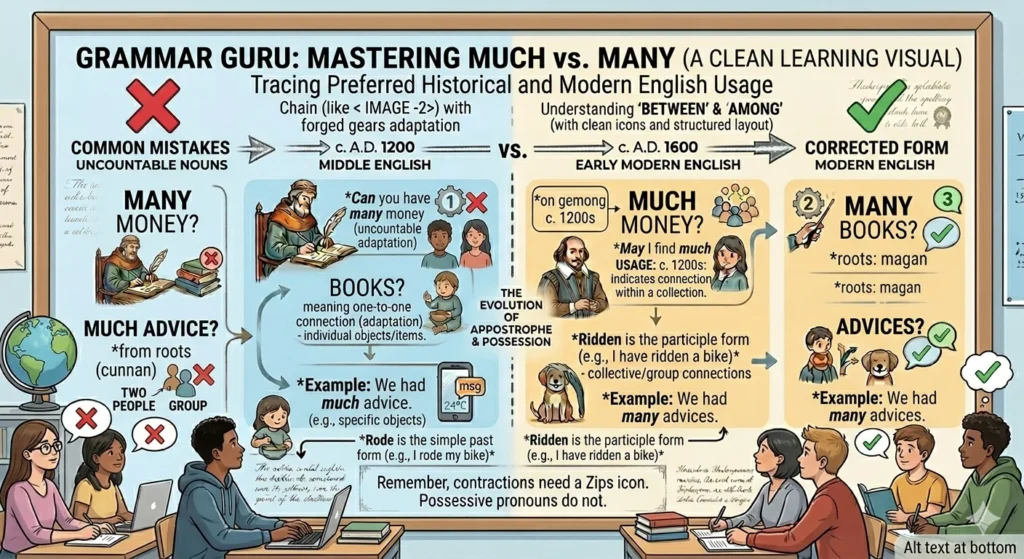
❌ Many water → ✔️ Much water
❌ Much books → ✔️ Many books
❌ Too much people → ✔️ Too many people
Real Learner Mistake:
❌ I don’t have many time
✔️ I don’t have much time
Much vs Many in Real-Life Examples
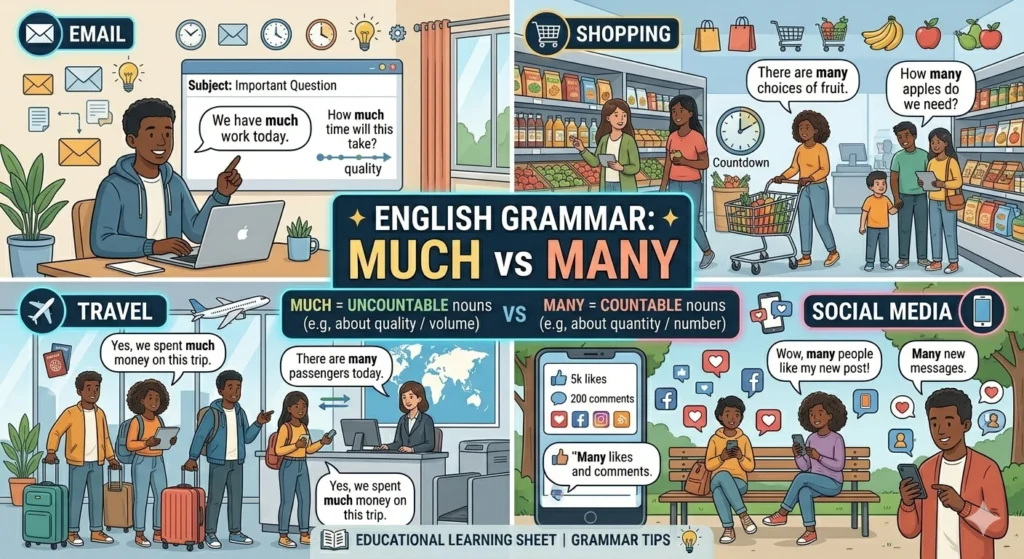
Daily Life:
- I don’t have much time
- There are many options
Shopping:
- I don’t have much cash
- There are many products
Work:
- We don’t have much data
- There are many tasks
Travel:
- There isn’t much traffic
- There are many tourists
Much vs Many Sentences
- I don’t have much information
- She has many friends
- How much time is needed?
- How many people are there?
Much and Many Examples with Answers
- There isn’t ___ milk → much
- There are ___ chairs → many
- How ___ time → much
- How ___ people → many
Much vs Many Exercises
Fill in the blanks:
- I don’t eat ___ sugar
- Are there ___ books?
- There isn’t ___ traffic
- She has ___ ideas
Answers:
much, many, much, many
Much vs Many Worksheet
Practice idea:
- Write 5 sentences with much
- Write 5 sentences with many
- Change them using a lot of
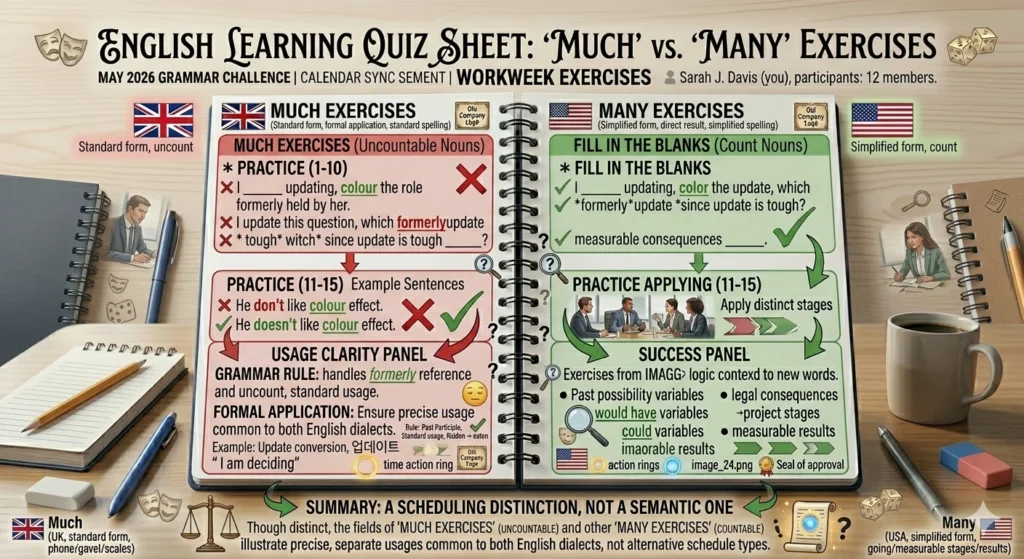
Much, Many, A Lot Of
| Word | Use | Example |
|---|---|---|
| Much | Uncountable | Much water |
| Many | Countable | Many books |
| A lot of | Both | A lot of people |
Much vs Many vs More
- Much → quantity
- Many → number
- More → comparison
Examples:
- I need more information
- There are more options
Advanced Usage
✔ So much vs so many:
- So much work
- So many people
✔ Much too:
- This task is much too difficult
👉 This is where many learners get confused.
Sentence Correction Practice
- Many sugar ❌ → Much sugar ✔️
- Much people ❌ → Many people ✔️
- Too much cars ❌ → Too many cars ✔️
Google Trends & Search Intent
The keyword much vs many grammar is popular worldwide.
Who searches it?
- Students (school, IELTS)
- Bloggers (SEO writing)
- Professionals (emails, reports)
Why?
- To avoid mistakes
- To improve writing
- To learn correct grammar
👉 Beginners want rules
👉 Advanced learners want examples
Related Grammar Topics (Important)
Few vs Little
👉 Same rule:
- Few → countable
- Little → uncountable
Less vs Fewer
👉 Used for comparison
- Less → uncountable
- Fewer → countable
👉 These help you fully understand much vs many grammar
FAQs
1. Is it much or many money?
Much money ✔️ (because money is uncountable)
2. Where can I use many?
Use many with countable nouns like books, people, and ideas.
3. What is the difference between too much and too many?
Too much = uncountable
Too many = countable
4. Do I say how many or how much?
How much = uncountable
How many = countable
5. Can I use much in positive sentences?
Yes, but mostly in formal English.
6. Is “a lot of” better?
Yes, in casual speaking.
7. Why is this important?
It helps you write correct and clear English.
Conclusion
Understanding much vs many is simple when you remember one rule:
👉 Much = uncountable nouns
👉 Many = countable nouns
This rule is used in daily speaking, writing, and exams. Many learners make mistakes because they don’t know if a noun is countable or not. But once you understand this difference, your English becomes clear and correct.
In real life, people often use a lot of because it is easy. However, using much and many correctly shows strong grammar skills, especially in formal writing.
✔ Final Tip:
Try writing 5 sentences using much and many today. Practice makes it natural.

Pam Peters is a linguist and grammar expert, known for clear explanations of modern English usage, style, and practical language rules.