Have you ever wondered about the difference between soar vs sore? These two words sound almost exactly the same, but they have very different meanings. Because of their similar pronunciation, many people use the wrong spelling when writing emails, school assignments, social media posts, or professional documents.
Common searches such as “Soar vs sore meaning,” “Soar vs sore pronunciation,” “What is the difference between soar and sore?” and “How do you spell sore as in painful?” show that this confusion affects both native English speakers and English learners. Some people even write phrases like “I sore you” instead of the correct phrase “I saw you.”
Understanding the difference between these words is important because using the wrong one can completely change the meaning of a sentence. For example, a bird can soar through the sky, but your muscles can feel sore after exercise. One word relates to flying or rising, while the other relates to pain or discomfort.
In this guide, you’ll learn the meanings, origins, pronunciation, spelling rules, examples, and common mistakes associated with soar and sore. By the end, you’ll know exactly which word to use in any situation.
Soar vs Sore
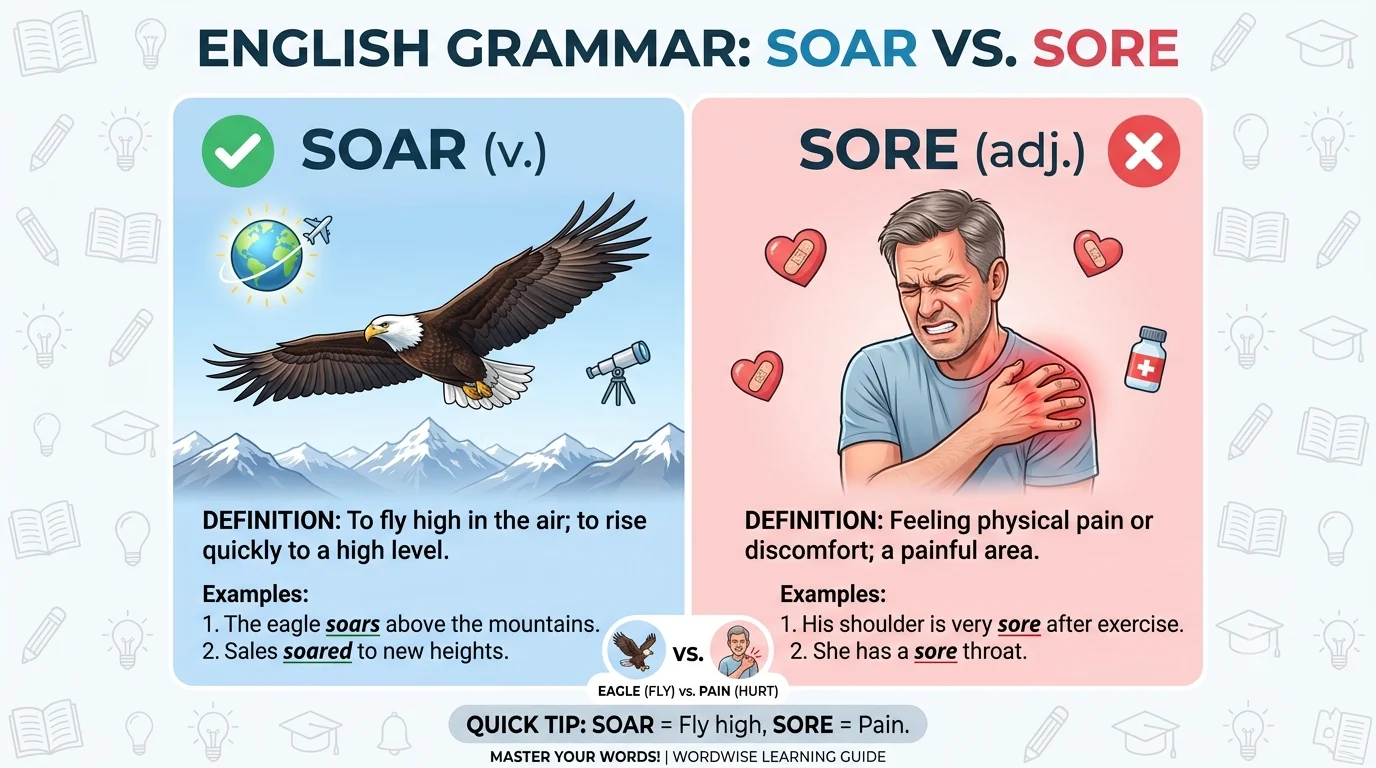
The difference between soar and sore is simple:
- Soar means to fly high, rise upward, or increase rapidly.
- Sore means painful, aching, injured, or tender.
Although the two words have nearly identical pronunciation, they are used in completely different situations.
Quick Examples
Soar
- Eagles soar above mountains.
- House prices continue to soar.
- Her confidence began to soar.
Sore
- My throat is sore.
- His muscles are sore after the workout.
- She has a sore knee.
Soar vs Sore Meaning
| Word | Meaning | Example |
|---|---|---|
| Soar | To fly high or rise quickly | The bird can soar above the clouds. |
| Sore | Painful or aching | My back feels sore today. |
Easy Memory Trick
Remember:
Soar = Sky
Sore = Pain
If something rises, flies, grows, or increases, use soar.
If something hurts, aches, or feels painful, use sore.
Are Soar and Sore Homophones?
Yes. Soar and sore are homophones.
A homophone is a word that sounds the same as another word but has a different meaning and spelling.
Examples:
- The eagle can soar above the valley.
- My shoulders are sore after lifting weights.
Because both words sound alike, writers often confuse them. However, understanding their meanings makes it easy to choose the correct spelling.
The Origin of Soar vs Sore
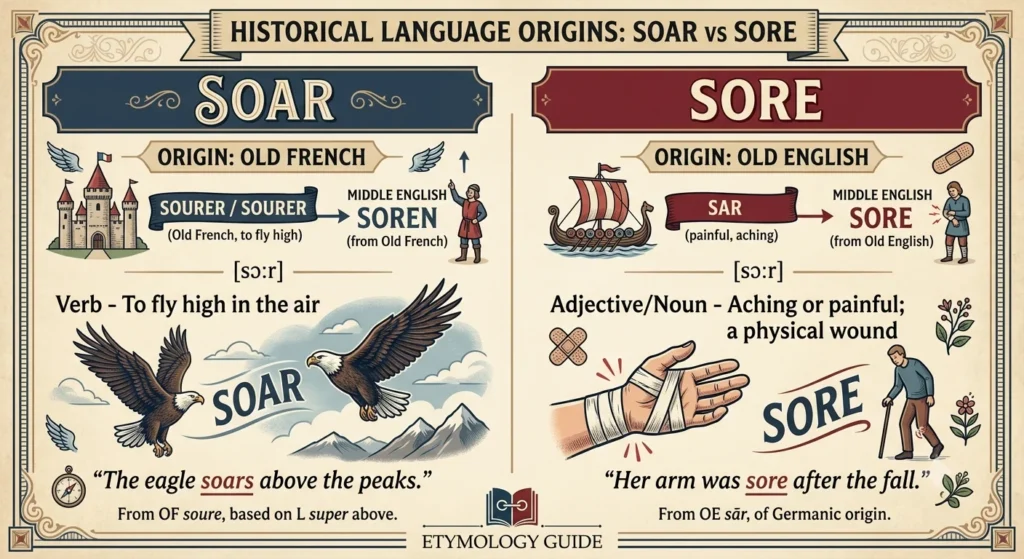
The words soar and sore may sound alike today, but they come from different language roots and developed independently over time.
Origin of Soar
The word soar comes from the Old French word essorer, which means “to rise into the air” or “to fly upward.”
Over time, English speakers began using soar not only for birds and aircraft but also for anything that rises quickly.
Examples:
- The eagle soared above the mountains.
- Sales soared during the holiday season.
- Temperatures may soar this summer.
Today, the word often appears in business, finance, aviation, sports, and news reports.
Origin of Sore
The word sore comes from the Old English word sar, meaning painful, wounded, distressed, or suffering.
For hundreds of years, English speakers have used sore to describe physical pain, injuries, illness, and emotional hurt.
Examples:
- A sore throat
- Sore muscles
- A sore knee
Because the two words evolved from completely different origins, they kept different spellings even though they eventually developed similar pronunciat
British English vs American English Spelling
Many English words have different spellings in British and American English. Examples include:
- Colour vs Color
- Organise vs Organize
- Centre vs Center
However, soar and sore are not among those words.
The spelling remains exactly the same in both British and American English.
Comparison Table
| Meaning | American English | British English |
|---|---|---|
| Fly high | Soar | Soar |
| Rise rapidly | Soar | Soar |
| Painful | Sore | Sore |
| Aching muscles | Sore muscles | Sore muscles |
American English Examples
- Housing prices continue to soar.
- My feet are sore after walking.
British English Examples
- Energy costs may soar this winter.
- He has a sore throat.
Whether you write for readers in the United States, the United Kingdom, Canada, Australia, or anywhere else, the spelling remains the same.

Which Spelling Should You Use?
The correct choice depends entirely on the meaning you want to express.
Use Soar When Talking About:
- Flying
- Rising
- Growth
- Success
- Improvement
- Increasing numbers
Examples:
- The hawk soared above the forest.
- Company profits continue to soar.
- Tourism numbers soared last year.
- Her confidence began to soar.
Common Contexts for Soar
| Topic | Example |
|---|---|
| Aviation | Birds soar in the sky. |
| Business | Revenue soared by 30%. |
| Sports | Team morale soared after the victory. |
| Education | Test scores soared this year. |
Use Sore When Talking About:
- Pain
- Injury
- Illness
- Physical discomfort
- Tenderness
Examples:
- My legs are sore after running.
- She has a sore shoulder.
- He woke up with a sore throat.
- The injury left his knee sore.
Common Contexts for Sore
| Topic | Example |
|---|---|
| Health | I have a sore throat. |
| Fitness | My muscles are sore. |
| Sports | The athlete’s ankle was sore. |
| Medicine | Patients reported sore joints. |
Parts of Speech: Soar vs Sore
Understanding the grammar category of each word can help you avoid mistakes.
| Word | Part of Speech | Meaning |
|---|---|---|
| Soar | Verb | To rise, fly, or increase rapidly |
| Sore | Adjective | Painful, tender, aching |
Examples
Soar (Verb)
- Birds soar above the ocean.
- Prices soar during peak seasons.
Sore (Adjective)
- My shoulder is sore.
- His throat feels sore.
Because they belong to different parts of speech, they cannot usually replace each other in a sentence.
Quick Comparison Table
| Feature | Soar | Sore |
|---|---|---|
| Meaning | Rise or fly high | Painful or aching |
| Part of Speech | Verb | Adjective |
| Pronunciation | /sɔːr/ | /sɔːr/ |
| Positive or Negative | Usually positive | Usually negative |
| Common Topics | Growth, success, flying | Health, injury, pain |
| Example | Sales soar rapidly. | My muscles are sore. |
Key Takeaway
Use soar when talking about flying, rising, growing, or increasing.
Use sore when talking about pain, injury, tenderness, or discomfort.
Common Mistakes with Soar vs Sore
Because soar and sore sound almost identical, many people accidentally use the wrong word. These mistakes are common in emails, text messages, school assignments, and social media posts.
Learning the most frequent errors can help you avoid them in your own writing.
Mistake #1: Using Sore Instead of Soar
❌ Company profits are sore this year.
✅ Company profits are soaring this year.
Why?
Profits can increase or rise, so the correct word is soar.
Mistake #2: Using Soar Instead of Sore
❌ I have a soar throat.
✅ I have a sore throat.
Why?
A throat can hurt or feel painful, so the correct word is sore.
Mistake #3: Using Sore for Flying
❌ The eagle sore above the mountains.
✅ The eagle soared above the mountains.
Why?
Birds fly and rise through the air. Therefore, soar is the correct word.
Mistake #4: Using Soar for Pain
❌ My legs are soar after running.
✅ My legs are sore after running.
Why?
Muscles can hurt or ache, so sore is correct.
Mistake #5: Confusing Soar, Sore, and Saw
Many English learners mix up all three words.
| Word | Meaning |
|---|---|
| Soar | To rise or fly high |
| Sore | Painful or aching |
| Saw | Past tense of see |
Examples:
- The eagle soared above the lake.
- My shoulder feels sore.
- I saw you yesterday.
I Saw You or I Sore You?
This is one of the most searched grammar questions online.
The correct phrase is:
✅ I saw you
The incorrect phrase is:
❌ I sore you
Why Is “I Sore You” Wrong?
The word sore means painful or aching. It is never used as the past tense of the verb see.
The past tense of see is saw.
Correct Examples
- I saw you at the mall.
- I saw you yesterday.
- I saw you on television.
- I saw you during the meeting.
Incorrect Examples
- I sore you yesterday.
- I sore you at school.
- I sore you online.
If you are talking about seeing someone in the past, always use saw.
I Sore You Meaning
Many people search for “I sore you meaning” because they hear the phrase spoken and are unsure how to spell it.
In most cases, the person actually means:
✅ I saw you
Meaning:
“I noticed you” or “I saw your presence.”
Examples:
- I saw you at the restaurant.
- I saw you at the game.
- I saw you walking home.
Remember:
I sore you has no correct meaning in standard English.
I Sore Something
Another common search is:
“I sore something”
This phrase is also incorrect.
The correct sentence is:
✅ I saw something
Examples:
- I saw something moving outside.
- I saw something unusual today.
- I saw something interesting online.
Whenever you are talking about seeing something in the past, use saw, not sore.
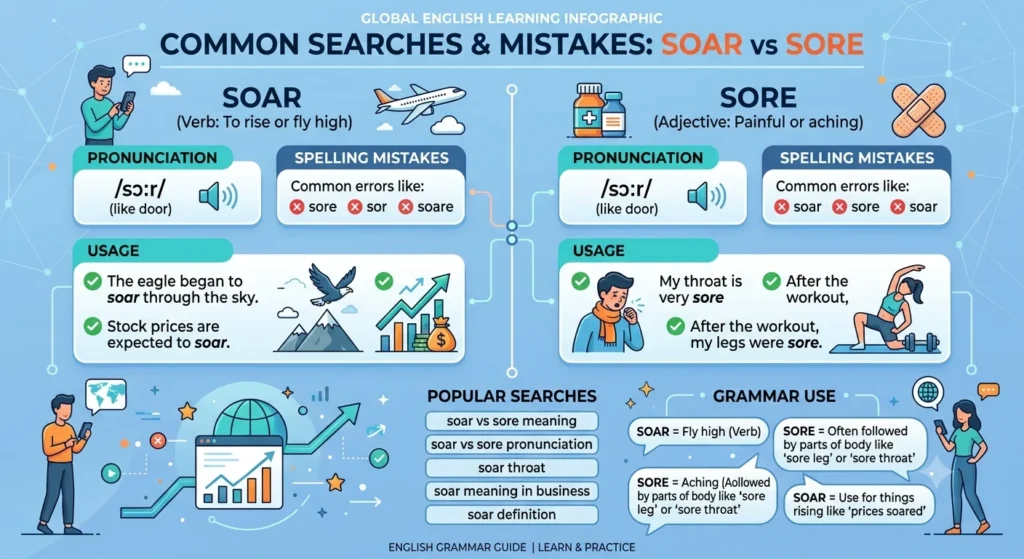
Soar vs Sore Pronunciation
One reason these words create confusion is that they have almost identical pronunciation.
Pronunciation Comparison Table
| Word | IPA | Sounds Like |
|---|---|---|
| Soar | /sɔːr/ | sor |
| Sore | /sɔːr/ | sor |
Both words are pronounced the same in most English accents.
This makes them homophones.
Soar Pronunciation
IPA:
/sɔːr/
Sounds like:
sor
Example:
- Watch the eagle soar through the clouds.
Many learners search for soar pronunciation audio because the word appears frequently in business news, aviation, and motivational content.
Words Related to Soar
- Soaring
- Soared
- Soars
Examples:
- The rocket soared into space.
- Prices are soaring.
- Birds soar gracefully.
Sore Pronunciation
IPA:
/sɔːr/
Sounds like:
sor
Example:
- My muscles are sore after exercise.
Words Related to Sore
- Soreness
- Sorely
Examples:
- Muscle soreness is common after a workout.
- The loss was sorely felt.
Easy Way to Remember Soar vs Sore
If you often confuse these words, this simple memory trick can help.
Soar = Sky
Think about birds flying high in the sky.
Examples:
- Eagles soar above mountains.
- Airplanes soar through the clouds.
- Sales continue to soar.
If something rises, flies, grows, or increases, choose soar.
Sore = Pain
Think about sore muscles, sore feet, or a sore throat.
Examples:
- My shoulders are sore.
- Her knee feels sore.
- He has a sore throat.
If something hurts or aches, choose sore.
Simple Formula
Soar = Rise
Sore = Hurt
This trick helps many English learners remember the correct spelling instantly.
Soar and Sore in a Sentence
Looking at real examples is one of the easiest ways to understand the difference.
Sentences with Soar
- Eagles soar above the mountains.
- Temperatures may soar this summer.
- House prices continue to soar.
- The rocket soared into space.
- Her confidence began to soar.
- Tourism numbers soared last year.
- The company’s profits soared dramatically.
Sentences with Sore
- My legs are sore after running.
- She has a sore throat.
- His back feels sore today.
- The athlete’s ankle remained sore.
- I woke up with sore muscles.
- Her shoulder was sore after the game.
- The bruise is still sore.
Side-by-Side Examples
| Soar | Sore |
|---|---|
| Birds soar through the sky. | My throat is sore. |
| Prices soar rapidly. | My muscles are sore. |
| Confidence can soar. | His knee feels sore. |
| The rocket soared upward. | Her back remains sore. |
| Sales continue to soar. | The injury is still sore. |
Soar vs Sore in Everyday Examples
Understanding how native speakers use these words in daily life makes them easier to remember.
In Emails
Soar
“Our sales continue to soar this quarter.”
Sore
“I may take a day off because my back is sore.”
In News Headlines
Soar
“Fuel Prices Soar Across the Country”
“Tourism Numbers Soar During Holiday Season”
Sore
“Athletes Report Sore Muscles After Competition”
On Social Media
Soar
“My motivation is soaring today!”
“Our channel just hit a new record. Views are soaring!”
Sore
“Leg day was brutal. I’m so sore.”
“My shoulders are sore after moving furniture.”
In Business Writing
Soar
- Revenue soared by 25%.
- Customer growth continues to soar.
- Market demand is soaring.
In Health and Medical Writing
Sore
- Patients reported sore joints.
- A sore throat is a common symptom.
- The area remained sore for several days.

Soar vs Sore – Google Trends & Usage Data
People search for soar vs sore because the words sound alike but have very different meanings. Search interest comes mainly from students, writers, job seekers, English learners, and professionals who want to avoid spelling mistakes.
Most Common Search Queries
The following searches are closely related to this topic:
- Soar vs sore meaning
- Soar vs sore pronunciation
- Sore pronunciation
- Soar pronunciation audio
- What is the difference between soar and sore?
- What does soar mean?
- How do you spell sore as in painful?
- I saw you or I sore you
- I sore you meaning
- I sore something
- Sore and soar in a sentence
- What is the difference between sore and sore?
These searches show that users mainly want help with pronunciation, spelling, grammar, and real-life usage.
Usage by Context
| Word | Common Contexts |
|---|---|
| Soar | Aviation, business, finance, success, growth, motivation |
| Sore | Health, fitness, sports, medicine, injuries |
Examples
Soar
- Stock prices soar.
- Eagles soar overhead.
- Confidence can soar after success.
Sore
- Sore throat
- Sore muscles
- Sore back
- Sore joints
Why People Confuse Soar and Sore
The main reason is pronunciation.
Both words sound almost identical in everyday speech.
Because they are homophones, many writers accidentally choose the wrong spelling when typing quickly.
However, their meanings are completely different:
- Soar = Rise
- Sore = Pain
Word Families of Soar and Sore
Learning related words helps expand your vocabulary and improve your writing.
Soar Word Family
| Word | Meaning |
|---|---|
| Soar | To rise or fly high |
| Soars | Present tense |
| Soared | Past tense |
| Soaring | Rising rapidly |
Examples
- The eagle soared above the valley.
- House prices are soaring.
- Birds soar across the sky.
Sore Word Family
| Word | Meaning |
|---|---|
| Sore | Painful |
| Soreness | State of being sore |
| Sorely | Greatly or painfully |
Examples
- My shoulder feels sore.
- Muscle soreness is common after exercise.
- The loss was sorely felt.
Words Commonly Confused with Soar and Sore
Many English learners confuse these words with other similar-sounding words.
Common Errors Table
| Incorrect | Correct |
|---|---|
| I sore you yesterday. | I saw you yesterday. |
| I sore something outside. | I saw something outside. |
| I have a soar throat. | I have a sore throat. |
| The eagle was sore above the clouds. | The eagle was soaring above the clouds. |
| Company profits are sore. | Company profits soared. |
Reviewing these mistakes can help improve your grammar accuracy.
What Is the Difference Between Sore and Sore?
This search appears frequently online.
The answer is simple:
There is no difference between sore and sore because they are the same word.
Most people who search this phrase actually mean:
“What is the difference between soar and sore?”
The answer is:
| Word | Meaning |
|---|---|
| Soar | To fly, rise, or increase |
| Sore | Painful, aching, or injured |
Quick Quiz: Test Your Understanding
Choose the correct word.
1. My legs are _____ after the marathon.
A) Soar
B) Sore
2. Eagles _____ above mountains.
A) Soar
B) Sore
3. House prices continue to _____.
A) Soar
B) Sore
4. I _____ you at the store yesterday.
A) Saw
B) Sore
5. She has a _____ throat.
A) Soar
B) Sore
Answers
- Sore
- Soar
- Soar
- Saw
- Sore
If you answered all five correctly, you understand the difference between soar, sore, and saw.
Soar vs Sore Comparison Table
| Feature | Soar | Sore |
|---|---|---|
| Meaning | Rise, fly, increase | Painful, aching |
| Part of Speech | Verb | Adjective |
| Pronunciation | /sɔːr/ | /sɔːr/ |
| Positive or Negative | Usually positive | Usually negative |
| Common Context | Growth, success, aviation | Health, injury, fitness |
| Example | Sales soar rapidly. | My muscles are sore. |
| Related Words | Soaring, soared | Soreness, sorely |
Frequently Asked Questions
What is the difference between soar and sore?
Soar means to rise, fly, or increase rapidly. Sore means painful, aching, or tender.
Example:
- Birds soar through the sky.
- My muscles are sore after exercise.
What does soar mean?
Soar means to rise high in the air or increase quickly.
Examples:
- The eagle soared above the mountains.
- Sales continue to soar.
How do you spell sore as in painful?
The correct spelling is sore.
Examples:
- Sore throat
- Sore muscles
- Sore back
Is “I sore you” correct?
No.
The correct phrase is:
✅ I saw you.
Incorrect:
❌ I sore you.
What does “I sore you meaning” mean?
Most people actually mean:
“I saw you.”
The phrase “I sore you” is a spelling mistake in standard English.
Are soar and sore pronounced the same?
Yes.
They are homophones and are pronounced almost exactly the same in most English accents.
Can soar mean success or growth?
Yes.
The word soar is often used to describe rapid growth or improvement.
Examples:
- Revenue soared last year.
- Her confidence began to soar.
Can sore be used emotionally?
Yes.
Although usually related to physical pain, sore can sometimes describe emotional hurt or resentment.
Example:
- He was still sore about losing the competition.
Conclusion
Understanding the difference between soar vs sore becomes easy once you remember their meanings. Although these words have nearly identical pronunciation, they serve completely different purposes in English. Soar is a verb that means to fly high, rise upward, or increase rapidly. It is commonly used when talking about birds, airplanes, business growth, success, confidence, and rising numbers. Sore, on the other hand, is an adjective that means painful, aching, tender, or injured. It is most often used with muscles, throats, backs, joints, and other parts of the body.
One of the most common mistakes is writing “I sore you” instead of “I saw you.” Remember that sore is never the past tense of the verb see. The correct past tense is always saw.
A simple memory trick can help you remember the difference forever:
Soar = Sky
Sore = Pain
If you’re talking about flying, rising, growing, improving, or increasing, use soar. If you’re talking about pain, injury, tenderness, or discomfort, use sore. Using the correct spelling will make your writing clearer, more professional, and easier to understand.

Pam Peters is a linguist and grammar expert, known for clear explanations of modern English usage, style, and practical language rules.