Have you ever seen an adorable puppy, a cute baby photo, or a sweet message online and wondered whether to write awe or aww? You’re not alone. The confusion between awe vs aww is extremely common because both words sound almost identical when spoken. As a result, many people accidentally use the wrong spelling in text messages, emails, social media comments, and even professional writing.
People frequently search questions like “What is correct, awe or aww?”, “How do you spell awe as in cute?”, “How is awe different from aww?”, “Is aww a word?”, and “What is the difference between aww and awh?” because they want to avoid grammar mistakes and communicate clearly.
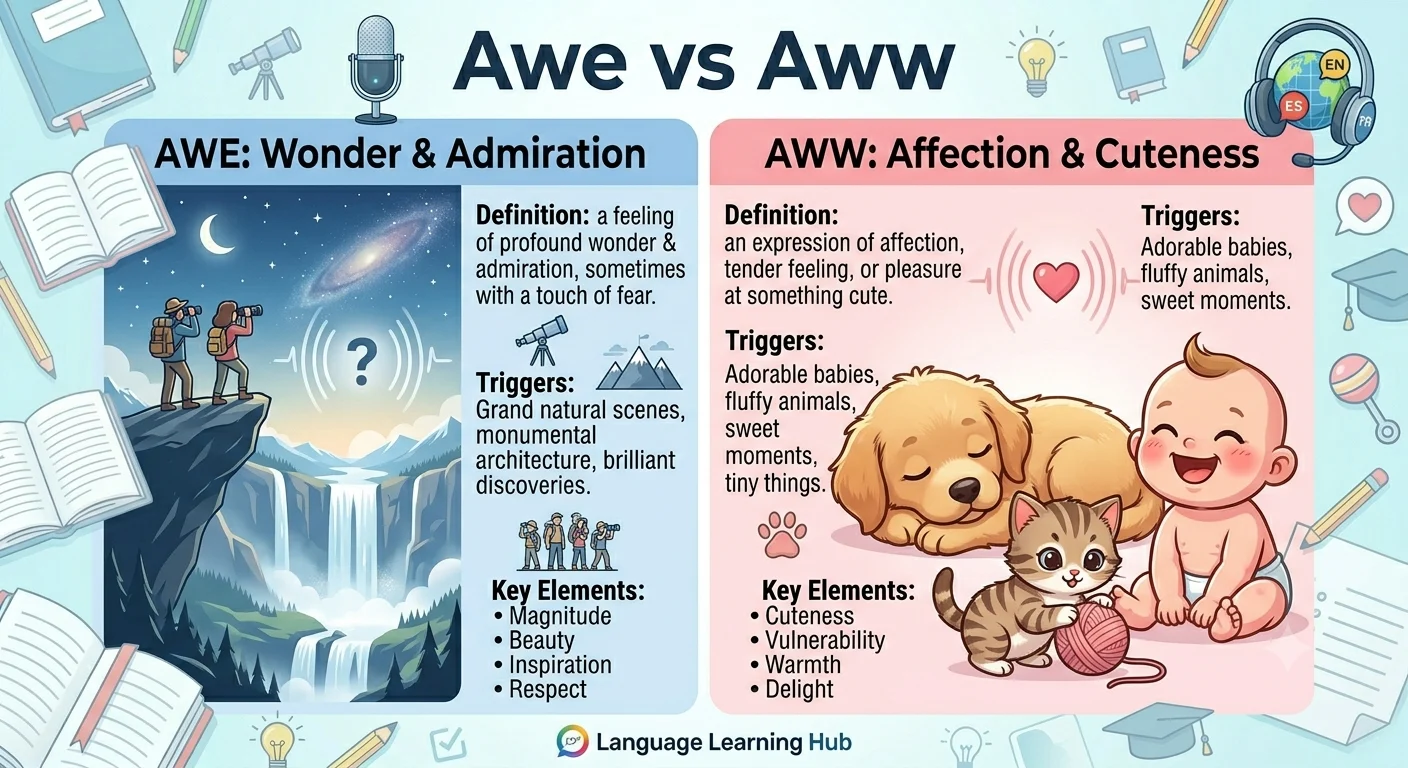
Although these words sound alike, they have very different meanings. Awe refers to a feeling of wonder, admiration, respect, or amazement. Aww, on the other hand, is an emotional reaction used when something is cute, sweet, heartwarming, or touching.
In this guide, you’ll learn the complete awe vs aww meaning, the difference between aww and awh, whether aww is a word, when to use ahh or aww, pronunciation tips, common mistakes, and the correct spelling for every situation.
Awe vs Aww
What Is Correct, Awe or Aww?
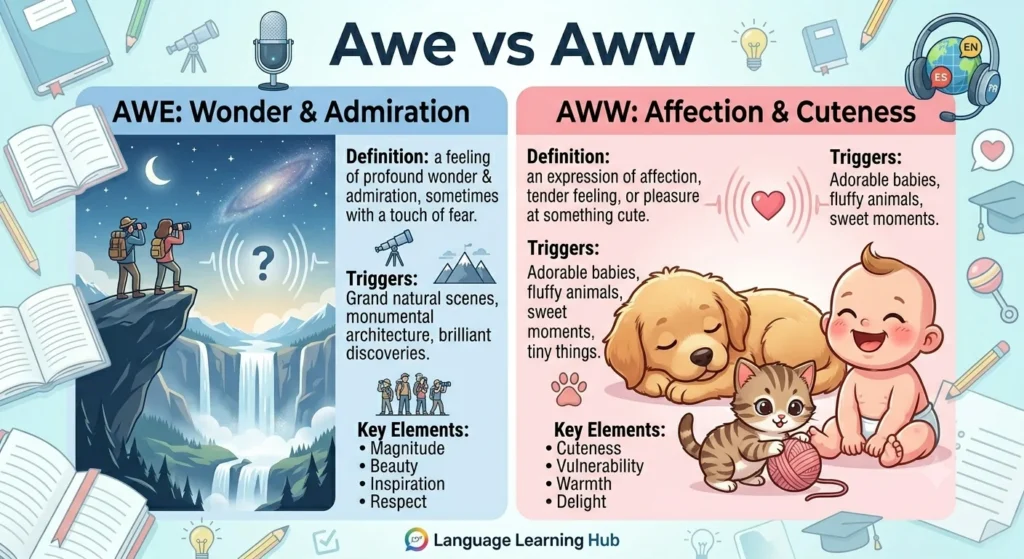
Both words are correct, but they have different meanings.
- Awe = Wonder, admiration, amazement, or respect.
- Aww = A cute, sweet, affectionate, or emotional reaction.
Use awe when talking about wonder, admiration, or respect.
Use aww when reacting to something cute, sweet, adorable, or heartwarming.
Examples
- The beautiful mountains filled us with awe.
- Aww, that puppy is adorable.
Quick Comparison Table
| Word | Meaning | Example |
|---|---|---|
| Awe | Wonder, admiration, respect | We looked at the waterfall in awe. |
| Aww | Cute or emotional reaction | Aww, that kitten is adorable. |
Easy Trick to Remember Awe vs Aww
Many people mix up these words because they sound alike. Fortunately, there is a simple memory trick.
| Word | Memory Trick |
|---|---|
| Awe | Amazing |
| Aww | Adorable |
Remember This Rule
Amazing = Awe
Adorable = Aww
Examples:
- The Northern Lights were amazing, so use awe.
- The puppy was adorable, so use aww.
This simple trick helps you choose the correct spelling every time.
How to Spell Awe as in Cute
One of the most searched questions online is:
How Do You Spell Awe as in Cute?
The answer is simple:
You don’t spell it awe.
The correct spelling is:
Aww
Examples:
✅ Aww, that’s so cute.
✅ Aww, that baby is adorable.
✅ Aww, that’s the sweetest thing ever.
Incorrect examples:
❌ Awe, that’s adorable.
❌ Awe, what a cute puppy.
Whenever you are expressing affection, cuteness, sympathy, or emotional warmth, use aww.
Awe vs Aww Meaning
Although the words sound similar, they communicate completely different emotions.
Meaning of Awe
Awe is a noun that describes a feeling of wonder, admiration, amazement, reverence, or respect.
People often feel awe when they experience:
- Natural wonders
- Historic landmarks
- Great achievements
- Powerful performances
- Extraordinary discoveries
Examples:
- We stood in awe of the mountains.
- The audience watched in awe.
- Her achievements inspire awe.
Meaning of Aww
Aww is an informal English expression used to show affection, sympathy, delight, or emotional warmth.
People commonly use aww when reacting to:
- Cute animals
- Sweet messages
- Romantic gestures
- Heartwarming stories
- Adorable children
Examples:
- Aww, that’s adorable.
- Aww, thank you for your kindness.
- Aww, that made my day.
Wonder and Admiration Meaning vs Cute Reaction Spelling
A quick way to remember:
Awe = Wonder and admiration
Aww = Cute reaction spelling
The Origin of Awe vs Aww
Understanding the history of these words makes the difference much easier to remember.
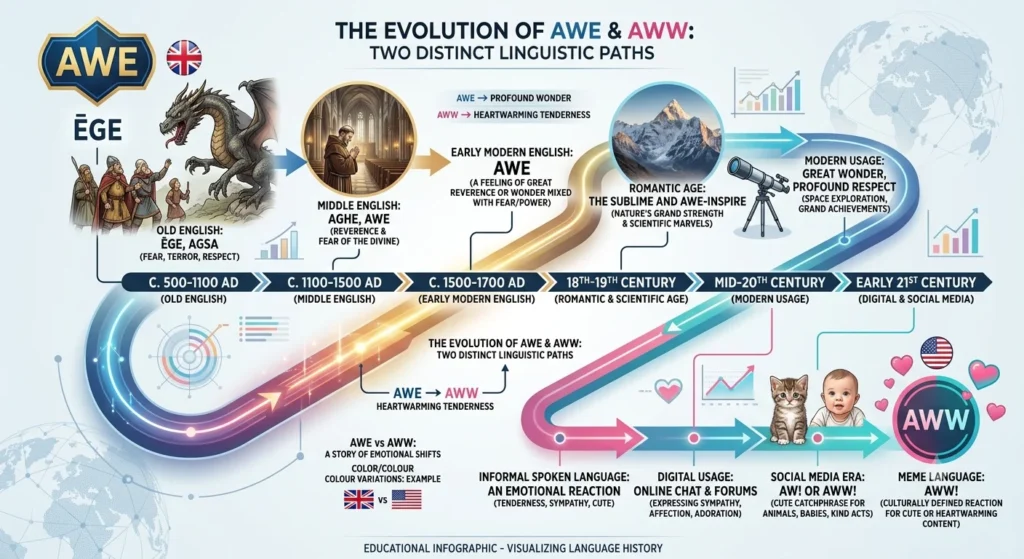
Origin of Awe
The word awe entered Middle English from the Old English word ege.
Originally, it described a mixture of:
- Fear
- Respect
- Wonder
- Reverence
Over time, the meaning shifted away from fear and became associated mainly with admiration and amazement.
Today, awe commonly describes powerful feelings inspired by:
- Nature
- Science
- Art
- History
- Human achievement
Examples:
- Awe of the universe
- Awe of ancient architecture
- Awe of human creativity
Origin of Aww
The word aww developed very differently.
Instead of coming from a traditional English root, it evolved as a written representation of a spoken emotional sound.
People naturally say:
- Aw!
- Aww!
- Awh!
when reacting emotionally to something sweet, cute, or touching.
As texting, messaging apps, and social media became popular, aww became the most widely accepted spelling.
Why Do the Spelling Differences Exist?
The spelling differences exist because:
- Awe is a traditional dictionary word with a long history.
- Aww is an informal written expression based on spoken emotion.
Because they sound alike, many writers accidentally confuse them.
Formal vs Informal English: Awe vs Aww
One of the easiest ways to understand the difference is by looking at formality.
Formal vs Informal Usage Table
| Situation | Correct Word |
|---|---|
| Academic Writing | Awe |
| News Articles | Awe |
| Professional Reports | Awe |
| Business Emails | Awe |
| Text Messages | Aww |
| Social Media Posts | Aww |
| Online Chats | Aww |
| Casual Conversations | Aww |
Examples
Formal:
- The discovery inspired awe among scientists.
- Visitors viewed the monument in awe.
Informal:
- Aww, that’s adorable.
- Aww, that was thoughtful.
Expert Writing Tip
Professional writers typically use awe in formal contexts because it conveys admiration and respect.
The word aww is best reserved for informal communication such as texting, chatting, and social media interactions.
If you’re unsure which word to choose, ask yourself a simple question:
Am I expressing admiration or affection?
- Admiration = Awe
- Affection = Aww
British English vs American English Spelling
Many English words have different spellings in American and British English.
However, awe and aww are exceptions.
Their spellings remain the same across all major English-speaking countries.
Comparison Table
| Usage | American English | British English |
|---|---|---|
| Wonder or admiration | Awe | Awe |
| Cute emotional reaction | Aww | Aww |
| Formal writing | Awe | Awe |
| Informal English expression | Aww | Aww |
| Social media slang | Aww | Aww |
Examples
American English:
- The Grand Canyon inspired awe.
- Aww, that’s adorable.
British English:
- The castle filled visitors with awe.
- Aww, what a lovely puppy.
Unlike words such as “color” and “colour,” there are no spelling differences between awe and aww in British and American English.
Can Awe and Aww Be Used Interchangeably?
No.
Although awe and aww are pronounced similarly, they should not be used interchangeably because they express completely different emotions.
Examples:
Incorrect:
❌ Awe, that puppy is cute.
Correct:
✅ Aww, that puppy is cute.
Incorrect:
❌ The audience watched in aww.
Correct:
✅ The audience watched in awe.
Choosing the wrong word can completely change the meaning of your sentence.
Which Spelling Should You Use?
Choosing between awe and aww is simple once you understand the emotion you want to express.
Use Awe When:
You are talking about:
- Wonder
- Admiration
- Respect
- Amazement
- Reverence
Examples:
- We stood in awe of the ancient temple.
- The audience listened in awe.
- Her accomplishments inspire awe.
Use Aww When:
You are expressing:
- Affection
- Sympathy
- Delight
- Emotional warmth
- A cute reaction
Examples:
- Aww, that’s adorable.
- Aww, thank you for remembering.
- Aww, that was so thoughtful.
Audience-Based Advice
| Audience | Recommended Usage |
|---|---|
| United States | Awe for admiration, Aww for cute reactions |
| United Kingdom | Awe for admiration, Aww for cute reactions |
| Canada | Same rule |
| Australia | Same rule |
| New Zealand | Same rule |
| Global Audience | Same rule |
No matter where your audience lives, the distinction remains the same.
Common Mistakes with Awe vs Aww
Because these words sound alike, many people use the wrong spelling.
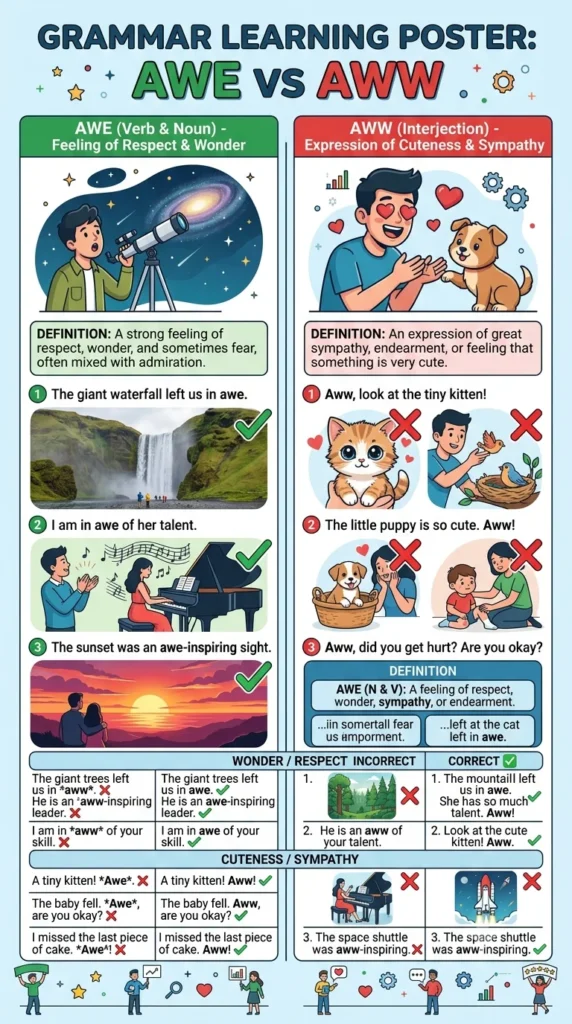
Mistake #1
❌ Awe, that’s so cute.
✅ Aww, that’s so cute.
Why?
You’re expressing affection, not admiration.
Mistake #2
❌ The audience watched in aww.
✅ The audience watched in awe.
Why?
The sentence describes wonder and admiration.
Mistake #3
❌ I felt aww while standing on the mountain.
✅ I felt awe while standing on the mountain.
Why?
A mountain inspires wonder, not a cute reaction.
Mistake #4
❌ Awe, thank you so much.
✅ Aww, thank you so much.
Why?
The speaker is expressing warmth and appreciation.
Mistake #5
❌ The breathtaking view created aww.
✅ The breathtaking view created awe.
Why?
Beautiful scenery inspires admiration and amazement.
Common Search Variations and Their Meanings
Many users search similar phrases when trying to understand the difference.
Awe vs Aww Meaning
- Awe = Wonder and admiration.
- Aww = Affection and cuteness.
How to Spell Awe as in Cute
The correct spelling is:
Aww
Example:
- Aww, that puppy is adorable.
Awe So Cute Meaning
Many people write:
“Awe, so cute!”
However, the correct spelling is:
“Aww, so cute!”
The phrase expresses affection and delight.
Difference Between Aww and Awh
Both represent the same emotional sound, but aww is the most common modern spelling.
Ahh or Aww
Use:
- Ahh for relief or understanding.
- Aww for affection or cuteness.
Publicly vs Publically: Which Spelling Is Correct?
Awe vs Aww in Everyday Examples
Understanding real-life usage helps prevent mistakes.
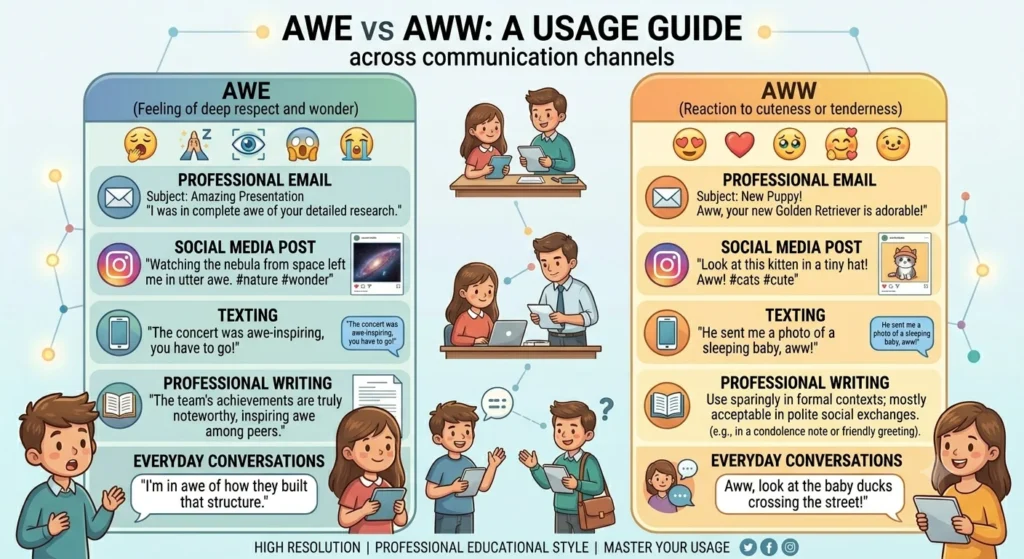
In Emails
Formal Email:
- The team was in awe of your presentation.
Informal Email:
- Aww, thank you for your thoughtful message.
In News Articles
Professional journalism commonly uses awe.
Examples:
- Visitors watched the historic event in awe.
- The discovery inspired awe among researchers.
News organizations rarely use aww because it is considered informal.
In Social Media Posts
Examples:
- Aww, this puppy is adorable.
- Aww, that made my day.
- Aww, they’re the cutest couple.
Social media slang heavily favors aww.
In Text Messages
Examples:
- Aww, that’s sweet.
- Aww, I appreciate that.
- Aww, you remembered.
Texting is one of the most common places where aww appears.
In Formal Writing
Examples:
- The magnificent cathedral inspired awe.
- Visitors gazed in awe at the artwork.
Formal writing almost always uses awe.
In Business Communication
Examples:
- Clients were in awe of the company’s innovation.
- The presentation generated awe among attendees.
Avoid using aww in professional documents.
In Romantic Conversations
Examples:
- Aww, that’s so sweet.
- Aww, you’re making me smile.
- Aww, that’s adorable.
Is Aww a Flirty Response?
Sometimes.
Depending on context, aww may show:
- Affection
- Appreciation
- Warmth
- Emotional interest
- Mild flirting
However, it does not automatically mean romantic attraction.
Difference Between Aww and Awh
This is another common spelling question.
Aww vs Awh
Both spellings attempt to represent the same emotional sound.
However, their popularity differs.
| Word | Popularity | Common Usage |
|---|---|---|
| Aww | Very Common | Social media, texting, comments |
| Awh | Less Common | Alternative spelling |
| Aw | Common | Shortened version |
Examples
✅ Aww, that’s adorable.
✓ Awh, that’s adorable.
✓ Aw, that’s adorable.
Most modern writers prefer aww.
Ahh or Aww?
These expressions communicate different emotions.
Meaning of Ahh
People use ahh when expressing:
- Relief
- Comfort
- Understanding
- Realization
Examples:
- Ahh, now I understand.
- Ahh, that feels better.
- Ahh, I see what happened.
Meaning of Aww
People use aww when expressing:
- Affection
- Sympathy
- Delight
- Cuteness
Examples:
- Aww, that’s adorable.
- Aww, poor puppy.
- Aww, that’s sweet.
Ahh vs Aww Comparison
| Expression | Meaning |
|---|---|
| Ahh | Relief or understanding |
| Aww | Affection or cuteness |
This distinction helps avoid another common spelling mistake.
Is Aww a Word?
One of the most searched questions is:
Is Aww a Word?
Yes.
Aww is widely recognized as an informal English interjection.
It is commonly used to express:
- Sympathy
- Affection
- Delight
- Emotional warmth
Examples:
- Aww, that’s kind of you.
- Aww, that made my day.
- Aww, how sweet.
Although informal, it is accepted in modern English communication.
Awe Pronunciation Guide
Another common search query is:
Awe Pronunciation American
In American English, awe is pronounced:
/ɔː/
It sounds similar to:
- Law
- Saw
- Paw
- Raw
Awe Pronunciation British
British English uses a very similar pronunciation:
/ɔː/
Awe Pronunciation Tip
Although awe and aww are usually pronounced the same way, context determines which spelling is correct.
This similarity is one reason people often confuse the words.
Awe Pronunciation Audio
If you want to hear the pronunciation, trusted dictionaries such as Cambridge, Oxford, and Merriam-Webster provide free audio examples.
Related Words to Awe
Understanding related vocabulary improves word choice.
Synonyms of Awe
- Wonder
- Amazement
- Admiration
- Reverence
- Respect
- Astonishment
- Inspiration
Examples:
- The view inspired wonder.
- The discovery caused amazement.
- The performance earned admiration.
Related Words to Aww
These words express emotions similar to aww.
Similar Expressions
- Cute
- Adorable
- Sweet
- Precious
- Heartwarming
- Lovely
- Endearing
Examples:
- That puppy is adorable.
- What a sweet gesture.
- That’s a heartwarming story.
Using related words can make your writing more natural and expressive.
Awe vs Aww Usage Trends
Many people search awe vs aww because the words sound alike but have different meanings.
While both words are common, they are popular in different situations.
Where Is Awe Commonly Used?
The word awe appears most often in:
- Books
- News articles
- Educational content
- Academic writing
- Professional communication
Examples:
- The discovery inspired awe.
- Visitors stood in awe of the monument.
Where Is Aww Commonly Used?
The word aww appears most often in:
- Text messages
- Social media comments
- Online chats
- Informal conversations
- Cute reaction posts
Examples:
- Aww, that’s adorable.
- Aww, that made my day.
Usage by Context
| Context | Awe | Aww |
|---|---|---|
| Academic Writing | Very Common | Rare |
| Professional Writing | Common | Rare |
| News Articles | Common | Very Rare |
| Books | Common | Rare |
| Social Media | Moderate | Very Common |
| Text Messages | Rare | Extremely Common |
| Online Comments | Moderate | Very Common |
Popularity by Country
The distinction between awe and aww is understood across:
- United States
- United Kingdom
- Canada
- Australia
- New Zealand
Although usage patterns may vary, the meanings remain the same worldwide.
Why Is Aww More Popular Online?
The rise of texting, social media, and instant messaging has increased the use of aww.
People often use it to react quickly to:
- Cute pets
- Baby photos
- Romantic messages
- Heartwarming videos
As a result, aww has become one of the most common emotional reaction words on the internet.
Awe vs Aww Comparison Table
Here is a complete side-by-side comparison.
| Feature | Awe | Aww |
|---|---|---|
| Meaning | Wonder, admiration, amazement | Affection, sympathy, cuteness |
| Part of Speech | Noun | Interjection |
| Formal or Informal | Formal | Informal |
| Dictionary Word | Yes | Yes (informal) |
| Used in Academic Writing | Yes | No |
| Used in Social Media | Sometimes | Very Often |
| Used in Texting | Rarely | Frequently |
| Emotional Tone | Respectful | Warm and affectionate |
| Example | We stood in awe. | Aww, that’s adorable. |
| Audience | Professional and general | Casual and social |
Awe vs Aww at a Glance
If you only remember one thing from this guide, remember this table.
| Situation | Correct Word |
|---|---|
| Looking at a breathtaking mountain | Awe |
| Watching a historic achievement | Awe |
| Reacting to a cute puppy | Aww |
| Responding to a sweet message | Aww |
| Writing a formal article | Awe |
| Commenting on social media | Aww |
| Expressing admiration | Awe |
| Expressing affection | Aww |
Ultimate Memory Trick
Awe = Amazing
Aww = Adorable
This simple rule solves most spelling mistakes instantly.
Frequently Asked Questions
1. What Is Correct, Awe or Aww?
Both are correct.
Use awe for wonder, admiration, and respect.
Use aww for cute, sweet, or emotional reactions.
2. How Is Awe Different From Aww?
Awe describes amazement and admiration.
Aww expresses affection, sympathy, delight, or cuteness.
3. How Do You Spell Awe as in Cute?
You don’t.
The correct spelling for a cute reaction is:
Aww
Example:
- Aww, that puppy is adorable.
4. Is Aww a Word?
Yes.
Aww is a recognized informal English interjection used to express affection, sympathy, or delight.
5. Is Aww a Flirty Response?
Sometimes.
Depending on the context, aww may show:
- Appreciation
- Warmth
- Affection
- Romantic interest
However, it is not always flirtatious.
6. Difference Between Aww and Awh?
Both spellings represent the same emotional sound.
However, aww is the most common modern spelling.
7. Ahh or Aww: Which Should I Use?
Use:
- Ahh for relief or understanding.
- Aww for affection or cuteness.
8. Can Awe and Aww Be Pronounced the Same?
Yes.
They are often pronounced similarly, which is why many people confuse them.
9. Is Awe a Positive Word?
Yes.
Awe usually expresses admiration, wonder, inspiration, or respect.
Example:
- We felt awe while watching the sunrise.
10. Why Do People Write Awe Instead of Aww?
Because the two words sound almost identical when spoken.
Many writers mistakenly assume they share the same spelling.
11. Can Awe and Aww Be Used Interchangeably?
No.
Although they sound alike, they express different emotions and should not be used interchangeably.
12. Which Word Is More Formal?
Awe is formal and appropriate for professional writing.
Aww is informal and best suited for casual communication.
Expert Usage Tips
Professional editors and English teachers often recommend checking the emotion behind the sentence before choosing a spelling.
Ask yourself:
Are You Expressing Wonder?
Use:
Awe
Examples:
- The monument inspired awe.
- We looked in awe at the stars.
Are You Expressing Affection?
Use:
Aww
Examples:
- Aww, that’s adorable.
- Aww, that’s so sweet.
This simple method helps avoid almost every mistake.
Conclusion
Understanding the difference between awe vs aww is easier once you know the emotion behind each word. Although they sound very similar, they serve completely different purposes in English.
Awe is a formal word that expresses wonder, admiration, amazement, respect, or reverence. It is commonly used in books, news reports, educational writing, professional communication, and descriptions of inspiring experiences. When something leaves you amazed or deeply impressed, awe is usually the correct choice.
Aww, on the other hand, is an informal emotional expression. People use it when reacting to something cute, sweet, heartwarming, or touching. It frequently appears in text messages, social media comments, online chats, and casual conversations. If you’re responding to an adorable puppy, a thoughtful gesture, or a touching story, aww is the right spelling.
Because both words are often pronounced the same way, confusion is common. However, remembering one simple rule can help:
Final Rule
Awe = Amazing
Aww = Adorable
If something inspires wonder, use awe.
If something inspires affection, use aww.
Following this simple guideline will help you choose the correct spelling confidently in every situation.

Betty Azar is a respected English language educator and author, known for clear grammar explanations and practical resources for learners worldwide.