Many English learners lose marks in exams because of one small topic: since vs for. These two words look easy, but they confuse millions of students. You may ask: “Is it since 2018 or for 2018?” or “Why do we use since in present perfect?”
People search for since vs for examples, since vs for sentences, since vs for exercises, and since vs for quiz because they want a quick answer and clear rules. The problem is simple: both words talk about time, but they do different jobs.
Most learners remember this rule the wrong way. Here is the easiest way to never forget it. This guide will fix your confusion step by step. You will learn the difference between since and for, simple rules, advanced usage, real-life examples, and common mistakes. You will also see how these words are used in exams, emails, and daily English.
By the end, you will use since and for correctly and confidently.
Since vs For
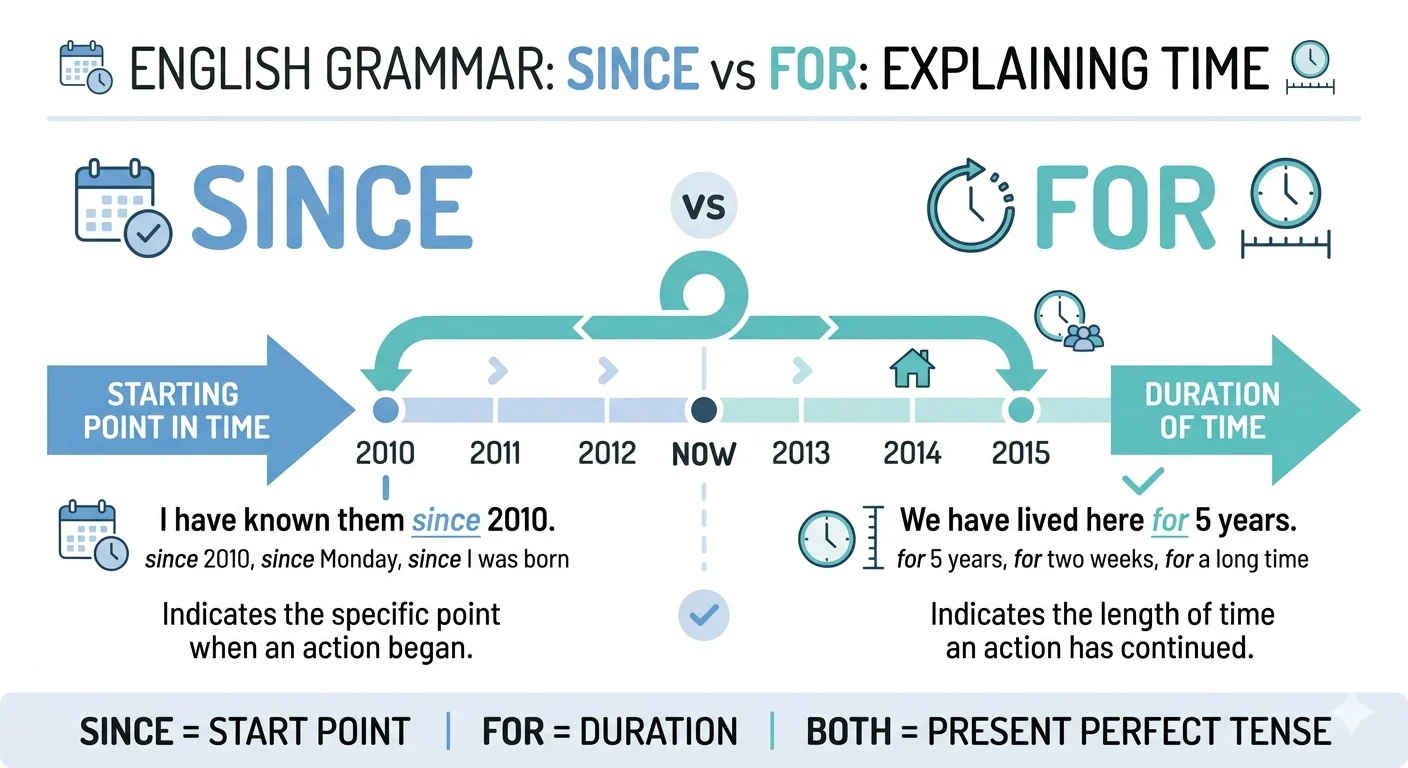
Since vs For Definition:
- Since = starting time (since 2020, since Monday)
- For = duration or length of time (for 5 years, for two hours)
👉 If the answer is “when did it start?” → use since
👉 If the answer is “how long?” → use for
Examples:
- I have lived here since 2020.
- I have lived here for 5 years.
👉 Quick Tip:
Since = beginning point | For = time period
Since vs For – Rules
To fully understand since and for rules, think in terms of time logic.
1. Use of Since (Exact Time / Beginning Point)
Use since with:
- Years (since 2018)
- Days (since Monday)
- Specific moments (since 9 AM)
👉 It shows the exact starting point of an action.
Examples:
- She has lived here since 2010.
- I have studied English since childhood.
2. Use of For (Length of Time / Duration)
Use for with:
- Minutes, hours, days, years
- General periods (for a long time)
👉 It shows the length or duration of time.
Examples:
- She has lived here for 10 years.
- I studied for two hours.
3. Why Present Perfect is Used
This is the key to mastering since vs for present perfect.
We use present perfect because:
- The action started in the past
- The action is still true now
Examples:
- I have worked here since 2021.
- I have worked here for 3 years.
👉 Quick Tip:
Present perfect = past + present connection
📌 Learn present perfect tense in our detailed guide to understand this rule more deeply.
📌 Also explore time expressions in English to master similar grammar patterns.
The Origin of Since vs For
- Since comes from Old English “siththan”, meaning after that time.
- For comes from Old English “for”, meaning duration or purpose.
There is no spelling difference between British and American English. The confusion is only about usage, not spelling.
👉 According to English grammar experts, understanding time expressions is the key to using these words correctly.
British English vs American English Usage
There is no spelling difference in since vs for, but style may vary slightly.
Comparison Table:
| Feature | British English | American English |
|---|---|---|
| Grammar rules | Same | Same |
| Style | Slightly formal | More direct |
| Example | I’ve lived here since 2010 | I have lived here since 2010 |
👉 Conclusion: The rules are the same worldwide.
Which One Should You Use?
Use since or for based on meaning—not location.
Best Practice:
- Exams (IELTS, school) → follow grammar rules strictly
- Blogging/writing → use clear, simple English
- Daily speaking → focus on natural usage
👉 Teachers recommend practicing since vs for sentences daily to build fluency.
Why Learners Confuse Since vs For
Many learners translate directly from their native language. This causes confusion.
👉 Reasons:
- Both words relate to time
- Some languages do not separate start time and duration clearly
👉 Result:
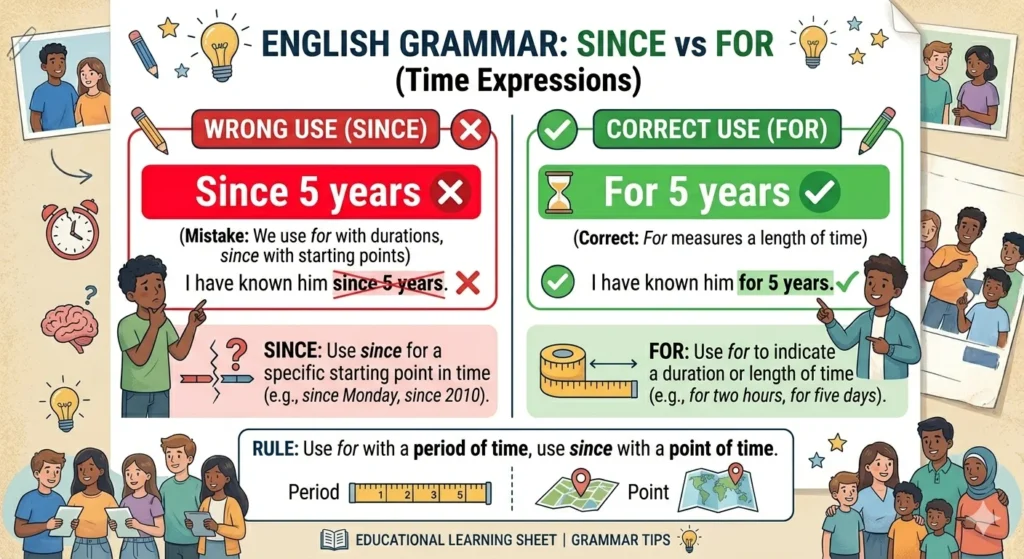
- Errors like “since 5 years”
👉 Quick Tip:
Think like this:
- Beginning = since
- Length = for
Common Mistakes with Since vs For
❌ Mistake 1:
I am here since 2 hours
✔️ I have been here for 2 hours
❌ Mistake 2:
I have lived here for 2010
✔️ I have lived here since 2010
❌ Mistake 3:
Wrong tense
✔️ I live here since 2020 ❌
✔️ I have lived here since 2020 ✔️
❌ Mistake 4:
Wrong combination
✔️ since 5 years ❌
✔️ for 5 years ✔️
👉 Quick Tip:
Since = exact time | For = time period
Since vs For in Everyday Examples
Emails:
- I have worked here since last week.
- I have worked here for 7 days.
News:
- The company has grown since 2020.
- The company has grown for three years.
Social Media:
- I’ve known her since school.
- We’ve been friends for years.
Formal Writing:
- The policy has been active since January.
- The policy has been active for six months.
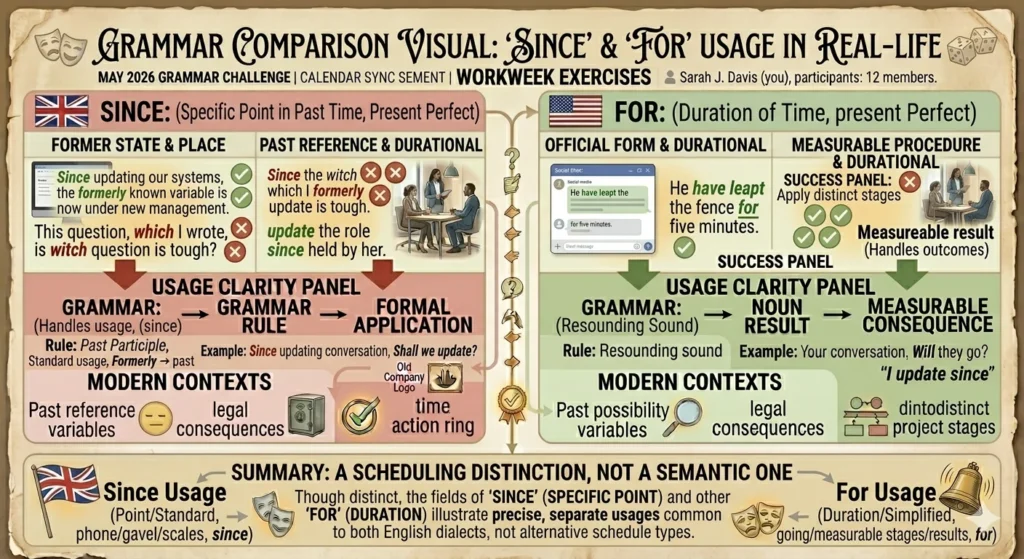
Advanced Usage
1. Since with Clauses:
- I have been happy since I moved here
2. For in Future:
- I will stay here for two days
3. For in Past:
- I studied for three hours yesterday
👉 This helps in exams and advanced writing.
Since vs For Exercises
Fill in the blanks:
- I have lived here ___ 2020
- I have lived here ___ five years
- She has worked here ___ Monday
✔️ Answers:
- since
- for
- since
Since vs For Quiz
Choose the correct answer:
- I have studied English ___ 3 years
a) since
b) for
✔️ Answer: b) for
Use of Since and For Examples Worksheet
Practice daily:
- Write 5 sentences using since
- Write 5 sentences using for
👉 This is one of the fastest ways to improve grammar.
Since vs For Wordwall
Teachers and students use Wordwall for:
- Grammar games
- Matching exercises
- Quiz practice
👉 This makes learning fun and effective.
Since vs For – Google Trends & Usage Insight
Search behavior shows different user intent:
- since vs for examples → beginner learners
- since vs for quiz → exam preparation
- since vs for worksheet → teachers
- since vs for Wordwall → classroom tools
- since vs for present perfect → grammar-focused learners
Who searches this topic?
- Students before exams
- Bloggers writing grammar content
- Teachers creating worksheets
Popular regions:
- Pakistan
- India
- Philippines
👉 This shows strong demand in ESL learning.
👉 Quick Tip:
Understanding user intent helps you learn faster and write better.
Comparison Table
| Feature | Since | For |
|---|---|---|
| Meaning | Starting point | Duration |
| Question | When? | How long? |
| Use | Exact time | Time period |
| Example | Since 2020 | For 5 years |
| Tense | Mostly present perfect | All tenses |
| Common Error | Since 5 years ❌ | For 2010 ❌ |
FAQs
1. What is the difference between since and for?
Since shows the starting time of an action. For shows the length of time the action continues. Both are used with time expressions.
2. Is it for 2018 or since 2018?
✔️ Correct: since 2018
Because 2018 is a specific starting point, not a duration.
3. What is the rule for since and for?
Use since for exact time (since Monday).
Use for for duration (for two days or for many years).
4. Where do we use since or for?
We use them with time expressions, especially in present perfect tense, to connect past actions to the present.
5. Can we use since with past tense?
Mostly no. It is mainly used with present perfect, but it can appear in clauses like “since I was young.”
6. Can we use for with all tenses?
Yes. For can be used in past, present, and future sentences without restriction.
7. Why is since used in present perfect?
Because it connects a past starting point to a situation that is still true now, making the sentence meaningful.
Conclusion
The difference between since vs for is simple but very powerful.
- Since tells you the starting time
- For tells you the duration or length of time
Many learners struggle because both words talk about time, but they serve different purposes. Once you understand this difference, your grammar becomes much clearer.
To master this topic, practice daily. Write your own since vs for sentences, complete exercises, and test yourself using quizzes. Focus especially on present perfect tense, because this is where these words are most commonly used.
Avoid common mistakes like “since 5 years” or “for 2010.” These are very common in exams and real-life communication.
👉 Final Action Step:
Write 5 sentences using since and 5 using for right now. Practice is the fastest way to learn.

Pam Peters is a linguist and grammar expert, known for clear explanations of modern English usage, style, and practical language rules.