“Hope vs wish” is one of the most confusing topics in English grammar. Both words express a desire, so many learners think they are the same. But in real English, they are used in very different ways.
People search for hope vs wish grammar, is hope the same as a wish, and which is stronger, wish or hope because small mistakes can completely change a sentence’s meaning. For example, “I wish you pass the exam” is incorrect, while “I hope you pass the exam” is correct.
This confusion happens because one word is used for real situations, while the other is used for imaginary or unreal situations. If you are a student, blogger, or English learner, understanding this difference is essential.
In this guide, you will learn the difference between hope and wish in English grammar, along with rules, examples, quizzes, exercises, and worksheet ideas. By the end, you will use both words correctly and confidently.
Quick Summary
- Hope = real or possible situation
- Wish = unreal or imaginary situation
- Hope → present or future
- Wish → past or impossible situation
Hope vs Wish
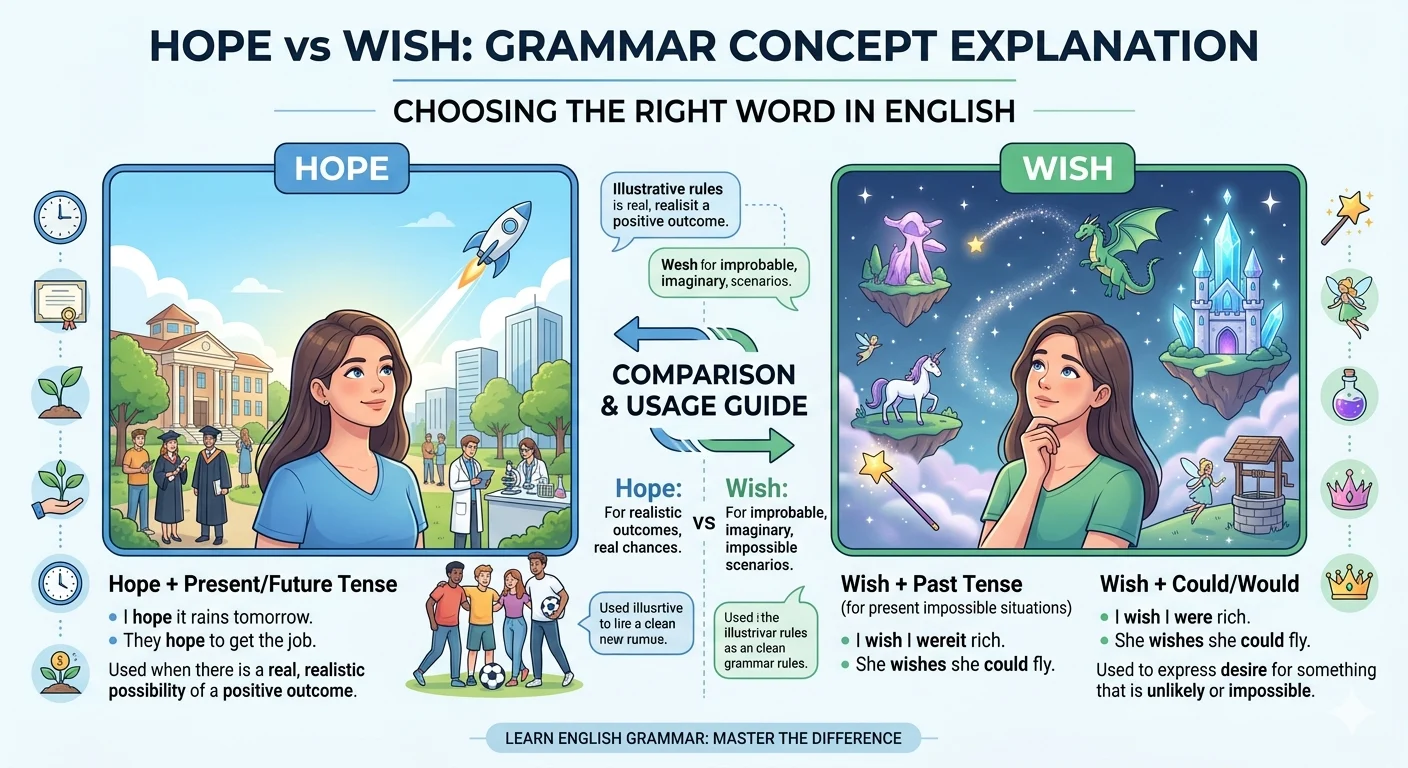
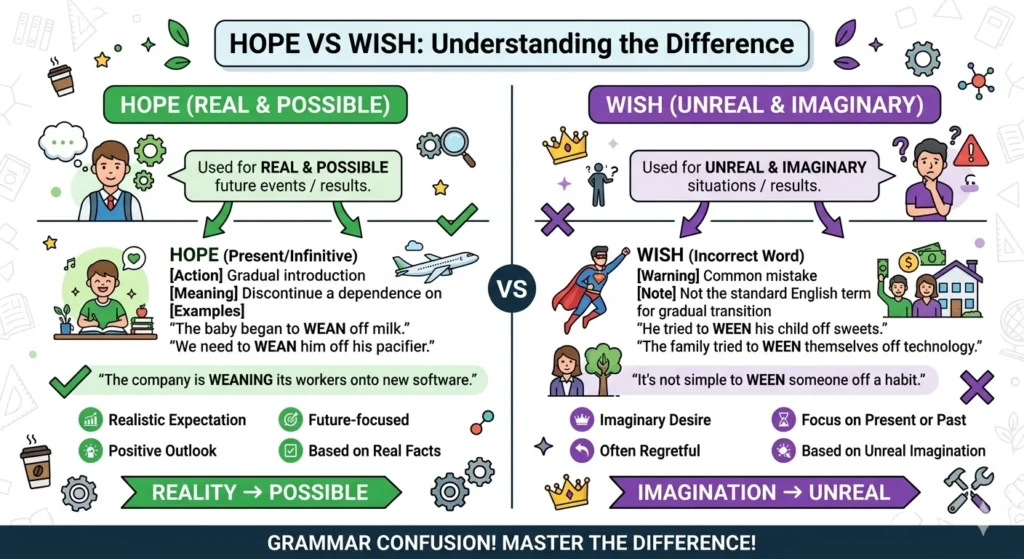
Hope = real or possible situation
Wish = unreal, imaginary, or unlikely situation
Examples:
- I hope you pass the exam ✅
- I wish you pass the exam ❌
- I wish I were taller ✅
- I hope I were taller ❌
⭐ Golden Rule
👉 If it is real → use HOPE
👉 If it is unreal → use WISH
The Origin of Hope vs Wish
The words “hope” and “wish” come from Old English, but their meanings changed over time.
- Hope comes from “hopa”, meaning expectation or trust
- Wish comes from “wyscan”, meaning desire or longing
Why they are different today:
- Hope stayed connected to real future possibilities
- Wish became connected to imagination, regret, and unreal situations
Expert Grammar Insight:
“Wish” uses past tense to talk about present unreal situations.
👉 Example:
I wish I had more money (means: I don’t have it now)
👉 Advanced example:
I wish I were you (formal and correct structure)
This explains a common learner confusion in hope vs wish grammar rules.
Usage Differences
There is no spelling difference, but usage is different.
| Situation | Hope | Wish |
|---|---|---|
| Real future | ✔ | ❌ |
| Unreal present | ❌ | ✔ |
| Past regret | ❌ | ✔ |
| Formal email | ✔ | ✔ |
| Emotional tone | Light | Strong |
Recur vs Reoccur: Which One Is Correct?
Which Should You Use?
Use HOPE when:
- Talking about real or possible events
- Writing emails or professional messages
- Speaking politely
👉 Example:
“I hope you are doing well.”
Use WISH when:
- Talking about dreams or imagination
- Expressing regret
- Showing strong emotions
👉 Example:
“I wish I had more time.”
Common Mistakes with Hope vs Wish
❌ I wish you pass the exam
✅ I hope you pass the exam
❌ I hope I were rich
✅ I wish I were rich
❌ I wish I will go there
✅ I hope I will go there
❌ I hope I had a car
✅ I wish I had a car
👉 Main mistake: confusing real and unreal situations
Hope vs Wish in Everyday Examples
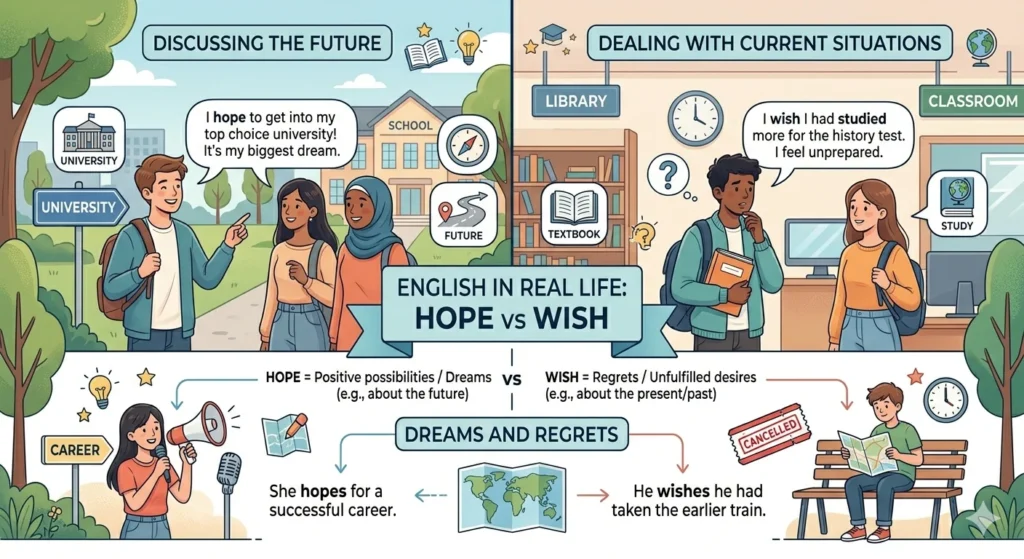
🎓 Exams:
- I hope I pass
- I wish I had studied more
💬 Conversation:
- I hope you feel better
- I wish I could help
📧 Emails:
- I hope you are doing well
- I wish you success
📱 Social Media:
- I hope today is amazing
- I wish I was on vacation
👉 These are common hope vs wish examples sentences in daily life.
Hope vs Wish Grammar Rules
Use HOPE:
- Hope + present or future
👉 I hope she comes
Use WISH:
1. Present Unreal:
wish+past simplewish + past\ simplewish+past simple
👉 I wish I had a car
2. Past Regret:
wish+past perfectwish + past\ perfectwish+past perfect
👉 I wish I had studied
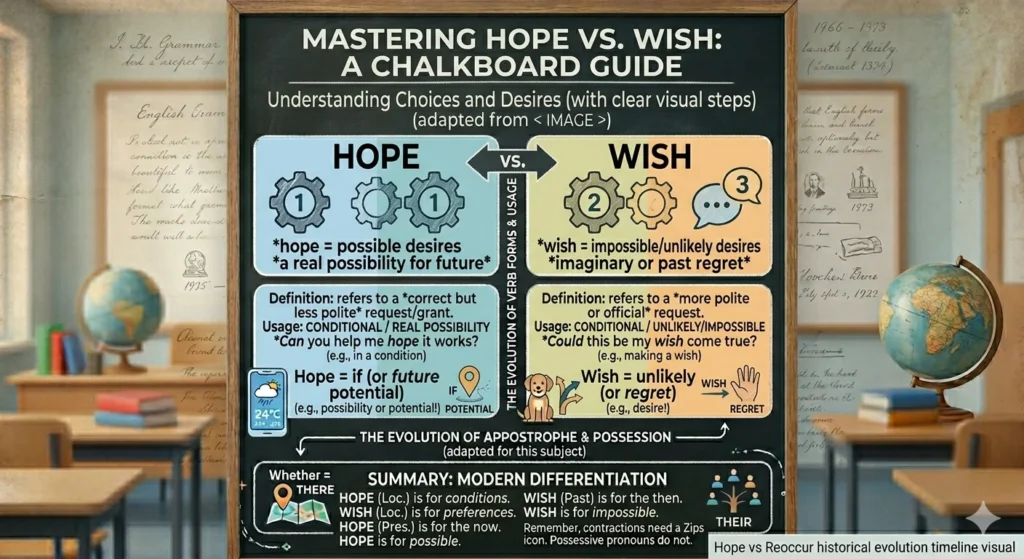
Hope vs Wish Examples
Hope Examples:
- I hope you understand
- I hope we win
- I hope it rains
Wish Examples:
- I wish I were taller
- I wish I knew the answer
- I wish I had more time
Hope vs Wish – Google Trends & Usage Data
Search trends show that:
- “hope vs wish grammar” is highly searched
- “wish and hope exercises” are popular for exams
- “hope vs wish quiz” is trending among learners
Top countries:
- Pakistan
- India
- Philippines
- UK
Usage insight:
- Hope → daily communication
- Wish → emotional or imaginary situations
Comparison Table: Hope vs Wish
| Feature | Hope | Wish |
|---|---|---|
| Meaning | Real possibility | Unreal desire |
| Time | Present/Future | Past/Imaginary |
| Grammar | Simple | Complex |
| Emotion | Positive | Emotional |
| Example | I hope it rains | I wish it rained |
Hope vs Wish Quiz
- I ___ I could fly
- I ___ you pass
- I ___ I studied harder
Answers:
- wish
- hope
- wish
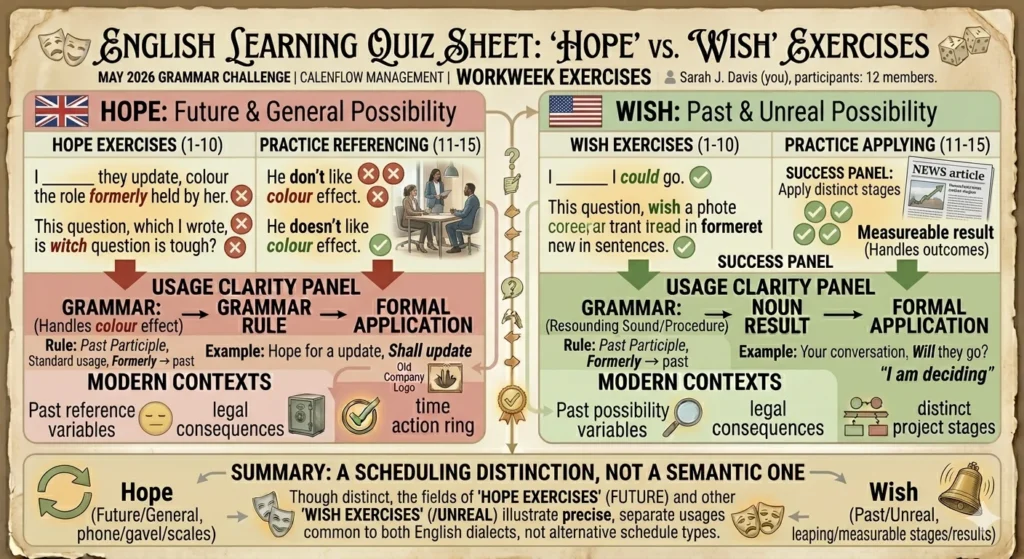
Wish and Hope Exercises
Fill in the blanks:
- I ___ you succeed
- I ___ I had a car
- We ___ for peace
Answers:
- hope
- wish
- hope
Hope vs Wish Exercises with Answers PDF
Create a downloadable PDF with:
- Fill in the blanks
- MCQs
- Sentence correction
This helps rank for:
- wish and hope grammar pdf
- hope and wish worksheet
Hope and Wish Worksheet Ideas
- Match real vs unreal situations
- Correct wrong sentences
- Rewrite examples
Hopes and Wishes Saying
- I hope for the best
- Best wishes for you
- I wish you happiness
FAQs
1. Is hope the same as a wish?
No. Hope is real and possible. Wish is unreal or imaginary.
2. Which is stronger, wish or hope?
Wish is more emotional. Hope is more realistic.
3. Are wishing and hoping the same thing?
No. Hoping means expecting something possible. Wishing means imagining something unreal.
4. What is an example of hopes and wishes?
Hope: I hope you win
Wish: I wish I won
5. What is hope vs wish grammar?
Hope uses present/future. Wish uses past tense for unreal meaning.
6. Can I use wish for the future?
Rarely. Use hope for real future events.
7. Where can I practice?
Use quizzes, worksheets, and exercises with answers.
Conclusion
Understanding “hope vs wish” is essential for correct English communication. While both words express desire, they are used in very different ways. Hope is used for real and possible situations. It shows expectation and positive thinking. Wish is used for unreal situations, imagination, or regret, and often uses past tense grammar.
👉 Final rule:
If it can happen → use HOPE
If it is unreal → use WISH
Many learners struggle with this topic, but with practice, it becomes easy. Use quizzes, exercises, and real-life examples to improve your understanding. Mastering this small difference can make your English sound natural, fluent, and more professional.
👉 Practice with a hope vs wish quiz and worksheet to master this topic completely.
👉 You can also learn similar topics like affect vs effect and ensure vs assure to improve your grammar further.

Pam Peters is a linguist and grammar expert, known for clear explanations of modern English usage, style, and practical language rules.