Many English learners get confused between whether vs rather because both appear in sentences related to choices. At first look, they seem similar, but in grammar they are completely different.
This confusion often happens in exams, writing, and daily conversation. For example, learners think both can be used in decision sentences, but their meaning is not the same.
Simply put:
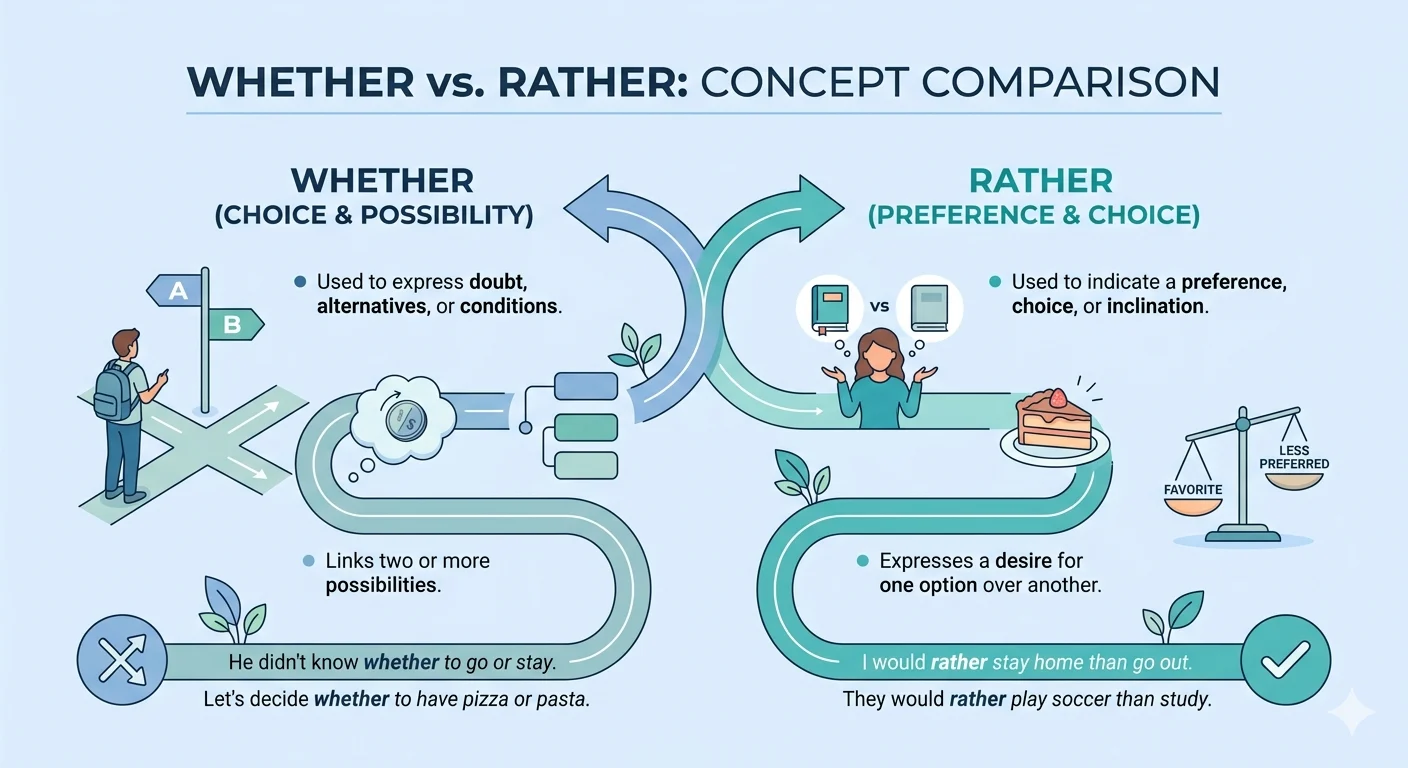
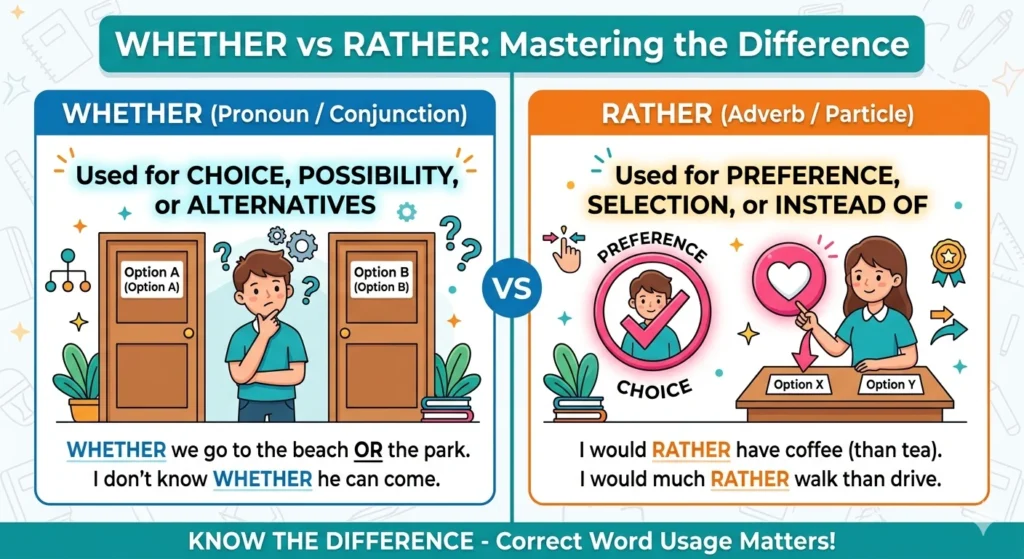
- Whether = uncertainty or choice between options
- Rather = personal preference or choice
This guide explains everything in very simple English with real examples, natural spoken sentences, common mistakes, and correct usage so you never get confused again.
Whether vs Rather
✔ Whether
Used when you are not sure or talking about options.
✔ Rather
Used when you prefer one thing over another.
Examples:
- I don’t know whether he is coming.
- I would rather stay at home.
👉 Simple memory trick:
- Whether = “I am not sure”
- Rather = “I prefer this”
Grammar of Whether
Whether is used for uncertainty or indirect questions.
Structure:
Whether + clause
Examples:
- I don’t know whether she will come.
- Tell me whether you are ready.
- Whether he agrees or not doesn’t matter.
Natural spoken English:
- I’m not sure whether I should go.
- I don’t know whether it’s true or not.
- Whether or not he comes, I will go.
👉 It shows doubt, not preference.
Grammar of Rather
Rather is used to show preference or stronger choice.
Structure:
Would rather + base verb
Examples:
- I would rather stay home.
- She would rather work alone.
- They would rather not go outside.
Natural spoken English:
- I’d rather not talk about it.
- I’d rather go now.
- I’d rather you didn’t do that.
👉 It shows what you prefer emotionally.
Whether vs Rather – Clear Difference
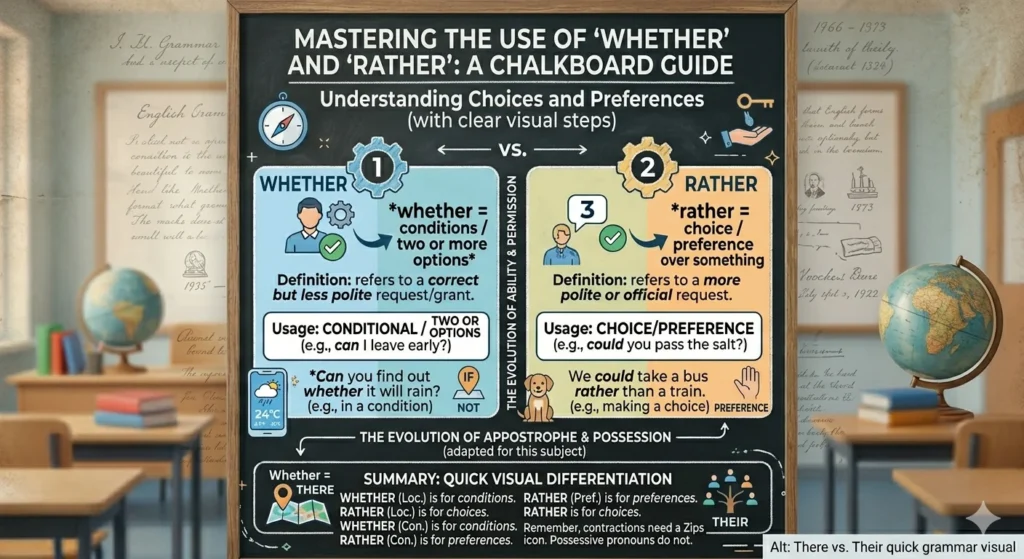
| Feature | Whether | Rather |
|---|---|---|
| Meaning | Choice / uncertainty | Preference |
| Feeling | Neutral | Personal / emotional |
| Use | Options or doubt | What you like more |
| Example | I don’t know whether he is coming | I would rather stay home |
Important Contrast
✔ Correct vs Incorrect:
- I don’t know whether he is coming. ✔
- ❌ I don’t know rather he is coming.
✔ Real confusion examples:
- Tell me whether you agree. ✔
- ❌ Tell me rather you agree.
👉 This is the key rule:
“Rather can never replace whether.”
Advanced Natural Usage
Whether (real situations):
- Whether he comes or not, the meeting will happen.
- I’m unsure whether I should accept the offer.
- Whether you like it or not, this is final.
Rather (real situations):
- I would rather you didn’t say that.
- I’d rather not get involved in this matter.
- I would rather have stayed silent.
👉 These are natural English expressions used in real life.
Real-Life Usage
📧 Email:
- Please confirm whether you are available.
- I would rather schedule it tomorrow.
💬 Conversation:
- I don’t know whether he is serious or joking.
- I’d rather stay quiet about it.
🎓 Study / Exams:
- The question asks whether the result is correct.
- She would rather not answer the question.
Common Mistakes
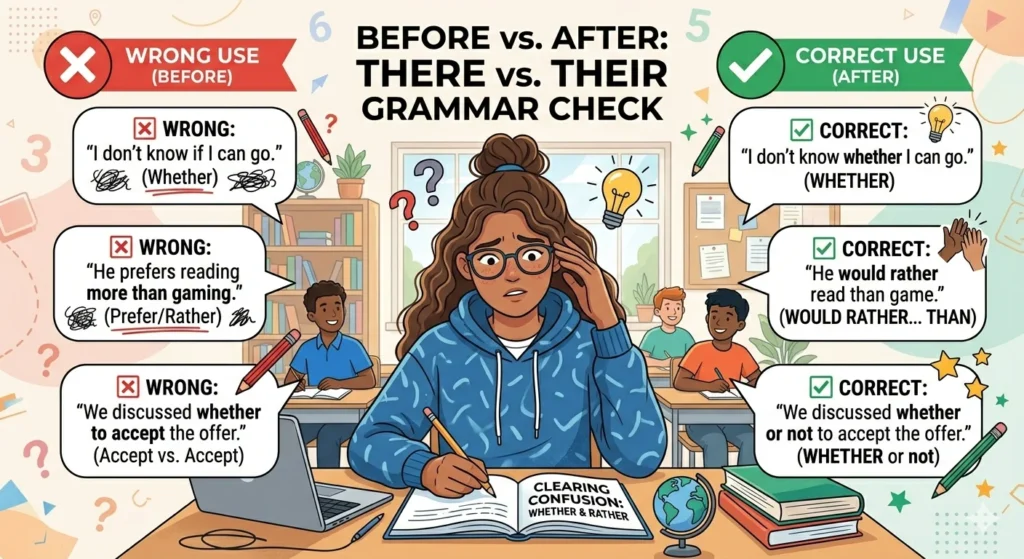
❌ Wrong:
I don’t know rather he will come.
✔ Correct:
I don’t know whether he will come.
❌ Wrong:
I rather go now.
✔ Correct:
I would rather go now.
❌ Wrong:
Rather or not you agree.
✔ Correct:
Whether or not you agree.
Could vs Can: The Grammar Difference Explained
Whether vs Rather vs Weather
- Whether = choice
- Rather = preference
- Weather = climate (rain, sun, wind)
Example:
I don’t know whether it will rain because the weather is bad.
Simple Learning Trick
👉 If you can replace it with “if” → use whether
👉 If you can replace it with “prefer” → use rather
Mini Real-Life Story
A student writes in an exam:
❌ “I don’t know rather he is coming.”
The teacher marks it wrong.
Correct sentence:
✔ “I don’t know whether he is coming.”
👉 Small mistake, big meaning difference.
Frequently Asked Questions
1. Should I use rather or whether?
Use whether for choice and rather for preference.
2. How do you use rather correctly?
Use “would rather + verb”.
3. How do you use whether correctly?
Use it for uncertainty or options.
4. Is it wether or rather?
Correct spelling is whether.
5. What is the difference between whether and weather?
Whether = choice, Weather = climate.
6. Can rather replace whether?
No, they are completely different.
7. What does rather mean?
It means personal preference.
Conclusion
Understanding whether vs rather is very important for correct English. These two words often confuse learners because they appear in similar sentence patterns, but their meanings are completely different.
Whether is used when you are not sure or talking about options.
Rather is used when you express what you prefer.
If you remember one simple idea —
👉 Whether = uncertainty
👉 Rather = preference
you will never confuse them again.
With practice in real sentences, both words become very easy and natural to use in speaking, writing, exams, and daily communication.

Scott Thornbury is a respected English language educator and author, known for practical grammar insights, teacher training, and clear learner-focused explanations.