Have you ever written a sentence like “She jumped over the fence” and thought, “Wait… should I use leaped or leapt instead?”
This is a very common confusion in English grammar. Even native speakers sometimes hesitate because both words look correct—and both are correct. The difference is not about meaning, but about style, region, and writing preference.
You will often see leaped in modern writing, blogs, and American English. On the other hand, leapt is more common in British English and traditional literature. This creates confusion for learners who want to write correctly for school, blogs, exams, or professional work.
In this guide, you will clearly understand the difference between leaped vs leapt, where each is used, what grammar experts say, and which one is better for your writing. By the end, you will never feel confused again when using this verb.
Leaped vs Leapt
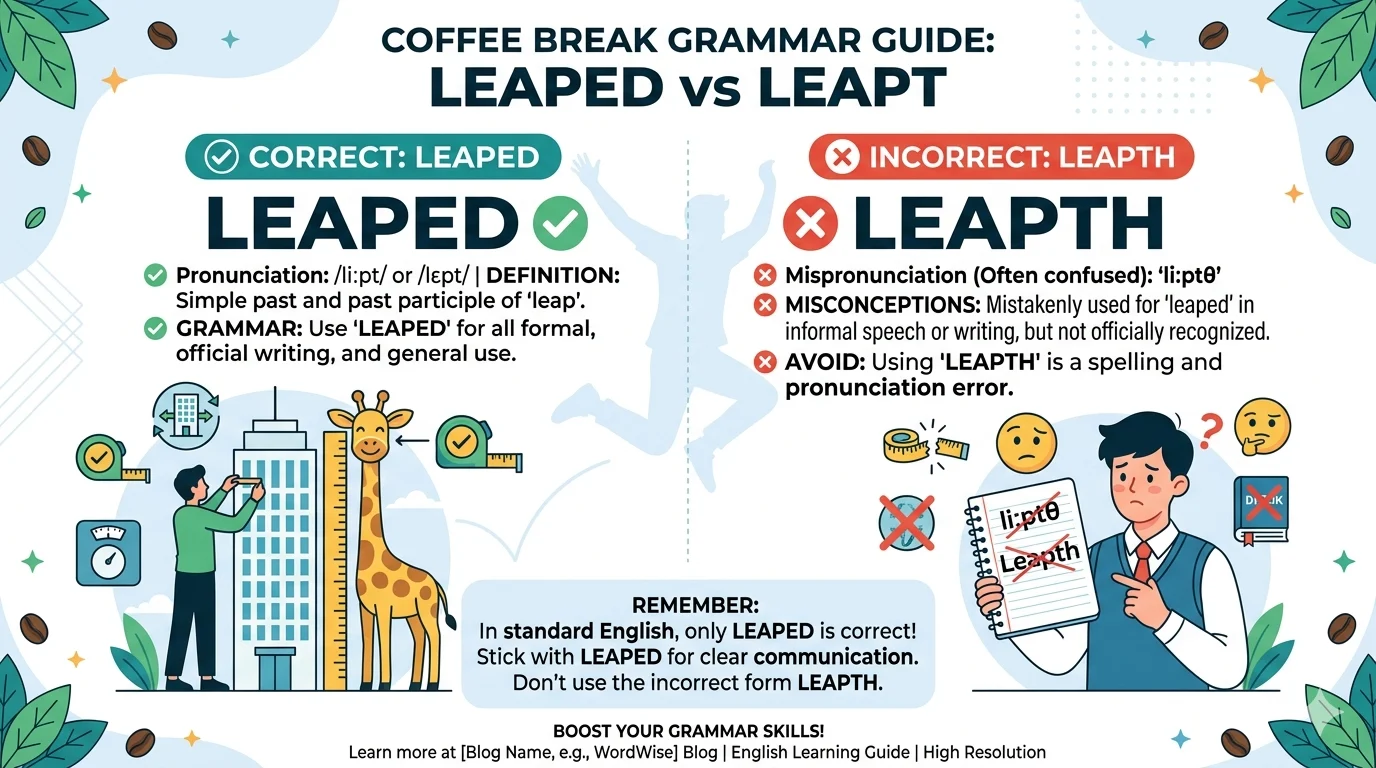
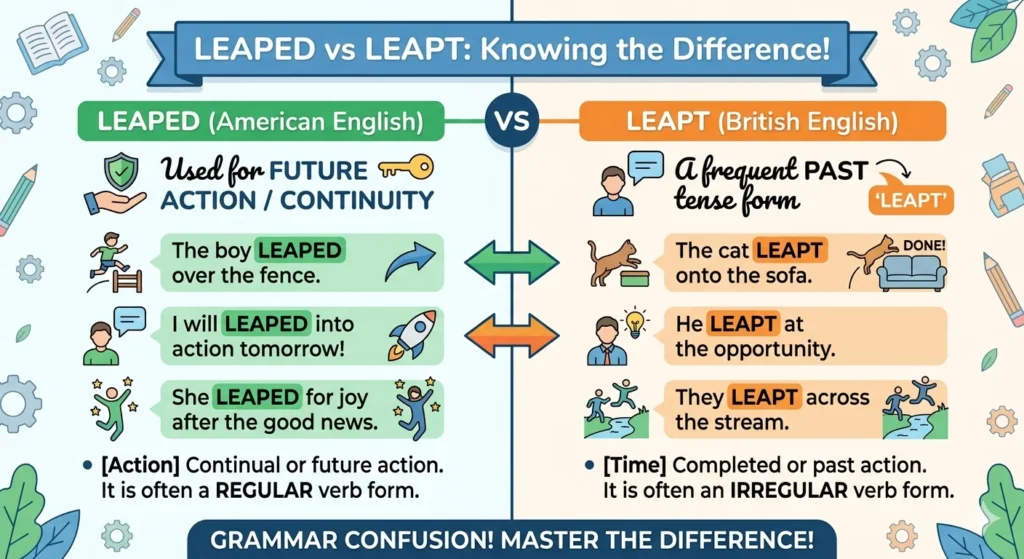
Both leaped and leapt are correct past tense forms of the verb leap.
- Leaped → more common in American English and modern writing
- Leapt → more common in British English and traditional writing
Examples:
- She leaped over the puddle. ✔️
- She leapt over the puddle. ✔️
👉 Meaning is exactly the same: to jump or move quickly upward or forward.
Leaped vs leapt:
Leaped and leapt are both past tense forms of the verb leap. “Leaped” is commonly used in American English, while “leapt” is preferred in British English. Both words have the same meaning: to jump or spring forward.
What Does “Leaped” Mean?
Leaped simply means:
👉 to jump suddenly or quickly, often with energy or force.
Examples:
- The cat leaped onto the table.
- He leaped forward when he heard his name.
👉 It is a regular verb form and feels more modern in tone.
What Does “Leapt” Mean?
Leapt also means:
👉 to jump or spring forward suddenly.
Examples:
- The athlete leapt over the barrier.
- She leapt out of her chair in shock.
👉 It is an irregular verb form and feels more traditional or literary.
Leaped vs Leapt – Key Difference
There is no difference in meaning, only in usage style.
| Feature | Leaped | Leapt |
|---|---|---|
| Type | Regular verb | Irregular verb |
| Usage | American English | British English |
| Tone | Modern, simple | Traditional, formal |
| Meaning | Jumped | Jumped |
👉 Both are grammatically correct according to major dictionaries like Oxford English Dictionary and Cambridge Dictionary.
Why Are There Two Forms?
The verb leap comes from Old English hlēapan, meaning “to jump or spring.”
Over time, English developed two patterns:
- Regular verbs → add “-ed” (leaped)
- Irregular verbs → change form (leapt)
British English preserved more irregular forms like leapt, while American English simplified many verbs into regular forms like leaped.
British English vs American English Usage
American English
- Prefer: leaped
- Common in: news, blogs, academic writing, SEO content
British English
- Prefer: leapt
- Common in: literature, formal writing, UK publications
👉 Example difference:
- US: He leaped over the wall.
- UK: He leapt over the wall.

Which One Should You Use?
This depends on your writing goal:
Use “Leaped” if:
- You are writing blogs or websites
- Your audience is international
- You want simple and clear English
- You are doing SEO writing
Use “Leapt” if:
- You are writing for UK readers
- You are writing stories or novels
- You want a traditional tone
👉 Best practical advice:
If you are unsure, use leaped. It is more widely accepted in global digital content.
Common Mistakes Learners Make
❌ He has leapted over the fence
✔️ He has leapt over the fence
❌ She leapedt quickly
✔️ She leaped quickly
❌ Mixing both forms in one article
✔️ Stick to one style consistently
Real-Life Usage Examples
📧 Email Example:
The system leaped in performance after the update.
📰 News Example:
The team leapt into first place after the final match.
📱 Social Media:
That dog just leaped into the pool! 😂
📖 Academic Writing:
The study leapt forward after new data was added.
Is “Leapt” Still Correct in Modern English?
Yes ✔️
Even though leaped is more common in modern usage, leapt is still fully correct and widely accepted in British English and formal writing.
Grammar experts confirm that both forms are standard English.
Leaped vs Leapt – Simple Memory Trick
👉 Think like this:
- “Leaped” = Easy, modern, global
- “Leapt” = Classic, British, traditional
FAQs
1. Is leaped or leapt correct?
Both are correct. They are just different styles.
2. Do Americans use leapt?
Yes, but leaped is more common.
3. What is the past tense of leap?
Both leaped and leapt are correct.
4. Is leapt formal or informal?
It is slightly more formal and traditional.
5. Which is better for blogging writing?
Leaped, because it is more widely used online.
6. Is there any difference in meaning?
No, both mean the same thing: to jump.
Conclusion
The difference between leaped vs leapt is not about grammar correctness—it is about style and regional preference. Both words are correct, both are used in real writing, and both mean exactly the same thing.
If you are writing for modern readers, blogs, or global audiences, leaped is usually the better choice because it is simpler and more widely used. If you are writing for British readers or want a traditional tone, leapt works perfectly fine.
The most important rule in English writing is consistency. Choose one form and use it throughout your content.
Now you fully understand leaped vs leapt, and you can use both confidently in any situation.

David Crystal is a renowned English linguist and author, known for making English grammar, linguistics, and language history clear and engaging.