
Many English learners get confused when writing rode vs ridde (more correctly, rode vs ridden) because both words come from the same verb “ride,” but they are used in different situations. This confusion often appears in writing, captions, and everyday communication, especially when people are unsure about past tense forms in English.
The correct forms are “rode” and “ridden.” The word rode is the simple past tense of “ride,” used when talking about an action that happened in the past. For example: “She rode her bike to school yesterday.”
On the other hand, ridden is the past participle form of “ride,” and it is usually used with helping verbs like has, have, or had. For example: “He has ridden horses since childhood.” or “They had ridden all day before stopping.”
The word “ridde” is incorrect and is not used in standard English. This mistake usually happens because learners try to guess the spelling based on sound, but English irregular verbs do not always follow simple patterns.
A simple way to remember it is: rode = past action, ridden = completed action with helping verbs.
Understanding the difference between rode vs ridden helps you avoid a common grammar mistake and improves your accuracy in writing, exams, and everyday communication.
Quick Answer
Rode vs ridden difference:
“Rode” is the past simple form of ride used for completed actions. “Ridden” is the past participle form used with has, have, or had to show experience or perfect tense actions.
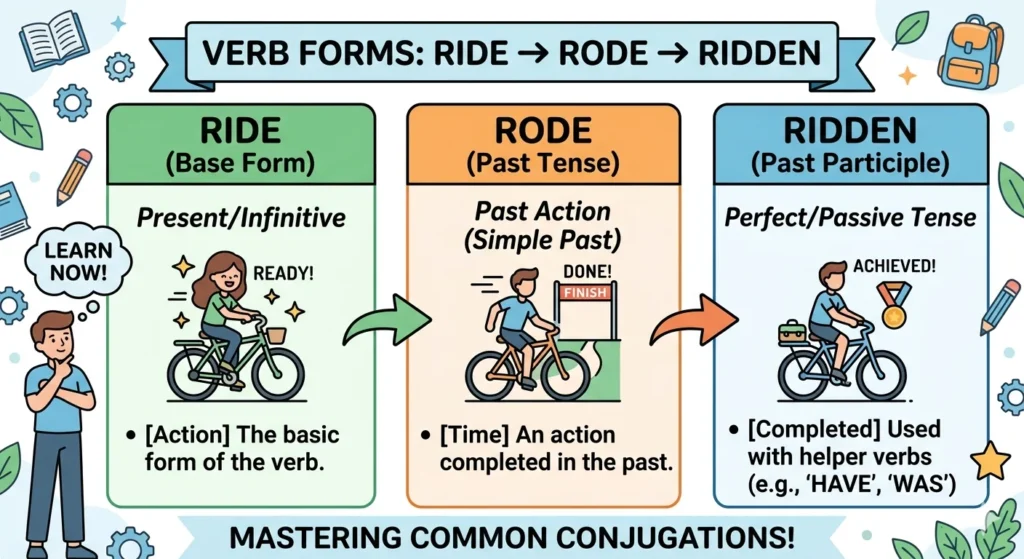
Rode vs Ridden – Meaning Explained Simply
- Ride = present form
- Rode = past simple (finished action)
- Ridden = past participle (experience / perfect tense)
Simple understanding:
- Rode = “I did it in the past”
- Ridden = “I have done it before”
Examples:
- I rode a bike yesterday.
- I have ridden a bike many times.
Grammar Rule
English irregular verbs do not follow “-ed” rules. Instead, they change form completely.
✔ Ride → Rode → Ridden
Correct usage:
- I rode a horse yesterday.
- I have ridden a horse before.

British & American English
There is no difference between British and American English for this verb.
| Form | Usage | Example |
|---|---|---|
| Ride | Present | I ride daily |
| Rode | Past | I rode yesterday |
| Ridden | Perfect tense | I have ridden before |
📌 Both Cambridge and Oxford grammar references confirm this structure.
When to Use Rode vs Ridden
✔ Use “Rode” when:
- Talking about past action
- No helping verb
Example:
- I rode a bike yesterday.
✔ Use “Ridden” when:
- Using has / have / had
- Showing experience
Example:
- I have ridden a bike many times.
Common Mistakes
❌ I have rode a bike
✔ I have ridden a bike
❌ Have you ever rode a horse?
✔ Have you ever ridden a horse?
❌ I ridden a bike yesterday
✔ I rode a bike yesterday
👉 This is one of the most common ESL grammar mistakes worldwide.

Everyday English Usage
Speaking:
- I rode my bike to school.
- I have ridden that route before.
Writing:
- She rode the horse in the competition.
- He has ridden professionally for years.
Social Media:
- “I just rode my first mountain trail 🚴”
- “I’ve ridden horses since childhood 🐎”
Easy Memory Trick
✔ No “have/has” → use rode
✔ With “have/has/had” → use ridden
Mini Practice Test
Fill in the blanks:
- I have ___ a horse before.
- She ___ to school yesterday.
- Have you ever ___ a bike?
✔ Answers:
- ridden
- rode
- ridden
Expert Grammar Note
According to widely accepted English grammar rules (Cambridge University Press & Oxford Learner’s Grammar), irregular verbs like ride must be memorized because they do not follow standard conjugation patterns.
This is why:
👉 ride → rode → ridden
must be learned as fixed forms.
FAQs
1. What is the difference between rode and ridden?
Rode is past simple; ridden is past participle used with has/have/had.
2. Is “I have rode” correct?
No, correct form is “I have ridden.”
3. Have you ever rode or ridden a horse?
Correct: Have you ever ridden a horse?
4. How do I say I rode a bike?
Correct: I rode a bike.
5. Why is ridden correct in perfect tense?
Because perfect tense always uses past participle form.
Conclusion
Understanding rode vs ridden is essential for correct English grammar. Both come from the verb “ride,” but they are used in different grammatical structures.
Use “rode” for simple past actions, and use “ridden” when using helping verbs like has, have, or had. For example:
- I rode a bike yesterday.
- I have ridden a bike many times.
This small difference is very important in exams, IELTS writing, job communication, and daily English speaking. Even advanced learners sometimes make mistakes, but once you understand the rule, it becomes very easy.
If you remember just one idea—rode = past, ridden = experience—you will avoid most common grammar mistakes.
Keep practicing real sentences, and your English will become more natural, accurate, and professional.

Pam Peters is a linguist and grammar expert, known for clear explanations of modern English usage, style, and practical language rules.