Have you ever typed “I don’t want to loose money” in an email or social media post and suddenly wondered if the spelling was wrong? You are not alone. The confusion between loose vs lose is one of the most common English grammar and spelling mistakes online. Students, bloggers, professionals, and even native English speakers often mix up these words because they look almost identical.
A single extra letter can completely change the meaning of a sentence. Writing “loose weight” instead of “lose weight” or “loose money” instead of “lose money” can make your writing look unprofessional and confusing. This mistake appears in text messages, school assignments, business emails, captions, and even news comments every day.
That is why thousands of people search questions like Which is correct lose or loose?, Do you lose or loose weight?, Do you loose or lose someone?, and Is it lose or loose money? every month.
The good news is that the difference is actually simple. In basic English:
- lose means to no longer have something
- loose means not tight or free
In this complete grammar guide, you will learn the meanings, pronunciation, spelling rules, examples, professional writing tips, common mistakes, and memory tricks for loose vs lose in very simple English.
Loose vs Lose
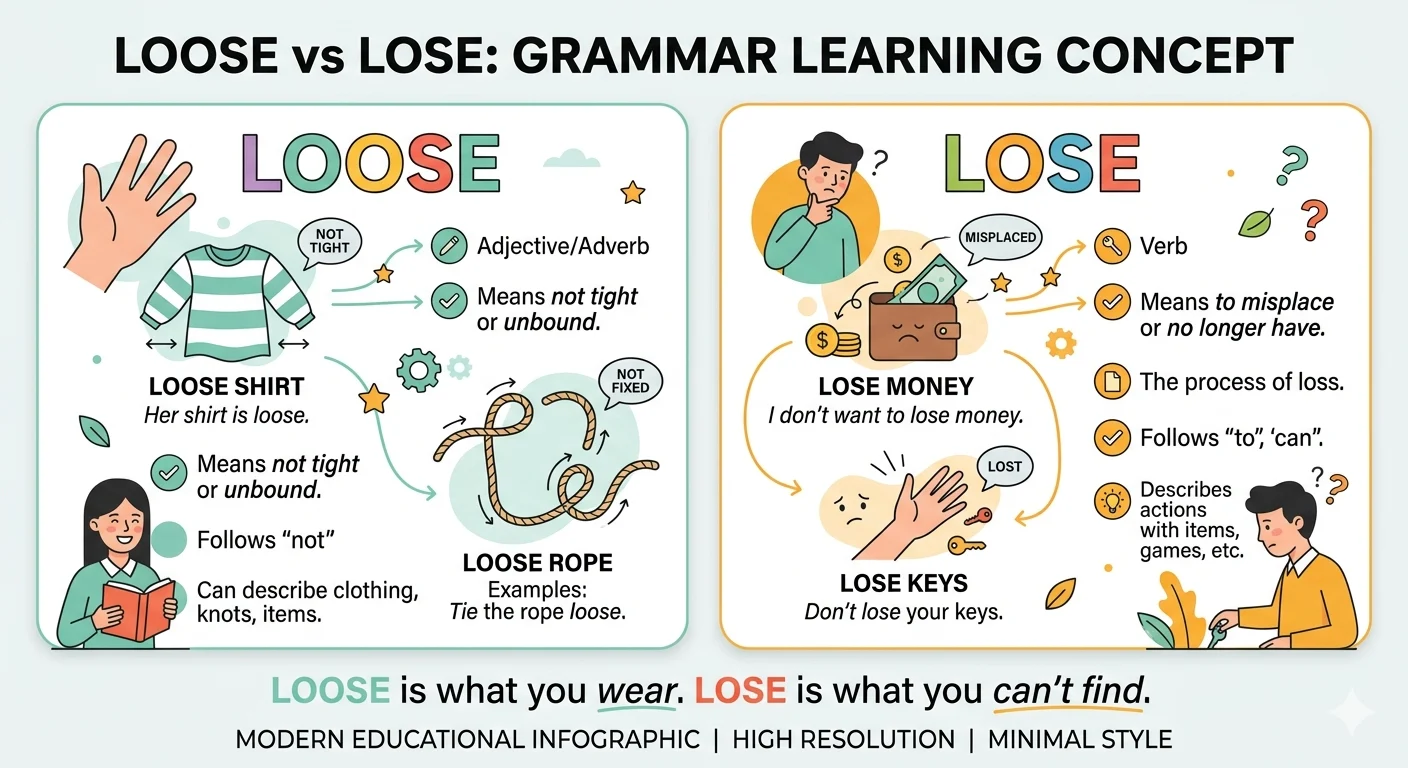
The difference between loose vs lose is easy to understand.
| Word | Meaning | Word Type | Example |
|---|---|---|---|
| Lose | To no longer have something | Verb | I may lose my wallet. |
| Loose | Not tight or free | Adjective | My jacket feels loose. |
Quick Rule
- Lose = losing something
- Loose = not tight
Quick Examples
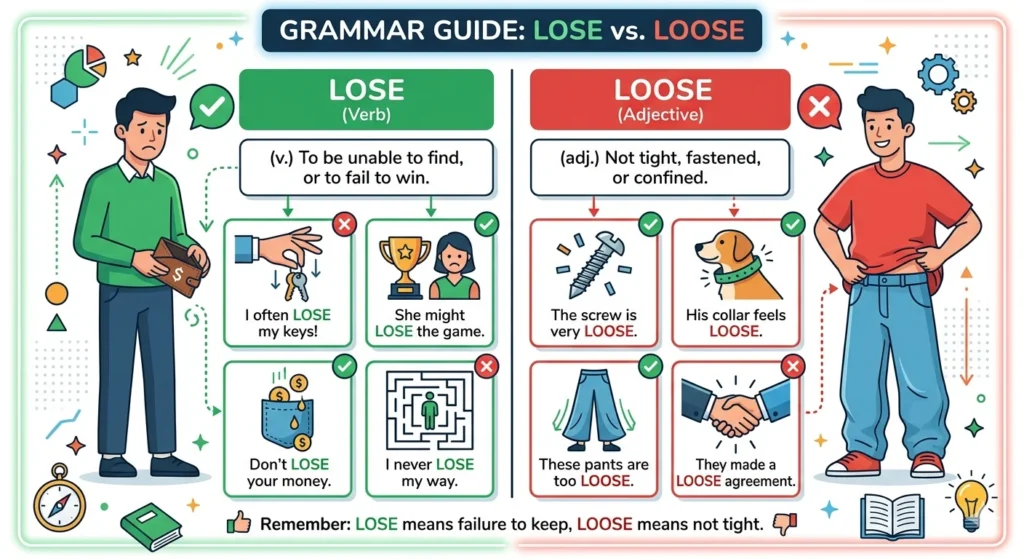
✅ I do not want to lose money.
✅ These shoes are too loose.
❌ I do not want to loose money.
❌ These shoes are too lose.
Easy Memory Trick
Most grammar teachers recommend this simple trick:
- Lose loses one “O.”
- Loose has an extra “O” because loose things have extra space.
This small trick helps many English learners remember the correct spelling quickly.
Which is Correct Lose or Loose?
Both words are correct English words, but they are used differently.
Use “Lose” for Actions
Use lose when talking about:
- losing money
- losing weight
- losing focus
- losing games
- losing someone
- losing interest
Examples
- She wants to lose weight naturally.
- Companies can lose customers because of poor service.
- Students may lose focus during long lectures.
- Nobody wants to lose someone they love.
Use “Loose” for Description
Use loose when describing something:
- not tight
- relaxed
- free
- not fixed properly
Examples
- My shirt feels too loose.
- One wheel on the chair is loose.
- The dog escaped because the rope was loose.
- He prefers wearing loose clothing in summer.
Loose vs Lose Cheat Sheet
Fast Summary Table
| Correct Phrase | Incorrect Phrase |
|---|---|
| lose weight | loose weight |
| lose money | loose money |
| lose interest | loose interest |
| lose focus | loose focus |
| loose shirt | lose shirt |
| loose cable | lose cable |
Quick Grammar Reminder
- You lose things.
- Things become loose.
This simple rule solves most spelling confusion instantly.
The Origin of Loose vs Lose
Understanding word origins can make grammar easier to remember.
Origin of Lose
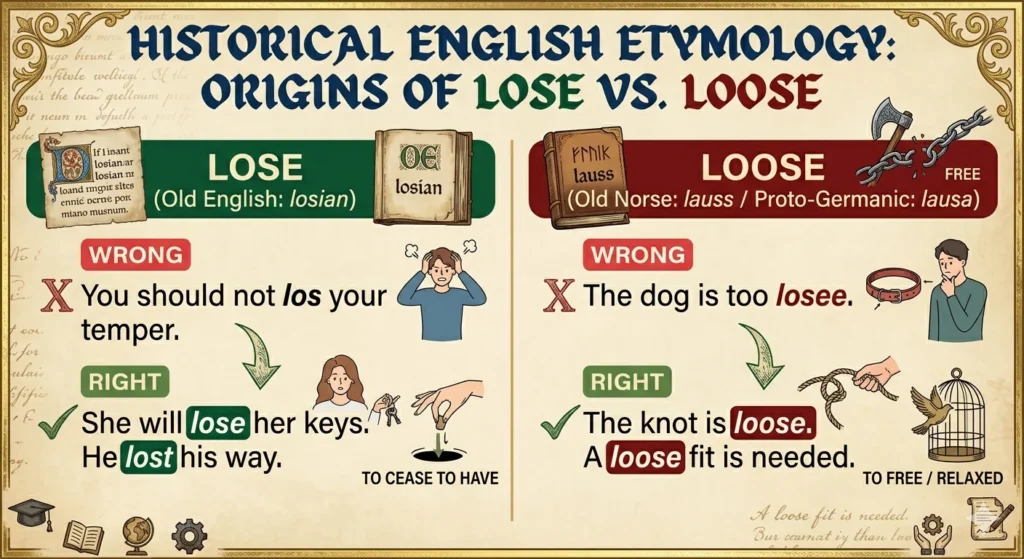
The word lose comes from the Old English word losian, meaning:
- fail
- perish
- no longer possess something
Over time, it became the modern English verb lose.
Common Uses
- lose confidence
- lose balance
- lose patience
- lose a competition
Origin of Loose
The word loose came from Old Norse and Old English roots meaning:
- free
- untied
- relaxed
Today, it usually describes objects, clothing, or connections that are not tight.
Common Uses
- loose shoelaces
- loose pages
- loose connection
- loose knot
British English vs American English Spelling
Unlike many English spelling differences, lose and loose are spelled the same in both British and American English.
| Phrase | British English | American English |
|---|---|---|
| lose money | Correct | Correct |
| lose weight | Correct | Correct |
| loose clothing | Correct | Correct |
| loose rope | Correct | Correct |
There is no regional spelling difference for these words.
Loose vs Lose Pronunciation
Although the spellings look similar, the pronunciation is slightly different.
| Word | Pronunciation | Sounds Like |
|---|---|---|
| Lose | /luːz/ | “looz” |
| Loose | /luːs/ | “looss” |
Pronunciation Memory Trick
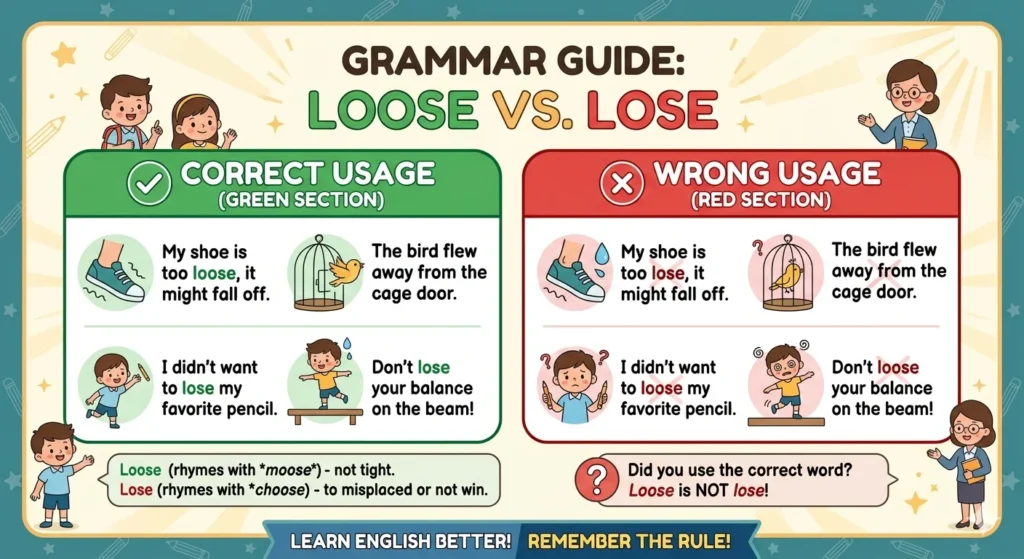
- Lose rhymes with choose
- Loose rhymes with moose
This pronunciation guide is especially helpful for English learners and beginner writers.
Which Spelling Should You Use?
The correct spelling depends completely on your sentence meaning.
Use “Lose” When Talking About:
- competition
- money
- emotions
- relationships
- business situations
Examples
- The company may lose money this year.
- Teams hate to lose matches.
- Readers can lose interest in boring articles.
- Investors sometimes lose confidence in markets.
Use “Loose” When Describing Something
Examples
- The backpack strap feels loose.
- One cable inside the machine became loose.
- He wore a loose hoodie.
- The bottle lid feels loose.
Common Mistakes with Loose vs Lose
This spelling confusion appears everywhere online, especially in social media captions, comments, text messages, and business emails.
Many people type quickly on phones and accidentally write loose instead of lose.
Do You Lose or Loose Weight?
Correct Answer:
lose weight
Use “lose” because weight is something you stop having.
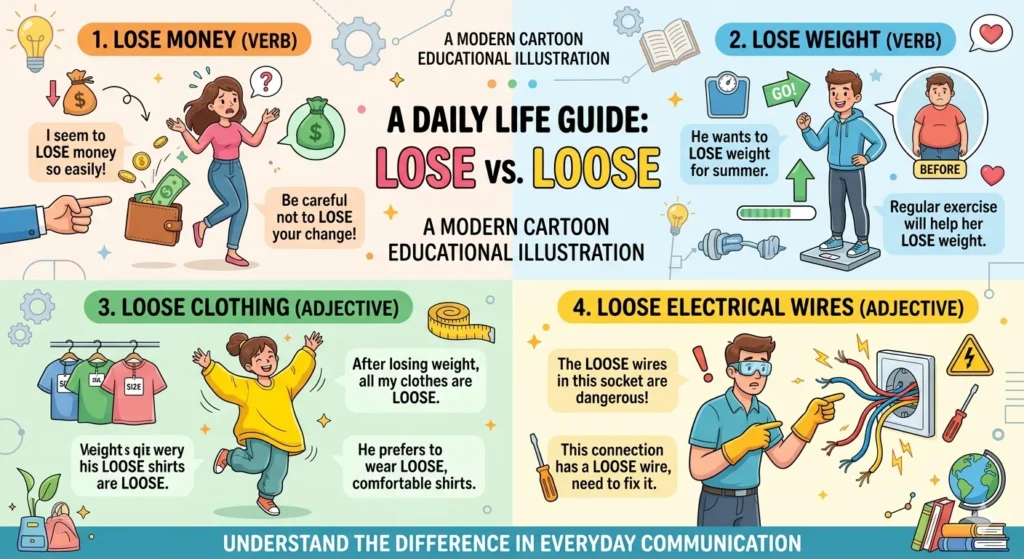
✅ She wants to lose weight before summer.
❌ She wants to loose weight before summer.
Is It Lose or Loose Money?
Correct Answer:
lose money
You lose money when you no longer have it.
✅ Businesses can lose money during inflation.
❌ Businesses can loose money during inflation.
Do You Loose or Lose Someone?
Correct Answer:
lose someone
✅ Nobody wants to lose someone they love.
❌ Nobody wants to loose someone they love.
Loose vs Lose Interest
Correct Answer:
lose interest
✅ Readers may lose interest in difficult articles.
❌ Readers may loose interest in difficult articles.
I Will Lose or Loose
Correct Answer:
I will lose
✅ I will lose the game without practice.
❌ I will loose the game without practice.
Loose vs Lose Meaning
According to most English dictionaries, lose usually functions as a verb, while loose usually works as an adjective.
Lose Meaning
The word lose means:
- to fail to keep something
- to stop having something
- to misplace something
Examples
- lose a wallet
- lose customers
- lose energy
- lose hope
Loose Meaning
The word loose means:
- not tight
- free
- relaxed
Examples
- loose belt
- loose chain
- loose pages
- loose lid
Loose vs Lose Examples
Learning through real-life examples makes grammar easier to understand.
Everyday Conversation
- Please do not lose your passport.
- Your shoelaces are loose again.
Business Writing
Spelling mistakes in workplace emails can reduce professionalism and clarity.
Examples
- Companies may lose clients because of poor communication.
- A loose wire stopped the machine.
Using the correct spelling helps professional writing look more polished and trustworthy.
Academic Writing
- Students can lose marks for grammar mistakes.
- The experiment failed because of a loose connection.
Social Media
- Trying to lose weight this year.
- I love wearing loose hoodies at home.
News Headlines
- Investors fear they could lose billions.
- Officials warned residents about loose electrical wires.
Pro Writing Tip
If you can replace the word with:
- “misplace”
- “fail”
- “no longer have”
then use lose.
If you can replace the word with:
- “not tight”
- “free”
- “relaxed”
then use loose.
This simple trick works in most English sentences.
Lose vs Lost
Many English learners also confuse lose vs lost.
| Word | Usage |
|---|---|
| Lose | Present or future tense |
| Lost | Past tense |
Examples
- I may lose my wallet today.
- Yesterday, I lost my wallet.
Loose vs Lose – Google Trends & Usage Data
Search engines show that loose vs lose is one of the most searched grammar confusion topics online.
Popular Search Queries
People commonly search:
- Which is correct lose or loose?
- Loose vs lose meaning
- Loose vs lose pronunciation
- Lose meaning
- Loose or lose weight
- Lose vs lost
- I will lose or loose
Countries Where Searches Are Popular
This grammar keyword is highly searched in:
- United States
- United Kingdom
- Canada
- Australia
- India
Why This Grammar Topic Trends
This spelling confusion is common because:
- the words look nearly identical
- pronunciation sounds similar
- autocorrect often misses the typo
- many English learners struggle with verb vs adjective usage
- fast typing causes spelling mistakes
Related Grammar Words
If you confuse loose vs lose, you may also struggle with:
- affect vs effect
- advice vs advise
- your vs you’re
- their vs there
- farther vs further
People who confuse spelling and pronunciation differences often mix up these grammar pairs as well.
Practice Sentences
Choose the correct word.
- I do not want to ___ my phone.
- My backpack strap feels too ___.
- Companies can ___ customers quickly.
- One screw on the chair is ___.
- Readers may ___ interest in boring content.
Answers
- lose
- loose
- lose
- loose
- lose
Loose vs Lose Comparison Table
| Feature | Lose | Loose |
|---|---|---|
| Meaning | No longer have something | Not tight |
| Word Type | Verb | Adjective |
| Pronunciation | Looz | Looss |
| Used For | Actions | Description |
| Example | lose money | loose shirt |
| Common Phrase | lose weight | loose knot |
Key Takeaways
Important Grammar Rules
- Lose is a verb.
- Loose is usually an adjective.
- You lose money, games, and focus.
- Wires, ropes, and clothing can become loose.
Fast Pronunciation Tip
- lose → choose
- loose → moose
Professional Writing Tip
Before sending:
- emails
- assignments
- resumes
- blog posts
- social media captions
quickly check whether you mean:
- losing something → lose
- describing something free → loose
Small grammar corrections can make your writing look clearer, smarter, and more professional.
FAQs About Loose vs Lose
Which is correct lose or loose?
Both are correct words, but they have different meanings.
Do you lose or loose weight?
Correct:
lose weight
Is it lose or loose money?
Correct:
lose money
What is the meaning of lose?
“Lose” means to no longer have something.
What is the meaning of loose?
“Loose” means not tight or free.
How do you pronounce lose and loose?
- lose = “looz”
- loose = “looss”
Is “I will loose” grammatically correct?
Usually no.
Correct:
I will lose
Conclusion
Understanding loose vs lose becomes easy once you learn the main difference. The word lose is used when you no longer have something, while loose describes something that is free or not tight. Even though these words look very similar, their meanings are completely different.
Many people accidentally write “loose money” or “loose weight,” but the correct forms are always lose money and lose weight. On the other hand, phrases like loose rope, loose shirt, and loose cable are perfectly correct because they describe something relaxed or untied.
A simple memory trick can help you remember forever:
- lose loses one “o”
- loose has extra space
Mastering small grammar differences like loose vs lose can improve your confidence, professionalism, and English writing skills. Whether you are writing emails, articles, assignments, or social media posts, using the correct spelling makes your communication clearer, more polished, and more trustworthy.

David Crystal is a renowned English linguist and author, known for making English grammar, linguistics, and language history clear and engaging.