Have you ever typed “Please advice me” in an email and suddenly wondered if it was correct? You are not alone. The confusion between advice vs advise is one of the most common English grammar mistakes in the world. Students, bloggers, teachers, office workers, and even native speakers often mix these words because they look and sound very similar.
But this small spelling mistake can create confusion in professional communication, business English, academic writing, and social media posts. In formal writing, using the wrong word may make your message look less professional.
People search for phrases like advice vs advise meaning, please advice vs advise, doctor advice or advise, and advice vs advise pronunciation because they want a quick answer with simple examples. According to language-learning search trends, these grammar keywords receive thousands of searches every month, especially in Pakistan, India, the UK, and the United States.
The good news is that the rule is actually simple. Once you understand the noun-versus-verb difference, you will never confuse these words again.
In this complete guide, you will learn:
- the meaning of advice and advise
- pronunciation differences
- British vs American English usage
- common grammar mistakes
- Urdu meanings
- professional examples
- expert English writing tips
By the end of this article, you will confidently know when to use advice and when to use advise in everyday English.
Advice vs Advise
| Word | Part of Speech | Meaning | Example |
|---|---|---|---|
| Advice | Noun | A suggestion or recommendation | “Thank you for your advice.” |
| Advise | Verb | To give a suggestion or recommendation | “I advise you to rest.” |
What Is the Difference Between Advice and Advise?
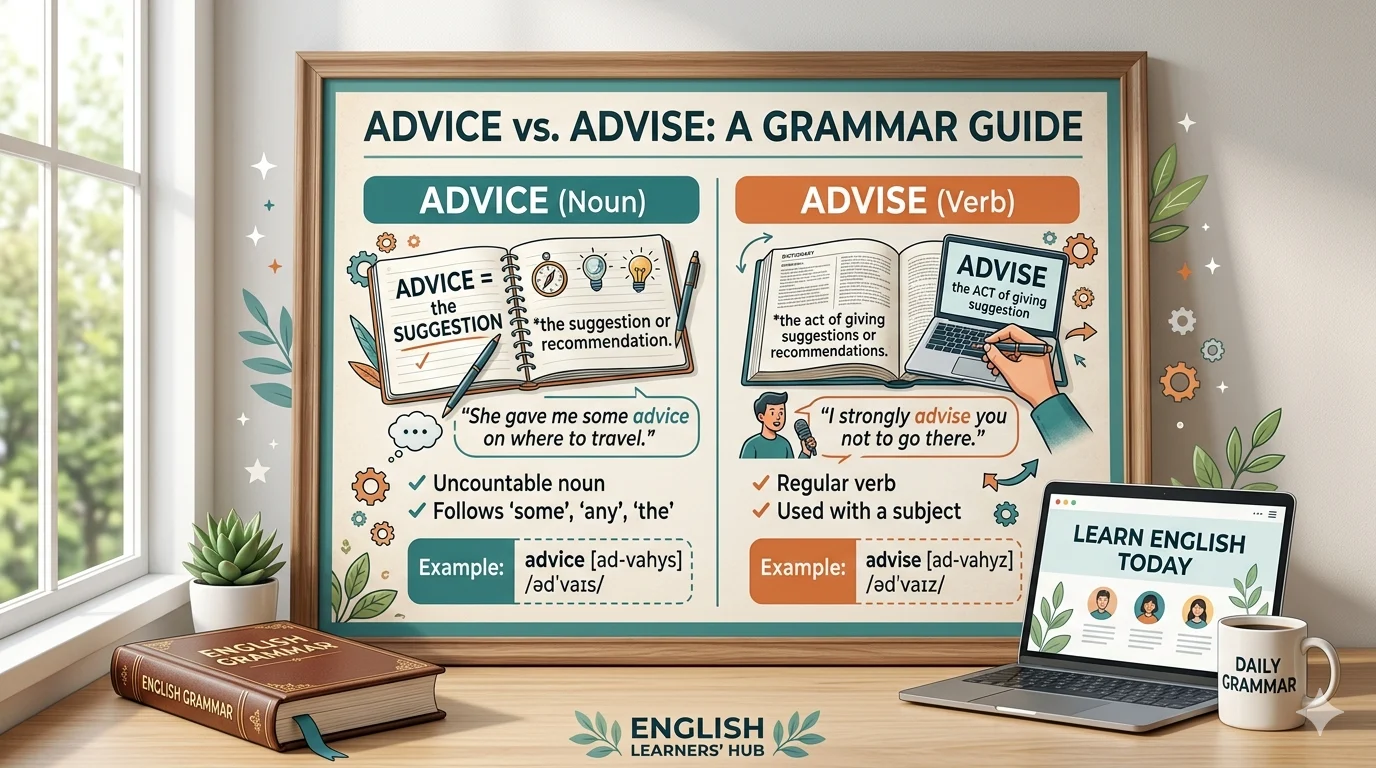
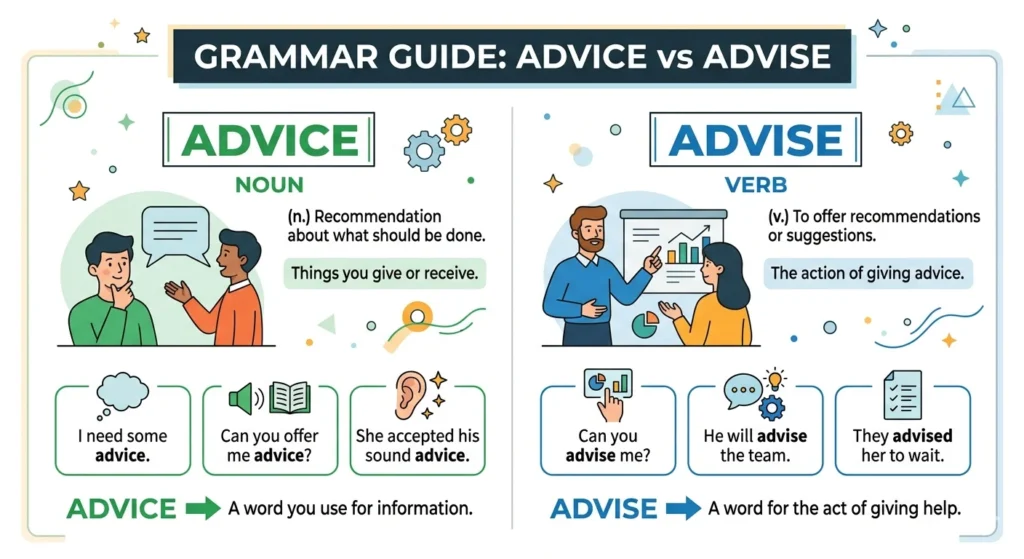
Advice is a noun that means a suggestion or guidance.
Advise is a verb that means to recommend or guide someone.
Examples
- She gave me useful advice.
- I advise you to study daily.
This is the simplest explanation grammar experts use when teaching confusing English words.
Simple Rule to Remember
Here is the easiest trick to remember the difference forever:
If you can replace the word with “suggestion,” use advice.
If you can replace it with “recommend,” use advise.
Easy Memory Trick
- Advice = thing
- Advise = action
English teachers often use this noun-versus-verb method because it works quickly for beginners.
The Origin of Advice vs Advise
The words advice and advise come from Old French and Latin roots related to thinking carefully and giving guidance.
The verb advise came first from the Old French word aviser, which meant:
- to think carefully
- to consider
- to guide
Later, English created the noun form advice from the same root.
Over time, English spelling evolved to separate the noun and verb forms more clearly.
This pattern also appears in other confusing English words.
| Verb | Noun |
|---|---|
| Advise | Advice |
| Devise | Device |
| Revise | Revision |
Grammar experts say learning word patterns like these improves English vocabulary faster.
British English vs American English Spelling
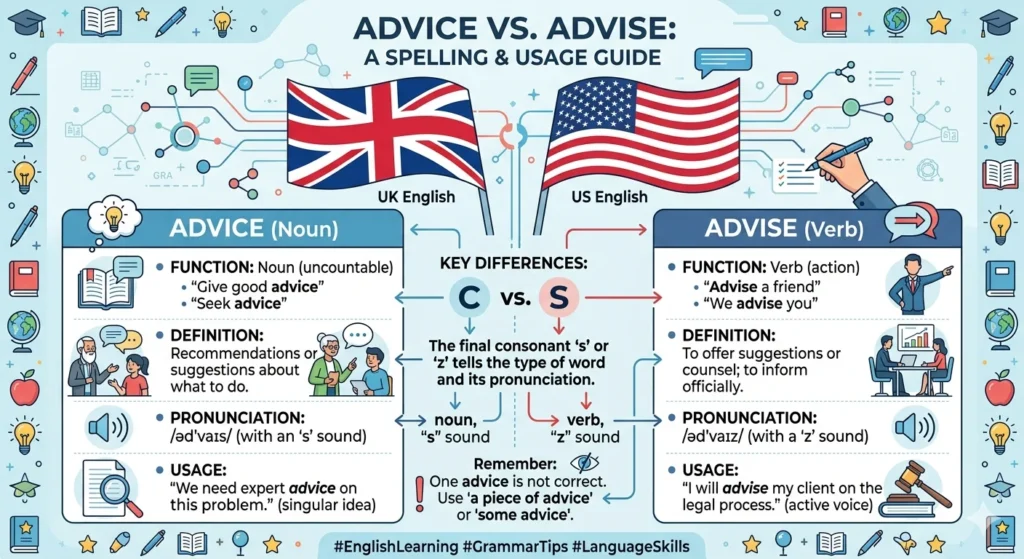
Many learners search for advice vs advise UK because they think the spelling changes in British English and American English.
The answer is simple:
Both British and American English use the same spellings.
| Usage | British English | American English |
|---|---|---|
| Noun | Advice | Advice |
| Verb | Advise | Advise |
There is no spelling difference between the US and the UK for these words.
However, pronunciation may sound slightly different depending on the accent.
Less vs Fewer: The Hidden Rule Most Miss
Advice vs Advise Pronunciation
| Word | Pronunciation |
|---|---|
| Advice | ad-VICE |
| Advise | ad-VIZE |
Pronunciation Trick
- Advice ends with an “S” sound like “ice.”
- Advise ends with a “Z” sound like “eyes.”
Many English learners remember the difference through pronunciation practice.
Which Spelling Should You Use?
The correct spelling depends on grammar.
Use Advice When You Need a Noun
Use advice when talking about:
- guidance
- suggestions
- recommendations
- opinions
Examples
- Thank you for your advice.
- I need financial advice.
- Her career advice helped me.
- His advice improved my writing.
Use Advise When You Need a Verb
Use advise when someone gives guidance or recommends something.
Examples
- I advise you to save money.
- Doctors advise regular exercise.
- Experts advise checking grammar carefully.
- Teachers advise students daily.
Professional editors recommend double-checking advice and advise in formal business English because this is a very common grammar mistake.
Common Mistakes with Advice vs Advise
The small spelling difference causes many common English errors.
| Incorrect Sentence | Correct Sentence |
|---|---|
| Please advice me | Please advise me |
| I need your advise | I need your advice |
| Can you give me an advise? | Can you give me some advice? |
| Doctor advise | Doctor’s advice |
| He gave many advices | He gave lots of advice |
Please Advice vs Advise
Many people write:
❌ Please advice me.
Correct version:
✅ Please advise me.
Why? Because “advise” is the action word.
Can You Please Advise or Advice Me?
Correct sentence:
✅ Can you please advise me?
You need a verb after “please.”
Can You Give Me Some Advice or Advise?
Correct sentence:
✅ Can you give me some advice?
Because “advice” is the noun.
Is It Doctor’s Advice or Advise?
Correct usage:
✅ Doctor’s advice
Example:
- The doctor’s advice helped me recover.
- Doctors advise patients to drink water.

Important Grammar Rule
The word advice is usually uncountable.
Correct:
- some advice
- good advice
- useful advice
Incorrect:
- an advice
- many advices
This is one of the most common grammar mistakes in English writing.
Desert vs Dessert: The Common Mistake Explained
Advice vs Advise in Everyday Examples
Real-world examples make grammar easier to remember.
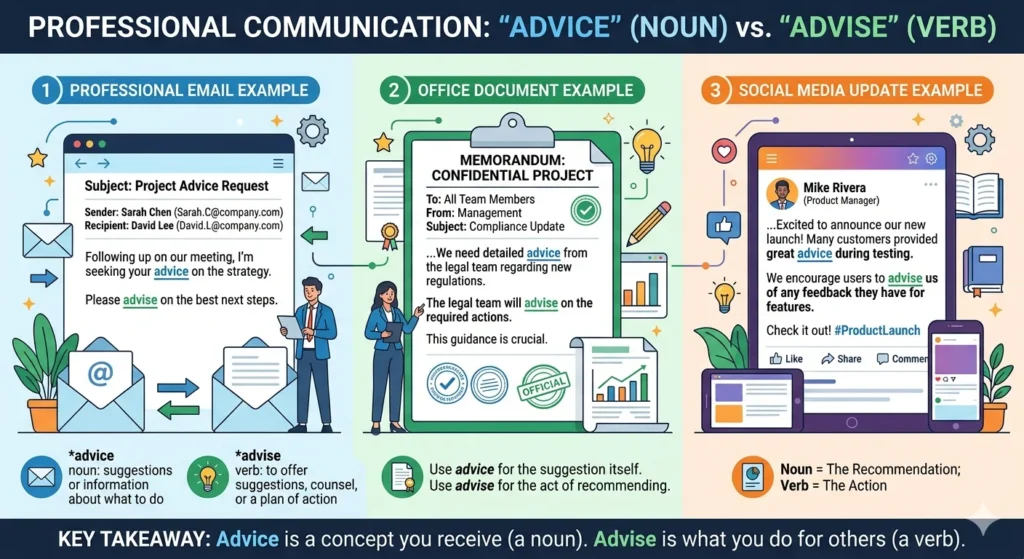
In Emails
- Please advise me about the meeting.
- Thank you for your advice regarding the project.
In Business English
- Payment advice was emailed yesterday.
- The manager advised employees to arrive early.
In News Reports
- Experts advise caution during storms.
- Financial advice can help families save money.
On Social Media
- Can someone give me travel advice?
- My friends advised me to visit Lahore.
In School and College
- Teachers give useful advice.
- Counselors advise students about careers.
These examples show how advice and advise appear naturally in daily English communication.
Advice vs Advise Meaning in Urdu
Many learners search for advice vs advise meaning in Urdu to understand the difference more clearly.
| English Word | Urdu Meaning |
|---|---|
| Advice | مشورہ |
| Advise | مشورہ دینا |
Urdu Examples
- He gave me good advice.
→ اس نے مجھے اچھا مشورہ دیا۔ - I advise you to work hard.
→ میں تمہیں محنت کرنے کا مشورہ دیتا ہوں۔
Payment Advice or Advise
In banking and office communication, the correct phrase is:
✅ Payment advice
“Payment advice” means payment information or a payment notification.
Example
- The company sent payment advice by email.
This phrase is common in formal business English.
Advice vs Advise – Google Trends & Usage Data
Search trend data shows that advice vs advise meaning receives thousands of monthly searches globally.
The highest search interest often comes from:
- Pakistan
- India
- United States
- United Kingdom
- Canada
- Australia
People frequently search:
- advice vs advise pronunciation
- please advice vs advise
- doctor advice or advise
- can you advise me or advice me
Why Do People Confuse These Words?
People confuse them because:
- The spelling difference is very small.
- The pronunciation sounds similar.
- Both words relate to suggestions and guidance.
- English noun-and-verb rules can feel confusing.
Most searches come from students, bloggers, content writers, and office workers improving professional communication skills.
Quick Practice Quiz
Test yourself with this mini grammar quiz.
Fill in the blanks:
- Can you _____ me about this problem?
- Thank you for your helpful _____.
- Doctors often _____ patients to exercise.
- She gave me excellent _____.
Answers
- advise
- advice
- advise
- advice
Practice exercises like these help learners remember confusing English words faster.
Comparison Table: Advice vs Advise
| Feature | Advice | Advise |
|---|---|---|
| Grammar Type | Noun | Verb |
| Meaning | Suggestion | To recommend |
| Usage | Thing | Action |
| Example | Helpful advice | I advise you |
| Urdu Meaning | مشورہ | مشورہ دینا |
| Pronunciation | “ice” sound | “eyes” sound |
| Common Error | “an advice” | “please advice me” |
Related Grammar Topics You Should Learn
If you want to improve English grammar and vocabulary, you should also learn:
- affect vs effect
- there vs their
- compliment vs complement
- accept vs except
- advice vs suggestion
These confusing English words are very common in academic writing and professional communication.
FAQs About Advice vs Advise
When should I use advice or advise?
Use advice as a noun for suggestions or guidance. Use advise as a verb when recommending something.
Example:
- She gave useful advice.
- I advise practicing daily.
Can you please advise or advice me?
Correct sentence:
✅ Can you please advise me?
Because “advise” is the verb.
Can you give me some advice or advise?
Correct sentence:
✅ Can you give me some advice?
Because “advice” is the noun.
Is it doctor’s advice or advise?
Correct phrase:
✅ Doctor’s advice
Example:
- The doctor’s advice improved my health.
What is the difference between advice and advise?
Advice means a suggestion or recommendation. Advise means to recommend or guide someone.
Is advice countable or uncountable?
Advice is usually uncountable.
Correct:
- some advice
Incorrect:
- an advice
How do you pronounce advice and advise?
- Advice → ends with an “S” sound
- Advise → ends with a “Z” sound
This pronunciation difference helps learners remember the correct usage.
Conclusion
The confusion between advice vs advise is very common, but the rule is actually simple once you understand grammar basics. The word advice is a noun that means a suggestion, recommendation, or guidance. The word advise is a verb that means to give guidance or recommend something.
A quick memory trick can help forever:
- Advice = thing
- Advise = action
This small difference matters in business English, academic writing, professional emails, and everyday communication. Many grammar mistakes happen because writers accidentally use the noun instead of the verb.
Grammar experts and professional editors recommend checking advice and advise carefully before sending important emails or documents. Correct grammar improves trust, clarity, and professionalism.
Next time you write a sentence, remember this simple rule:
You ask for advice, but people advise you.
Once you practice the examples and quiz in this guide, using advice and advise correctly will become natural in daily English writing and speaking.

Pam Peters is a linguist and grammar expert, known for clear explanations of modern English usage, style, and practical language rules.