Have you ever written “many country’s” and wondered if it was wrong? You are not alone. Many students, bloggers, and English learners confuse countries vs country’s because both words look similar, but they have different meanings in English grammar.
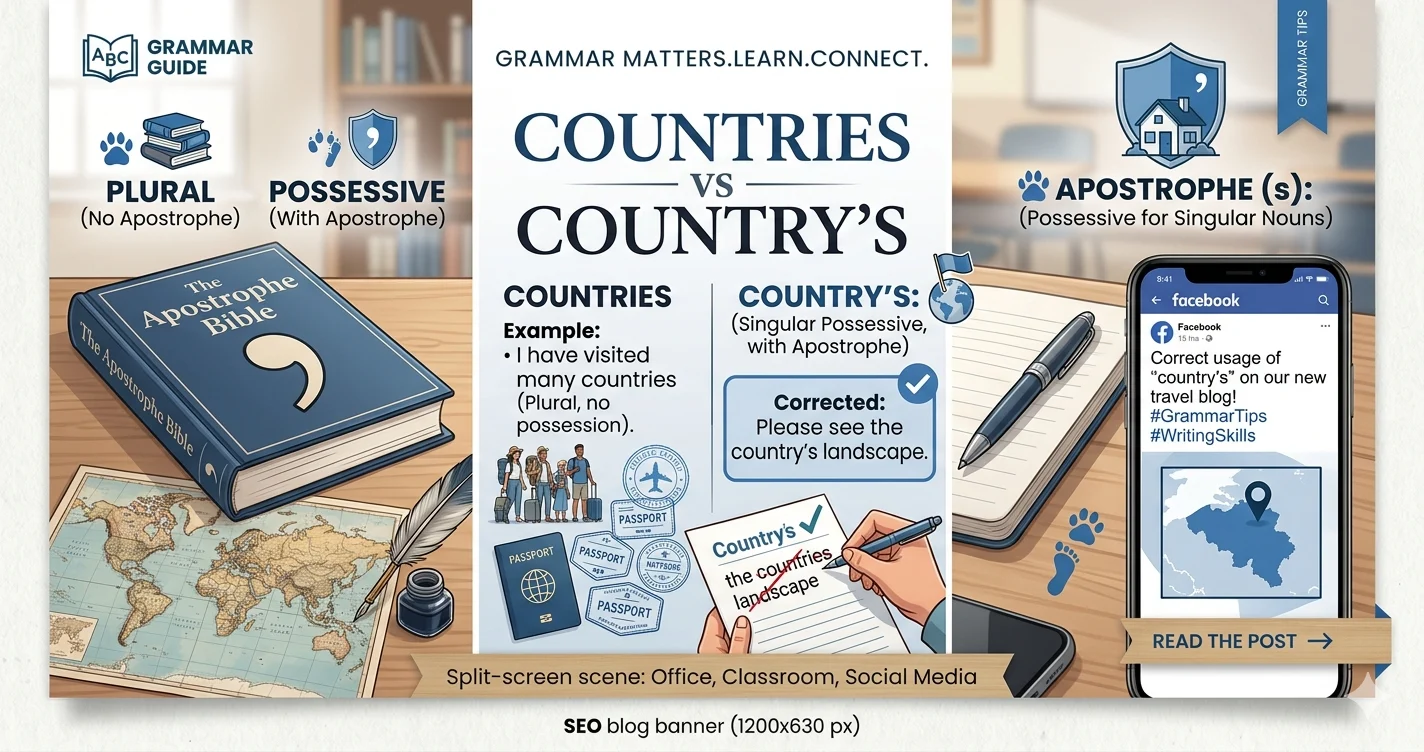
The simple difference is:
- Countries is the plural form of country
- Country’s shows possession or ownership
This small apostrophe changes the meaning completely. That is why many people search questions like:
- Which one is correct, country’s or countries?
- What is the plural form of country?
- Country’s or countries possessive?
In this guide, you will learn the grammar rules, meanings, examples, common mistakes, and correct usage of countries, country’s, and countries’ in simple English.
Countries vs Country’s
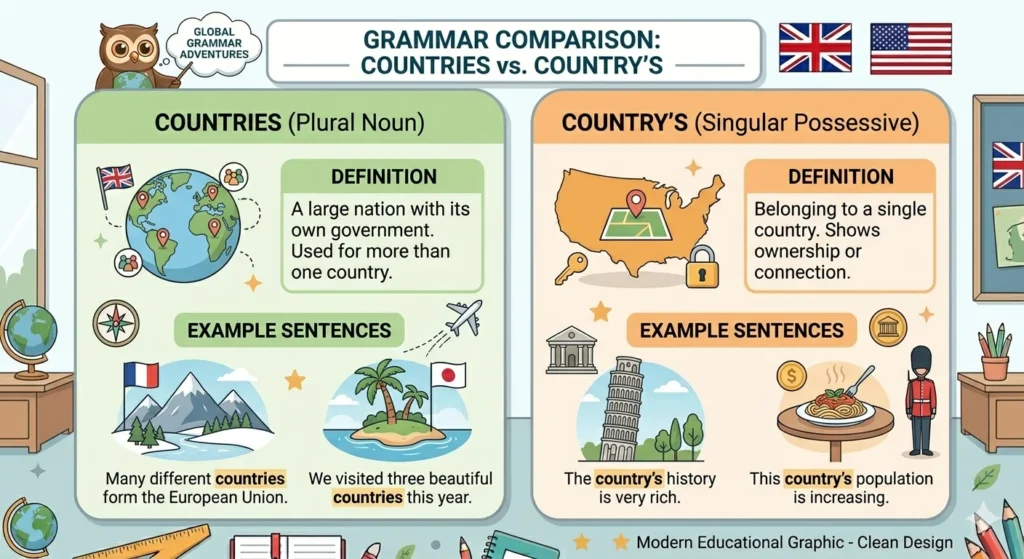
Countries is the plural form of country.
Country’s is the singular possessive form showing ownership.
Examples
- Many countries support international trade.
- The country’s economy is improving rapidly.
Countries vs Country’s
The difference between countries and country’s is simple.
| Word | Meaning | Grammar Type |
|---|---|---|
| Countries | More than one country | Plural noun |
| Country’s | Something belongs to one country | Singular possessive noun |
Simple Grammar Rule
Use “Countries”
When talking about:
- multiple nations
- several countries
- groups of nations
Use “Country’s”
When showing:
- ownership
- possession
- belonging
Quick Examples
- Several countries joined the meeting.
- The country’s president gave a speech.
- Many countries have different cultures.
- The country’s healthcare system improved.
This follows standard English punctuation and possessive grammar rules used in academic, business, and professional writing.
Why This Grammar Mistake Matters
Many people think apostrophe mistakes are small, but they can affect writing quality and professionalism.
Correct grammar:
- improves readability
- builds reader trust
- strengthens academic writing
- makes blogs look professional
- improves communication clarity
Even small punctuation mistakes can confuse readers or make writing look less polished.
For example:
- “Many country’s joined the event” looks incorrect immediately to experienced readers.
- “Many countries joined the event” looks natural and professional.
That is why understanding countries vs country’s grammar is important for students, bloggers, businesses, and English learners.
The Origin of Countries vs Country’s
Understanding word history makes grammar easier.
The word country comes from the Old French word contree, meaning land, region, or territory. Later, Middle English adopted the spelling country.
Over time, English grammar developed separate rules for:
- plural nouns
- possessive nouns
- apostrophe usage
That is why countries and country’s have different meanings today.
How “Countries” Was Formed
English grammar changes nouns ending in consonant + y into -ies in plural form.
Examples
| Singular | Plural |
|---|---|
| Country | Countries |
| City | Cities |
| Family | Families |
| Baby | Babies |
So the plural form of country becomes countries.
This follows a standard English plural noun rule.
How “Country’s” Was Formed
English uses apostrophes to show possession.
Examples
- The teacher’s desk
- The company’s office
- The country’s flag
In these examples, something belongs to someone or something.
So:
Country’s means something belonging to one country.
This is called a singular possessive noun in English grammar.
British English vs American English Spelling
Some English words change spelling between British and American English.
Examples:
- Colour → Color
- Travelling → Traveling
- Centre → Center
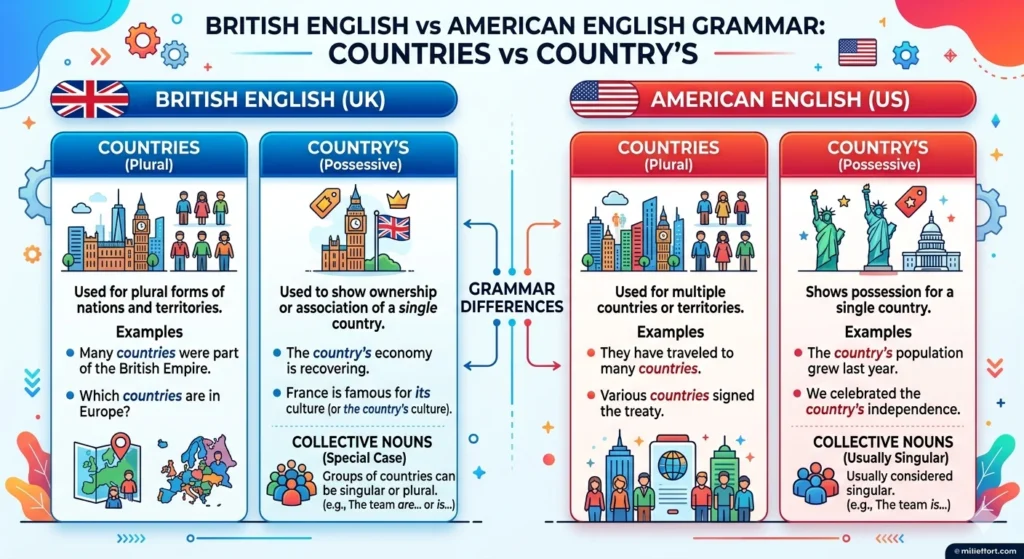
However, countries vs country’s follows the same grammar rules in both writing systems.
There is no spelling difference here.
British vs American Comparison Table
| Usage | British English | American English |
|---|---|---|
| Plural form | Countries | Countries |
| Singular possessive | Country’s | Country’s |
| Plural possessive | Countries’ | Countries’ |
British English Examples
- European countries signed the agreement.
- The country’s healthcare system improved.
American English Examples
- Several countries increased exports.
- The country’s economy grew rapidly.
Whether you write for the UK, US, Canada, Australia, or international audiences, these grammar rules stay exactly the same.
Which Spelling Should You Use?
The correct spelling depends on your sentence meaning.
Use “Countries” for Plural Meaning
Use countries when talking about:
- multiple nations
- several regions
- groups of countries
Examples
- Many countries support climate action.
- Different countries have different cultures.
- Asian countries are growing rapidly.
Use “Country’s” for Possession
Use country’s when something belongs to one nation.
Examples
- The country’s economy improved.
- The country’s laws changed recently.
- The country’s leader addressed the public.
Professional Writing Advice
Correct apostrophe usage improves:
- writing clarity
- professionalism
- reader trust
- grammar accuracy
For Students
Correct grammar improves academic writing quality.
For Bloggers
Proper punctuation makes content look more trustworthy.
For Businesses
Grammar mistakes reduce credibility in emails, reports, and presentations.
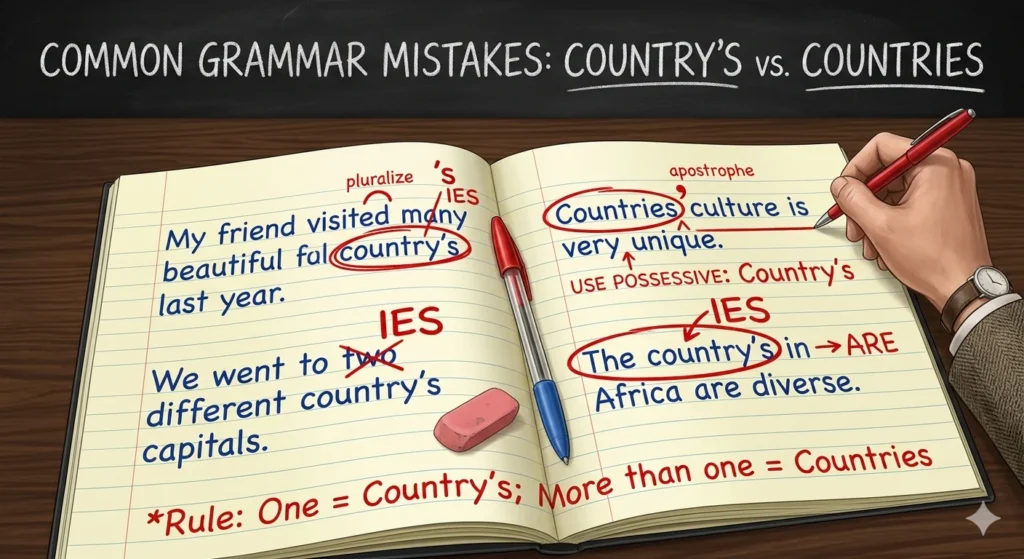
Common Mistakes with Countries vs Country’s
Apostrophe mistakes are among the most common English writing errors online.
Many writers incorrectly believe apostrophes make words plural. In standard English grammar, apostrophes usually show possession instead.
Similar confusion also happens in grammar pairs like:
- Its vs It’s
- Their vs There
- Advice vs Advise
Common Errors and Corrections
| Incorrect Sentence | Correct Sentence |
|---|---|
| Many country’s joined the event. | Many countries joined the event. |
| The countries economy is improving. | The country’s economy is improving. |
| Several country’s signed the agreement. | Several countries signed the agreement. |
| The countries flag is blue. | The country’s flag is blue. |
Why These Mistakes Happen
People often confuse:
- plural nouns
- possessive nouns
- apostrophe rules
- punctuation grammar
This confusion is extremely common among beginner writers and English learners.
Small grammar mistakes like this happen more often than people think, especially in:
- fast typing
- social media captions
- informal emails
- online comments
Easy Memory Trick
Ask yourself:
Talking about many nations?
Use → Countries
Showing ownership for one nation?
Use → Country’s
Showing ownership for many nations?
Use → Countries’
This simple proofreading trick helps writers avoid punctuation mistakes quickly.
Quick Proofreading Tip
Before publishing your writing, quickly check your sentence:
Remove the apostrophe
If you mean:
- multiple countries
- many nations
- plural meaning
Keep the apostrophe
If you mean:
- ownership
- possession
- belonging
This simple proofreading habit can instantly improve grammar accuracy in essays, blogs, emails, and professional writing.
Countries vs Country’s in Everyday Examples
Grammar becomes easier when you see real-world examples.
In Emails
- Several countries accepted the proposal.
- The country’s ambassador replied yesterday.
In News Headlines
- European countries discuss trade policy.
- The country’s economy shows strong growth.
In Social Media
- I want to visit more countries this year.
- The country’s beaches look beautiful.
In Academic Writing
- Developing countries need stronger infrastructure.
- The country’s legal system changed recently.
Countries or Country’s in a Sentence
| Word | Example Sentence |
|---|---|
| Countries | Different countries have unique traditions. |
| Country’s | The country’s leader announced reforms. |
These examples show how one apostrophe changes sentence meaning completely.
Countries vs Country’s – Google Trends & Usage Data
Searches related to countries vs country’s grammar continue growing because apostrophe rules confuse millions of English learners worldwide.
Grammar-related searches are especially popular in:
- United States
- United Kingdom
- India
- Pakistan
- Canada
- Australia
Why People Search This Keyword
Common search queries include:
- What is the plural form of country?
- Country’s or countries possessive
- Countries or country’s meaning
- Countries or country’s examples
- Countries or country’s grammar
- Countries or country’s plural possessive
These searches show strong interest in:
- punctuation rules
- possessive grammar
- grammar correction
- English writing mistakes
- plural noun rules
Usage by Writing Context
| Writing Context | Most Common Form |
|---|---|
| Travel blogs | Countries |
| News articles | Both |
| Political writing | Country’s |
| Academic essays | Both |
| Social media | Countries |
Plural forms appear more in travel and geography writing, while possessive forms appear more in political and economic content.
Countries vs Country’s Comparison Table
| Feature | Countries | Country’s |
|---|---|---|
| Meaning | More than one country | Belonging to one country |
| Grammar Type | Plural noun | Singular possessive noun |
| Apostrophe | No | Yes |
| Example | Many countries trade globally. | The country’s economy improved. |
| Purpose | Quantity | Ownership |
Country’s vs Countries’ – Understanding Plural Possessive Forms
Many learners also confuse country’s and countries’.
Here is the complete grammar breakdown:
| Form | Meaning |
|---|---|
| Country | One nation |
| Countries | More than one nation |
| Country’s | Belonging to one nation |
| Countries’ | Belonging to many nations |
Examples
Singular Possessive
- The country’s capital city is beautiful.
(One country owns the capital.)
Plural Possessive
- The countries’ leaders met yesterday.
(Multiple countries own the leaders collectively.)
This punctuation rule is very important in formal English and academic writing.
Related Grammar Guides
If you enjoy learning English grammar differences, you may also like:
- Its vs It’s
- Their vs There
- Affect vs Effect
- Woman vs Women
- Advice vs Advise
- Principal vs Principle
- Less vs Fewer
- Then vs Than
Reading related grammar guides improves:
- punctuation skills
- vocabulary
- sentence clarity
- writing confidence
Expert Grammar Tip
Professional editors and grammar teachers recommend checking apostrophes carefully during proofreading.
A simple apostrophe mistake can:
- change sentence meaning
- reduce writing credibility
- confuse readers
- weaken professional writing
In academic and business English, correct punctuation improves clarity, trust, and communication quality.
Standard English grammar guides also agree that apostrophes usually show possession rather than plural forms.
FAQs About Countries vs Country’s
What’s the difference between country’s and countries?
Countries means more than one country, while country’s shows ownership for one country.
Is it our countries or country’s?
Use countries when talking about multiple nations. Use country’s when something belongs to one nation.
Which one is correct, country’s or countries?
Both words are correct, but they are used differently in sentences.
What is the plural form of country?
The plural form of country is countries.
What does country’s mean?
Country’s means something belongs to one country.
Example:
- The country’s economy improved rapidly.
What is the plural possessive form?
The plural possessive form is countries’.
Example:
- The countries’ leaders attended the summit.
Why does country become countries?
English grammar changes nouns ending in consonant + y into -ies in plural form.
Example:
- Country → Countries
Can country’s be plural?
No. Country’s is singular possessive, not plural.
Is countries’ grammatically correct?
Yes. Countries’ is the plural possessive form.
Conclusion
Understanding countries vs country’s is simple once you know the difference between plural nouns and possessive nouns. Countries means more than one country, while country’s shows ownership for one country.
Apostrophe mistakes are very common in English writing, especially in blogs, emails, essays, and social media posts. The easiest way to avoid confusion is to ask yourself:
“Am I talking about many countries or ownership?”
If you mean multiple nations, use countries. If something belongs to one nation, use country’s. And if something belongs to many nations, use countries’.
Using correct grammar improves clarity, professionalism, and writing confidence in both academic and everyday English.