Your spell checker says canceled, but another website writes cancelled. So which spelling is actually correct?
This small spelling difference confuses millions of English learners, bloggers, students, teachers, and even native speakers every year. You may read canceled in an American newspaper, while British websites often use cancelled with two “L’s.” Because both spellings appear online, many people think one version must be wrong.
The truth is simple: both spellings are correct. The difference comes from American English vs British English spelling rules. In the United States, writers usually use canceled. In the United Kingdom, Canada, Australia, and many Commonwealth countries, people commonly use cancelled.
That is why users search for questions like:
- Which is correct cancelled or canceled?
- Is it cancelled or canceled in the US?
- Canceled or cancelled AP style
- Canceled vs cancelled grammar
- What does “canceled” mean?
This guide explains everything clearly in simple English. You will learn spelling rules, grammar differences, pronunciation, dictionary preferences, real-life examples and common mistakes. By the end, you will know exactly which spelling to use confidently in emails, essays, blogs, business writing, and social media posts.
Canceled vs Cancelled
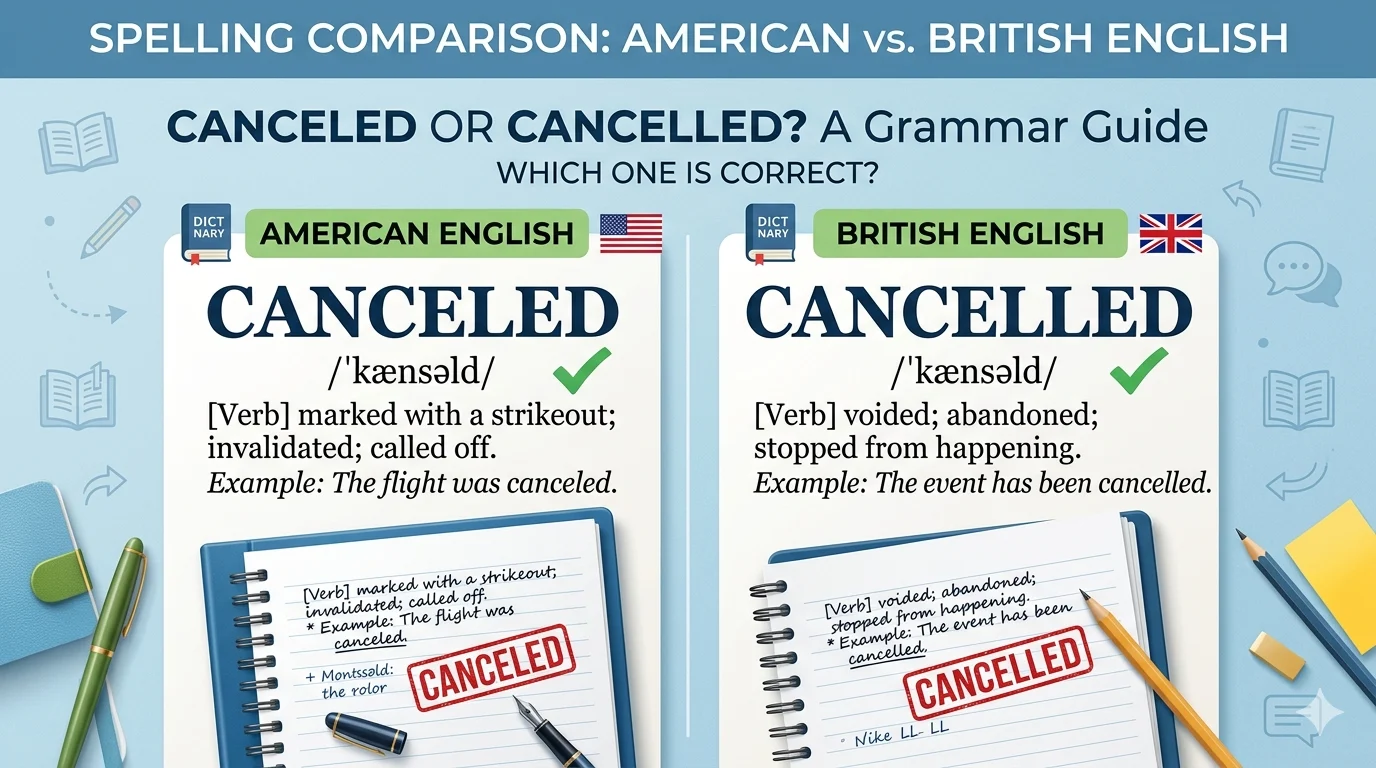
Which is correct: cancelled or canceled?
✅ Both spellings are correct.
✅ Canceled is American English.
✅ Cancelled is British English.
Both words have the same meaning. They mean:
- stopped
- called off
- ended
- removed before completion
Quick Examples
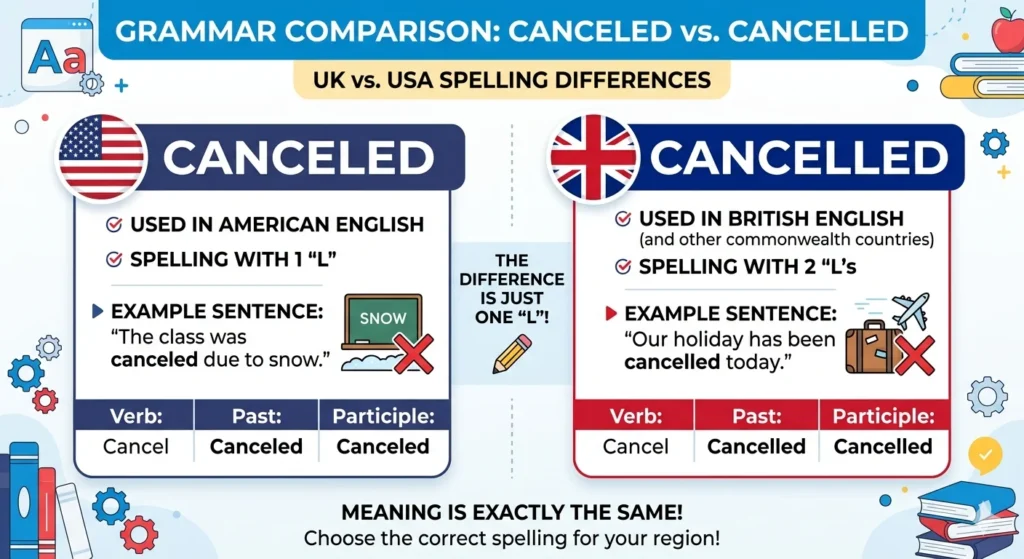
American English 🇺🇸
- The flight was canceled because of snow.
- Our meeting got canceled today.
British English 🇬🇧
- The concert was cancelled after the storm.
- The football match was cancelled yesterday.
Quick Comparison Table
| Word | English Style | Example |
|---|---|---|
| Canceled | American English | The class was canceled. |
| Cancelled | British English | The class was cancelled. |
If you write for American readers, use canceled.
If you write for British or Commonwealth readers, use cancelled.
The Origin of Canceled vs Cancelled
The word cancel comes from the Latin word cancellare, meaning “to cross out.” Later, it entered Old French and eventually became part of English vocabulary.
Over time, British English and American English developed different spelling systems. This created many spelling differences that still exist today.
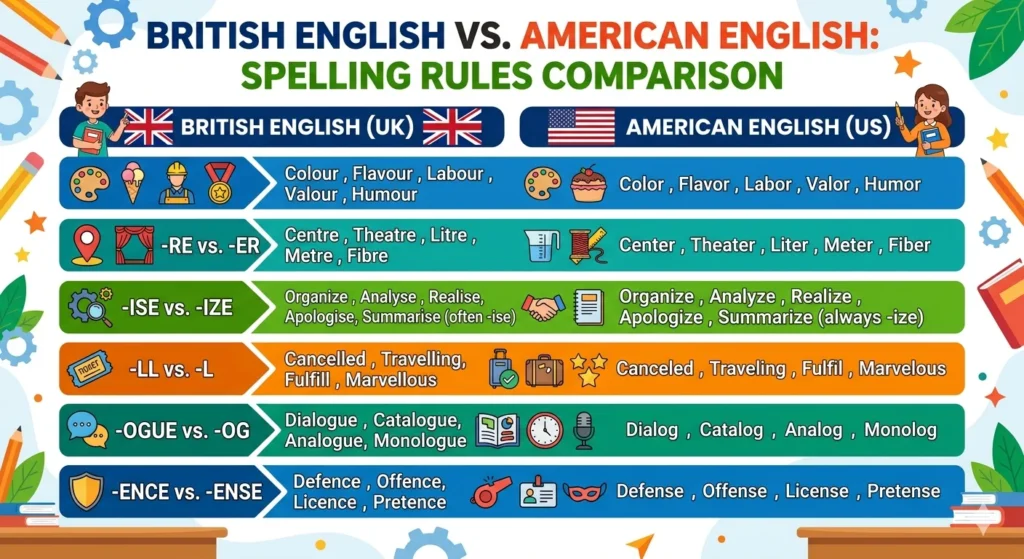
American vs British Spelling Patterns
| American English | British English |
|---|---|
| traveled | travelled |
| labeled | labelled |
| modeled | modelled |
| canceled | cancelled |
Why Does British English Use “Cancelled”?
British English usually doubles the final “L” before adding endings like:
- -ed
- -ing
Examples:
- travel → travelled
- signal → signalled
- cancel → cancelled
Why Does American English Use “Canceled”?
American English simplified many spelling patterns over time. Dictionaries and style guides in the United States preferred shorter spellings.
Examples:
- traveled
- labeled
- canceled
This spelling difference is part of the larger spelling differences between American and British English.
British English vs American English Spelling
The difference between canceled vs cancelled mainly comes from regional spelling rules.
American English Spelling Rule
In American English, writers usually do not double the final consonant unless the last syllable is stressed.
The stress in cancel falls on the first syllable:
CAN-cel
So Americans usually write:
✅ canceled
✅ canceling
American English Examples
- The event was canceled yesterday.
- She is canceling her subscription.
- Our flight got canceled again.
British English Spelling Rule
British English often doubles the final “L” before adding endings.
So British writers usually prefer:
✅ cancelled
✅ cancelling
British English Examples
- The meeting was cancelled this morning.
- He is cancelling the order.
- Their reservation was cancelled online.
Full Comparison Table
| American English | British English |
|---|---|
| canceled | cancelled |
| canceling | cancelling |
| traveled | travelled |
| labeled | labelled |
| signaling | signalling |
Canceling vs Cancelling
Many people searching for canceled vs cancelled also want to understand canceling vs cancelling.
The rule is exactly the same.
| American English | British English |
|---|---|
| canceling | cancelling |
Examples
American English
- She is canceling her gym membership.
British English
- She is cancelling her gym membership.
Important Writing Tip
Choose one English style and stay consistent.
Do not write:
❌ canceling and cancelling together randomly
Consistency improves:
- readability
- professionalism
- SEO quality
- reader trust
Which Spelling Should You Use?
The correct spelling depends on your audience and writing style.
Use “Canceled” If:
Use canceled when:
- writing for American readers
- following AP Style
- creating US business content
- publishing on American websites
- using American spelling rules
Example
- The airline canceled all flights.
Use “Cancelled” If:
Use cancelled when:
- writing for UK readers
- targeting Canada or Australia
- following British English
- writing for Commonwealth countries
Example
- The train was cancelled because of bad weather.
Best Advice for Global Writing
If your audience is international:
✅ choose one spelling style
✅ use it consistently everywhere
Mixing American and British spelling in the same article can confuse readers and reduce professionalism.
Common Mistakes with Canceled vs Cancelled
Many English learners make small grammar and spelling mistakes with these words.
Mistake 1: Mixing Both Spellings
Wrong
❌ The show was canceled and later cancelled again.
Correct
✅ The show was canceled and later canceled again.
OR
✅ The show was cancelled and later cancelled again.
Mistake 2: Using the Wrong Style Guide
Many writers search for:
Canceled or cancelled AP style?
The Associated Press Stylebook uses:
✅ canceled
✅ canceling
because AP Style follows American English spelling.
Mistake 3: Wrong Past Tense Forms
People often search for:
Cancel past tense
Here are the correct forms:
| Verb Form | American English | British English |
|---|---|---|
| Present | cancel | cancel |
| Past | canceled | cancelled |
| Continuous | canceling | cancelling |
Mistake 4: Spelling Errors
Common misspellings include:
❌ cancellled
❌ cancelld
❌ cancealed
Correct spellings are:
✅ canceled
✅ cancelled
Why Do Spell Checkers Disagree?
Many people become confused because grammar checkers and spell checkers sometimes show different results.
This usually happens because of language settings.
American English Settings
If your device uses US English, programs like:
- Grammarly
- Microsoft Word
- Google Docs
usually prefer:
✅ canceled
✅ canceling
British English Settings
If your device uses UK English, the same tools may prefer:
✅ cancelled
✅ cancelling
Why This Happens
Spell checkers follow regional dictionary rules.
For example:
- Merriam-Webster mainly uses American spelling
- Cambridge Dictionary often uses British spelling
- Oxford Dictionary includes both forms
Your spelling checker is not necessarily correcting you because you are wrong. It is simply following a different English language setting.
How to Pronounce Canceled and Cancelled
Many learners wonder whether the pronunciation changes.
The answer is simple:
✅ Both words are pronounced the same way.
Pronunciation
CAN-suhld
The only difference is spelling, not pronunciation.
Canceled vs Cancelled in Everyday Examples
Real examples make grammar rules easier to remember.
In Emails
American English
- Your appointment has been canceled.
British English
- Your booking has been cancelled.
In News Headlines
US News Style
- Flights Canceled Across Chicago
UK News Style
- Football Matches Cancelled Due to Snow
In Social Media
- “My vacation got canceled 😭”
- “The concert was cancelled again!”
Social media often mixes both spellings because users come from different countries.
In Formal Writing
Formal writing should stay consistent with one spelling style.
Business Example
- The contract was canceled immediately.
Academic Example
- Classes were cancelled because of severe weather.
Canceled vs Cancelled Grammar Rules
Many users search for Canceled vs cancelled grammar because the spelling rule looks confusing.
The good news is that the grammar pattern is simple.
American Grammar Pattern
American English usually avoids doubling the final consonant unless the stress is on the last syllable.
Examples:
| Word | American Form |
|---|---|
| visit | visited |
| open | opened |
| cancel | canceled |
British Grammar Pattern
British English doubles the final “L” more often before adding endings.
Examples:
| Word | British Form |
|---|---|
| travel | travelled |
| signal | signalled |
| cancel | cancelled |
This spelling difference is part of broader English spelling rules.
Canceled vs Cancelled Meaning
What does “canceled” mean?
The word means:
- stopped
- ended
- called off
- removed before completion
The meaning stays exactly the same in both spellings.
Examples
- The teacher canceled the exam.
- Our order was canceled online.
- The festival was cancelled because of rain.
- She cancelled her subscription yesterday.
Canceled vs Cancelled Examples
Here are more real-life examples.
| Situation | American English | British English |
|---|---|---|
| Flight | The flight was canceled. | The flight was cancelled. |
| Meeting | The meeting was canceled. | The meeting was cancelled. |
| Reservation | I canceled my booking. | I cancelled my booking. |
| Subscription | She canceled the service. | She cancelled the service. |
Canceled vs Cancelled Reddit Discussions
Searches for Canceled vs cancelled Reddit remain popular because many people discuss this spelling confusion online.
Most Reddit discussions agree on these points:
✅ Both spellings are correct
✅ Americans prefer “canceled”
✅ British writers prefer “cancelled”
✅ AP Style uses “canceled”
Dictionary Preferences
Many users also compare how major dictionaries handle the spelling difference.
Merriam-Webster
Prefers:
✅ canceled
Cambridge Dictionary
Often prefers:
✅ cancelled
Oxford Dictionary
Includes:
✅ both spellings
This is why people continue seeing different spellings across websites, books, blogs, and news articles.
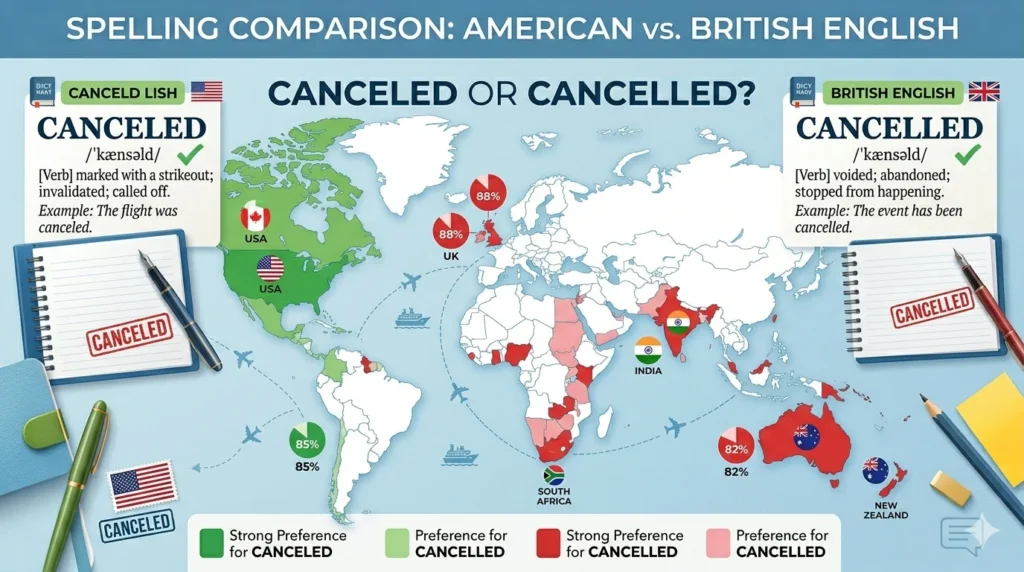
Canceled vs Cancelled – Google Trends & Usage Data
Google Trends shows strong regional spelling differences.
Countries That Prefer “Canceled”
The spelling canceled is more common in:
- United States
- American companies
- US media
- AP Style publications
Google Trends data also shows that “canceled” receives higher search volume in the United States.
Countries That Prefer “Cancelled”
The spelling cancelled is more popular in:
- United Kingdom
- Canada
- Australia
- New Zealand
- Commonwealth countries
British schools and websites usually teach “cancelled” as the standard spelling.
Why This Keyword Trends Every Year
Millions of people continue searching this spelling difference every year because:
- spell checkers give different answers
- American and British English use different rules
- students want grammar help
- bloggers need SEO consistency
- social media mixes both spellings
That is why canceled vs cancelled remains one of the most searched English spelling differences online.
Related Spelling Differences
If you enjoyed learning about canceled vs cancelled, you may also want to learn these common spelling differences:
- traveled vs travelled
- labeled vs labelled
- modeling vs modelling
- signaling vs signalling
- traveled or travelled
- favorite vs favourite
These spelling differences also follow American English vs British English writing rules.
FAQs About Canceled vs Cancelled
Which is correct cancelled or canceled?
Both spellings are correct. “Canceled” is standard in American English, while “cancelled” is preferred in British English and many Commonwealth countries.
Is it cancelled or canceled in the US?
In the United States, the correct and most common spelling is “canceled” with one “L.” American dictionaries and AP Style also prefer this spelling.
Is it canceled or cancelled Merriam Webster?
Merriam-Webster mainly uses “canceled” because it follows American English spelling conventions. British dictionaries often prefer “cancelled.”
What does “canceled” mean?
The word “canceled” means something was stopped, ended, removed, or called off before completion.
Is cancelled wrong?
No. “Cancelled” is completely correct in British English and many Commonwealth countries like Canada and Australia.
What is the past tense of cancel?
The past tense is:
- canceled in American English
- cancelled in British English
Both forms are grammatically correct.
Which spelling should I use for SEO?
Use the spelling that matches your target audience. American readers usually search more for “canceled,” while British readers often search for “cancelled.”
Quick Memory Trick
🇺🇸 America → one L → canceled
🇬🇧 Britain → two Ls → cancelled
This simple trick makes the spelling difference easy to remember.
Conclusion
The confusion between canceled vs cancelled is very common because both spellings appear online, in books, on social media, and in professional writing. Many people become unsure when spell checkers, dictionaries, and websites show different versions of the same word.
The simple answer is that both spellings are correct. The difference comes from regional English spelling rules. American English prefers canceled and canceling, while British English prefers cancelled and cancelling.
If you write for an American audience or follow AP Style, use canceled. If your audience is in the United Kingdom, Canada, Australia, or other Commonwealth countries, use cancelled instead.
The most important writing tip is consistency. Choose one spelling style and use it throughout your article, email, essay, or website. Consistent spelling improves readability, professionalism, SEO quality, and reader trust.
Now you never need to pause and wonder whether to write canceled or cancelled again. You can confidently choose the correct spelling based on your audience, writing style, and language preference.

David Crystal is a renowned English linguist and author, known for making English grammar, linguistics, and language history clear and engaging.