One tiny spelling mistake can completely change your sentence. Many people accidentally write “take a brake” instead of “take a break.” Since both words sound exactly the same, the confusion is very common in English writing.
The difference between break vs brake confuses students, bloggers, office workers, and even native English speakers. People search for phrases like break vs brake meaning, take a break or brake, and does a car break or brake because they want a quick answer and a simple explanation.
English teachers explain that these words are examples of homophones in English. Homophones are words with the same pronunciation but different meanings and spellings. Using the wrong spelling can create grammar mistakes, reduce writing clarity, and make professional writing look less polished.
The good news is that this grammar confusion is easy to fix once you understand the context of each word. This complete grammar guide explains meanings, pronunciation, common mistakes, sentence examples, memory tricks, usage tips, FAQs, and professional writing advice in simple English.
Whether you are a student, content writer, blogger, or English learner, this article will help you use break and brake correctly every time.
Key Takeaways
- Break means pause, damage, separate, or rest.
- Brake means stopping or slowing a vehicle.
- “Take a break” is correct.
- Cars use brakes, not breaks.
- Both words sound the same but have different meanings.
- Break and brake are commonly confused English words.
Break vs Brake
| Word | Meaning | Example |
|---|---|---|
| Break | Pause, damage, stop, separate | “I need a break.” |
| Brake | A device that stops a vehicle | “Press the brake slowly.” |
Simple Difference
- Break = rest, pause, damage
- Brake = stop a car, bike, or machine
Quick Examples
- “Let’s take a break.”
- “The driver pressed the brake.”
- “She broke her phone.”
- “The brake pedal is stuck.”
People often ask:
- Take a break or brake? → Correct: break
- Is it lunch break or brake? → Correct: break
- Does a car break or brake? → Correct: brake
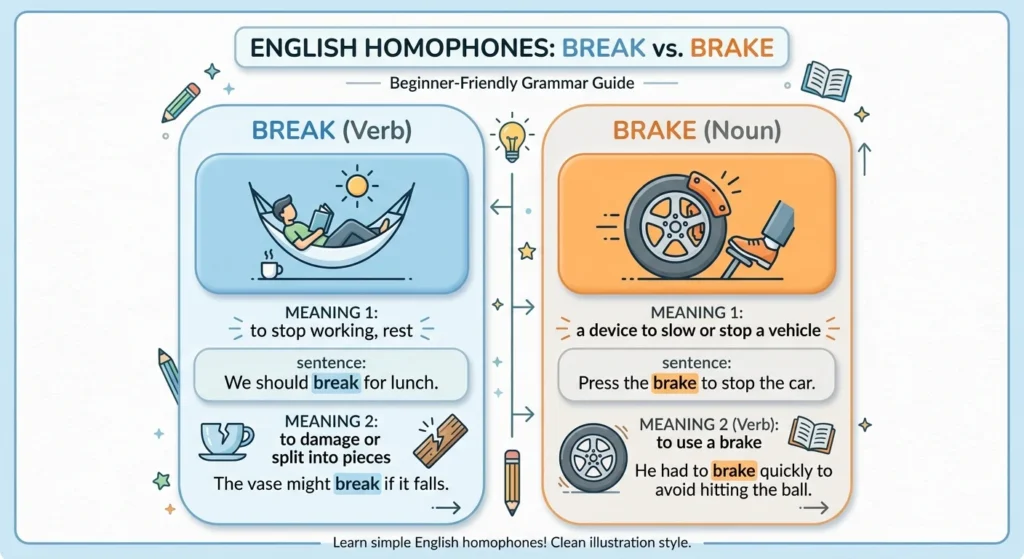
These spelling mistakes are common because the pronunciation is identical.
Easy Memory Trick
A simple memory trick can help you remember the difference forever.
Remember This
- Brake → related to cars and stopping movement.
- Break → related to rest, pause, or damage.
Easy Word Association
| Word | Memory Tip |
|---|---|
| Brake | Think of a car brake |
| Break | Think of a coffee break |
Writing Tip
If the sentence talks about:
- driving,
- cars,
- bikes,
- stopping movement,
then the correct spelling is usually brake.
If the sentence talks about:
- resting,
- pausing,
- damaging,
- separating,
then use break.
The Origin of Break vs Brake
Learning the history of words improves vocabulary understanding and writing accuracy.
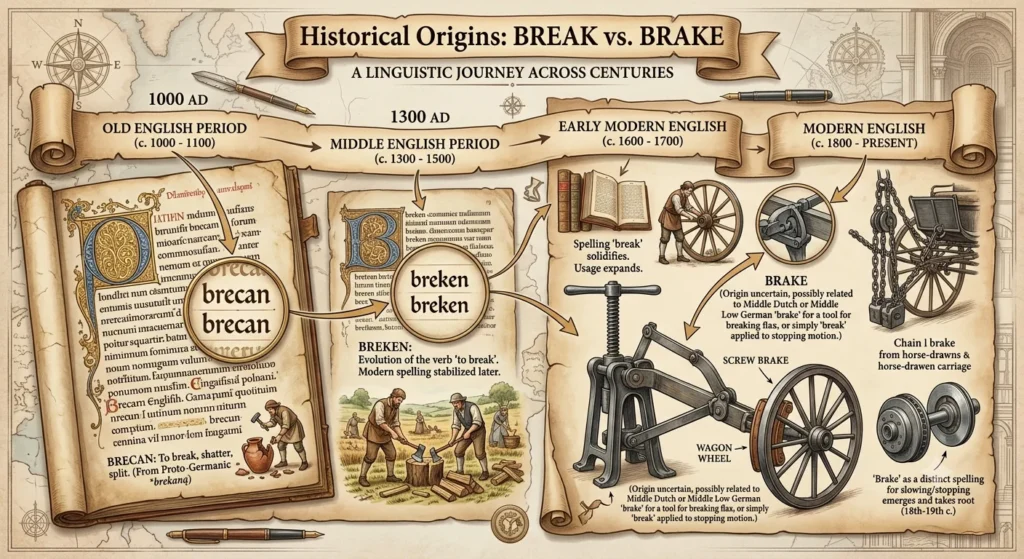
Origin of “Break”
The word break comes from the Old English word brecan. It originally meant:
- split,
- destroy,
- interrupt,
- or separate.
Over time, English speakers started using “break” in many situations:
- break a promise,
- break a bone,
- break the rules,
- coffee break.
Today, it is one of the most commonly used verbs in English grammar.
Origin of “Brake”
The word brake appeared later in English history. It first described a heavy tool used for crushing or slowing movement. As transportation evolved, the meaning became connected to vehicles and stopping systems.
Now, “brake” mainly refers to:
- car brakes,
- bike brakes,
- brake pedals,
- emergency brakes.
British English vs American English Spelling
Unlike many spelling differences in English, break and brake stay the same in both British and American English.
Comparison Table
| Phrase | British English | American English |
|---|---|---|
| Take a break | Correct | Correct |
| Brake pedal | Correct | Correct |
| Lunch break | Correct | Correct |
| Car brake | Correct | Correct |
| Break a bone | Correct | Correct |
Important Note
There is no regional spelling change like:
- colour vs color,
- organise vs organize.
The only challenge is choosing the correct word based on meaning and context.
Which Spelling Should You Use?
The correct spelling depends entirely on the sentence meaning.
Use “Break” When Talking About:
- rest,
- pause,
- damage,
- interruption,
- separation.
Examples
- “Take a break.”
- “Don’t break the glass.”
- “We had a lunch break.”
- “She broke her arm.”
Use “Brake” When Talking About:
- vehicles,
- stopping movement,
- driving,
- transportation systems.
Examples
- “Press the brake pedal.”
- “The brakes stopped working.”
- “The driver slammed the brake.”
Expert Writing Tip
Professional writers and editors carefully proofread words like break and brake because spelling mistakes can reduce clarity and trust.
If you are writing:
- blogs,
- school assignments,
- emails,
- social media captions,
- or business content,
always double-check the sentence meaning before choosing the spelling.
Common Mistakes with Break vs Brake
This grammar confusion appears often in everyday writing.
Mistake #1: “Take a Brake”
❌ Incorrect: “I need to take a brake.”
✅ Correct: “I need to take a break.”
Why?
Because “break” means rest or pause.
Mistake #2: “The Car Breaks Fast”
❌ Incorrect: “The car breaks quickly.”
✅ Correct: “The car brakes quickly.”
Why?
Cars use brakes to stop.
Mistake #3: “Lunch Brake”
❌ Incorrect: “Lunch brake”
✅ Correct: “Lunch break”
A lunch break means a pause from work or school.
Mistake #4: “Brake a Bone”
❌ Incorrect: “He braked his leg.”
✅ Correct: “He broke his leg.”
Mistake #5: “Break Pedal”
❌ Incorrect: “Break pedal”
✅ Correct: “Brake pedal”
This spelling mistake is common in driving-related writing.
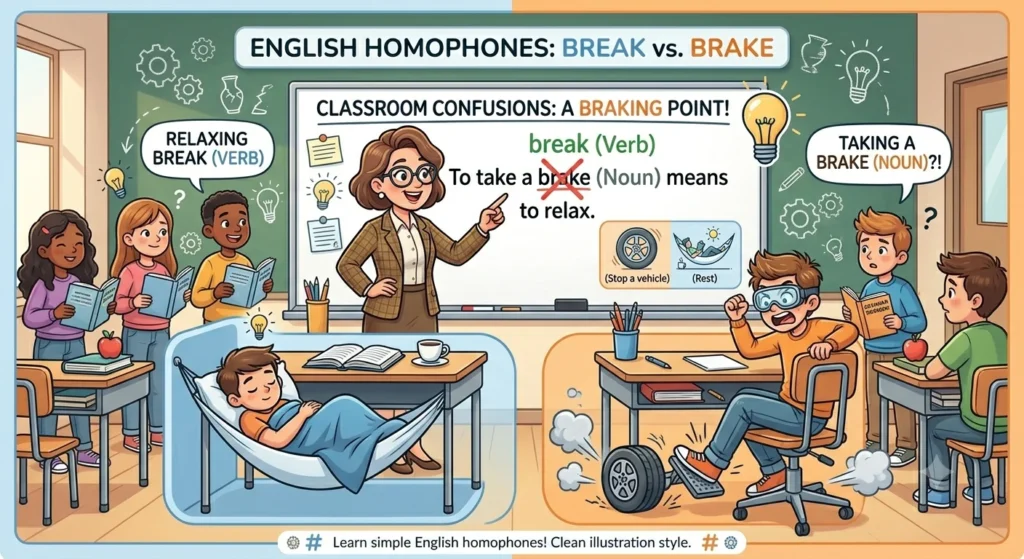
Break and Brake in One Sentence
Using both words together helps learners understand the difference more clearly.
Examples
- “The driver used the brake before the crash could break the fence.”
- “If the brakes fail, the accident may break the wall.”
- “She hit the brake suddenly and nearly broke her phone.”
These sentence examples improve grammar learning and vocabulary memory.
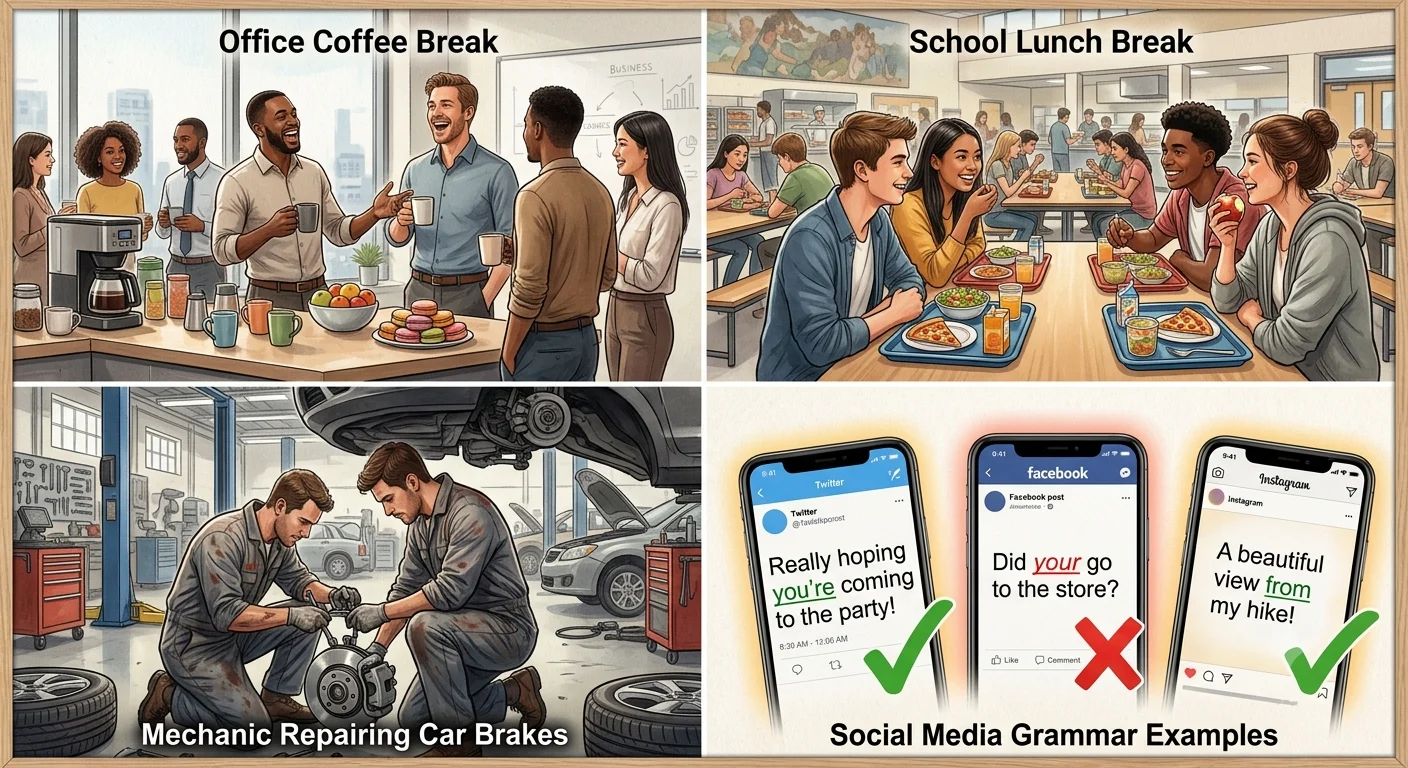
Break vs Brake in Everyday Examples
Real-life examples help English learners understand word usage naturally.
In Schools
- “Students get a lunch break at noon.”
- “The school bus brake needed repair.”
In Offices
- “Employees receive two coffee breaks daily.”
- “The company car brake lights were damaged.”
In Emails
- “Let’s take a short break before the next meeting.”
- “The delivery van brake system needs inspection.”
In Social Media
- “I seriously need a break today.”
- “My bike brake stopped working again.”
In News Headlines
- “Driver presses brake to avoid accident.”
- “Athlete breaks world record.”
In Driving Tests
Driving instructors often remind students:
“Always press the brake slowly during wet weather.”
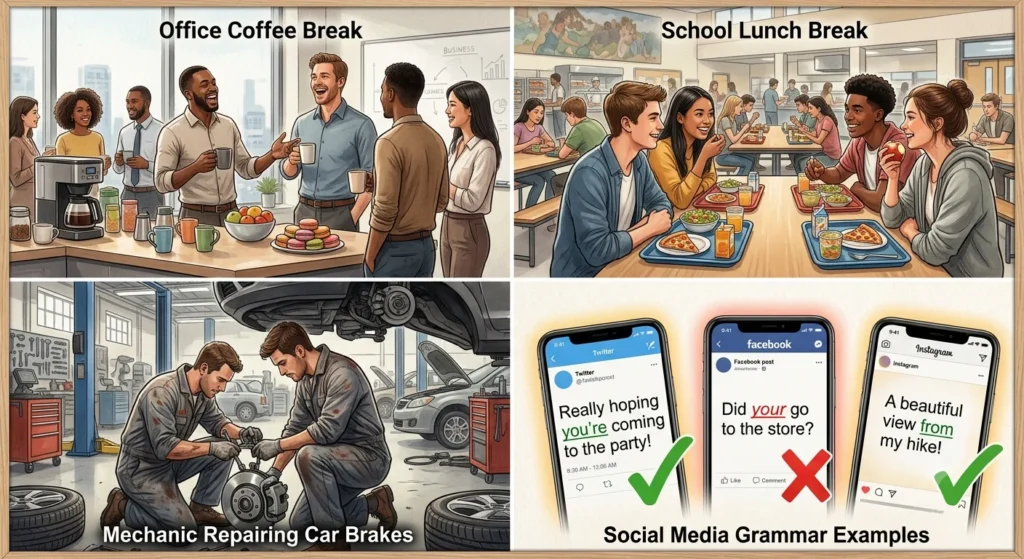
This real-world context helps learners remember the correct spelling.
Break vs Brake Meaning
Meaning of Break
“Break” usually means:
- pause,
- damage,
- separate,
- interrupt,
- rest.
Common Examples
- break a promise,
- break the rules,
- coffee break,
- break a habit.
Meaning of Brake
“Brake” means:
- stop movement,
- slow a vehicle,
- control speed.
Common Examples
- brake pedal,
- emergency brake,
- bike brake,
- brake lights.
Break vs Brake Pronunciation
Pronunciation
Both words are pronounced exactly the same:
/breɪk/
This identical pronunciation causes many spelling mistakes in English.
Break vs Brake Sound
- Break → “brayk”
- Brake → “brayk”
You cannot know the spelling from pronunciation alone. You must understand the sentence meaning.
Break vs Brake Car Usage
When talking about vehicles, the correct word is almost always brake.
Correct Examples
- “The brake pedal feels soft.”
- “The mechanic fixed the rear brake.”
- “Brake lights improve road safety.”
- “The driver pressed the brakes hard.”
Incorrect Examples
❌ “The car break failed.”
✅ “The car brake failed.”
This is one of the most common driving-related grammar mistakes online.
Break vs Brake Bone Usage
When talking about injuries, always use break.
Examples
- “She broke her arm.”
- “He broke a bone.”
- “The accident nearly broke his leg.”
Never use “brake” for injuries or body parts.
Break vs Brake Worksheet and Quiz Practice
Many English learners search for:
- break vs brake worksheet,
- break vs brake quiz,
- brake or break correct spelling.
Practice questions help improve grammar accuracy.
Quick Quiz
1. I need a short ___ from work.
✅ Answer: break
2. Press the car ___ slowly.
✅ Answer: brake
3. She nearly ___ her phone.
✅ Answer: broke
4. The bike ___ stopped working.
✅ Answer: brake
These mini exercises help students remember spelling rules faster.
Google Trends & Usage Data
Search interest for break vs brake remains high because these are commonly confused English words.
Countries Searching the Most
- United States
- United Kingdom
- Canada
- Australia
- India
- Pakistan
Popular Search Queries
People commonly search:
- break vs brake meaning
- break vs brake pronunciation
- break vs brake examples
- take a break or brake
- does a car break or brake
- is it lunch break or brake
- is it taking a break or taking a brake
Why This Topic Is Popular
This keyword stays popular because:
- both words sound identical,
- autocorrect misses the error,
- students confuse the spelling,
- writers want better proofreading accuracy,
- grammar learners search for sentence examples.
Comparison Table: Break vs Brake
| Feature | Break | Brake |
|---|---|---|
| Meaning | Pause, damage, separate | Stop movement |
| Related to vehicles | No | Yes |
| Used for rest | Yes | No |
| Pronunciation | /breɪk/ | /breɪk/ |
| Part of speech | Noun/Verb | Noun/Verb |
| Example | “Take a break.” | “Press the brake.” |
FAQs About Break vs Brake
1. What is the difference between break and brake?
“Break” means pause or damage. “Brake” means stopping a vehicle or machine.
2. Is it taking a break or taking a brake?
Correct phrase:
✅ “taking a break.”
3. Does a car break or brake?
A car uses brakes to stop safely.
4. Is it lunch break or lunch brake?
Correct phrase:
✅ “lunch break.”
5. Why do break and brake sound the same?
Because they are homophones in English grammar.
6. Can break and brake be used in one sentence?
Yes.
Example:
“The driver used the brake before the crash could break the fence.”
7. How can I remember the difference?
Use this memory trick:
- break = pause or damage,
- brake = vehicle stopping system.
Conclusion
The confusion between break vs brake is extremely common because both words have the same pronunciation but completely different meanings. “Break” is connected to resting, pausing, interrupting, separating, or damaging something, while “brake” relates to stopping vehicles and controlling movement.
The easiest way to remember the difference is simple:
- use break for rest, pauses, or damage,
- use brake for cars, bikes, trucks, and stopping systems.
This grammar difference matters in school writing, professional emails, blog posts, workplace communication, and social media content. English teachers and editors often explain that small spelling mistakes can affect writing quality and reader trust. That is why proofreading commonly confused words is important for clear communication.
If you still feel unsure, focus on the sentence meaning:
- talking about rest or damage? → use break
- talking about driving or stopping? → use brake
Bookmark this grammar guide so you never confuse break and brake again.

Pam Peters is a linguist and grammar expert, known for clear explanations of modern English usage, style, and practical language rules.