Have you ever written “bare with me” instead of “bear with me”? You are not alone. The confusion between bear vs bare is one of the most common English grammar mistakes because both words sound exactly the same.
People often search for phrases like “I can’t bear it or bare it,” “bear vs bare meaning,” and “is it bear the pain or bare the pain?” because they want a quick and clear answer. These words are called homophones, meaning they have the same pronunciation but different meanings and spellings.
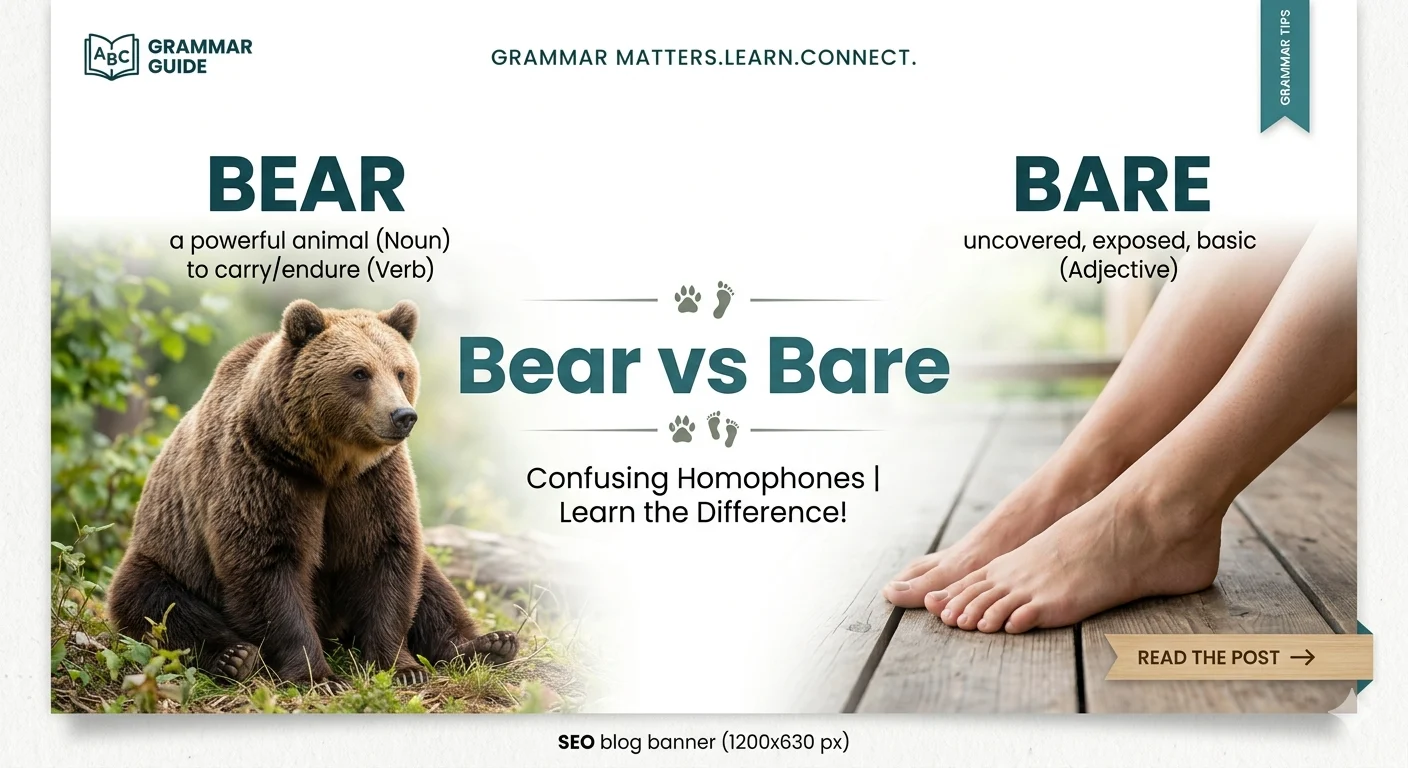
The difference is simple once you understand it. Bear usually means to endure, support, or tolerate something, while bare means uncovered or exposed.
In this guide, you will learn the meanings, grammar rules, common mistakes, real-life examples, and correct usage of bear and bare in everyday English.
Key Takeaways
- Bear means endure, support, or tolerate.
- Bare means uncovered or exposed.
- “Bear with me” is correct.
- “Bare feet” is correct.
- Bear and bare are homophones with different meanings.
Bear vs Bare
Bear vs bare is one of the most confusing English word pairs.
- Bear means to endure, support, tolerate, or carry.
- Bare means uncovered, exposed, or empty.
Quick Definition
Bear vs bare: “Bear” means to endure or carry something, while “bare” means uncovered or exposed.
Simple Examples
| Word | Meaning | Correct Example |
|---|---|---|
| Bear | Endure or carry | “I can’t bear the pain.” |
| Bare | Uncovered or exposed | “She walked with bare feet.” |
Quick Writing Tip
If you can replace the word with “tolerate,” use bear.
If you can replace it with “uncovered,” use bare.
Common Searches Answered
| Question | Correct Answer |
|---|---|
| I can’t bear it or bare it? | ✅ Bear it |
| Bear with me or bare with me? | ✅ Bear with me |
| Bear or bare the pain? | ✅ Bear the pain |
| Bear or bare the cost? | ✅ Bear the cost |
| Bare or bear the thought? | ✅ Bear the thought |
| Is it bare or bear any weight? | ✅ Bear weight |
| Is it bear the loss or bare the loss? | ✅ Bear the loss |
The Origin of Bear vs Bare
The history of these confusing English words explains why people still mix them up today.
Origin of “Bear”
The word bear comes from Old English beran, which meant:
- to carry
- to support
- to endure
- to tolerate
Over time, people started using it in phrases like:
- bear responsibility
- bear the pain
- bear the cost
- bear with me
Today, the meaning still relates to carrying or enduring something difficult.
Origin of “Bare”
The word bare comes from Old English bær, meaning:
- uncovered
- exposed
- empty
This meaning still appears in modern phrases like:
- bare feet
- bare hands
- bare walls
- bare minimum
Why People Confuse Them
It is easy to understand why people confuse these words because they sound exactly alike in everyday conversation.
Since bear and bare are English homophones, many writers hear the word correctly but choose the wrong spelling while typing quickly.
Trusted grammar sources like Merriam-Webster and Cambridge Dictionary also explain that these words are commonly confused in English grammar.
British English vs American English Spelling
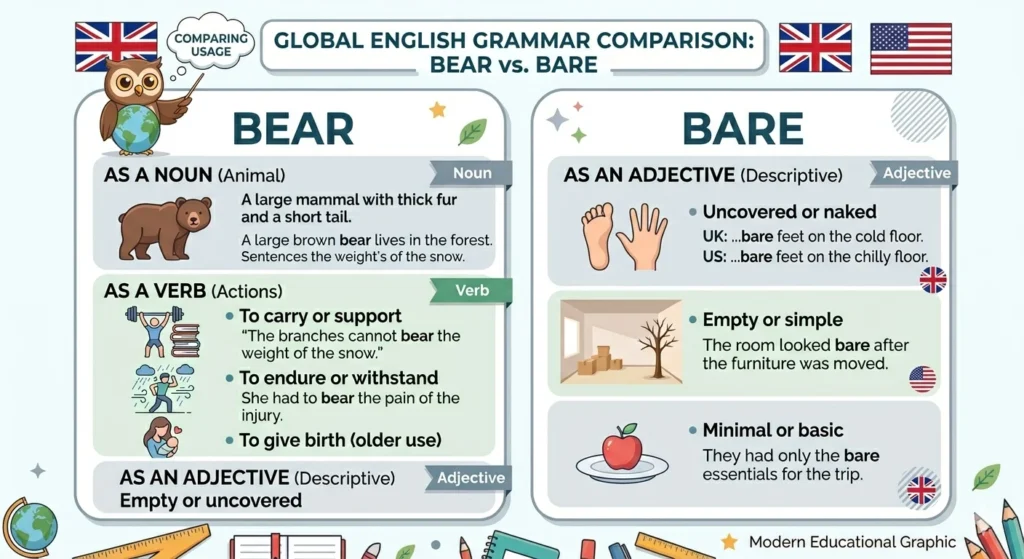
Unlike some English spelling differences, bear and bare are spelled the same in both British and American English.
There are no regional spelling changes.
Comparison Table
| Phrase | Correct Spelling | British English | American English |
|---|---|---|---|
| Bear the pain | ✅ Correct | Same | Same |
| Bare the pain | ❌ Incorrect | Same | Same |
| Bear with me | ✅ Correct | Same | Same |
| Bare with me | ❌ Incorrect | Same | Same |
| Bare feet | ✅ Correct | Same | Same |
| Bear feet | ❌ Incorrect | Same | Same |
British English Examples
- “The family must bear the loss.”
- “He could not bear the thought.”
American English Examples
- “This shelf can bear heavy weight.”
- “The room looked completely bare.”
Whether your audience is in the United States or the United Kingdom, the grammar rule stays the same.
Which Spelling Should You Use?
The correct spelling depends on the meaning of your sentence.
Use “Bear” When Talking About:
- enduring pain
- carrying responsibility
- supporting weight
- tolerating situations
- accepting costs or losses
Examples
- I cannot bear the noise anymore.
- The company will bear the cost.
- She could not bear the pain.
- This bridge can bear heavy trucks.
- We must bear responsibility.
Use “Bare” When Talking About:
- uncovered body parts
- empty spaces
- exposed objects
- revealing something
Examples
- He walked with bare feet.
- The walls were completely bare.
- She revealed the bare truth.
- The trees looked bare in winter.
Professional Writing Tip
Before choosing the spelling, ask yourself:
Am I talking about enduring something or exposing something?
If the meaning is endure, use bear.
If the meaning is uncovered, use bare.
Common Mistakes with Bear vs Bare
These are some of the most common spelling mistakes in English grammar.
| Incorrect Phrase | Correct Phrase |
|---|---|
| Bare with me | Bear with me |
| I can’t bare it | I can’t bear it |
| Bare the pain | Bear the pain |
| Bare the loss | Bear the loss |
| Bear feet | Bare feet |
| Bare responsibility | Bear responsibility |
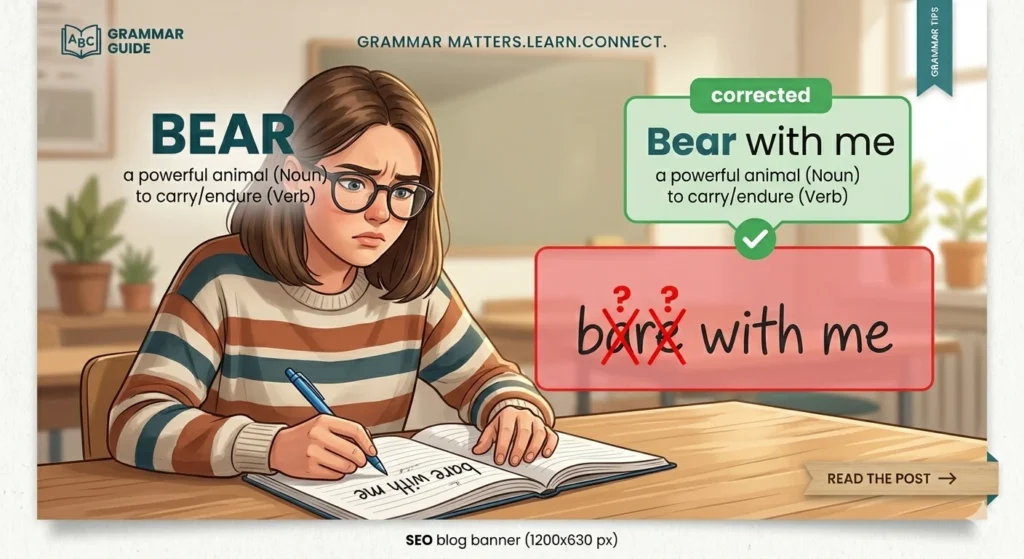
1. “Bare with me”
This is one of the most common grammar mistakes online.
- ❌ Bare with me
- ✅ Bear with me
The phrase means “please be patient with me.”
2. “I can’t bear it or bare it”
Correct version:
- ✅ I can’t bear it.
Because “bear” means tolerate or endure.
3. “Bear or bare the pain”
Correct phrase:
- ✅ Bear the pain
Pain is something you endure, not uncover.
4. “Bear or bare the cost”
Correct phrase:
- ✅ Bear the cost
This means to accept or pay the expense.
5. “Bare or bear the thought”
Correct phrase:
- ✅ Bear the thought
This means tolerate the idea mentally.
6. “Is it bear the loss or bare the loss?”
Correct phrase:
- ✅ Bear the loss
Because loss is something you endure emotionally or financially.
7. “Is it bare or bear any weight?”
Correct phrase:
- ✅ Bear weight
Because objects support or carry weight.
Bear vs Bare Grammar Rules
Understanding grammar usage makes these confusing words easier.
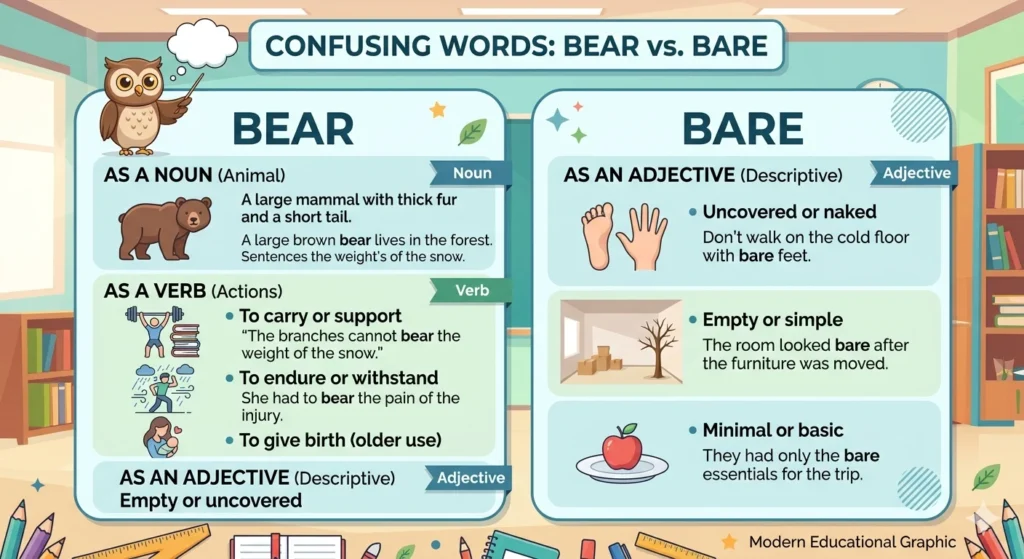
“Bear” as a Verb
The word bear is usually used as a verb.
Meanings of Bear
- carry
- support
- endure
- tolerate
Examples
- She cannot bear loud music.
- This chair can bear heavy weight.
- We must bear responsibility.
“Bare” as an Adjective
The word bare is usually an adjective.
Meanings of Bare
- uncovered
- exposed
- empty
Examples
- The room looked bare.
- He had bare arms.
- They stood on bare ground.
“Bare” as a Verb
Sometimes “bare” can also mean “to reveal.”
Examples
- He bared his teeth angrily.
- She bared the truth during the meeting.
Bear vs Bare in Everyday Examples
Real-life examples help English learners remember the correct spelling naturally.
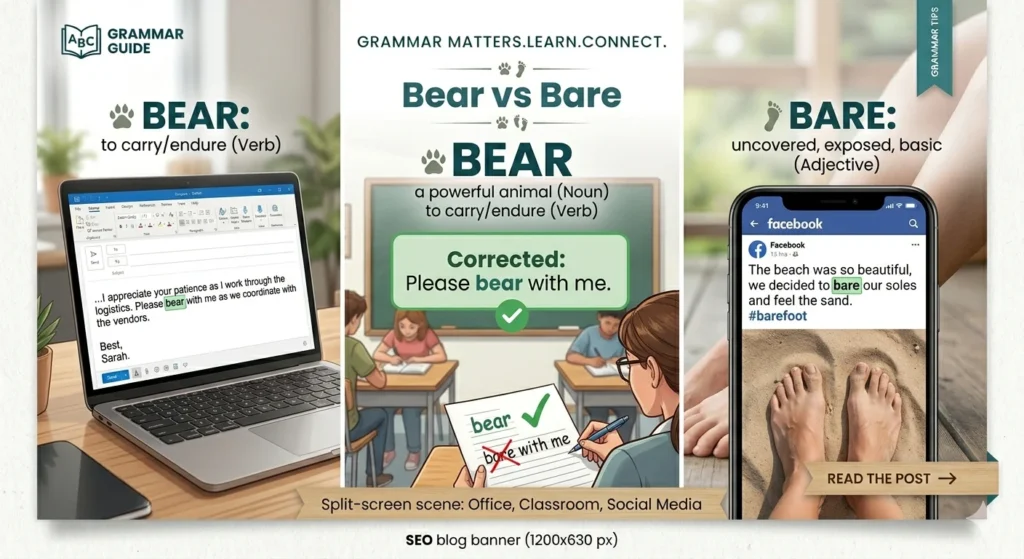
In Emails
- “Please bear with me while I check your account.”
- “We cannot bear additional costs this month.”
In Business Writing
- “The company will bear the financial loss.”
- “The office walls looked bare after renovation.”
In News Headlines
- “Families bear rising fuel costs.”
- “Bare trees covered the winter landscape.”
On Social Media
- “I can’t bear this stress anymore.”
- “No makeup today, just my bare face.”
In School Writing
- “The bridge can bear weight safely.”
- “The cave had bare stone walls.”
In Professional Communication
Using the correct spelling improves:
- grammar accuracy
- professional writing
- business communication
- academic writing
- SEO content writing
If you enjoy learning commonly confused words, you may also like topics such as:
- advice vs advise
- loose vs lose
- affect vs effect
- than vs then
Why Do People Confuse Bear and Bare?
Many people confuse these words because English pronunciation can be difficult.
Although the meanings are different, both words sound exactly the same when spoken. As a result, writers often choose the wrong spelling while typing quickly.
Another reason is that many English learners hear these words more often than they read them. This creates confusion during writing.
This type of mistake is very common with English homophones and confusing word pairs.
Is “Bear With Me” Grammatically Correct?
Yes, “bear with me” is grammatically correct.
The phrase means:
“Please be patient with me.”
Here, the word “bear” means tolerate or endure temporarily.
Correct Examples
- Please bear with me during this process.
- Bear with me while I explain.
Incorrect Examples
- ❌ Bare with me
- ❌ Bare with us
Can Bare Mean Reveal?
Yes. Although “bare” usually means uncovered, it can also work as a verb meaning “to reveal.”
Examples
- She bared her emotions.
- He bared his soul.
- The report bared the truth.
However, this usage is less common than the adjective form.
Is Bear a Noun and a Verb?
Yes. The word bear can work as both a noun and a verb.
Bear as a Noun
A large wild animal.
Example
- We saw a bear in the forest.
Bear as a Verb
To carry, endure, support, or tolerate.
Example
- I cannot bear the pressure.
Understanding this difference can improve your English vocabulary and grammar skills.
Bear Bare Homophones Sentences
These homophone examples clearly show the difference between the two words.
| Sentence | Meaning |
|---|---|
| I cannot bear the pain. | tolerate |
| The trees were bare in winter. | uncovered |
| Please bear with me. | be patient |
| He had bare hands. | exposed |
| The shelf can bear weight. | support |
| The apartment looked bare. | empty |
Bear vs Bare – Google Trends & Usage Data
Search interest for bear vs bare meaning continues growing because many people struggle with confusing English words online.
Countries With High Search Interest
Searches are especially common in:
- United States
- United Kingdom
- India
- Pakistan
- Canada
- Australia
Why This Keyword Is Popular
People often search this keyword because they want:
- correct English phrases
- grammar usage help
- spelling correction
- homophone examples
- professional writing accuracy
- quick grammar answers
Most Commonly Searched Phrases
- bear vs bare grammar
- bear with me or bare with me
- bear or bare the pain
- bear or bare the cost
- bare or bear the thought
- I can’t bear it or bare it
Online Usage Trends
The word bear appears more often in:
- business communication
- emotional expressions
- financial writing
- professional emails
Meanwhile, bare appears more in:
- descriptive writing
- storytelling
- visual descriptions
Therefore, understanding the context is important when choosing the correct spelling.
Quick Practice Quiz
1. Which sentence is correct?
- Bare with me.
- ✅ Bear with me.
2. Which sentence is correct?
- I cannot bare the pain.
- ✅ I cannot bear the pain.
3. Which sentence is correct?
- The child had bear feet.
- ✅ The child had bare feet.
4. Which sentence is correct?
- This bridge can bare weight.
- ✅ This bridge can bear weight.
5. Which sentence is correct?
- She could not bare the loss.
- ✅ She could not bear the loss.
Practicing sentences like these daily can help you master confusing English words faster.
Comparison Table: Bear vs Bare
| Feature | Bear | Bare |
|---|---|---|
| Main Meaning | Endure or support | Uncovered or exposed |
| Part of Speech | Usually verb | Usually adjective |
| Common Phrase | Bear with me | Bare feet |
| Used for Pain? | ✅ Yes | ❌ No |
| Used for Exposure? | ❌ No | ✅ Yes |
| Related to Weight? | ✅ Yes | ❌ No |
| Common Grammar Error | Bare with me | Bear feet |
FAQs About Bear vs Bare
1. What is the meaning of bear vs bare?
Bear means to endure, support, or tolerate something. Bare means uncovered, exposed, or empty.
2. Is it “bear with me” or “bare with me”?
The correct phrase is:
- ✅ Bear with me
This means “please be patient with me.”
3. Is it “I can’t bear it” or “I can’t bare it”?
Correct sentence:
- ✅ I can’t bear it.
Here, “bear” means tolerate or endure.
4. Is it bear the pain or bare the pain?
Correct phrase:
- ✅ Bear the pain
Because pain is something you endure.
5. Is it bare or bear any weight?
Correct phrase:
- ✅ Bear weight
Because objects support or carry weight.
6. Are bear and bare homophones?
Yes. They sound the same but have different meanings and spellings.
7. Can bare be used as a verb?
Yes. Bare can mean “to reveal.”
Example:
- “He bared his soul during the interview.”
Conclusion
Understanding bear vs bare is simple once you focus on the meaning. Bear means to endure, carry, support, or tolerate something, while bare means uncovered or exposed.
That is why phrases like “bear with me,” “bear the pain,” and “bear the cost” are correct. Meanwhile, phrases like “bare feet” and “bare walls” use the word bare correctly.
A quick memory trick is:
- Bear = endure
- Bare = uncovered
Although these words sound the same, using the correct spelling can improve your grammar, professional writing, and everyday English communication. Practice using both words in sentences daily, and choosing the right one will soon feel natural.

Pam Peters is a linguist and grammar expert, known for clear explanations of modern English usage, style, and practical language rules.