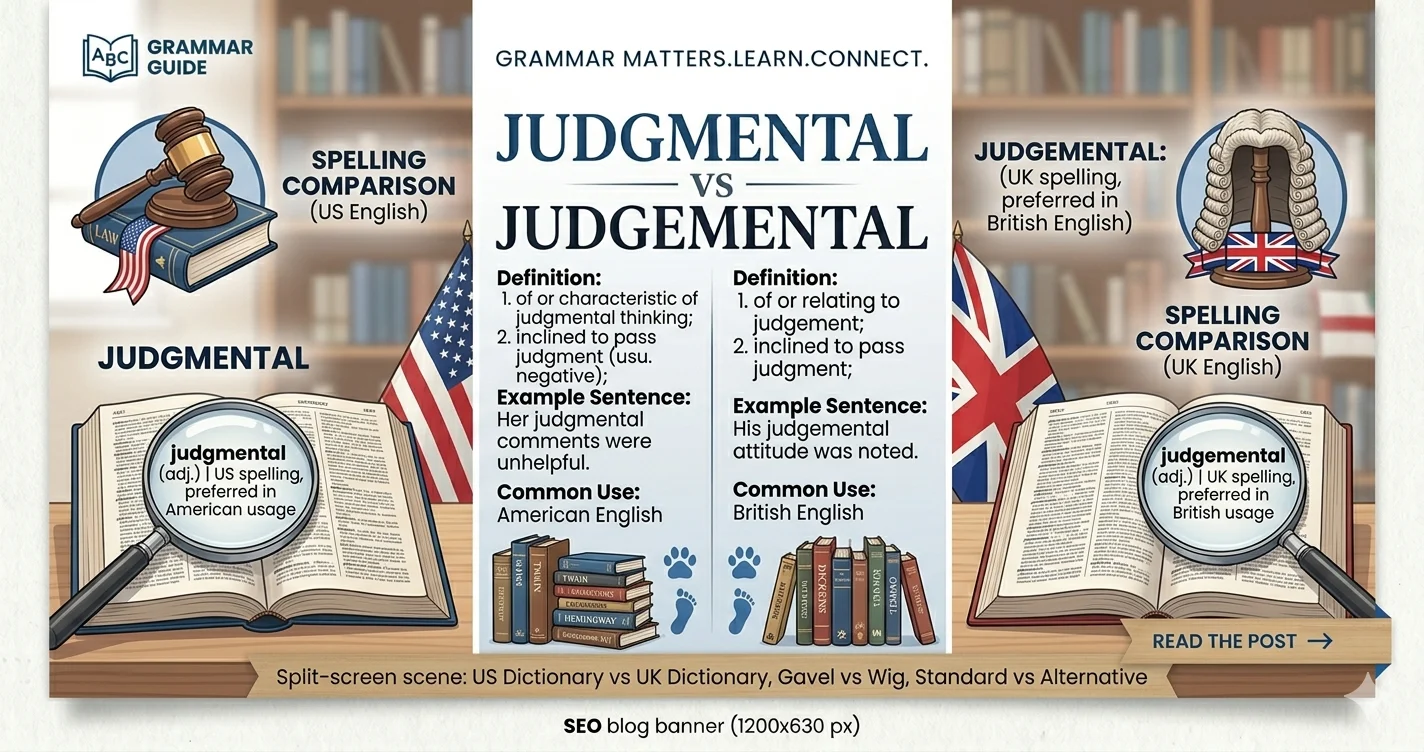
You are writing an email, blog post, or social media comment when suddenly your spellcheck creates confusion:
Should it be judgmental or judgemental?
Many English learners, bloggers, students, and professional writers face this exact grammar confusion. One dictionary accepts judgmental, another shows judgemental, and now both spellings look correct. That is why thousands of people search for judgmental vs judgemental every month.
The confusion happens because English has regional spelling variations. American English usually prefers judgmental, while British English often uses judgemental. However, modern online writing has blurred the difference, so you may now see both spellings across websites, news articles, Reddit discussions, academic writing, and formal communication.
According to Merriam-Webster, the standard American spelling is judgmental. Meanwhile, Cambridge Dictionary and Oxford English Dictionary recognize British spelling variations with the extra “e.”
This guide explains the correct spelling, meaning, pronunciation, grammar rules, dictionary preference, SEO usage, Google Trends data, common mistakes, and professional writing advice so you can confidently choose the right spelling for your audience.
Judgmental vs Judgemental
| Question | Answer |
|---|---|
| Correct spelling? | Both |
| American English | Judgmental |
| British English | Judgemental |
| Same meaning? | Yes |
| Same pronunciation? | Yes |
| Better for global SEO? | Judgmental |
Judgmental vs Judgemental
Is judgmental or judgemental correct?
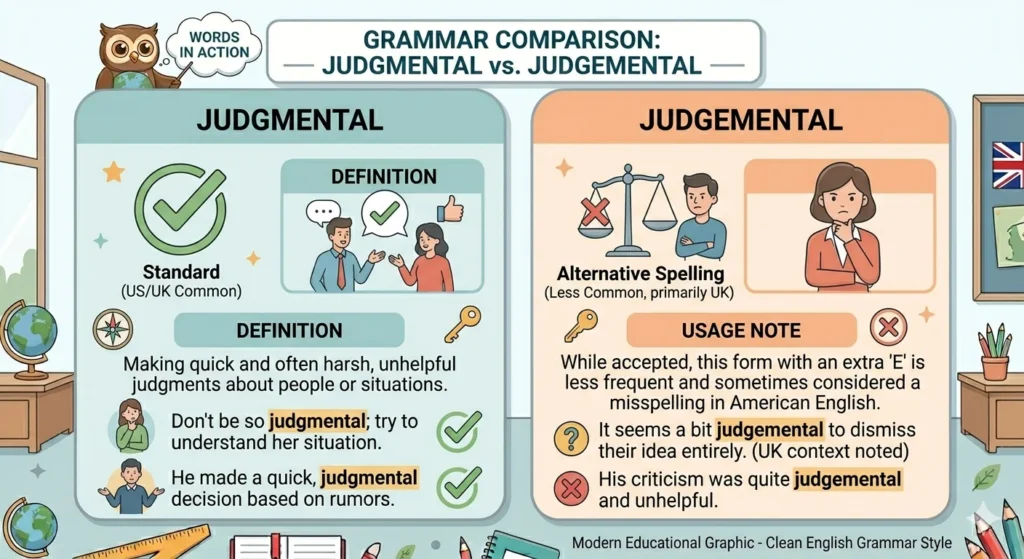
Both spellings are correct.
- Judgmental → American English
- Judgemental → British English
Both words have the same meaning and pronunciation.
Simple Meaning
A judgmental person criticizes people too quickly or unfairly.
Quick Examples
- Social media users can become very judgmental during online arguments.
- Her comment sounded slightly judgemental.
- Good managers avoid judgmental language in workplace communication.
Judgmental Meaning
Before understanding the spelling difference, it helps to understand the meaning clearly.
What does judgmental mean?
The word judgmental describes someone who forms harsh or unfair opinions about other people too quickly.
A judgmental person may criticize:
- appearance
- behavior
- lifestyle
- opinions
- personal decisions
Real-Life Example
Imagine posting a photo online and receiving rude comments from strangers. Those comments may feel judgmental because people are criticizing without knowing the full story.
Everyday Sentences
- Nobody likes a judgmental teacher.
- The article sounded too judgemental.
- Try to listen without sounding judgmental.
Both spellings sound identical when spoken, which is why many people never realize there are two spelling versions.
Now that the meaning is clear, the next question becomes obvious: why do two spellings exist at all?
The Origin of Judgmental vs Judgemental
The spelling confusion started hundreds of years ago.
The words come from:
- judgment / judgement
- Old French
- Latin roots connected to judging and decision-making
In older English, both spellings existed together. Over time, American English simplified many spellings by removing extra letters.
That is why American English now prefers:
- judgment
- judgmental
British English kept many older spelling traditions, including:
- judgement
- judgemental
This spelling pattern is similar to:
| American English | British English |
|---|---|
| Color | Colour |
| Honor | Honour |
| Canceled | Cancelled |
| Focused | Focussed |
This is called a regional spelling variation in English grammar.
Historical Evolution of Online Spelling
Over the last 20 years, American spellings have become more common online because global internet content is heavily influenced by US publishing standards and digital marketing trends.
That is one reason why judgmental now appears more frequently across websites worldwide.
What Do Dictionaries Prefer?
Different dictionaries follow different regional spelling rules.
| Dictionary | Preferred Spelling |
|---|---|
| Merriam-Webster | Judgmental |
| Cambridge Dictionary | Both accepted |
| Oxford English Dictionary | Judgemental common in UK |
Important Writing Tip
Dictionaries usually follow regional writing standards instead of declaring one spelling universally wrong.
That is why your spellcheck may accept one version while another dictionary prefers a different spelling.
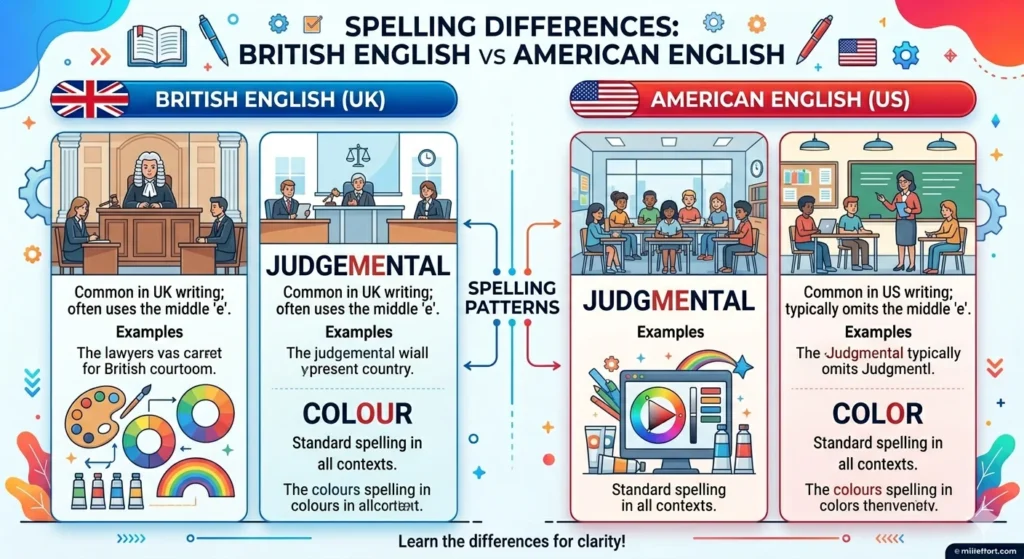
British English vs American English Spelling
The biggest difference between judgmental vs judgemental comes from regional English rules.
American English
American English strongly prefers:
- judgment
- judgmental
This spelling appears in:
- US schools
- AP Stylebook
- American newspapers
- business writing
- SEO content
Example
- The review sounded judgmental.
British English
British English traditionally uses:
- judgement
- judgemental
However, many modern British websites now also use judgmental because American spelling strongly influences online writing and SEO trends.
Example
- Some readers considered the article judgemental.
Comparison Table
| American English | British English | Meaning |
|---|---|---|
| Judgment | Judgement | Opinion or decision |
| Judgmental | Judgemental | Too critical |
| Nonjudgmental | Non-judgemental | Open-minded |
Real-Life Example
You may notice judgmental in American Netflix subtitles but judgemental in British newspapers. Both are correct for their audience.
Which Spelling Should You Use?
The correct spelling depends on your audience and writing goals.
Use “Judgmental” If:
- your readers are American
- you write global SEO content
- you follow American grammar rules
- you create blog posts for international audiences
- you want broader search engine visibility
Use “Judgemental” If:
- your audience is British
- you follow UK spelling rules
- you write for British schools or publishers
- your readers are in Australia or New Zealand
Best Choice for SEO Writers and Bloggers
If your website targets worldwide traffic, judgmental is usually the safest choice.
Why?
Because:
- global search volume is higher
- American spelling dominates internet content
- SEO tools often recommend shorter spellings
- international readers search the American version more frequently
Professional bloggers and content writers often choose judgmental because it performs better in global SEO results.
Still, writing consistency matters more than perfection.
Using both spellings in the same article creates grammar confusion and weakens formal communication.
Professional Writing Advice
If you work in:
- blogging
- journalism
- business writing
- academic writing
- content marketing
always match your spelling style to your audience and stay consistent throughout the document.
Professional writers rarely mix British and American spelling styles in the same piece of content.
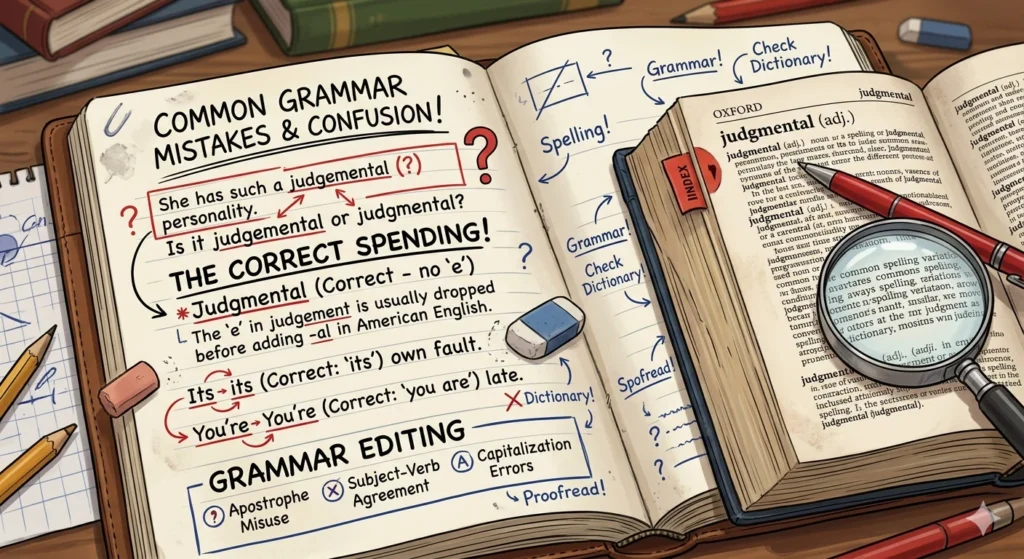
Why Spellcheck Flags “Judgemental”
Many people search this keyword because grammar tools mark one spelling as incorrect.
Why does this happen?
Most spellcheck tools follow language settings.
For example:
- US English settings usually prefer judgmental
- UK English settings may accept both spellings
- grammar software follows regional dictionary preferences
That is why tools like spelling checkers or grammar apps sometimes underline judgemental when American English is selected.
This is a very common English spelling confusion.
Common Mistakes with Judgmental vs Judgemental
Many English learners make the same grammar mistakes repeatedly.
Mistake 1: Mixing Both Spellings
❌ The article sounded judgmental and judgemental.
✅ The article sounded judgmental.
Choose one spelling style and stay consistent.
Mistake 2: Confusing Judging with Judgmental
Many users search:
What is the difference between judging and judgement?
Judging
Means forming an opinion or making a decision.
Judgmental
Means being overly critical or unfair.
Example
- The teacher is judging the competition.
- The audience became judgmental online.
Mistake 3: Confusing Observant with Judgmental
What is the difference between observant and judgemental?
| Observant | Judgmental |
|---|---|
| Notices details carefully | Criticizes quickly |
| Neutral behavior | Often negative |
| Watches carefully | Judges unfairly |
Example
- She is observant and notices everything.
- He is judgmental about people’s lifestyles.
Mistake 4: Using “Judgy” in Formal Writing
Is it judgy or judgemental?
| Word | Usage |
|---|---|
| Judgy | Informal slang |
| Judgmental | Formal English |
Example
- Don’t be so judgy. (casual speech)
- Avoid judgmental language in formal writing.
Judgmental vs Judgemental in Everyday Examples
These words appear in daily communication more often than many people realize.
In Emails
- Please avoid judgmental comments during meetings.
- Her reply sounded slightly judgemental.
In Social Media
Online discussions can become judgmental very quickly.
Many Reddit users discussing Judgmental vs judgemental reddit debates focus more on spelling preference than meaning.
In News Writing
- Critics described the documentary as judgmental.
In Workplace Communication
Managers should avoid judgmental feedback and instead offer constructive advice.
In Academic Writing
Formal English writing usually avoids emotional or judgmental wording because it may sound biased.
Judgemental vs Opinionated
These two words are similar but not identical.
| Opinionated | Judgmental |
|---|---|
| Has strong opinions | Criticizes others |
| Can sound neutral | Usually negative |
| Expresses beliefs strongly | Judges unfairly |
Example
- She is opinionated about politics.
- He is judgmental about people’s choices.
Nonjudgmental vs Non-judgemental
The opposite of judgmental is:
- nonjudgmental
- non-judgemental
Both spellings are correct depending on regional English style.
Meaning
A nonjudgmental person listens openly without criticizing unfairly.
Example
- Good counselors try to remain nonjudgmental.
Judgemental Synonym
Common synonyms include:
| Synonym | Meaning |
|---|---|
| Critical | Finds faults |
| Harsh | Too strict |
| Biased | Unfairly opinionated |
| Condemning | Shows disapproval |
| Close-minded | Not open to ideas |
Example
- His harsh tone sounded judgmental.
Judgemental Pronunciation
Both spellings share the same pronunciation.
Pronunciation
judg-men-tal
IPA Form
/dʒʌdʒˈmen.təl/
Easy Pronunciation Tip
Think of it as:
“judge + mental”
Judgmental vs Judgemental – Google Trends & Usage Data
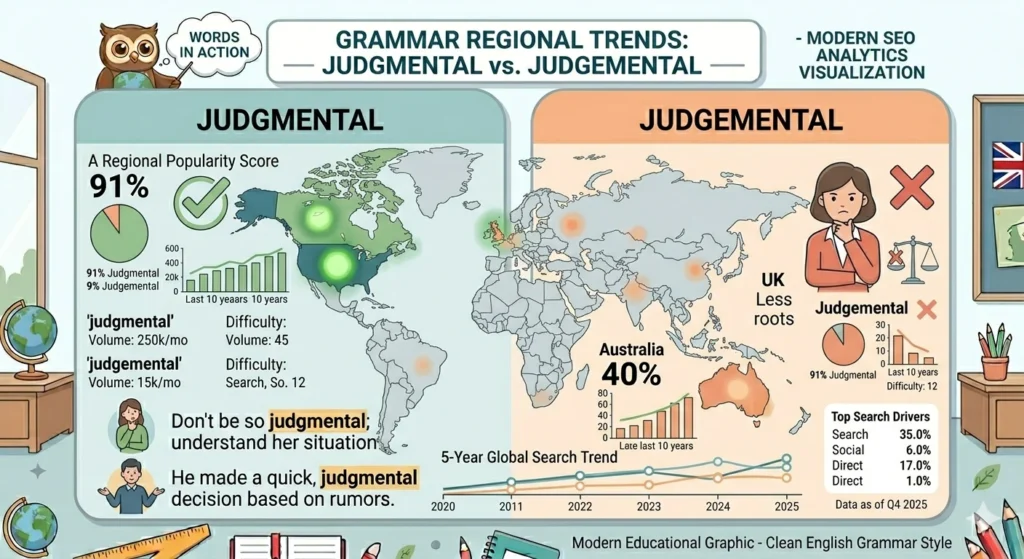
Search trends clearly show that judgmental is more popular worldwide.
Countries Where “Judgmental” Dominates
- United States
- Canada
- international SEO websites
- digital marketing blogs
Countries Where “Judgemental” Appears More Often
- United Kingdom
- Australia
- New Zealand
Why “Judgmental” Is Growing Online
Several things caused this trend:
- American websites dominate internet content
- global SEO often favors American spelling
- shorter spellings help branding consistency
- digital marketing tools usually track higher US traffic
This is why many British websites now also use judgmental in headlines and blog posts.
Still, UK readers understand both spellings without confusion.
Similar English Spelling Confusions
English contains many spelling differences similar to judgmental vs judgemental.
Common Examples
| American English | British English |
|---|---|
| Canceled | Cancelled |
| Focused | Focussed |
| Color | Colour |
| Adviser | Advisor |
You may also see grammar confusion with:
- judgment vs judgement
- country’s vs countries
- adviser vs advisor
Understanding these spelling patterns improves grammar accuracy and writing confidence.
Comparison Table: All Keyword Variations
| Keyword | Meaning | Region |
|---|---|---|
| Judgmental | Critical attitude | US |
| Judgemental | Critical attitude | UK |
| Judgment | Opinion or decision | US |
| Judgement | Opinion or decision | UK |
| Judgy | Informal criticism | Casual English |
FAQs
Is judgmental or judgemental correct?
Both spellings are correct. Judgmental is standard in American English, while judgemental is more common in British English.
What is the difference between judgemental and judgmental?
There is no difference in meaning or pronunciation. The only difference is regional spelling preference.
Which spelling is more popular online?
Globally, judgmental appears more often in search engines, SEO articles, and digital content.
Is judgemental used in the UK?
Yes. British English commonly accepts judgemental, although judgmental is becoming more common online.
What does judgmental mean?
Judgmental means forming unfair or overly critical opinions about people without understanding the full situation.
Is judgy a real word?
Yes. Judgy is an informal slang word commonly used in casual conversations and social media.
Can I use both spellings in one article?
No. Mixing both spellings can create grammar confusion and reduce writing consistency.
Conclusion
The confusion between judgmental vs judgemental comes from the long history of British and American spelling differences in English grammar. Both spellings are correct, both share the same pronunciation, and both describe someone who judges others too quickly or unfairly.
If you write for American or global audiences, judgmental is usually the safest and strongest choice because it dominates online writing, digital publishing, and blogging search trends. If your audience is mainly British, Australian, or from other Commonwealth countries, judgemental may feel more natural.
The most important grammar rule is consistency. Once you choose a spelling style, use it throughout your article, email, report, or website.
Understanding spelling variations like judgmental vs judgemental, judgment vs judgement, canceled vs cancelled, and even country’s vs countries helps English learners improve grammar accuracy, formal communication, and professional writing skills.
English spelling can feel confusing sometimes, but understanding regional differences makes writing much easier and more confident in everyday communication.

Scott Thornbury is a respected English language educator and author, known for practical grammar insights, teacher training, and clear learner-focused explanations.