You are writing an email, a blog post, or a social media caption when suddenly you pause at a single word: camaraderie or comradery. Which spelling is correct? Are both acceptable? Or is one simply a common mistake?
If you’ve searched for camaraderie vs comradery, you’re not alone. Thousands of English learners, students, writers, and professionals ask the same question every year. Since both words look similar and share the same meaning, the confusion is understandable. However, choosing the right spelling can make your writing look more polished and professional.
The good news is that both spellings are recognized in English. The important difference is that one spelling is far more common and widely accepted than the other. Understanding when and how to use these words can help you avoid mistakes in academic papers, workplace communication, website content, business emails, and professional writing.
In this guide, you’ll learn the difference between camaraderie vs comradery, their origins, meanings, pronunciations, usage examples, dictionary preferences, British and American English differences, Reddit discussions, and the spelling experts recommend.
Camaraderie vs Comradery
Featured Snippet Answer
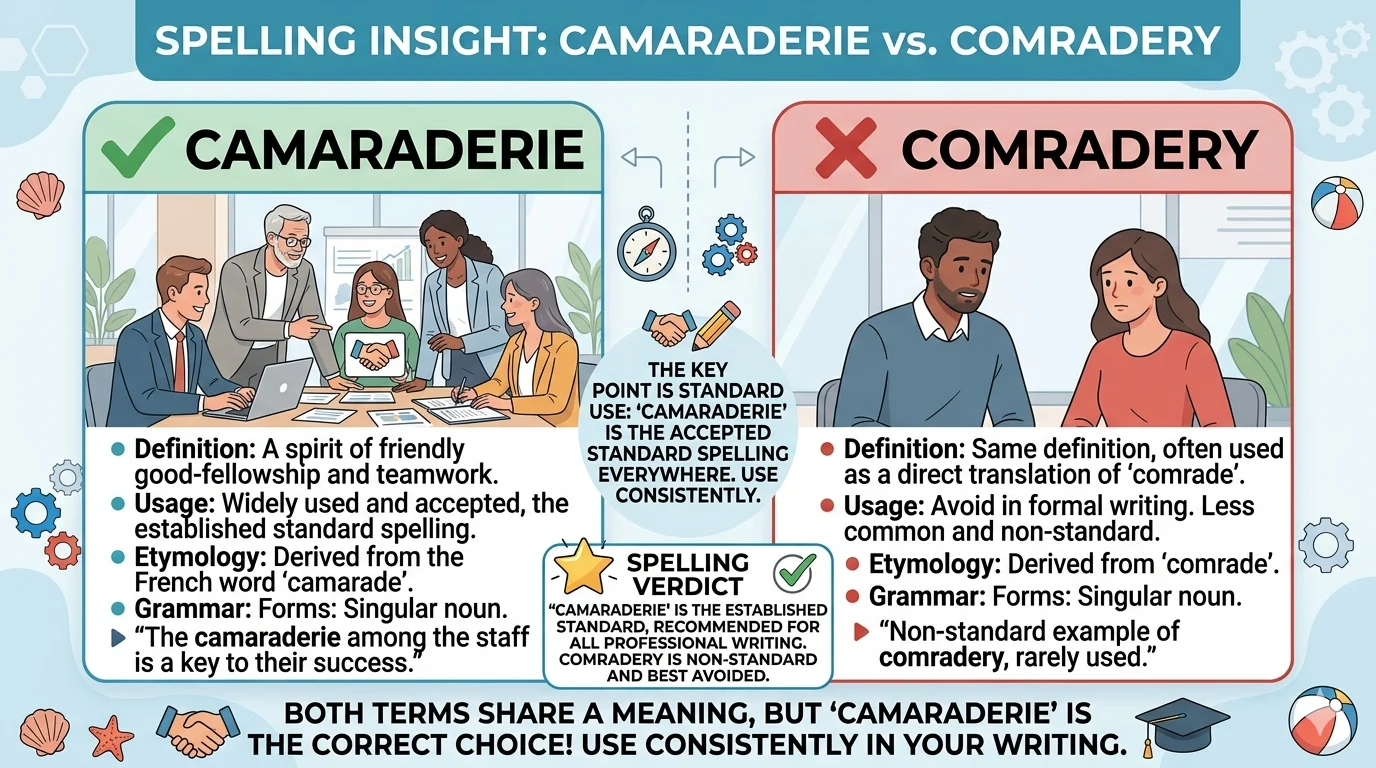
Camaraderie and comradery have the same meaning. Both refer to friendship, fellowship, teamwork, loyalty, and mutual support among people. However, camaraderie is the standard and preferred spelling used in British English, American English, and international writing. Comradery is a less common alternative spelling that appears mainly in some American usage.
Quick Examples
✅ The strong camaraderie among employees improved workplace culture.
✅ The athletes developed lasting camaraderie during the season.
✅ Their comradery helped them overcome challenges.
Although both spellings are understandable, most dictionaries and editors recommend camaraderie.
Quick Comparison Table
| Feature | Camaraderie | Comradery |
|---|---|---|
| Meaning | Friendship and team spirit | Same meaning |
| Standard Spelling | Yes | No |
| Dictionary Preference | Preferred | Alternative |
| Professional Writing | Recommended | Less common |
| Global Recognition | Very High | Moderate |

The Origin of Camaraderie vs Comradery
The history of these words explains why the spelling confusion exists.
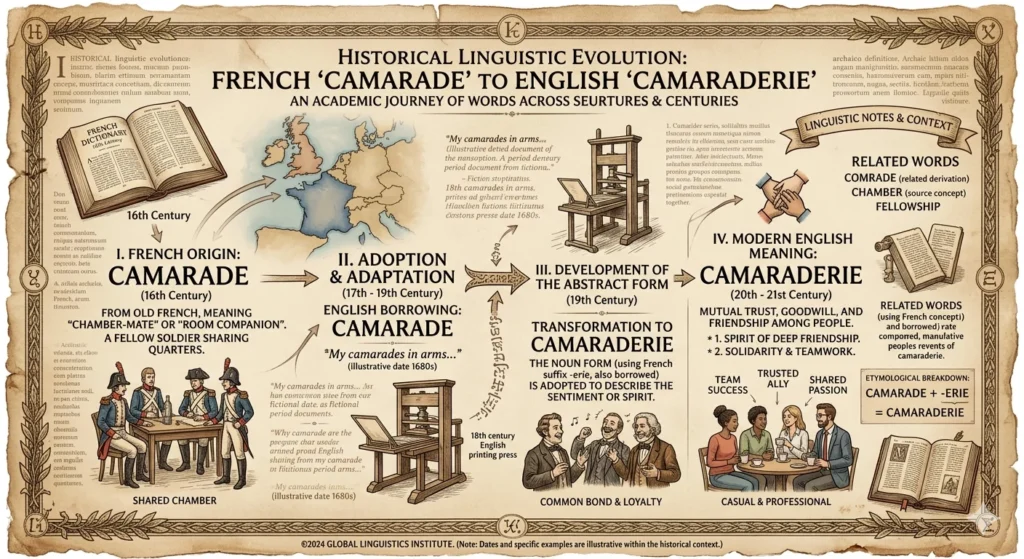
The word camaraderie comes from the French word camarade, which means companion, roommate, associate, or friend. English borrowed the term during the nineteenth century, and it gradually became associated with friendship, teamwork, trust, fellowship, and loyalty.
The word became especially popular in:
- Military groups
- Sports teams
- Workplaces
- Schools
- Community organizations
Why Does “Comradery” Exist?
Many English speakers naturally connect camaraderie to the word comrade.
Because of that connection, some writers began using the spelling comradery, believing it matched the English root word more closely.
As a result:
- Camaraderie remained the traditional spelling.
- Comradery emerged as an alternative spelling.
Today, both forms are recognized, but camaraderie remains overwhelmingly more common.
British English vs American English Spelling
Many spelling differences in English follow a British-versus-American pattern.
Examples include:
- Colour vs Color
- Centre vs Center
- Organise vs Organize
However, camaraderie vs comradery is different.
British English
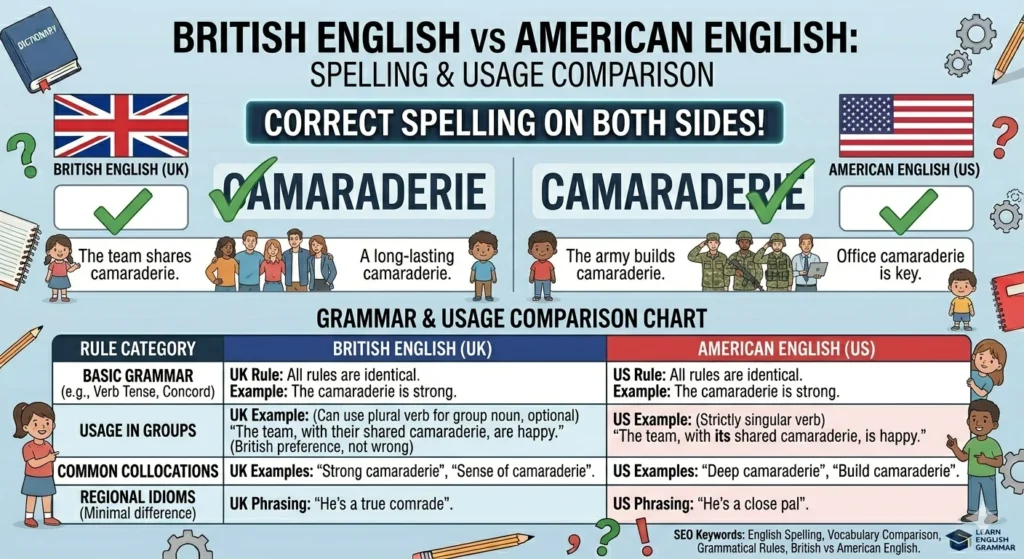
British writers almost always use:
✅ Camaraderie
Rarely:
❌ Comradery
American English
American writers also prefer:
✅ Camaraderie
Occasionally:
✅ Comradery
Comparison Table
| Region | Preferred Spelling |
|---|---|
| United Kingdom | Camaraderie |
| United States | Camaraderie |
| Canada | Camaraderie |
| Australia | Camaraderie |
| New Zealand | Camaraderie |
| International English | Camaraderie |
Examples
British Example:
The camaraderie among players impressed supporters.
American Example:
Workplace camaraderie improved employee engagement.
In both countries, camaraderie remains the dominant spelling.
What Do Dictionaries Say About Camaraderie vs Comradery?
One of the best ways to settle the camaraderie vs comradery debate is to look at major dictionaries.
Most dictionaries recognize both spellings. However, they consistently list camaraderie as the primary and preferred form.
Dictionary Preference Comparison
| Dictionary | Preferred Form |
|---|---|
| Oxford | Camaraderie |
| Merriam-Webster | Camaraderie |
| Collins | Camaraderie |
| Cambridge | Camaraderie |
Because dictionaries prioritize camaraderie, professional writers, editors, teachers, and publishers generally recommend using it.
Which Spelling Should You Use?
For most people, the answer is simple.
If You Write for American Readers
Use:
✅ Camaraderie
Although comradery is recognized, camaraderie looks more polished and professional.
If You Write for British Readers
Use:
✅ Camaraderie
This is the expected spelling throughout the UK.
If You Write for a Global Audience
Use:
✅ Camaraderie
It is instantly recognized around the world.
Professional Recommendation
Choose camaraderie when writing:
- Blog posts
- Academic papers
- Business emails
- Marketing content
- Website copy
- News articles
- LinkedIn posts
It is the safest and most widely accepted option.
Common Mistakes with Camaraderie vs Comradery
Writers often make several common errors.
Mistake #1: Assuming Comradery Is the Standard Form
❌ The office comradery improved morale.
✅ The office camaraderie improved morale.
Mistake #2: Confusing It with Comrade
People often think:
Comrade → Comradery
However, English retained the original French-influenced spelling:
Camaraderie
Mistake #3: Mixing Spellings
❌ The camaraderie was excellent. Their comradery increased teamwork.
Use one spelling consistently.
Mistake #4: Misspelling Camaraderie
Common errors include:
❌ camaradery
❌ camaradarie
❌ camraderie
✅ camaraderie
Mistake #5: Incorrect Pronunciation
Many learners struggle with pronunciation because of the unusual spelling.
Learning the correct pronunciation makes speaking more confident and natural.
Camaraderie vs Comradery Pronunciation
Many users search for camaraderie vs comradery pronunciation because the words look and sound different.
Pronunciation Comparison
| Word | Pronunciation |
|---|---|
| Camaraderie | Kam-uh-RAH-duh-ree |
| Comradery | KOM-ruh-duh-ree |
IPA Pronunciation
Camaraderie
/ˌkæməˈrɑːdəri/
Comradery
/ˈkɒmrədəri/
While the pronunciations differ slightly, the meaning remains the same.
Camaraderie vs Comradery Meaning in Urdu
Many Urdu speakers search for:
- Camaraderie vs comradery meaning in Urdu
- Camaraderie vs comradery in Urdu
Camaraderie Meaning in Urdu
دوستی، رفاقت، بھائی چارہ، باہمی اعتماد، مضبوط تعلق
Comradery Meaning in Urdu
رفاقت، دوستی، ساتھیوں کے درمیان دوستانہ تعلق
Urdu Example
ٹیم کے ارکان کے درمیان مضبوط رفاقت اور بھائی چارہ موجود تھا۔
Both words carry nearly identical meanings in Urdu.
Camaraderie vs Comradery in Everyday Examples
Understanding real-world usage makes the difference easier to remember.
In Emails
The camaraderie among team members has improved workplace culture.
In News Articles
The players displayed remarkable camaraderie throughout the tournament.
In Social Media
Love the camaraderie in this community!
In Business Writing
Employee camaraderie encourages collaboration, trust, and productivity.
In Academic Writing
Researchers observed strong camaraderie among participants.
In Sports
Team camaraderie played a major role in their success.
Comradery or Camaraderie Synonym
Both words share the same synonyms.
Common Synonyms
- Friendship
- Fellowship
- Brotherhood
- Team spirit
- Unity
- Togetherness
- Rapport
- Solidarity
- Collaboration
- Mutual trust
- Group cohesion
- Professional relationships
Example
Strong camaraderie encourages teamwork and collaboration.
Alternative:
Strong fellowship encourages teamwork and collaboration.
Camaraderie vs Comradery Reddit Discussions
Many people search for camaraderie vs comradery Reddit to see how native speakers use these words.
Across Reddit discussions and language forums, the general opinion is consistent:
- Both spellings are understood.
- Camaraderie looks more professional.
- Comradery is less common.
- Most readers expect to see camaraderie.
- Editors usually prefer camaraderie.
These discussions support the same conclusion reached by dictionaries and style guides.
Camaraderie vs Comradery – Google Trends & Usage Data
Usage patterns strongly favor one spelling.
Relative Popularity
| Search Term | Popularity |
|---|---|
| Camaraderie | 90%+ |
| Comradery | Less than 10% |
Countries Where Camaraderie Is Most Popular
- United States
- United Kingdom
- Canada
- Australia
- New Zealand
Common Usage Contexts
The word camaraderie frequently appears in:
- Workplace culture
- Employee engagement
- Team bonding
- Leadership training
- Sports teams
- Military groups
- Schools
- Community organizations
This widespread use explains why camaraderie remains the preferred spelling worldwide.
Camaraderie vs Comradery: Final Comparison Table
| Feature | Camaraderie | Comradery |
|---|---|---|
| Meaning | Friendship, fellowship, teamwork | Same meaning |
| Standard Spelling | Yes | |
| Alternative Spelling | No | Yes |
| Dictionary Preference | Strong | |
| Professional Writing | Recommended | |
| Academic Writing | Preferred | |
| British English | Preferred | |
| American English | Preferred | |
| Global Recognition | Very High | |
| Overall Recommendation | Best Choice |
Quick Rule to Remember
If you only remember one thing from this guide, remember this:
✅ Use camaraderie in professional, academic, business, and international writing.
✅ Use comradery only if you intentionally prefer the alternative spelling.
✅ When in doubt, choose camaraderie.
Easy Memory Trick
Camaraderie = Common + Accepted
The standard spelling is the one most readers recognize immediately.
Frequently Asked Questions
What is the difference between comradery and camaraderie?
There is no significant difference in meaning. The main difference is spelling. Camaraderie is the standard and preferred form.
Is there such a word as comradery?
Yes. Comradery is a recognized alternative spelling, although it is much less common.
Is camaraderie British?
No. Camaraderie is widely used in both British and American English.
Why is it spelled camaraderie?
The word comes from the French term camarade, and English retained the French-influenced spelling.
Camaraderie or comradery UK?
In the UK, camaraderie is overwhelmingly preferred.
Is camaraderie a positive word?
Yes. It describes friendship, trust, teamwork, loyalty, and mutual support.
Can camaraderie be used in business writing?
Absolutely. It is commonly used when discussing workplace culture, team bonding, collaboration, and employee engagement.
Why is camaraderie more common than comradery?
Because dictionaries, publishers, style guides, and professional writers have historically preferred the original spelling.
Conclusion
The debate over camaraderie vs comradery is ultimately about spelling, not meaning. Both words describe friendship, fellowship, teamwork, loyalty, trust, and strong relationships between people who share experiences or goals. However, modern English usage clearly favors camaraderie.
It is the spelling used most often in books, newspapers, academic papers, workplace communication, sports reporting, business writing, and online content. Although comradery is recognized as an alternative spelling, it appears far less frequently and may look unfamiliar to some readers.
For students, professionals, bloggers, marketers, and business writers, camaraderie is the safest and most effective choice. It aligns with dictionary recommendations, improves credibility, and ensures your audience instantly recognizes the word.
The simplest rule is this: both spellings mean the same thing, but camaraderie is the standard spelling that most readers, editors, and publishers expect to see.

Betty Azar is a respected English language educator and author, known for clear grammar explanations and practical resources for learners worldwide.