Imagine you’re writing an important email, school essay, or blog post. You type the word “irregardless” and suddenly pause. Is it actually a word? Is it grammatically correct? Or should you use “regardless” instead?
If you’ve ever had this question, you’re not alone. The debate over regardless vs irregardless is one of the most common grammar discussions in English. Students, professionals, bloggers, and even native speakers frequently wonder which word is correct and whether there is any real difference between them.
Many people search online for answers to questions like “Is it grammatically correct to say irregardless?”, “Why do Americans say irregardless?”, and “When should I use regardless?” The confusion comes from the fact that both words seem to mean the same thing. However, one is considered standard English while the other remains controversial.
In this complete guide, you’ll learn the regardless vs irregardless meaning, pronunciation, history, dictionary definitions, real-world examples, and professional writing recommendations. You’ll also discover what major dictionaries say, why some people use irregardless, and which word is best for formal, academic, and business writing.
By the end, you’ll know exactly which spelling to use and how to avoid a common English grammar mistake.
Regardless vs Irregardless
One-Sentence Answer
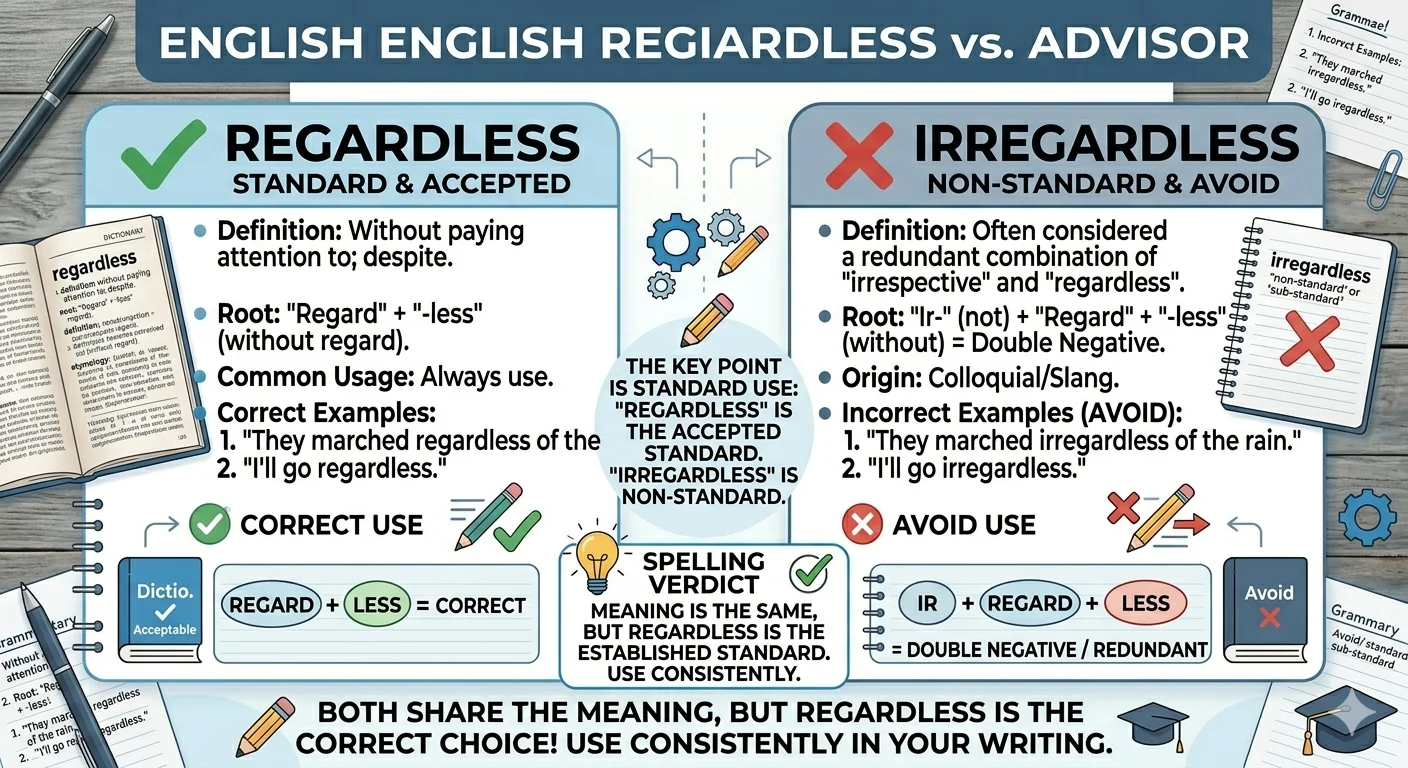
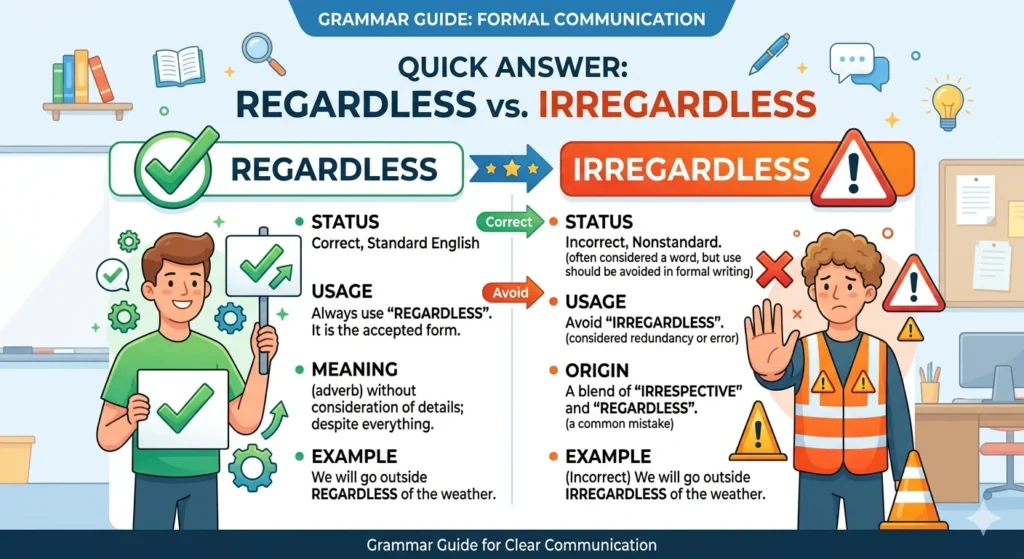
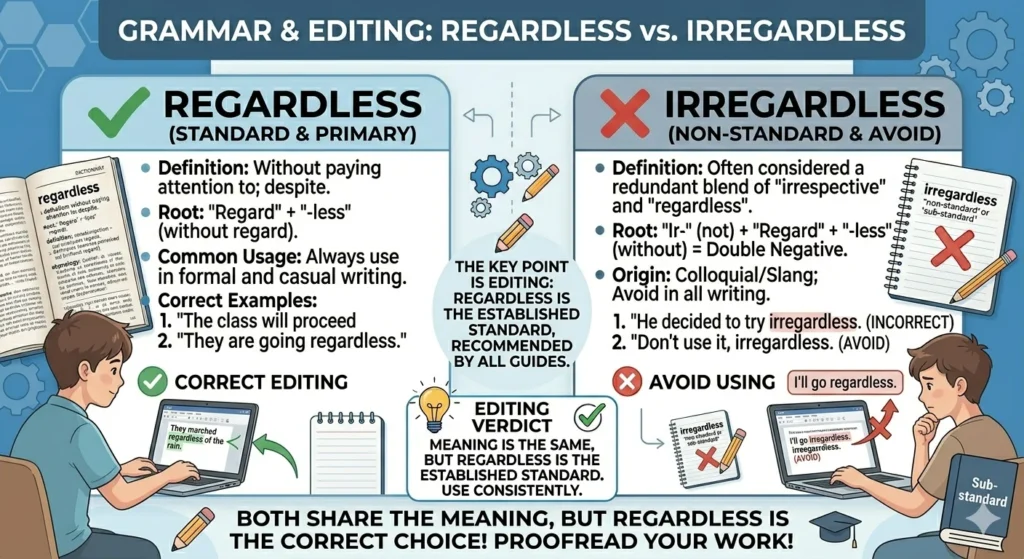
Regardless is the correct and standard English word. Irregardless is a nonstandard variant that means the same thing but is generally avoided in formal writing.
Quick Comparison
| Word | Meaning | Standard English? | Recommended? |
|---|---|---|---|
| Regardless | Despite something | Yes | Yes |
| Irregardless | Same meaning as regardless | No (Nonstandard) | No |
Examples
✅ We will continue regardless of the weather.
⚠️ We will continue irregardless of the weather.
Both sentences communicate the same idea, but the first is preferred by editors, teachers, and style guides.
Key Takeaway
If you’re writing for school, work, publishing, journalism, or professional communication, always use regardless.
The Origin of Regardless vs Irregardless
Understanding the history of these words makes the difference easier to remember.
Origin of Regardless
The word regardless dates back to the 1500s. It combines:
- Regard = attention or concern
- Less = without
Together, regardless literally means:
Without paying attention to something.
Example:
✅ She continued regardless of criticism.
Over time, the word became widely accepted in both British and American English.
Origin of Irregardless
The word irregardless appeared much later, around the late 1700s.
Language experts believe it developed when speakers blended words such as:
- Regardless
- Irrespective
Because many English words begin with the prefix ir-, some speakers naturally added it to regardless, creating irregardless.
Why the Spelling Difference Exists
The prefix ir- often means “not.”
Examples include:
- Irregular
- Irrelevant
- Irresponsible
Because regardless already contains the suffix -less, some grammar experts view irregardless as unnecessary or redundant.
Despite this criticism, the word continues to appear in spoken English and informal communication.

British English vs American English Spelling
Unlike spelling differences such as:
- Color vs Colour
- Organize vs Organise
- Center vs Centre
The difference between regardless and irregardless is not a regional spelling preference.
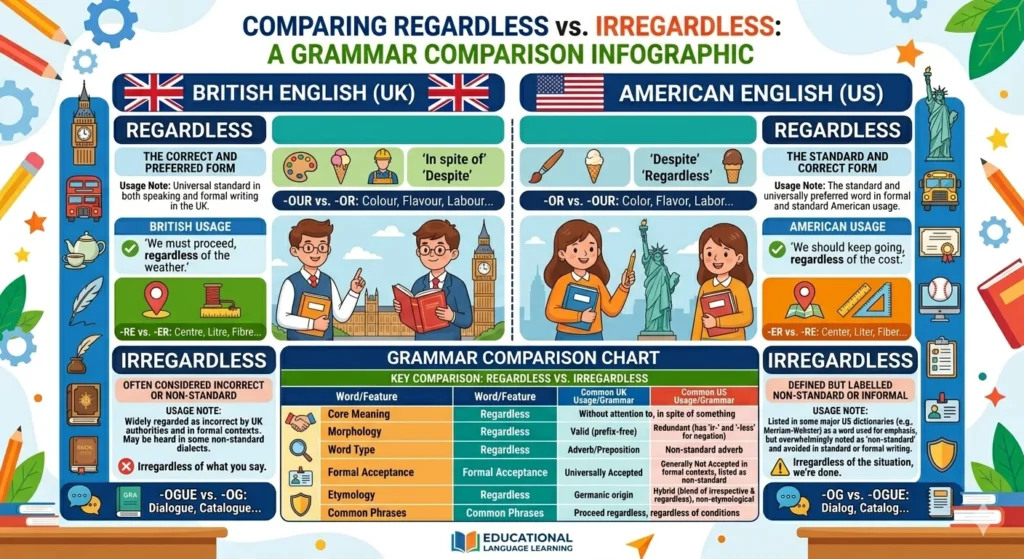
British English
British English strongly favors:
✅ Regardless
British writers, editors, and publishers rarely use irregardless.
American English
American English also prefers:
✅ Regardless
However, irregardless appears more often in casual speech and informal conversation within the United States.
Comparison Table
| Feature | Regardless | Irregardless |
|---|---|---|
| British English | Standard | Rare |
| American English | Standard | Occasionally Used |
| Academic Writing | Yes | No |
| Business Writing | Yes | No |
| Formal Documents | Yes | No |
| Informal Speech | Yes | Sometimes |
Example
British English:
✅ The meeting will continue regardless of the weather.
American English:
✅ The meeting will continue regardless of the weather.
Informal American speech:
⚠️ The meeting will continue irregardless of the weather.
Which Spelling Should You Use?
For American Readers
Use:
✅ Regardless
Although some Americans use irregardless in conversation, professional writers almost always choose regardless.
For British Readers
Use:
✅ Regardless
British English overwhelmingly accepts this form.
For International Audiences
Use:
✅ Regardless
It is understood and accepted worldwide.
For Academic Writing
Use:
✅ Regardless
Teachers, universities, and academic style guides recommend this spelling.
For Business Communication
Use:
✅ Regardless
Professional communication values clarity and standard English usage.
Professional Recommendation
Whether you’re writing:
- Blog posts
- Business emails
- Research papers
- Website content
- News articles
- Marketing materials
The safest choice is always:
✅ Regardless
Avoid:
❌ Irregardless
Using standard English helps establish credibility and trust.
What Major Dictionaries Say
One reason this topic creates confusion is that some major dictionaries include irregardless.
Dictionary Definition of Regardless
Most dictionaries define regardless as:
Without paying attention to current circumstances; despite everything.
This definition is accepted in standard English.
Dictionary Definition of Irregardless
Some dictionaries list irregardless because people use it.
However, it is often labeled:
- Nonstandard
- Informal
- Dialectal
Dictionary Consensus
| Dictionary Position | Regardless | Irregardless |
|---|---|---|
| Recognized Word | Yes | Yes |
| Standard English | Yes | No |
| Formal Writing | Yes | No |
| Recommended Usage | Yes | No |
Important Note
A word appearing in a dictionary does not automatically mean it is recommended for formal writing.
Dictionaries record how people use language, while style guides recommend how language should be used professionally.
Common Mistakes with Regardless vs Irregardless
Many writers make the same errors repeatedly.
Mistake #1: Thinking They Have Different Meanings
❌ Regardless means one thing and irregardless means the opposite.
✅ Both words have the same meaning.
Mistake #2: Using Irregardless in Professional Writing
❌ The company will proceed irregardless of objections.
✅ The company will proceed regardless of objections.
Mistake #3: Assuming Dictionary Inclusion Means Full Acceptance
Many people believe:
“If a dictionary includes a word, it must be correct.”
This is not always true.
Some dictionaries include nonstandard words because people use them frequently.
Mistake #4: Copying Informal Speech
You may hear people say:
⚠️ I’m going irregardless.
However, professional writers usually replace it with:
✅ I’m going regardless.
Mistake #5: Ignoring Style Guide Recommendations
Most writing style guides recommend:
✅ Regardless
Avoid:
❌ Irregardless
especially in academic, business, and professional writing.
Regardless vs Irregardless in Everyday Examples
One of the easiest ways to understand the difference between these words is to see them in real-life situations.
In Emails
✅ We will proceed with the project regardless of the delay.
❌ We will proceed with the project irregardless of the delay.
In Business Writing
✅ The policy applies regardless of department.
✅ Employees will receive training regardless of experience level.
In Academic Writing
✅ The results remained consistent regardless of age or background.
✅ The experiment continued regardless of weather conditions.
In News Articles
✅ The event went ahead regardless of public criticism.
✅ The government continued the program regardless of opposition.
On Social Media
Informal users sometimes write:
⚠️ I’m going irregardless of what people think.
However, standard English is:
✅ I’m going regardless of what people think.
In Everyday Conversation
You may hear:
⚠️ We’ll do it irregardless.
But professional speakers and writers usually say:
✅ We’ll do it regardless.
Regardless in Business, Academic, and Professional Writing
If you’re wondering when should I use regardless, the answer is simple: use it whenever you want your writing to sound professional and correct.
Business Communication
Business emails, reports, and presentations should always use regardless.
Example:
✅ Regardless of market conditions, we will continue serving our customers.
Academic Writing
Schools, colleges, and universities expect standard English usage.
Example:
✅ The findings were valid regardless of participant demographics.
Journalism and Publishing
News organizations and publishers follow style guides that recommend regardless.
Example:
✅ The ceremony continued regardless of heavy rain.
Professional Recommendation
If your writing will be reviewed by:
- Teachers
- Editors
- Clients
- Employers
- Publishers
Always choose:
✅ Regardless
Regardless vs Irregardless Pronunciation
Many people search for regardless vs irregardless pronunciation because the words sound similar.
Regardless Pronunciation
ri-GARD-less
Phonetic spelling:
/rɪˈɡɑːrdləs/
Irregardless Pronunciation
ir-ri-GARD-less
Phonetic spelling:
/ˌɪrɪˈɡɑːrdləs/
The extra “ir” sound makes irregardless slightly longer to pronounce.
Pronunciation Tip
Even though both words can be understood when spoken, most professionals still prefer using regardless.
Regardless vs Irregardless Synonym
Both words share the same meaning, so they also share many of the same synonyms.
Common Synonyms
- Despite
- Nevertheless
- Nonetheless
- Anyway
- Anyhow
- Notwithstanding
- Irrespective
Examples
Regardless of the cost, we will continue.
Similar sentence:
Despite the cost, we will continue.
Regardless of criticism, she followed her plan.
Similar sentence:
Nevertheless, she followed her plan.
What Does the Oxford Dictionary Say About Irregardless?
Many people search for:
- Irregardless Oxford Dictionary
- Irregardless vs regardless Oxford dictionary
The Oxford English Dictionary recognizes irregardless as a word that appears in English usage. However, it is commonly labeled as nonstandard.
This means the word exists and is used by some speakers, but it is generally not recommended in formal writing.
Oxford and most style guides still prefer:
✅ Regardless
for professional and academic communication.
Regardless vs Irregardless Dictionaries
Another common search is regardless vs irregardless dictionaries.
What Most Dictionaries Agree On
| Question | Regardless | Irregardless |
|---|---|---|
| Is it a real word? | Yes | Yes |
| Is it standard English? | Yes | No |
| Recommended for formal writing? | Yes | No |
| Common in professional writing? | Yes | Rare |
| Accepted by editors? | Yes | Usually avoided |
Dictionary Consensus
Most dictionaries record irregardless because people use it.
However, most grammar experts and writing style guides continue to recommend regardless.
Irregardless in a Sentence
Here are some examples of irregardless in a sentence.
⚠️ We are leaving irregardless of the weather.
⚠️ He continued irregardless of criticism.
⚠️ They attended irregardless of the warnings.
These sentences are understandable, but editors would normally replace irregardless with regardless.
Corrected Versions
✅ We are leaving regardless of the weather.
✅ He continued regardless of criticism.
✅ They attended regardless of the warnings.
Regardless vs Irregardless – Google Trends & Usage Data
Interest in this topic remains high because many people encounter both words online.
Why People Search This Topic
Users commonly want to know:
- Is irregardless accepted?
- Is irregardless a grammar mistake?
- What is the correct word regardless or irregardless?
- Which word should I use in professional writing?
Where Searches Commonly Come From
Interest is especially strong in:
- United States
- United Kingdom
- Canada
- Australia
- India
Why Search Interest Increases
Searches often increase during:
- School assignments
- Grammar lessons
- Editing and proofreading projects
- Blogging and content writing
- Social media grammar debates
Usage Trends
Regardless
Frequently used in:
- Business writing
- Journalism
- Academic papers
- Government documents
- Professional communication
Irregardless
Mostly found in:
- Casual conversations
- Informal speech
- Social media posts
- Regional dialects
Overall, regardless remains significantly more popular and accepted.
Complete Comparison Table: Regardless vs Irregardless
| Feature | Regardless | Irregardless |
|---|---|---|
| Meaning | Without regard | Same meaning |
| Standard English | Yes | No |
| Formal Writing | Recommended | Not Recommended |
| Academic Writing | Recommended | Avoid |
| Business Writing | Recommended | Avoid |
| Dictionary Recognition | Yes | Yes |
| Style Guide Approval | Yes | No |
| Common in Speech | Yes | Sometimes |
| Professional Usage | Yes | Rare |
| Best Choice | Yes | No |
FAQs About Regardless vs Irregardless
Is it grammatically correct to say irregardless?
Some dictionaries recognize it, but most grammar experts consider it nonstandard. Regardless is the preferred choice.
Is there a difference between regardless and irregardless?
No. Both words mean the same thing. The main difference is that regardless is standard English.
Why do Americans say irregardless?
Many linguists believe it developed from a blend of regardless and irrespective and became common in some regional speech patterns.
When should I use regardless?
Use regardless in academic, professional, business, and everyday writing.
Is irregardless a real word?
Yes. Modern dictionaries record it because it is used by some speakers. However, it remains nonstandard.
What is the correct word regardless or irregardless?
Regardless is the correct and recommended word for nearly all writing situations.
Is irregardless accepted in professional writing?
No. Most editors, teachers, and style guides recommend avoiding it.
What is the opposite of regardless?
Depending on context, opposites may include:
- Concerned with
- Influenced by
- Dependent on
Conclusion
The debate over regardless vs irregardless continues because both words are recognized and understood by English speakers. However, understanding the difference is important if you want your writing to be clear, professional, and grammatically correct.
While irregardless appears in some dictionaries and is occasionally heard in informal speech, it remains a nonstandard English word. Most teachers, editors, publishers, employers, and style guides do not recommend using it in formal communication.
On the other hand, regardless is fully accepted in British English, American English, and international English. It appears in academic papers, business reports, news articles, government documents, and professional websites. Because it is widely recognized and respected, it is always the safer choice.
Remember this simple rule: both words mean the same thing, but only regardless is considered standard English. Whether you’re writing an email, essay, article, report, or social media post, choosing regardless will help you communicate clearly and confidently.
When in doubt, use regardless. It is the preferred spelling, the professional choice, and the form most readers expect to see.

Pam Peters is a linguist and grammar expert, known for clear explanations of modern English usage, style, and practical language rules.