Have you ever heard someone say, “Me and my friend went to the store,” and wondered if it sounds correct? This is one of the most common grammar mistakes in English. The confusion between I vs me happens because both words refer to yourself, but they are used in different ways depending on the sentence.
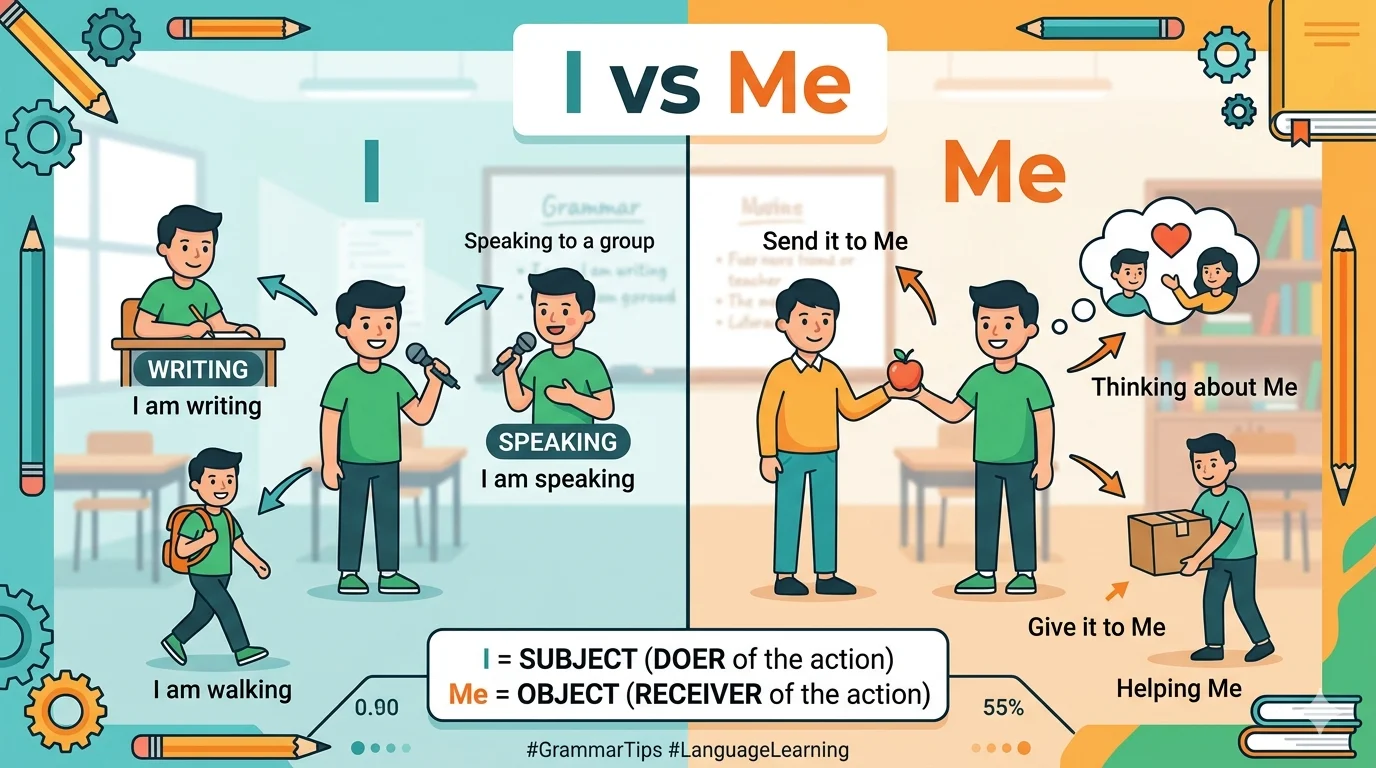
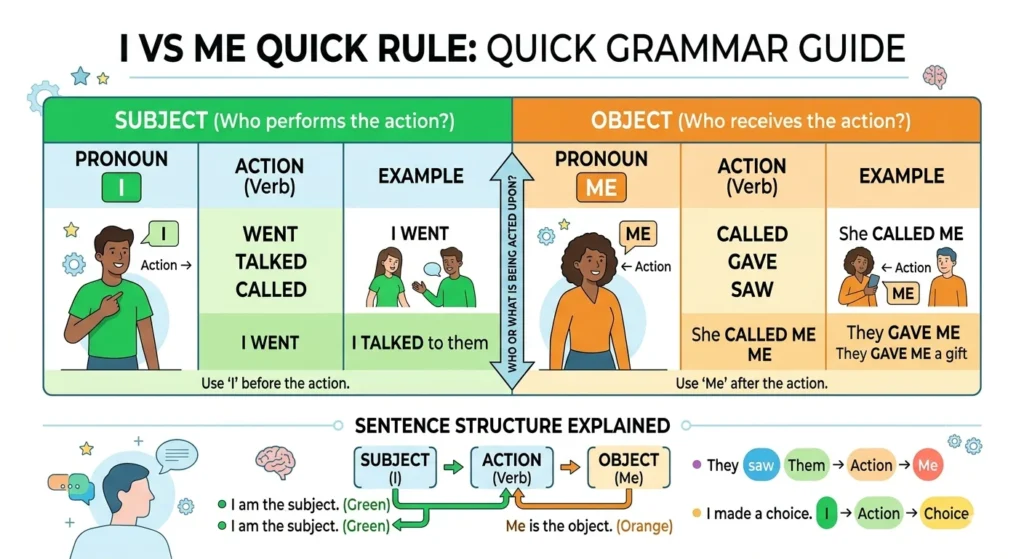
The word “I” is a subject pronoun, which means it is used when you are the one doing the action. For example: “I went to school.” or “I am studying English.”
The word “me” is an object pronoun, which is used when you are receiving the action. For example: “She called me.” or “He helped me.”
A simple way to avoid mistakes is to remove the other person from the sentence. Instead of saying “Me and John went,” test it as “Me went” (incorrect) vs “I went” (correct). This helps you quickly choose the right word.
Understanding the difference between I vs me grammar rules helps you speak more naturally and avoid common mistakes in conversations, texts, essays, and everyday English.
I vs Me
Use “I” when the pronoun is the subject performing the action.
Use “me” when the pronoun is the object receiving the action.
Examples:
- I finished the work. ✔
- She called me. ✔
- John and I went to school. ✔
- The teacher helped John and me. ✔
Quick Test:
Remove the other person:
- John and I went → I went ✔
- The teacher called John and me → called me ✔
👉 If the sentence still sounds correct alone, your choice is correct.
Subject vs Object Case
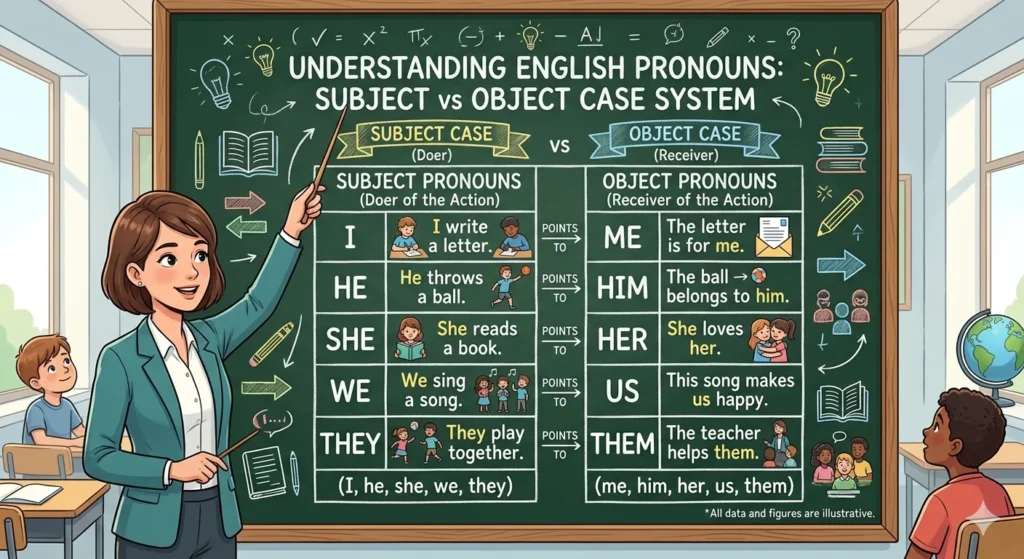
To fully understand this rule, you need to know English pronoun cases.
1. Subject Case (Doer of action)
Subject pronouns:
- I
- He
- She
- We
- They
Examples:
- I study English daily.
- We completed the project.
2. Object Case (Receiver of action)
Object pronouns:
- Me
- Him
- Her
- Us
- Them
Examples:
- She called me.
- They invited us.
👉 This structure is part of traditional English grammar called subjective and objective case system.
Origin of I and Me
The words come from Old English:
- “I” → from ic
- “Me” → from me / mec
English developed grammatical cases to show sentence roles. Even though modern English is simpler, pronouns still keep this system.
This is why we have two forms instead of one.
Why People Get Confused
Learners often make mistakes because:
- Spoken English is informal
- People copy incorrect speech patterns
- “Me and John went” sounds natural in conversation
- Grammar rules feel unnatural at first
👉 But in formal English, grammar rules always take priority.
Is It “John and I” or “John and Me”?
This is the most searched grammar question.
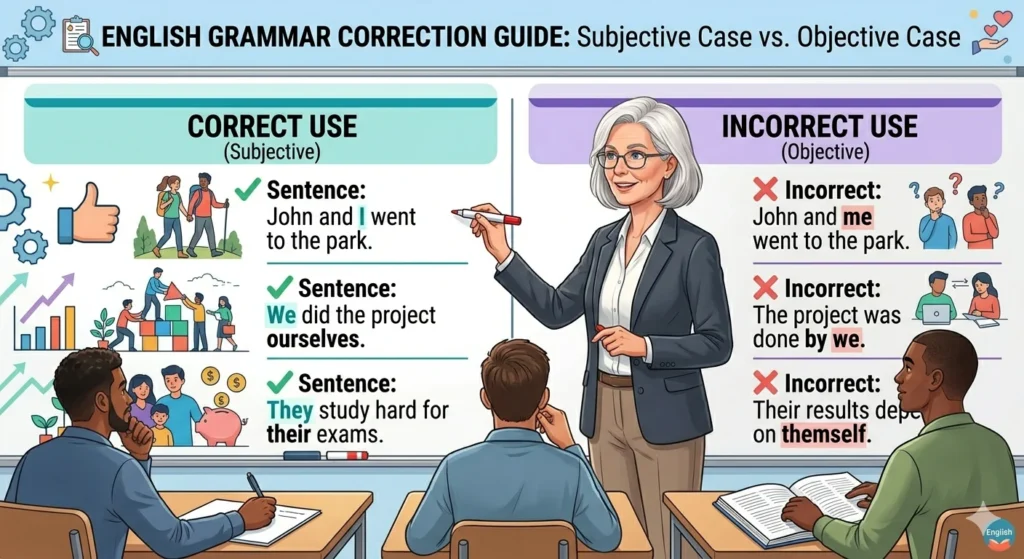
Use “John and I” (Subject)
When both are doing the action:
- John and I are working. ✔
- John and I went home. ✔
Use “John and Me” (Object)
When both receive the action:
- The manager called John and me. ✔
- They invited John and me. ✔
Golden Rule:
Remove the other person:
- “I went” → correct ✔
- “Me went” → incorrect ❌
Common Mistakes with I vs Me
❌ Me went to school
✔ I went to school
❌ She invited John and I
✔ She invited John and me
❌ Him and me finished work
✔ He and I finished work
❌ Please send it to Sarah and I
✔ Please send it to Sarah and me
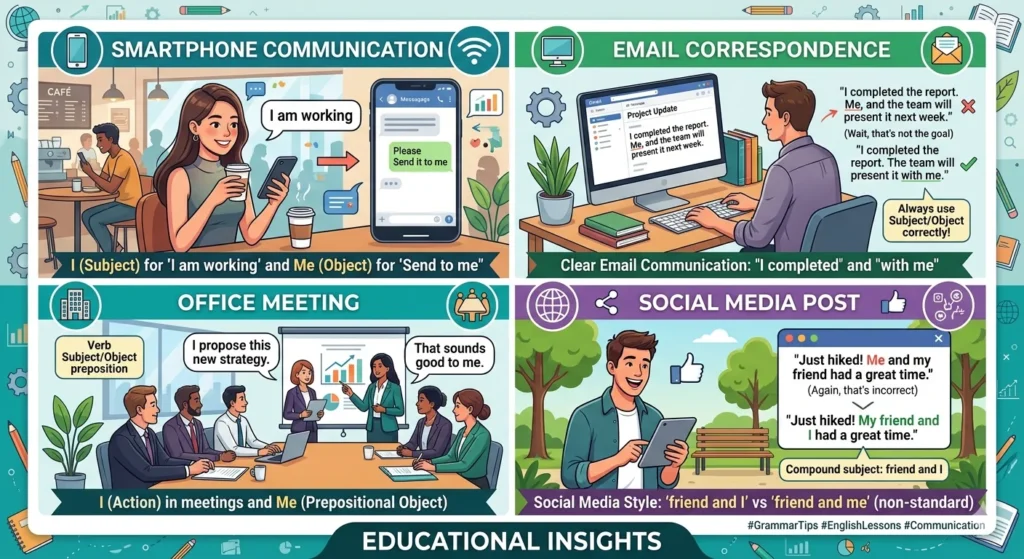
I vs Me in Real-Life Usage
Emails
✔ I will review the document.
✔ Please send it to me.
Office Communication
✔ I have completed the task.
✔ The report was given to me.
Social Media
✔ I am feeling happy today.
✔ Thank you for supporting me.
Academic Writing
✔ I agree with this conclusion.
✔ The data was shared with me.
Psychology Meaning of I vs Me
In psychology, I vs me is explained by sociologist George Herbert Mead.
The “I”
- Spontaneous self
- Natural reactions
- Action-based identity
The “Me”
- Social self
- How others see you
- Internalized rules
👉 This concept is known as Mead’s Self Theory, where identity is shaped by society and personal experience.
Google Search Trends Insight
The keyword I vs me remains highly searched globally due to:
- School exams (English grammar questions)
- IELTS & TOEFL preparation
- Job interviews
- Content writing needs
Popular searches:
- When to use I vs me?
- Is it John and I or John and me?
- I vs me examples
- I vs me quiz
- I vs me meaning
👉 Search spikes often occur during academic exam seasons.
Comparison Table: I vs Me
| Feature | I | Me |
|---|---|---|
| Role | Subject | Object |
| Function | Does action | Receives action |
| Position | Before verb | After verb/preposition |
| Example | I called him | He called me |
I vs Me Quiz
- ___ am ready.
✔ Answer: I - She called ___ yesterday.
✔ Answer: me - John and ___ went home.
✔ Answer: I - They helped ___.
✔ Answer: me
Expert Tip
👉 Always remove the other person and test the sentence.
This method works 100% of the time in English grammar for beginners and advanced learners.
Frequently Asked Questions
1. What is the rule for I vs me?
Use I for subjects and me for objects.
2. When should I use I vs me?
Use I when doing the action and me when receiving it.
3. Is it correct to say John and I?
Yes, when both are subjects.
4. Is it correct to say John and me?
Yes, when both are objects.
5. Why do people confuse I and me?
Because spoken English often ignores grammar rules.
6. What is the I vs me theory?
It refers to grammatical structure and Mead’s psychology theory of self.
7. What is the easiest way to learn it?
Remove the other person and check if the sentence still makes sense.
Conclusion
The difference between I and me is one of the most important basic rules in English grammar. Although both pronouns refer to yourself, they serve different roles in a sentence. I is used when you are performing the action, while me is used when you are receiving the action.
Understanding subject and object roles helps eliminate confusion instantly. With the simple “remove the other person” test, learners can easily choose the correct pronoun in speaking and writing.
This rule is essential for students, professionals, content writers, and English learners because it improves clarity, correctness, and communication confidence. Once mastered, it becomes automatic and prevents one of the most common English mistakes in everyday communication.

Pam Peters is a linguist and grammar expert, known for clear explanations of modern English usage, style, and practical language rules.