Have you ever stopped while writing and wondered whether you should use dependent or dependant? If so, you are not alone. This is one of the most common English spelling confusions, especially among students, writers, visa applicants, and professionals who work with international audiences.
Many people search for dependent vs dependant meaning, dependent vs dependant examples, and what is the difference between dependent and dependant? because both words look almost identical and are often used in similar situations. The confusion becomes even greater when dealing with immigration forms, tax documents, legal paperwork, and British vs American English spelling rules.
To make matters more confusing, dictionaries recognize both spellings, but they are not always interchangeable. Some countries prefer one spelling, while others use both depending on the context.
In this complete grammar guide, you’ll learn the difference between dependent vs dependant, their origins, usage rules, examples, UK and US spelling differences, visa terminology, academic usage, and professional writing recommendations. By the end, you’ll know exactly which spelling to use and when.
What Is the Difference Between Dependent and Dependant?
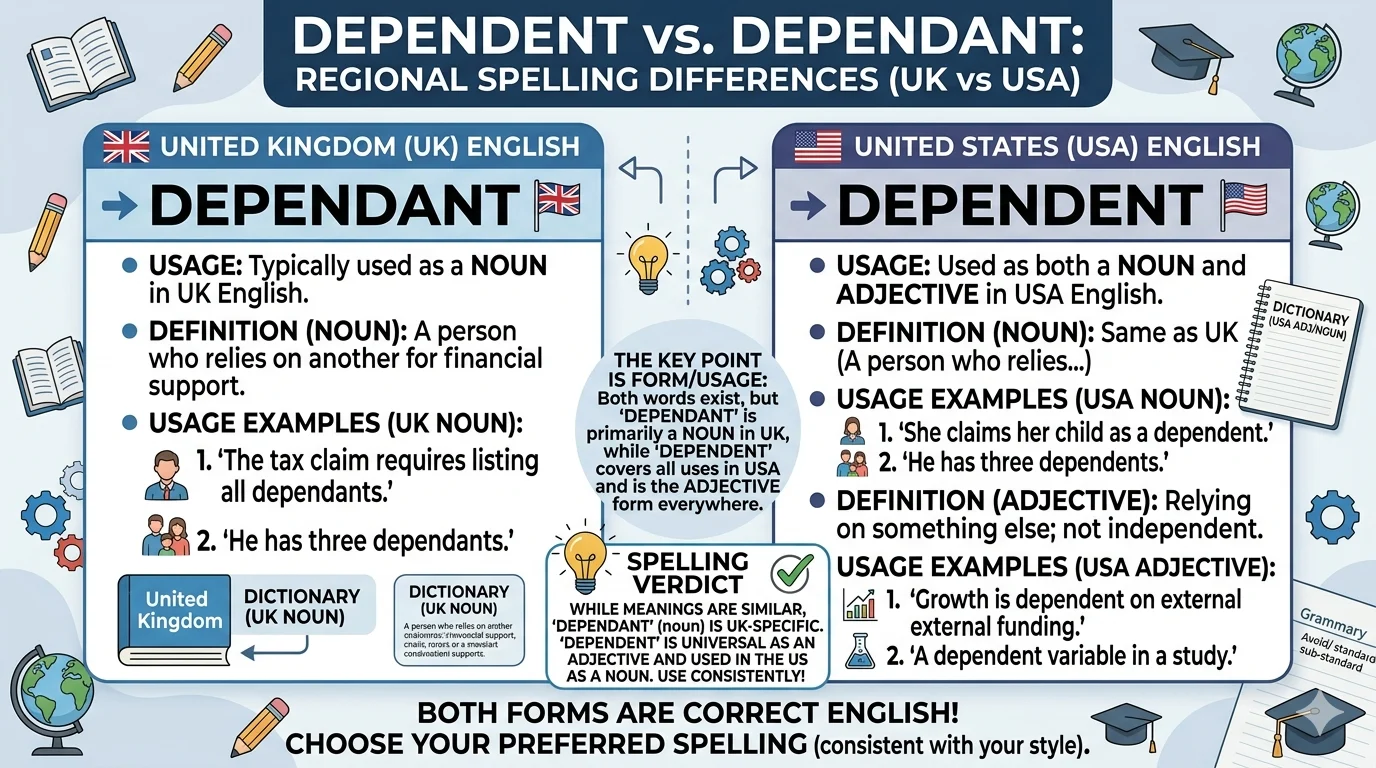
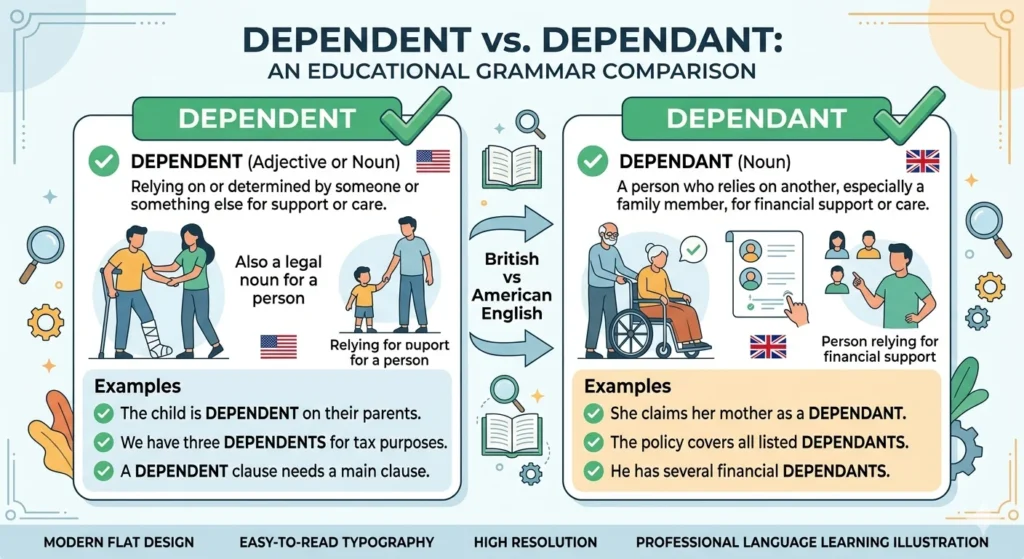
Dependent is the standard American English spelling and can function as both a noun and an adjective. Dependant is mainly a British English noun that refers to a person who relies on another person for financial support. While both words are correct, their usage depends on the region and context. If you are writing for an international audience, dependent is usually the safest choice
Dependent vs Dependant
The short answer is simple:
- Dependent is the standard spelling in American English.
- Dependant is mainly used in British English as a noun.
- Dependent is commonly used as an adjective in both American and British English.
Quick Comparison Table
| Feature | Dependent | Dependant |
|---|---|---|
| American English | ✓ Standard | Rare |
| British English | ✓ Common | ✓ Common |
| Adjective | ✓ Yes | ✗ No |
| Noun | ✓ Yes | ✓ Yes (UK) |
| Worldwide Usage | ✓ More Common | Less Common |
Examples
✓ The child is dependent on her parents.
✓ The outcome is dependent on weather conditions.
✓ He listed two dependants on his UK application form.
✓ She claimed her dependent on a US tax return.
If you are unsure, dependent is usually the safest choice.
The Origin of Dependent vs Dependant
Both words come from the Latin word dependere, which means “to rely on” or “to hang from.”
The word entered English through Old French and later developed into different spelling forms. Over time, English-speaking countries adopted different spelling conventions.
Historically:
- Dependent became the preferred spelling in American English.
- Dependant remained common in British legal and government writing.
- Modern international English increasingly favors dependent.
This pattern is similar to other spelling differences such as:
- Color vs Colour
- Favor vs Favour
- Center vs Centre
The difference is not about meaning but mainly about regional language rules and writing traditions.
What Does the Oxford Dictionary Say?
Many people searching dependent vs dependant Oxford dictionary want to know whether both spellings are correct.
According to Oxford dictionaries:
- Dependent can function as both a noun and an adjective.
- Dependant is primarily a British English noun that refers to a person who relies on another person for financial support.
This explains why both spellings still appear in modern English.
Oxford’s guidance helps writers understand that the choice often depends on regional usage rather than correctness alone.
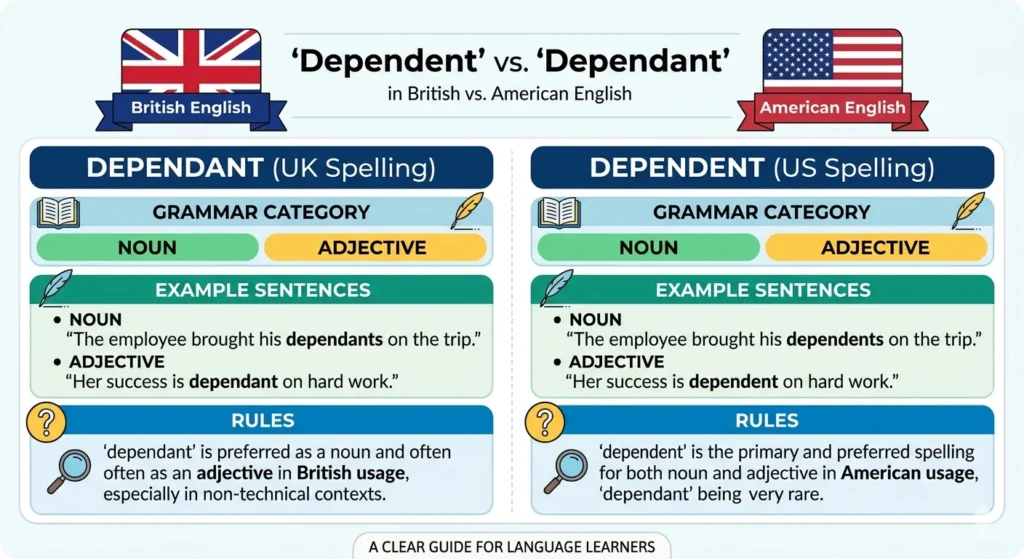
British English vs American English Spelling
One of the biggest reasons people confuse these words is the difference between British and American English.
American English
In the United States, dependent is used for both nouns and adjectives.
Examples:
- A dependent child
- A tax dependent
- Financially dependent
British English
In the United Kingdom:
- Dependent is usually an adjective.
- Dependant is often used as a noun.
Examples:
- The child is dependent on his parents.
- The child is a dependant of his parents.
Comparison Table
| Usage | American English | British English |
|---|---|---|
| Adjective | Dependent | Dependent |
| Noun | Dependent | Dependant |
| Tax Documents | Dependent | Dependant |
| Immigration Forms | Dependant less common | Dependant common |
| Academic Writing | Dependent | Dependent |
| Business Writing | Dependent | Usually Dependent |
Dependent vs Dependant UK
In modern UK writing, many businesses and universities now use dependent more often. However, government, legal, and immigration documents still frequently use dependant.
Which Spelling Should You Use?
The correct spelling depends on your audience.
For American Readers
Use dependent.
Examples:
- Blogs
- Business writing
- Tax forms
- Academic papers
For British Readers
Use:
- Dependent as an adjective.
- Dependant as a noun when referring to a person who receives support.
For Global Audiences
Use dependent whenever possible.
Why?
- More widely understood.
- Accepted internationally.
- Preferred in modern professional writing.
Professional Writing Advice
Major dictionaries, academic style guides, immigration authorities, and government agencies often follow regional spelling standards. Understanding these differences helps writers avoid mistakes and maintain credibility.
For most websites and blogs, dependent is the recommended spelling.
Simple Grammar Rule to Remember
A simple way to remember the difference is:
Use dependent when describing reliance or dependence.
Examples:
- The project is dependent on funding.
- Success is dependent on hard work.
- Children are dependent on their parents.
Use dependant when referring to a person who receives financial support in British English.
Examples:
- He listed two dependants on the application.
- Her children are registered as dependants.
This grammar rule helps prevent one of the most common English spelling mistakes.
Dependent vs Dependant Meaning
Understanding the meanings makes the difference easier.
Dependent Meaning
The word dependent means relying on someone or something.
Examples:
- The company is dependent on investors.
- Children are dependent on adults.
- Success is dependent on preparation.
Dependant Meaning
The word dependant usually refers to a person who relies on another person financially.
Examples:
- He has three dependants.
- Her spouse is listed as a dependant.
Meaning Comparison
| Word | Part of Speech | Meaning |
|---|---|---|
| Dependent | Noun/Adjective | Relies on support |
| Dependant | Noun | Person receiving support |
Common Mistakes with Dependent vs Dependant
Many writers make the same grammar mistakes.
Mistake #1
❌ The project is dependant on funding.
✅ The project is dependent on funding.
Mistake #2
❌ Success is dependant on teamwork.
✅ Success is dependent on teamwork.
Mistake #3
❌ I claimed my dependant on my US tax return.
✅ I claimed my dependent on my US tax return.
Mistake #4
❌ The experiment used a dependant variable.
✅ The experiment used a dependent variable.
Mistake #5
Using both spellings randomly in the same article.
Always stay consistent with your chosen style guide.
Dependent vs Dependant in a Sentence
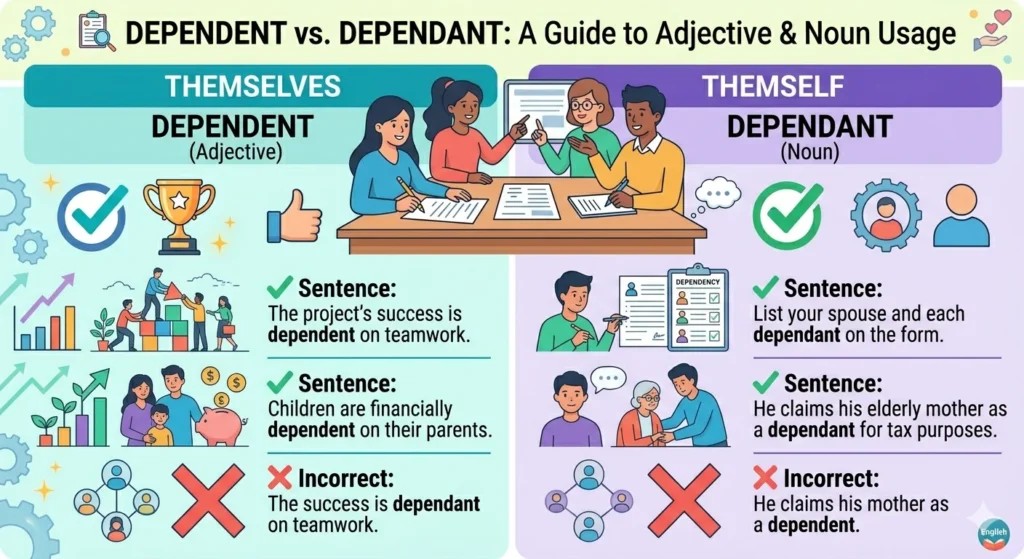
Many users search for dependent vs dependant in a sentence because examples make the difference easier to understand.
Dependent Examples
- The child is dependent on her parents.
- Our success is dependent on teamwork.
- The result is dependent on accurate data.
- The company is dependent on customer demand.
- She remains financially dependent on her family.
Dependant Examples
- The employee added two dependants to the application.
- His wife is listed as a dependant.
- The government provides benefits to eligible dependants.
- The form requires information about each dependant.
- Her children are registered as dependants.
Dependent vs Dependant in Everyday Examples
Email Example
“Please include information about all dependent family members.”
News Example
“The government announced support for dependants.”
Social Media Example
“My child is still dependent on me for school expenses.”
Business Example
“The company’s growth is dependent on market conditions.”
Formal Writing Example
“The applicant may bring eligible dependants under immigration rules.”
Dependant or Dependent Visa
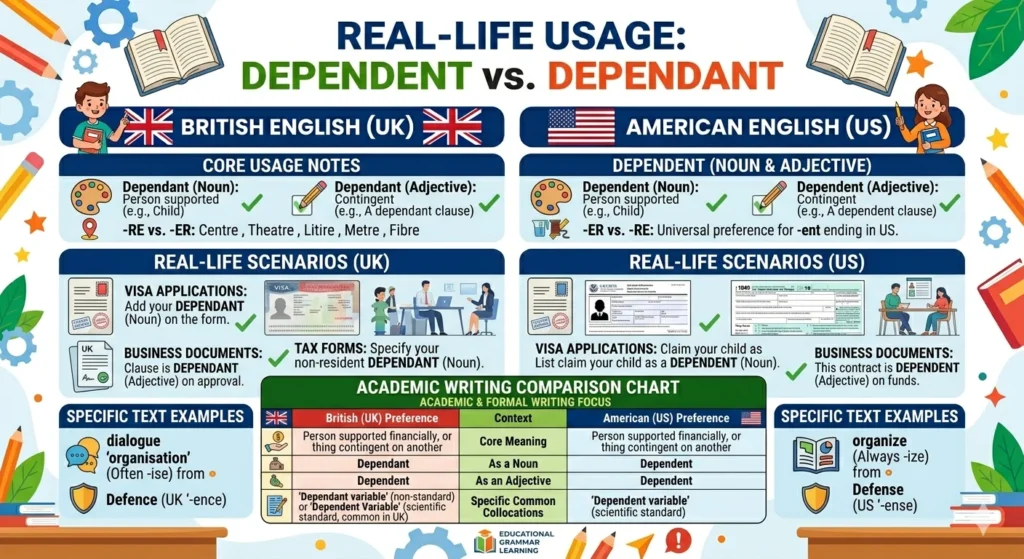
Visa applications often create confusion.
United States
The standard term is:
Dependent Visa
Examples:
- Dependent spouse visa
- Dependent child visa
United Kingdom
Both terms may appear, but dependant visa is often used in immigration and government documents.
Example:
“The applicant may bring eligible dependants to the UK.”
Always follow the terminology used by the relevant immigration authority.
Dependent vs Dependant Variable
Students frequently ask about dependent vs dependant variable.
The correct term is:
Dependent Variable
A dependent variable changes because another factor changes.
Example:
- Hours studied = Independent Variable
- Exam score = Dependent Variable
Example Sentence
“The dependent variable increased after the treatment was applied.”
In science, statistics, mathematics, and research papers, dependent variable is always the correct term.
Is a Child a Dependent or Dependant?
The answer depends on location.
United States
A child is normally called a dependent.
United Kingdom
A child may be called a dependant, especially in legal and government documents.
Examples:
US: “My child is my dependent.”
UK: “My child is my dependant.”
Both are correct within their regional language systems.
Is It Dependant or Dependent on UK?
When using the phrase dependent on, the correct spelling is:
✓ Dependent on
Examples:
- Success is dependent on effort.
- The outcome is dependent on weather.
- The project is dependent on funding.
Using dependant on is generally incorrect because dependant is normally a noun.
What Does Dependent Mean?
The word dependent means relying on another person, resource, or condition.
Examples:
- Financially dependent
- Emotionally dependent
- Dependent child
- Dependent variable
- Dependent relationship
It can function as both a noun and adjective, especially in American English.
Dependent vs Dependant – Google Trends & Usage Data
Search behavior shows clear regional preferences.
Countries Where “Dependent” Is More Popular
- United States
- Canada
- Australia
- New Zealand
- International business communities
Countries Where “Dependant” Is More Popular
- United Kingdom
- Ireland
- Some Commonwealth legal systems
Search Intent Behind the Keyword
Users commonly search:
- Dependent vs dependant meaning
- Dependent vs dependant examples
- Dependent vs dependant UK
- Dependent vs dependant Oxford dictionary
- Is a child a dependent or dependant?
- What does dependent mean?
- Dependant or dependent visa?
Most users want a quick answer followed by practical examples and grammar guidance.
FAQs
What is the difference between dependent and dependant?
Dependent is the standard American spelling. Dependant is mainly used as a British noun for a person receiving support.
Is dependant a real word?
Yes. It is recognized in British English and commonly appears in legal and immigration contexts.
Is dependent correct in the UK?
Yes. It is widely used as an adjective and increasingly appears as a noun.
Is a child a dependent or dependant?
In the US, a child is a dependent. In some UK contexts, a child may be a dependant.
What does dependent mean?
It means relying on someone or something for support, assistance, or success.
Is dependant outdated?
No. It is still used in British legal, government, and immigration documents.
Why does American English prefer dependent?
American English simplified usage by using one spelling for both noun and adjective forms.
Can dependent and dependant be used interchangeably?
Not always. Regional spelling conventions and context determine which form is appropriate.
Conclusion
The difference between dependent vs dependant is mainly a matter of regional spelling and usage. In American English, dependent serves as both a noun and an adjective, making it the preferred choice in most situations. In British English, dependant traditionally refers to a person who relies on someone else for financial support, while dependent remains the standard adjective.
For students, professionals, bloggers, and business writers, understanding this distinction helps improve clarity and accuracy. It also prevents common grammar mistakes in emails, academic papers, immigration forms, and official documents.
If you are writing for a global audience, dependent is usually the best option because it is widely recognized and accepted worldwide. However, if you are following British legal or government conventions, dependant may be the correct choice when referring to a person receiving support.
Remember the simple rule: use dependent when describing reliance and use dependant primarily as a British noun. Following this guideline will help you write confidently and professionally in any English-speaking setting.