Have you ever paused while writing and wondered whether to use as or like? You’re not alone. Many English learners, students, writers, and even native speakers confuse these two common words because they often seem to have the same meaning. However, they follow different grammar rules, and using the wrong one can make your sentence sound awkward or incorrect.
Many people search online for questions like “Which is the difference between as and like?”, “How to use like or as?”, or “Is it correct to say ‘like I said’ or ‘as I said’?” These questions show that understanding as vs like grammar is a common challenge.
The good news is that the difference is easy to learn. In this guide, you’ll discover simple grammar rules, clear comparison tables, real-life examples, common mistakes, and practice exercises. Whether you’re writing an email, preparing for an English exam, or improving your everyday communication, this article will help you choose the right word with confidence.
As vs Like
The difference between as and like is simple.
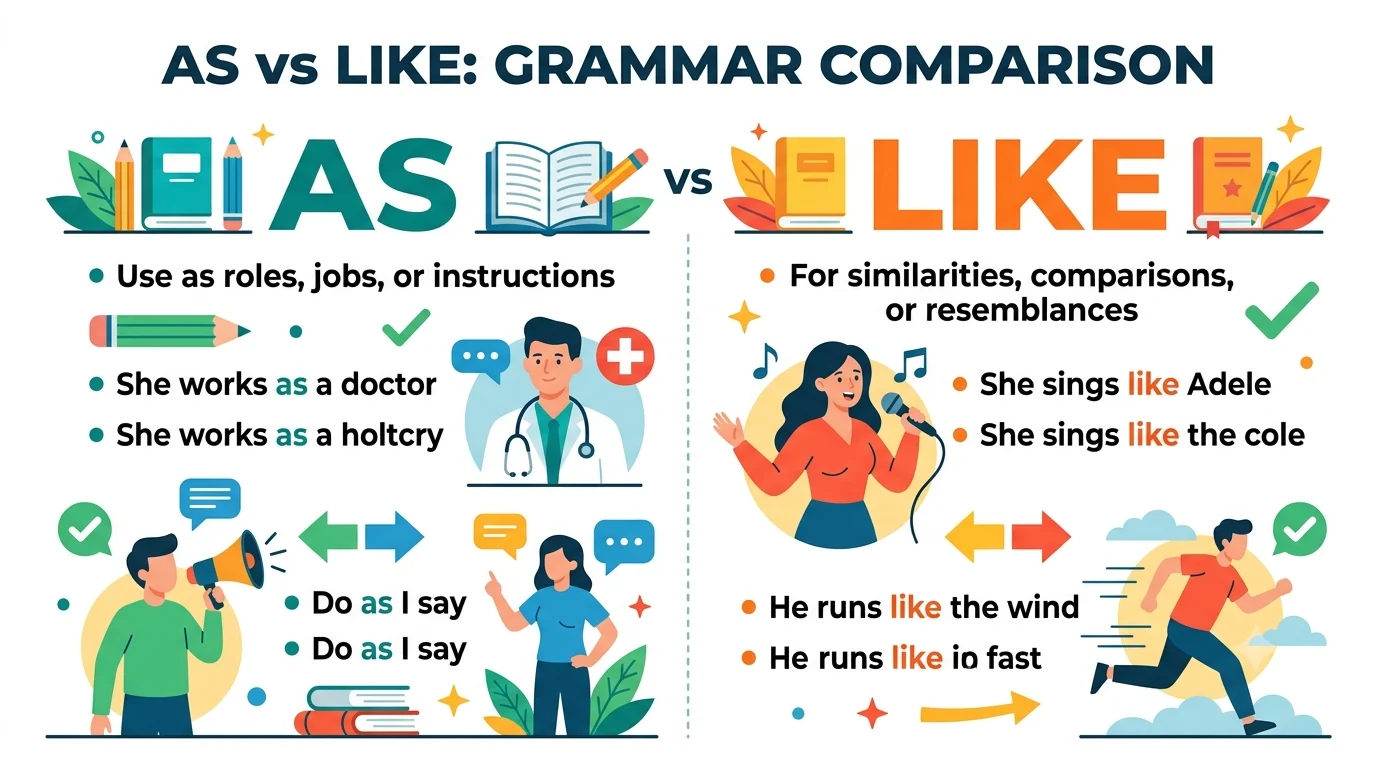
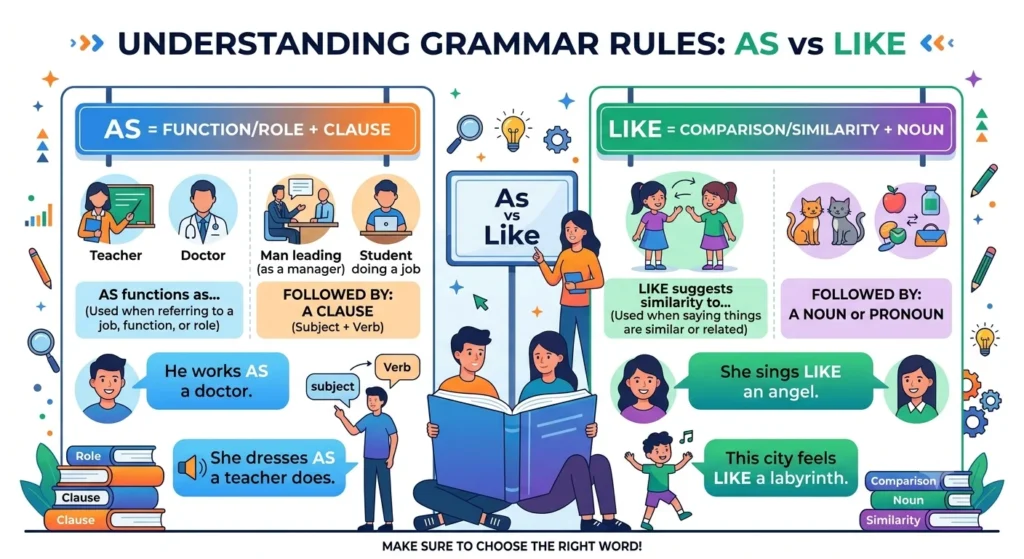
- As is used to describe a real role, job, function, or to introduce a clause.
- Like is used to compare people, animals, objects, or ideas.
Simple Examples
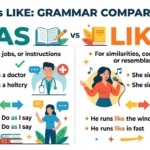
| As | Like |
|---|---|
| She works as a doctor. | She looks like her mother. |
| Do as I told you. | He runs like the wind. |
| He spoke as the team leader. | The cake tastes like chocolate. |
| Use the machine as instructed. | She sings like Adele. |
Quick Rule to Remember
Use “as” for a real role or before a complete clause. Use “like” to compare two things.
If you’re wondering which is the difference between as and like, here’s the answer:
- Use as when someone or something has a real role or when a subject and verb follow.
- Use like when comparing one person or thing to another.
For example:
- She works as a teacher. (She really is a teacher.)
- She teaches like a great teacher. (You’re making a comparison.)
As vs Like Grammar Rules
Understanding a few simple rules makes it easy to choose the correct word.
Rule 1: Use “As” for a Real Role or Job
Use as when talking about someone’s actual position, profession, or responsibility.
Examples
- She works as a nurse.
- He served as the company director.
- I joined the team as an intern.
- They hired her as a designer.
Tip: If the person truly has the role, use as.
Rule 2: Use “Like” to Compare Things
Use like when showing that one thing is similar to another.
Examples
- He swims like a dolphin.
- The baby looks like her father.
- It smells like fresh bread.
- She dances like a professional.
Tip: If you’re making a comparison, use like.
Rule 3: Use “As” Before a Clause
A clause contains a subject and a verb.
Examples
- Do as I told you.
- As I expected, the train arrived late.
- Leave the room as you found it.
- Everything happened as we planned.
Notice that each example after as has its own subject and verb.
Rule 4: Use “Like” Before a Noun or Pronoun
Use like before a noun, pronoun, or noun phrase when making a comparison.
Examples
- She looks like her sister.
- It sounds like music.
- He eats like a child.
- The clouds look like cotton.
Rule 5: Informal English Often Uses “Like” Instead of “As”
In everyday conversation, especially in American English, many people say:
- Like I said yesterday…
- Like we discussed…
These expressions are common in casual speech.
In formal writing, however, use:
- As I said yesterday…
- As we discussed…
This small change makes your writing sound more professional.
How to Choose Between As and Like
If you’re still unsure, use this simple guide.
Are you talking about someone's real job or role?

        │
       Yes
        │
      Use AS
        │
       No
        │
Are you comparing two people or things?
        │
       Yes
        │
     Use LIKE
Quick Examples
| Situation | Correct Word | Example |
|---|---|---|
| Real profession | As | She works as a teacher. |
| Similar appearance | Like | She looks like her mother. |
| Giving instructions | As | Do as I say. |
| Comparing actions | Like | He runs like the wind. |
The Origin of As vs Like
The words as and like have been part of English for hundreds of years. Although they are often confused today, they came from different Old English words and developed different meanings over time.
The Origin of “As”
The word as comes from the Old English word ealswā, which means “just so,” “in the same way,” or “to the same degree.” Over time, the word became shorter and easier to pronounce, eventually becoming the modern as.
Because of its history, as is often used to describe roles, functions, or actions.
Examples
- She worked as a teacher.
- Please do as I asked.
- Everything happened as expected.
In modern English, as is commonly used in both formal and informal writing, especially when introducing a clause or describing someone’s real position.
The Origin of “Like”
The word like comes from the Old English word gelīc, meaning “similar,” “having the same appearance,” or “resembling.”
Its original meaning has stayed almost the same for centuries.
Today, like is mainly used to compare people, objects, or ideas.
Examples
- He looks like his father.
- This cake tastes like chocolate.
- She sings like a professional singer.
Because like naturally expresses similarity, it is one of the most common comparison words in English.
Why Do People Confuse As and Like?
Many learners think as and like have the same meaning because both can appear in sentences that compare things.
However, they have different grammar functions.
- As describes a real role or introduces a clause.
- Like shows similarity or comparison.
Compare These Sentences
❌ She works like a doctor.
✅ She works as a doctor.
Here, she really is a doctor.
❌ He runs as a cheetah.
✅ He runs like a cheetah.
Here, you’re comparing his speed to a cheetah.
Remember this simple rule:
As = Role or Function
Like = Comparison or Similarity
British English vs American English
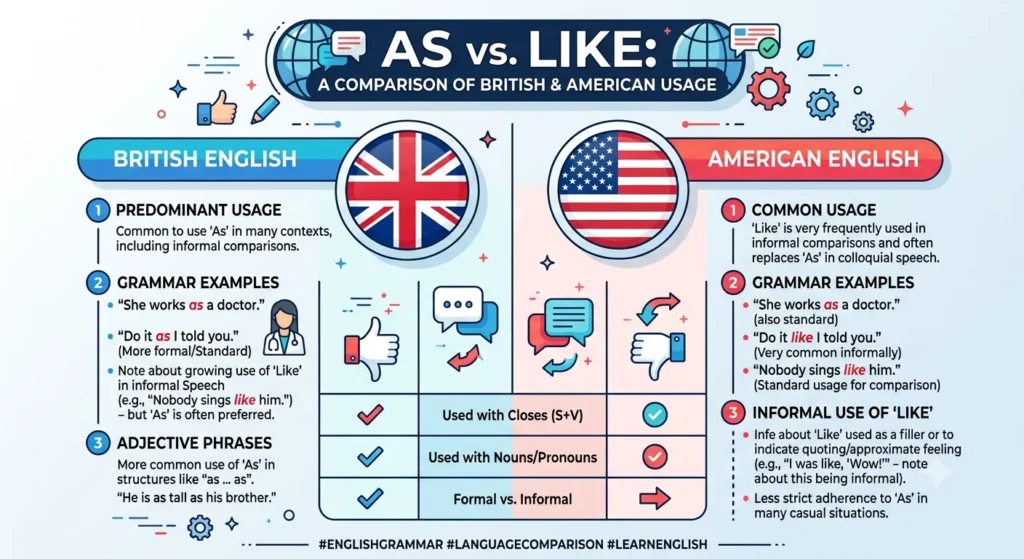
One of the biggest questions learners ask is whether as and like change between British English and American English.
The answer is simple:
There is no spelling difference.
Unlike words such as colour/color or realise/realize, both countries spell these words exactly the same.
The difference is mainly style, not spelling.
British English
British English usually follows traditional grammar rules in formal writing.
Examples:
- As I mentioned earlier…
- Do as you’re told.
- She works as an architect.
In conversation, British speakers also use like, but formal writing still prefers as before a clause.
American English
American English follows the same grammar rules, but casual speech is often more relaxed.
You’ll frequently hear:
- Like I said…
- Like we talked about…
These expressions are common in everyday conversation.
However, in business writing, academic papers, and professional emails, American English also prefers:
- As I said…
- As discussed…
British English vs American English Comparison
| Feature | British English | American English |
|---|---|---|
| Spelling | as / like | as / like |
| Grammar Rules | Same | Same |
| Formal Writing | Prefers as before clauses | Prefers as before clauses |
| Everyday Speech | Uses both words | Uses like more often in conversation |
| Professional Writing | Formal grammar preferred | Formal grammar preferred |
Grammar Comparison Table
| Situation | Use As | Use Like |
|---|---|---|
| Real profession | ✔ | ✘ |
| Official role | ✔ | ✘ |
| Comparison | ✘ | ✔ |
| Similar appearance | ✘ | ✔ |
| Before a complete clause | ✔ | Usually informal |
| Before a noun | Sometimes | ✔ |
Which Should You Use?
The correct word depends on what you want to say and who you’re writing for.
If Your Audience Is in the United States
Use standard grammar in formal writing.
Examples:
- She works as an engineer.
- He looks like his brother.
In casual conversations, phrases like “Like I said” are widely accepted.
If Your Audience Is in the United Kingdom
British English follows the same grammar rules.
Formal examples include:
- As expected…
- As shown below…
- As discussed earlier…
These forms are common in schools, universities, newspapers, and business writing.
If Your Audience Is Global
If you’re writing for readers from different countries, keep your grammar simple.
Use:
- As for jobs, roles, and clauses.
- Like for comparisons.
This approach works well in international communication and helps avoid confusion.
Quick Decision Table
| If You Mean… | Use |
|---|---|
| Someone’s real job | As |
| A comparison | Like |
| A complete clause | As |
| Something looks similar | Like |
| Formal instructions | As |
Common Mistakes with As vs Like
Many English learners make the same mistakes. Learning these common errors will help you write more naturally and confidently.
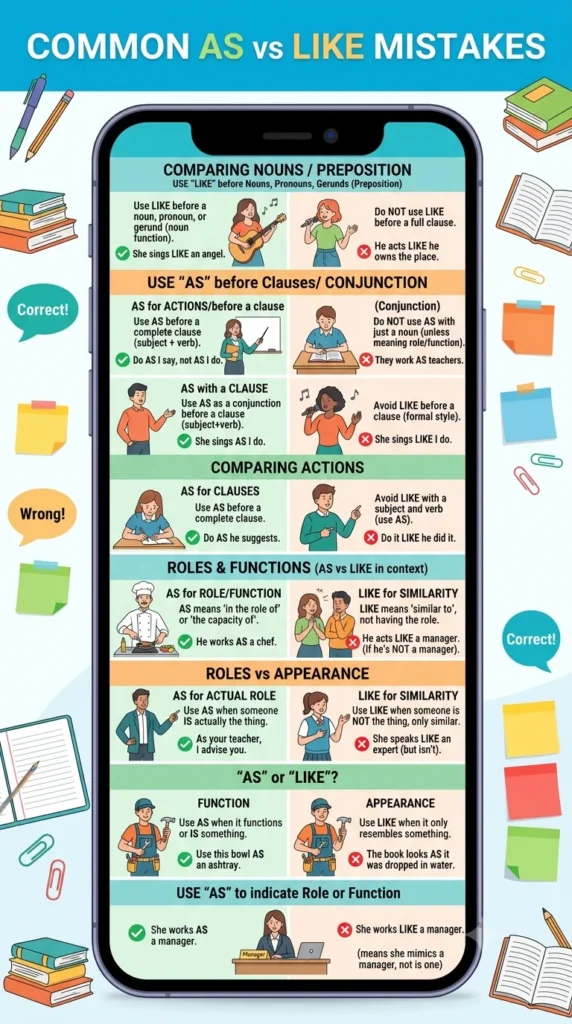
Mistake 1: Using “Like” for a Real Job
❌ She works like a nurse.
✅ She works as a nurse.
Why?
She actually has the job of a nurse.
Mistake 2: Using “As” for a Comparison
❌ He swims as a fish.
✅ He swims like a fish.
Why?
You’re comparing his swimming to a fish.
Mistake 3: Using “Like” Before a Clause in Formal Writing
❌ Like I explained yesterday…
✅ As I explained yesterday…
Why?
A complete clause follows, so as is the grammatically correct choice in formal English.
Mistake 4: Confusing a Role with a Comparison
❌ She acted like the team leader.
✅ She acted as the team leader.
Use as when she officially held the position.
If you only mean her behavior was similar, use:
✅ She acted like a team leader.
Mistake 5: Incorrect Instructions
❌ Use the software like shown.
✅ Use the software as shown.
Common Mistakes Table
| Incorrect | Correct | Reason |
|---|---|---|
| Work like a teacher | Work as a teacher | Real profession |
| Runs as a lion | Runs like a lion | Comparison |
| Like I explained (formal) | As I explained | Clause follows |
| Like shown | As shown | Standard expression |
| Looks as her sister | Looks like her sister | Similar appearance |
Quick Tip to Remember
Ask yourself one simple question:
Am I describing a real role or making a comparison?
- If it’s a real role, choose as.
- If it’s a comparison, choose like.
This simple trick will help you avoid most grammar mistakes.
As vs Like in Everyday Examples
The best way to understand as vs like is to see how each word is used in everyday situations. These examples will help you write and speak more naturally.
In Emails
Professional emails usually follow standard grammar rules.
Correct Examples
- Please complete the report as discussed in yesterday’s meeting.
- She joined the company as a project manager.
- Your presentation looks like the previous version.
Incorrect Examples
❌ Please complete the report like discussed.
✅ Please complete the report as discussed.
In News Articles
News writers use clear and formal English.
Examples
- The scientist spoke as the lead researcher.
- The river flowed like a powerful stream.
- Follow the safety rules as instructed.
On Social Media
Social media is more relaxed, so you’ll often see informal grammar.
Examples:
- Like I said, this movie is amazing!
- It feels like summer today.
- She dresses like her favorite singer.
Although “Like I said” is common online, “As I said” is still the preferred choice in formal writing.
In School and College Writing
Students should use standard grammar.
Examples:
- Write your answer as shown in the example.
- The puppy looks like a teddy bear.
- She served as the class president.
In Business Writing
Professional documents should be clear and accurate.
Examples:
- The employee worked as a financial advisor.
- The results were as expected.
- The new design looks like the original version.
Like and As Examples
| Sentence | Correct Word | Why? |
|---|---|---|
| She works ___ a teacher. | As | Real profession |
| He swims ___ a fish. | Like | Comparison |
| Do ___ I told you. | As | Complete clause |
| It smells ___ fresh bread. | Like | Similarity |
| She served ___ captain. | As | Official role |
| The baby looks ___ her father. | Like | Appearance |
These like and as examples show that choosing the correct word depends on the meaning of the sentence.
Like and As in Similes and Metaphors
Many learners search for like and as metaphor because both words are common in figurative language.
Using “Like” in Similes
A simile compares two different things using like or as.
Examples:
- He fought like a lion.
- She shines like the sun.
- The lake was like glass.
Here, like compares two things without saying they are the same.
Using “As” in Similes
As is also used in many common similes.
Examples:
- As brave as a lion.
- As busy as a bee.
- As quiet as a mouse.
- As light as a feather.
These expressions compare qualities and are common in everyday English.
What About Metaphors?
Unlike similes, metaphors do not use like or as.
Compare these examples:
| Type | Example |
|---|---|
| Simile | He is like a lion. |
| Simile | She is as brave as a lion. |
| Metaphor | He is a lion. |
Remember:
- Similes use like or as.
- Metaphors do not.
What Does “As Like” Mean?
Many people search for as like meaning, but this phrase often causes confusion.
In standard English, as like is not a fixed expression. Instead, as and like have different grammar functions.
- As describes a real role or introduces a clause.
- Like compares two people or things.
Correct Examples
- She works as a doctor.
- She looks like a doctor.
These sentences have different meanings.
In some regional dialects, you may hear as like, but it is uncommon in standard written English.
As vs Like – Google Trends & Usage Data
The keyword as vs like is searched by thousands of people every month because it is one of the most common grammar questions in English.
Students, teachers, writers, and professionals all want to understand the difference between these two words.
Who Searches for This Topic?
People searching as vs like grammar often include:
- English learners
- School students
- University students
- IELTS and TOEFL candidates
- Teachers
- Business professionals
- Content writers
Popular Search Queries
Many users also search for:
- Which is the difference between as and like?
- How to use like or as?
- As vs like grammar
- Like and as examples
- As vs like grammar examples
- As vs like exercises
- As vs like exercises PDF
- Like and as metaphor
- As like meaning
- As vs like Wordwall
- Is it correct to say “Like I said” or “As I said”?
These searches show that learners want clear explanations, examples, and practice activities.
Where Is This Topic Most Popular?
| Country | Common Reason for Searching |
|---|---|
| United States | Grammar and business writing |
| United Kingdom | Academic writing |
| Canada | School assignments |
| Australia | English learning |
| India | Competitive exams |
| Pakistan | Grammar improvement |
| Philippines | ESL education |
Usage by Context
| Context | As | Like |
|---|---|---|
| Academic writing | ⭐⭐⭐⭐⭐ | ⭐⭐ |
| Business writing | ⭐⭐⭐⭐⭐ | ⭐⭐⭐ |
| News articles | ⭐⭐⭐⭐⭐ | ⭐⭐⭐ |
| Daily conversation | ⭐⭐⭐ | ⭐⭐⭐⭐⭐ |
| Social media | ⭐⭐ | ⭐⭐⭐⭐⭐ |
While like is very common in everyday speech, as remains the preferred choice in formal and professional writing.
Quick Comparison Table
| Feature | As | Like |
|---|---|---|
| Main Meaning | Role or function | Comparison or similarity |
| Used Before a Clause | ✔ Yes | Usually no |
| Used Before a Noun | Sometimes | ✔ Yes |
| Shows Similarity | Sometimes | ✔ Yes |
| Formal Writing | ✔ Preferred | Limited |
| Everyday Conversation | ✔ Common | ✔ Very Common |
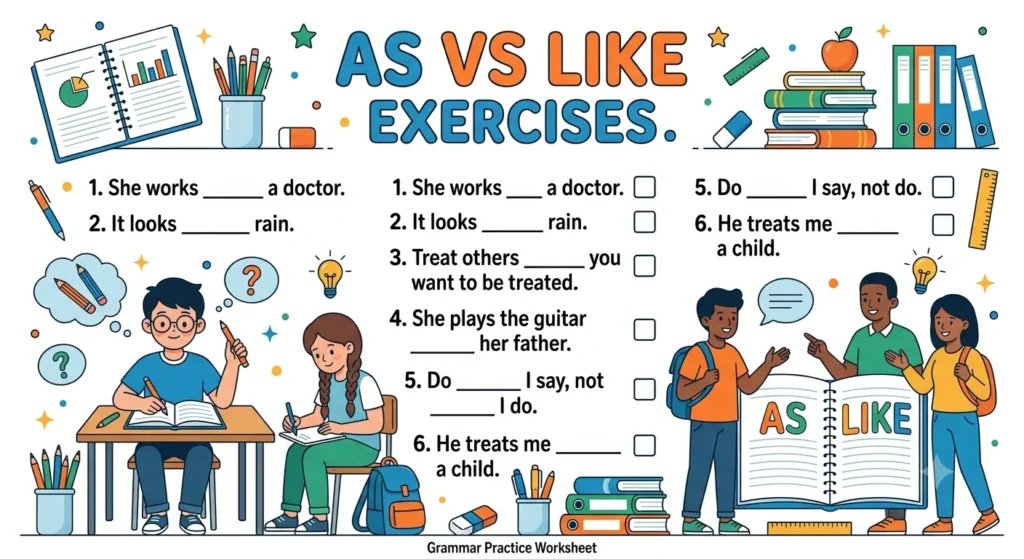
As vs Like Exercises
Practicing is the best way to remember the difference between as and like. Try these simple exercises before checking the answers.
Exercise 1: Choose the Correct Word
Fill in the blanks with as or like.
- She works _____ a dentist.
- He runs _____ a cheetah.
- Do _____ I told you.
- This tastes _____ fresh strawberries.
- She served _____ the team captain.
- The baby looks _____ her mother.
- Use the software _____ explained in the manual.
- He sings _____ a famous singer.
Answers
- as
- like
- as
- like
- as
- like
- as
- like
People Also Ask
Can I use “like” instead of “as”?
Sometimes. In casual conversation, many native speakers use like where formal grammar prefers as. However, in professional, academic, and business writing, it’s best to follow the standard grammar rules.
Why do native speakers say “Like I said”?
“Like I said” is common in informal American English. It sounds natural in everyday conversation. In formal writing, “As I said” is the grammatically preferred choice.
Is “as if” the same as “like”?
No. As if introduces a clause with a subject and verb, while like is usually followed by a noun or pronoun.
Examples
- She smiled as if she knew the answer.
- She smiled like her mother.
Can “as” and “like” ever mean the same thing?
In some informal situations, they can express a similar idea. However, in standard grammar, as is used for roles or clauses, while like is used for comparisons.
Can I use “like” in formal writing?
Yes, but only when it is used correctly to compare people or things.
Example:
- The new design looks like the previous version.
Avoid using like instead of as before a clause in formal writing.
Frequently Asked Questions
1. Which is the difference between as and like?
As describes a real role, function, or introduces a clause. Like compares one person or thing with another.
Examples
- She works as a doctor.
- She sings like a professional singer.
2. How to use like or as?
Use as for jobs, roles, instructions, and clauses.
Use like to compare people, animals, objects, or ideas.
3. Is it correct to say “Like I said” or “As I said”?
Both are common, but they fit different situations.
- As I said → Formal and grammatically preferred.
- Like I said → Informal and common in everyday speech.
4. What is the V1, V2, and V3 of “like”?
| Verb Form | Word |
|---|---|
| V1 | Like |
| V2 | Liked |
| V3 | Liked |
Examples
- I like reading.
- I liked the movie.
- I have liked this song for years.
7. Are “as” and “like” interchangeable?
Not always.
Choose as when talking about a real role or introducing a clause.
Choose like when making a comparison.
Understanding this difference will make your English clearer and more accurate.
Conclusion
Understanding the difference between as and like is easier than it first seems. Although both words can express similarity, they have different grammar functions and should not always be used interchangeably.
Remember the simple rule: use “as” when describing a real role, job, function, or when introducing a clause with a subject and verb. Use “like” when comparing people, objects, or ideas. This small distinction can make a big difference in the clarity and professionalism of your writing.
Whether you’re writing an email, completing a school assignment, preparing for an English exam, or improving your everyday communication, using the correct word will help your sentences sound more natural and accurate.
If you’re ever unsure, ask yourself one simple question: Am I describing a real role or making a comparison? The answer will usually tell you whether to choose as or like. Keep practicing with real-life examples and grammar exercises, and soon using as and like correctly will become second nature.

Scott Thornbury is a respected English language educator and author, known for practical grammar insights, teacher training, and clear learner-focused explanations.