Have you ever stopped while writing an email or social media post because you weren’t sure whether to use complimentary or complementary? You’re not alone. These two words sound almost the same, but they have completely different meanings. One relates to praise or something given for free, while the other describes things that complete or improve each other.
Many English learners, students, writers, and even native speakers search for “Is it complimentary or complementary?” because the spelling difference is small but the meaning changes the entire sentence. Using the wrong word can make your writing look unprofessional or even confuse your readers.
In this guide, you’ll learn the difference between complimentary vs complementary, their meanings, pronunciation, real-life examples, spelling rules, common mistakes, and when to use each one. By the end, you’ll know exactly which word fits every situation and feel confident using both correctly in everyday and professional writing.
Complimentary vs Complementary
Quick Answer
The difference is simple:
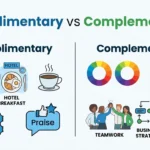
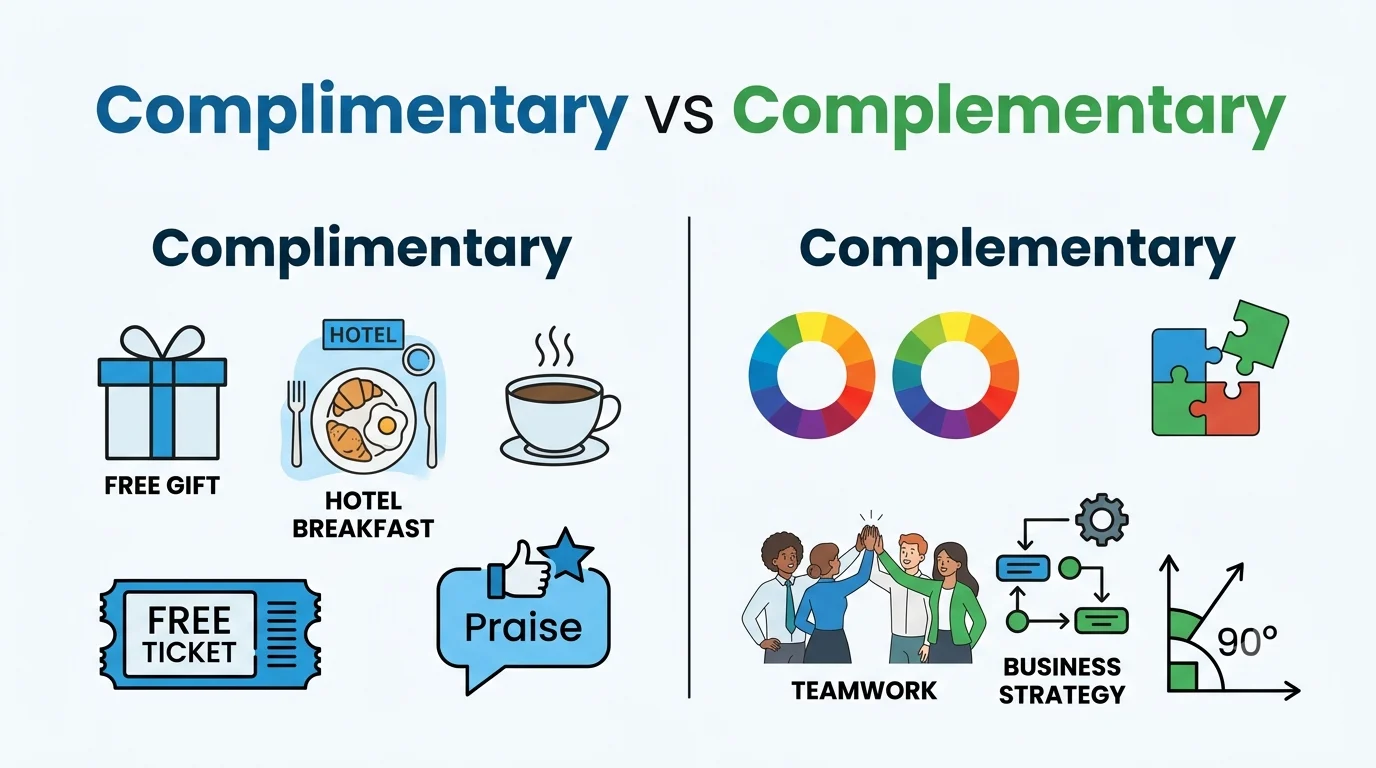
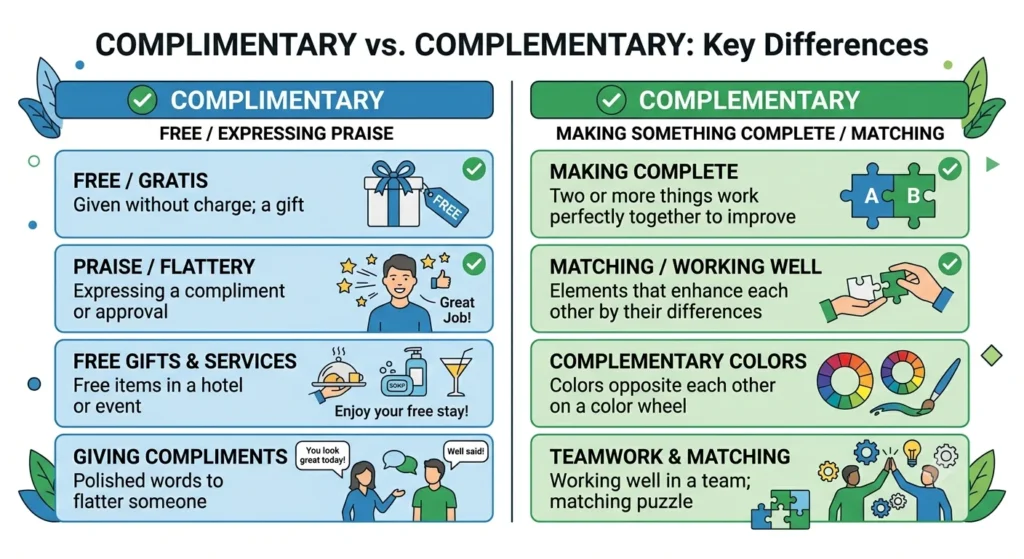
- Complimentary means expressing praise or admiration, or provided free of charge.
- Complementary means two or more things that complete, improve, or work well together.
Examples
| Word | Meaning | Example |
|---|---|---|
| Complimentary | Free or praising | The hotel offered complimentary breakfast. |
| Complimentary | Giving compliments | She was very complimentary about your presentation. |
| Complementary | Completing each other | Blue and orange are complementary colors. |
| Complementary | Working well together | Their skills are complementary, making them a strong team. |
Remember This Simple Trick
- Complimentary has “i”, just like compliment, which means praise.
- Complementary has “e”, just like complete, because it means to complete or match something.
This easy memory trick helps you choose the correct spelling every time.
Complimentary vs Complementary Meaning
Although these words sound alike, they belong to different contexts.
Complimentary Meaning
Complimentary has two common meanings:
- Expressing praise or admiration
- Given free of charge
Examples
- The manager was complimentary about her excellent work.
- Every guest received a complimentary drink.
- The airline offered complimentary snacks during the flight.
- Thank you for your complimentary remarks.
Complementary Meaning
Complementary means forming a perfect match, completing each other, or making something better when combined.
Examples
- Their personalities are complementary.
- The designer chose complementary colors.
- Marketing and sales have complementary roles.
- These two software tools offer complementary features.
Is It Complimentary or Complementary?
The correct word depends entirely on what you want to say.
Use complimentary if you mean:
- Free
- Praise
- Admiration
- Positive comments
Examples
- Complimentary coffee
- Complimentary ticket
- Complimentary upgrade
- Complimentary review
Use complementary if you mean:
- Matching
- Completing
- Enhancing
- Working together
Examples
- Complementary colors
- Complementary skills
- Complementary products
- Complementary services
The Origin of Complimentary vs Complementary
Understanding where these words come from makes their meanings much easier to remember.
Both words trace back to the Latin word complēre, meaning “to fill up” or “complete.” Over time, English developed two different word families from related roots, giving us compliment and complement. Although they sound almost identical, they evolved to express different ideas.
Origin of Complimentary
The word complimentary comes from compliment, which entered English through French. Originally, a compliment referred to a polite expression of respect or praise. Over time, complimentary came to describe both giving compliments and something offered free as a gesture of goodwill, such as a complimentary meal or ticket.
Examples
- Complimentary remarks
- Complimentary review
- Complimentary breakfast
- Complimentary ticket
Origin of Complementary
The word complementary comes from complement, which means something that completes another thing. Its Latin roots relate to the idea of making something whole or complete.
Today, complementary is widely used in science, mathematics, design, business, education, and everyday English to describe things that naturally fit together.
Examples
- Complementary angles
- Complementary colors
- Complementary products
- Complementary strengths
Why Are Complimentary and Complementary So Easily Confused?
Many people mix up these words because they:
- Sound almost identical in pronunciation.
- Differ by only one letter (i vs e).
- Share similar historical roots.
- Appear in business, marketing, education, and daily conversations.
- Are both commonly used in professional writing.
The easiest way to avoid confusion is to focus on the meaning:
- Complimentary = Compliment = Praise or Free
- Complementary = Complete = Matching or Completing
Whenever you’re unsure, ask yourself:
- Am I talking about praise or something free? → Use complimentary.
- Am I talking about things that fit or complete each other? → Use complementary.
Following this simple rule will help you choose the correct word confidently in every situation.
British English vs American English Spelling
One common question is whether complimentary and complementary are different spellings in British and American English.
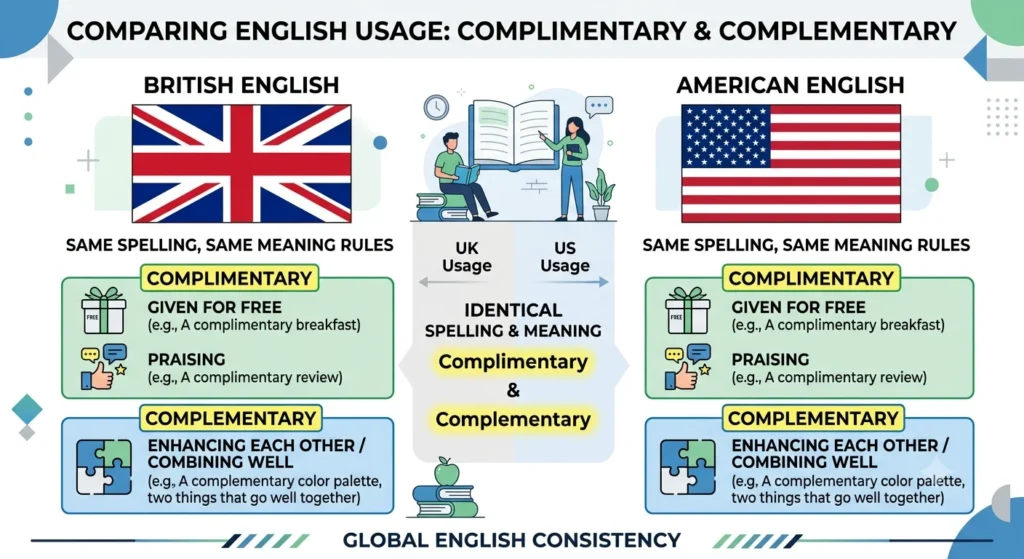
The answer is no. Unlike words such as colour/color or organise/organize, both British English and American English use the same spellings for complimentary and complementary.
The only difference is how the words are used, not how they are spelled.
British English
In the UK and other Commonwealth countries, people use:
- Complimentary for praise or something given free.
- Complementary for things that complete or match each other.
Examples
- The hotel offered complimentary afternoon tea.
- These fabrics have complementary colors.
- She made several complimentary comments about the performance.
- The company’s products are complementary.
American English
American English follows the same rule.
Examples
- Guests received complimentary parking.
- The software includes complementary tools.
- He was very complimentary about the new design.
- Red and green are complementary colors.
British vs American English Comparison
| Feature | British English | American English |
|---|---|---|
| Complimentary (free) | ✅ Complimentary | ✅ Complimentary |
| Complimentary (praise) | ✅ Complimentary | ✅ Complimentary |
| Complementary (matching) | ✅ Complementary | ✅ Complementary |
| Complementary (completing) | ✅ Complementary | ✅ Complementary |
| Spelling difference | None | None |
| Meaning difference | Same | Same |
Key Point: There is no British vs American spelling difference for these words. The correct choice depends on the meaning, not the country.
Which Spelling Should You Use?
Choosing between complimentary and complementary is easy once you know what you want to express.
Use “Complimentary” When You Mean:
- Free of charge
- Praise
- Admiration
- Positive feedback
Examples
- Complimentary breakfast
- Complimentary ticket
- Complimentary upgrade
- Complimentary drinks
- Complimentary review
This is the correct word if something is provided at no cost or if someone is giving compliments.
Use “Complementary” When You Mean:
- Matching
- Completing
- Enhancing
- Working well together
Examples
- Complementary skills
- Complementary colors
- Complementary products
- Complementary services
- Complementary personalities
This word describes things that fit together or make each other better.
Advice for Different Audiences
| Audience | Best Choice |
|---|---|
| United States | Use complimentary for free or praise, complementary for matching or completing. |
| United Kingdom | Follow the same rule. |
| Canada | Same spellings and meanings. |
| Australia | Same spellings and meanings. |
| New Zealand | Same spellings and meanings. |
| International English | Use the word that matches your intended meaning. |
No matter where your readers live, these spellings are accepted and understood worldwide.
Complimentary vs Complementary as in Free
One of the biggest sources of confusion is when businesses advertise something as free.
If something costs nothing, the correct word is always complimentary.
Correct Examples
- Complimentary coffee
- Complimentary Wi-Fi
- Complimentary breakfast
- Complimentary shuttle service
- Complimentary ticket
- Complimentary gift
- Complimentary upgrade
Incorrect Examples
- ❌ Complementary breakfast
- ❌ Complementary drinks
- ❌ Complementary parking
These are incorrect because complementary does not mean free.
Complimentary vs Complementary Ticket
Many people search for complimentary vs complementary ticket because both words sound alike.
The correct phrase is:
✅ Complimentary ticket
A complimentary ticket is a ticket given free of charge, often for a concert, event, movie, sports game, or conference.
Examples
- The sponsor provided complimentary tickets.
- Winners received two complimentary tickets.
- Employees were offered complimentary admission.
A complementary ticket would only make sense in a very unusual context where one ticket somehow completes another ticket. In normal English, this usage is incorrect.
What Is the Difference Between Complimenting and Complementary?
These words belong to different parts of speech and have different meanings.
| Word | Part of Speech | Meaning | Example |
|---|---|---|---|
| Complimenting | Verb | Giving praise or admiration | She is complimenting her colleague. |
| Complementary | Adjective | Completing or matching | Their talents are complementary. |
Examples
- She kept complimenting his excellent work.
- Their personalities are complementary.
- The teacher was complimenting the students.
- These two apps provide complementary features.
A simple way to remember the difference is:
- Complimenting = praising someone
- Complementary = matching or completing something
Common Mistakes with Complimentary vs Complementary
Because the words sound almost identical, writers often use the wrong one. These mistakes appear in emails, advertisements, websites, business documents, and even news articles.
Here are the most common errors and how to fix them.
| Incorrect | Correct | Why |
|---|---|---|
| Complementary breakfast | Complimentary breakfast | It is free. |
| Complementary ticket | Complimentary ticket | The ticket costs nothing. |
| Complimentary colors | Complementary colors | Colors match each other. |
| Complimentary angles | Complementary angles | Angles complete 90°. |
| Complimentary products | Complementary products | Products work well together. |
| Complementary remarks | Complimentary remarks | The speaker is giving praise. |
| Complementary review | Complimentary review | The review contains compliments. |
Mistake #1: Using “Complementary” to Mean Free
❌ The hotel offers complementary breakfast.
✅ The hotel offers complimentary breakfast.
Mistake #2: Using “Complimentary” for Matching Things
❌ The designer selected complimentary colors.
✅ The designer selected complementary colors.
Mistake #3: Mixing Up Business Terms
❌ Our complementary gift is included.
✅ Our complimentary gift is included.
Mistake #4: Confusing Praise with Completion
❌ The manager gave complementary feedback.
✅ The manager gave complimentary feedback.
Easy Memory Trick
Remember these two keywords:
- Complimentary → Compliment → Praise or Free
- Complementary → Complete → Match or Complete
If you can remember compliment and complete, you’ll almost never confuse these words again.
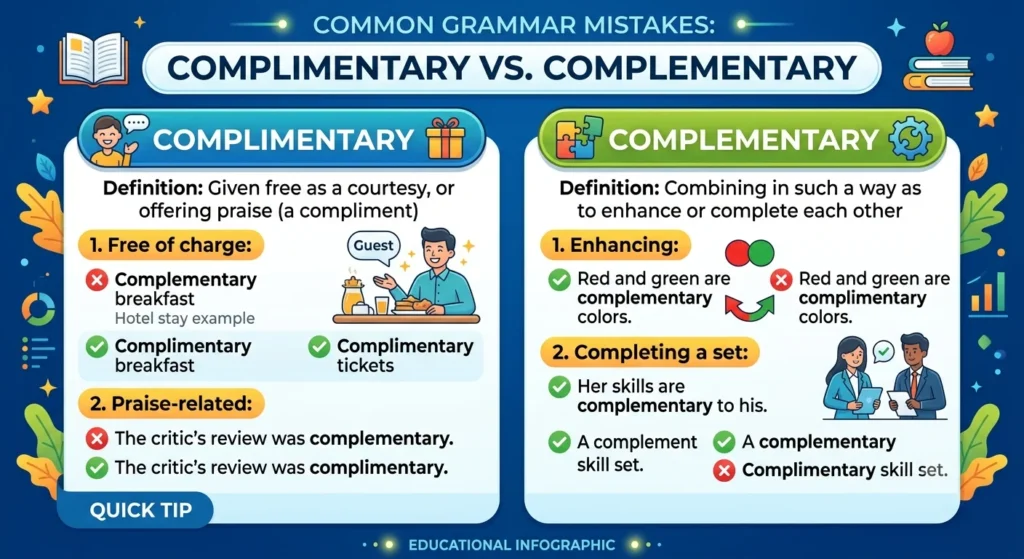
Complimentary vs Complementary in Everyday Examples
The easiest way to remember the difference is to see how these words are used in real life. Below are common examples from emails, news, social media, business writing, education, and daily conversations.
In Emails
Complimentary
- Thank you for your complimentary feedback.
- We are pleased to offer you a complimentary consultation.
- Every new customer receives a complimentary welcome gift.
Complementary
- Our design and marketing teams have complementary skills.
- These software tools provide complementary features.
- The two training courses are complementary.
In Business Writing
Businesses often use both words, but with different meanings.
Complimentary
- Complimentary shipping on orders over $100.
- Complimentary airport pickup is included.
- Complimentary customer support for the first year.
Complementary
- Our products offer complementary solutions.
- These services are complementary and work together.
- The departments have complementary responsibilities.
In News Articles
Journalists use the words differently depending on the context.
Complimentary
- Visitors received complimentary museum tickets.
- The actor was complimentary about the director’s work.
- Guests enjoyed complimentary refreshments.
Complementary
- Scientists studied complementary technologies.
- The report recommends complementary policies.
- Experts say renewable energy sources play complementary roles.
On Social Media
You’ll often see both words used in posts and advertisements.
Complimentary
- Enjoy a complimentary coffee with every order!
- Thanks for all the complimentary comments!
- Win a complimentary VIP pass today.
Complementary
- These outfits have complementary colors.
- Yoga and meditation are complementary practices.
- Our apps include complementary features.
In Formal Writing
Formal documents require precise word choice.
Correct Examples
- The committee was complimentary about the proposal.
- The scholarship includes complimentary accommodation.
- The two research methods are complementary.
- These policies have complementary objectives.
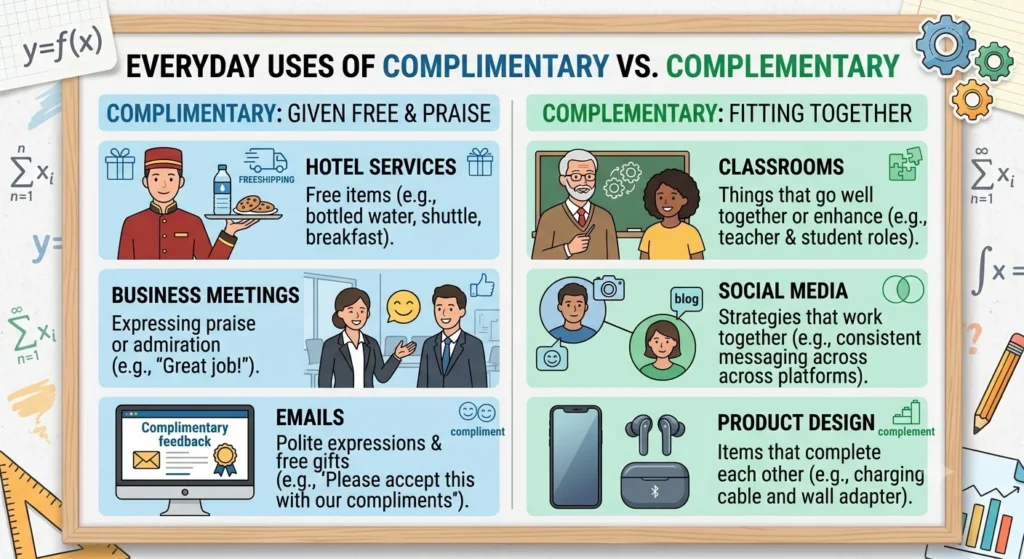
Complimentary vs Complementary Examples
Here are more examples to help you master the difference.
| Complimentary | Complementary |
|---|---|
| Complimentary breakfast | Complementary colors |
| Complimentary drinks | Complementary angles |
| Complimentary ticket | Complementary products |
| Complimentary gift | Complementary services |
| Complimentary parking | Complementary skills |
| Complimentary upgrade | Complementary personalities |
| Complimentary review | Complementary technologies |
| Complimentary remarks | Complementary strategies |
Sentence Practice
Complimentary
- The hotel served a complimentary breakfast every morning.
- She received a complimentary upgrade to first class.
- His speech was highly complimentary.
- The restaurant offered complimentary desserts.
Complementary
- Black and white are complementary colors in many designs.
- Their leadership styles are complementary.
- These courses provide complementary knowledge.
- The software packages have complementary functions.
Complimentary vs Complementary Pronunciation
Another reason people confuse these words is that they are pronounced almost the same.
| Word | Pronunciation | Meaning |
|---|---|---|
| Complimentary | kom-pluh-MEN-tuh-ree | Free or expressing praise |
| Complementary | kom-pluh-MEN-tuh-ree | Completing or matching |
In everyday speech, most native English speakers pronounce them almost identically. That means context, not pronunciation, tells listeners which word is intended.
How to Remember the Pronunciation
Since pronunciation won’t help you choose the correct spelling, focus on the meaning:
- Complimentary → Compliment → Praise or Free
- Complementary → Complete → Match or Complete
Complimentary vs Complementary Angles
Students often confuse this phrase.
The correct mathematical term is complementary angles.
Complementary angles are two angles whose measures add up to 90 degrees.
Examples
- 30° and 60° are complementary angles.
- 45° and 45° are complementary angles.
- 20° and 70° are complementary angles.
❌ Complimentary angles is incorrect because angles cannot praise each other or be free.
Complementary vs Supplementary
Another common question is the difference between complementary and supplementary.
Although both words describe relationships between things, they have different meanings.
| Complementary | Supplementary |
|---|---|
| Completes another thing | Adds something extra |
| Forms a perfect match | Provides additional support |
| Works together naturally | Extends or improves something |
| Often essential to the whole | Usually optional or additional |
Examples
Complementary
- Marketing and sales are complementary teams.
- Tea and biscuits are complementary refreshments.
- Complementary colors create strong contrast.
Supplementary
- Students received supplementary reading materials.
- The company provides supplementary training.
- She takes supplementary notes during meetings.
Complementary vs Supplementary Angles
These terms are especially important in geometry.
| Type | Total Degrees |
|---|---|
| Complementary angles | 90° |
| Supplementary angles | 180° |
Remember:
- Complementary = 90°
- Supplementary = 180°
Complimentary vs Complementary – Google Trends & Usage Data
Search interest for complimentary vs complementary remains steady because people frequently confuse the two words. Students, professionals, writers, and English learners regularly search for the correct spelling before sending emails, writing reports, or creating online content.
Where Are These Searches Most Popular?
The keyword is commonly searched in:
- United States
- United Kingdom
- Canada
- Australia
- India
- Pakistan
- New Zealand
These countries have large English-speaking populations and many learners who want to improve their grammar and writing.
When Do People Search This Keyword?
Users often search for this topic when they are writing:
- Business emails
- Hotel and travel content
- Product descriptions
- Academic assignments
- Marketing copy
- News articles
- Social media posts
They usually want a quick answer to avoid using the wrong word.
Most Common Related Searches
People also search for:
- Is it complimentary or complementary?
- Complimentary vs complementary meaning
- Complimentary vs complementary examples
- Complimentary vs complementary pronunciation
- Complimentary vs complementary as in free
- Complimentary vs complementary ticket
- What is the difference between complimenting and complementary?
- Does complimentary mean giving compliments?
- Is a gift complimentary or complementary?
- Complementary vs supplementary
- Complementary meaning
- Complimentary breakfast meaning
- Complementary colors meaning
These related searches show that users want simple explanations, practical examples, and clear rules they can apply immediately.
Complimentary vs Complementary Comparison Table
| Feature | Complimentary | Complementary |
|---|---|---|
| Main meaning | Expressing praise or provided free | Completing, matching, or enhancing |
| Root word | Compliment | Complement |
| Memory trick | Compliment = Praise | Complete = Match |
| Used for hotels | ✅ Yes | ❌ No |
| Used for free gifts | ✅ Yes | ❌ No |
| Used for matching colors | ❌ No | ✅ Yes |
| Used in mathematics | ❌ No | ✅ Yes (complementary angles) |
| Used in business partnerships | Rarely | ✅ Frequently |
| Used in professional feedback | ✅ Yes | ❌ No |
| Used for products that work together | ❌ No | ✅ Yes |
Quick Recap
| If You Mean… | Use This Word |
|---|---|
| Free of charge | Complimentary |
| Giving praise | Complimentary |
| Positive remarks | Complimentary |
| Completing each other | Complementary |
| Matching colors | Complementary |
| Complementary angles | Complementary |
| Products that work together | Complementary |
By remembering “Compliment = Praise” and “Complete = Match,” you can confidently choose the correct word in almost every situation.
Frequently Asked Questions
1. Is it complimentary or complementary?
It depends on the meaning.
- Use complimentary when something is free or when someone is giving praise.
- Use complementary when two or more things complete, match, or improve each other.
Examples
- Complimentary breakfast ✅
- Complimentary ticket ✅
- Complementary colors ✅
- Complementary skills ✅
2. What is the difference between complimenting and complementary?
Complimenting is the act of giving praise or admiration.
Complementary describes things that complete or work well with each other.
Examples
- She is complimenting her coworker on a great presentation.
- Their leadership styles are complementary, making the team more effective.
3. Is a gift complimentary or complementary?
A free gift is complimentary because it is provided at no cost.
Correct Examples
- Every guest received a complimentary gift.
- The hotel offered a complimentary welcome basket.
Use complementary only if you mean that one gift goes well with another.
4. What is the difference between complementary and supplementary?
Complementary means something completes or enhances another thing.
Supplementary means something adds extra support or information.
Examples
- A keyboard and mouse are complementary devices.
- The teacher handed out supplementary reading materials.
In geometry:
- Complementary angles = 90°
- Supplementary angles = 180°
5. Is complement a flirt?
No.
A compliment is a polite expression of praise or admiration. Giving someone a compliment does not automatically mean flirting.
For example:
- “Your presentation was excellent.”
- “I love your writing style.”
These are compliments and are often simply kind or professional remarks.
6. Does complimentary mean giving compliments?
Yes, one meaning of complimentary is expressing praise or admiration.
For example:
- She was complimentary about the new design.
- The customer wrote a complimentary review.
However, complimentary can also mean free of charge.
For example:
- Complimentary breakfast
- Complimentary parking
- Complimentary Wi-Fi
7. How can I remember the difference between complimentary and complementary?
A simple memory trick makes it easy:
- Complimentary = Compliment = Praise or Free
- Complementary = Complete = Match or Complete
If you’re talking about kind words or something free, choose complimentary.
If you’re talking about things that fit together, choose complementary.
Conclusion
The difference between complimentary vs complementary becomes simple once you focus on the meaning instead of the spelling. Although the two words are pronounced almost the same, they are never interchangeable.
Choose complimentary when you mean expressing praise, positive feedback, or something provided free of charge, such as a complimentary breakfast, ticket, drink, or hotel upgrade. Choose complementary when describing things that complete, balance, or improve each other, such as complementary colors, skills, products, services, or angles.
A useful way to remember the distinction is: compliment = praise, while complete = complement. This small memory trick helps you avoid one of the most common spelling mistakes in English.
Whether you’re writing an email, creating business content, studying English grammar, or preparing professional documents, using the correct word makes your writing clearer and more credible. When in doubt, ask yourself a simple question: Am I talking about something free or praising someone? Or am I describing things that work well together? The answer will always lead you to the correct choice.

Scott Thornbury is a respected English language educator and author, known for practical grammar insights, teacher training, and clear learner-focused explanations.