Have you ever stopped while writing and wondered whether the correct word is flair or flare? You’re not alone. These two words sound exactly the same, making them one of the most commonly confused word pairs in English. Many people search for flair vs flare meaning, What is the difference between flair and flare?, or Is it flare up or flair up? because they want to avoid embarrassing spelling mistakes in emails, school assignments, business writing, and social media posts.
The confusion happens because flair and flare are homophones—words that share the same pronunciation but have different spellings and meanings. Although they sound alike, they cannot be used interchangeably.
This guide gives you a quick answer first, then explains each word in simple language with real-life examples, grammar tips, usage advice, history, and comparison tables. By the end, you’ll know exactly when to use flair and when to use flare, helping you write with confidence whether you’re creating professional content, chatting online, or improving your English skills.
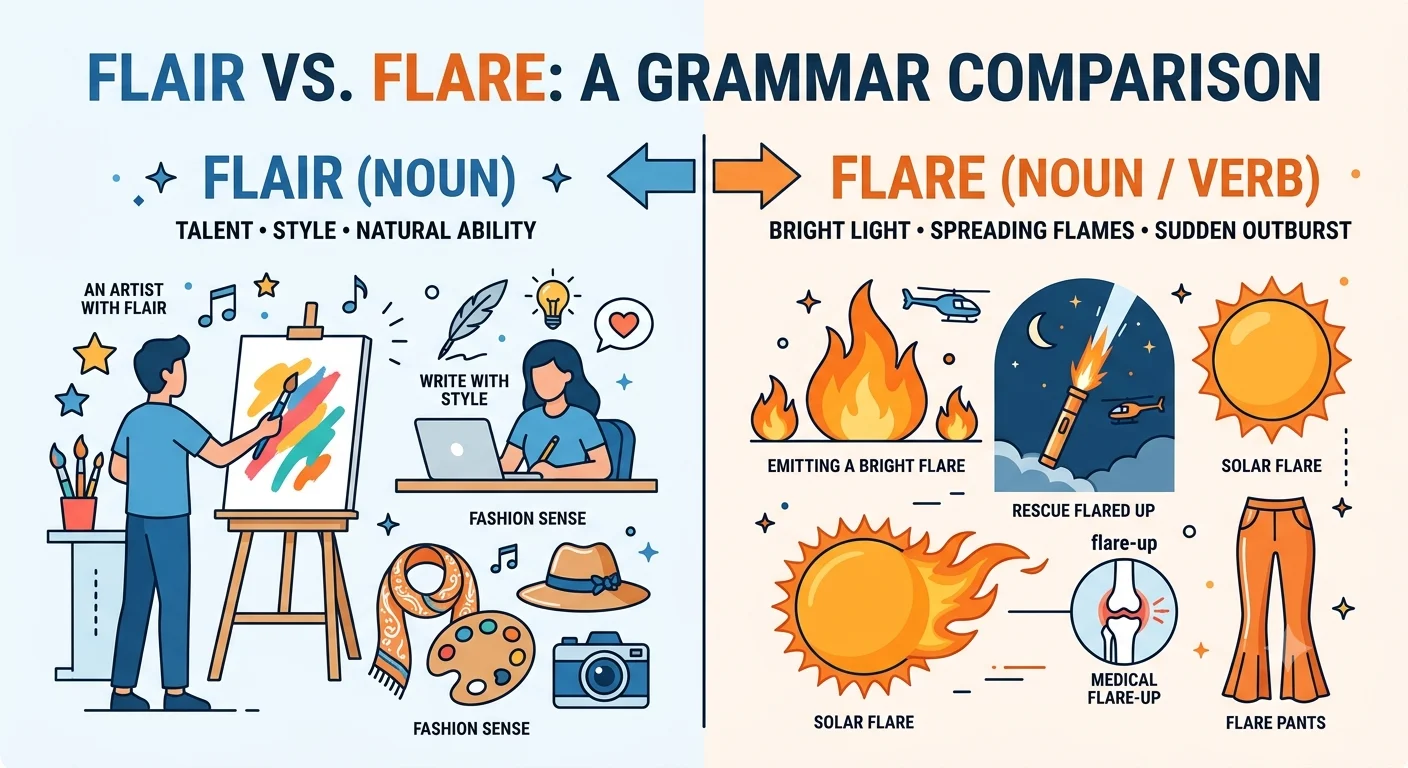
Flair vs Flare
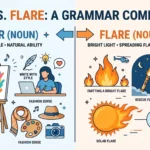
The difference between flair and flare is simple:
| Word | Meaning | Example |
|---|---|---|
| Flair | A natural talent, style, or special ability | She has a flair for storytelling. |
| Flare | A sudden burst of light, fire, emotion, illness, or something that spreads outward | The fire began to flare. |
Quick Rule
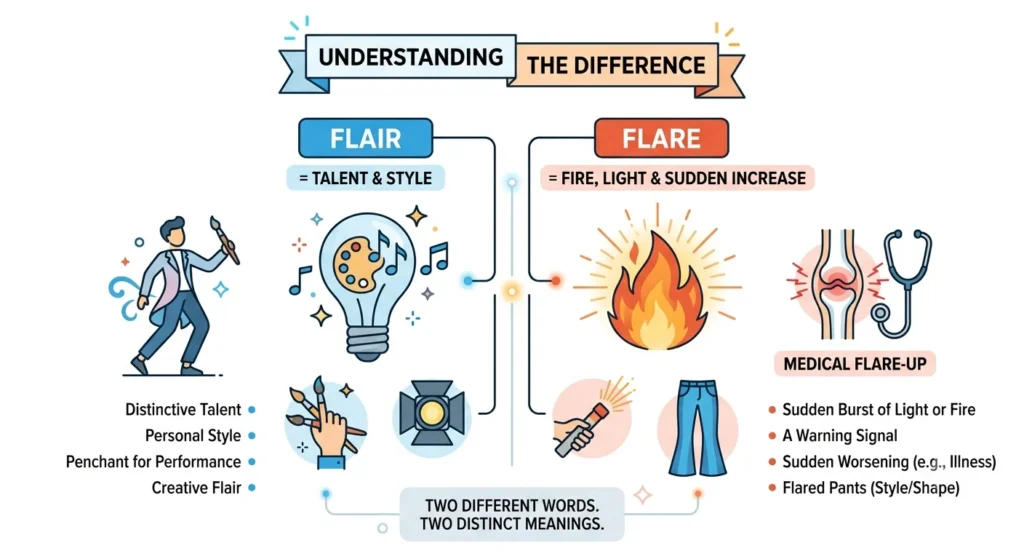
- Use flair when talking about talent, creativity, fashion, or personal style.
- Use flare when talking about fire, light, anger, disease, emergencies, or something widening outward.
Examples
✅ He has a flair for painting.
✅ She decorated the room with artistic flair.
✅ The campfire started to flare after more wood was added.
✅ His asthma began to flare during allergy season.
One easy memory trick is:
- Flair = Talent
- Flare = Fire
If you’re describing someone’s unique ability or creative touch, choose flair. If you’re describing something that burns brighter, spreads outward, suddenly becomes stronger, or relates to illness, choose flare.
The Origin of Flair vs Flare
Understanding where these words came from makes them much easier to remember.
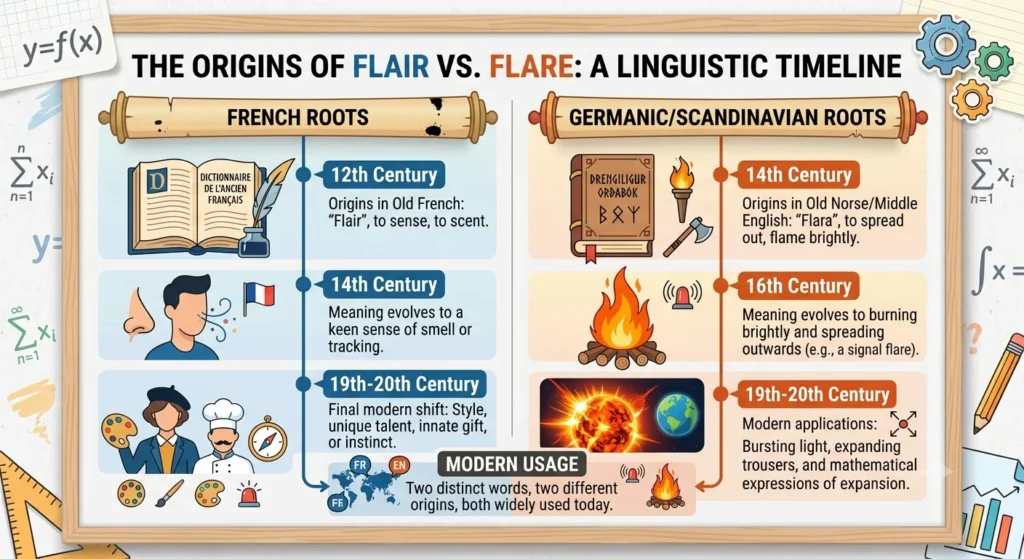
Origin of “Flair”
The word flair entered English during the 1800s from the French word flair, which originally meant “sense of smell.” Over time, English speakers expanded its meaning to describe a person’s natural instinct, talent, or stylish ability.
Today, flair usually refers to:
- Natural talent
- Creative ability
- Personal style
- Artistic skill
- Fashion sense
Examples
- She has a flair for photography.
- The chef cooks with incredible flair.
- His presentation showed confidence and flair.
In modern English, flair is almost always connected with positive personal qualities.
Origin of “Flare”
The word flare comes from older Germanic and Scandinavian words that described burning brightly or spreading outward.
Its meaning gradually expanded to include:
- Fire growing stronger
- Bright light
- Sudden anger
- Medical symptoms becoming active again
- Clothing widening at the bottom
Today, flare appears in many everyday expressions.
Examples include:
- Flames flare quickly.
- Tempers flare during arguments.
- Arthritis can flare up.
- A rescue flare helped locate the boat.
- She wore flare pants.
Unlike flair, which focuses on ability, flare usually describes movement, light, heat, expansion, or sudden increases.
Why Are Flair and Flare Confused?
These words confuse many English learners because they are perfect homophones.
They share:
- The same pronunciation
- Similar spelling
- Only one letter difference
But they have completely different meanings.
| Word | Pronunciation | Meaning |
|---|---|---|
| Flair | /fler/ | Talent or style |
| Flare | /fler/ | Fire, light, spread, widening, or sudden increase |
This is why people often search:
- Flair vs flare pronunciation
- Flair vs flare meaning
- What does flair mean?
- Flare meaning
- Dramatic flair or flare?
- Flair vs flare up
- Flair vs flare pants
Although they sound identical, context always tells you which word is correct.
British English vs American English Spelling
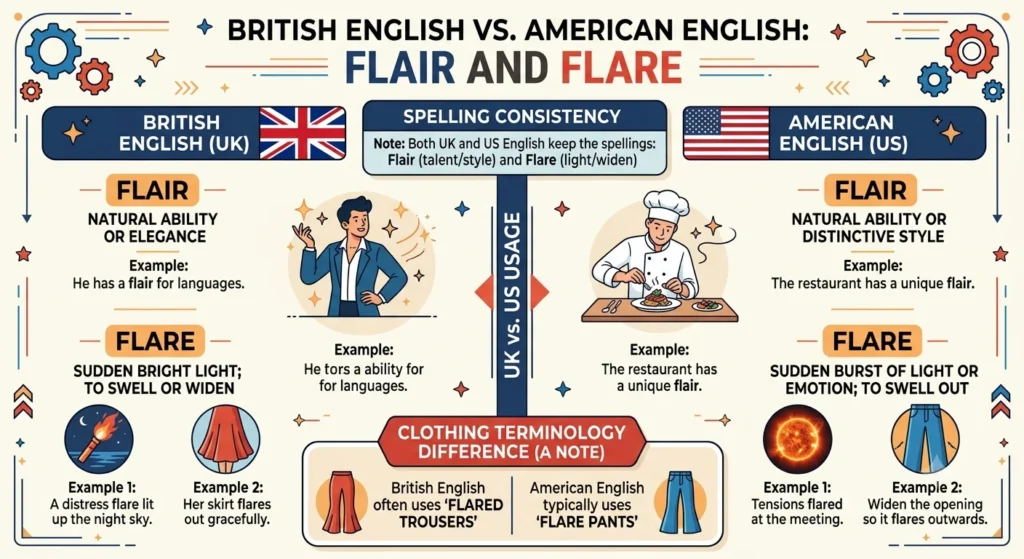
Unlike word pairs such as color vs colour or organize vs organise, flair and flare are not different regional spellings.
Both British English and American English use exactly the same spellings because they are different words with different meanings.
Whether you’re writing in the United States, the United Kingdom, Canada, Australia, or New Zealand, the meanings stay the same.
Comparison
| Topic | American English | British English |
|---|---|---|
| Talent | Flair | Flair |
| Creative style | Flair | Flair |
| Fire or bright light | Flare | Flare |
| Medical flare-up | Flare-up | Flare-up |
| Flare pants/trousers | Flare pants | Flared trousers (more common) |
The only small difference is vocabulary preference:
- Americans often say flare pants.
- British speakers more commonly say flared trousers.
Both refer to trousers that widen below the knee.
British vs American Usage Examples
| Situation | US English | UK English |
|---|---|---|
| Natural talent | She has a flair for design. | She has a flair for design. |
| Fire growing stronger | The flames flared suddenly. | The flames flared suddenly. |
| Medical condition | His eczema flared up again. | His eczema flared up again. |
| Fashion | She bought flare pants. | She bought flared trousers. |
Key Takeaway
The spellings flair and flare do not change between British and American English. The difference is based on meaning, not regional spelling. Always choose the word that matches the context:
- Flair = talent, creativity, style
- Flare = fire, light, illness, emotion, or something that spreads outward
Which Spelling Should You Use?
Choosing between flair and flare depends entirely on what you want to say, not where you live. Since both words are correct English words, the right choice comes down to their meaning.
If you’re writing for an American, British, Canadian, Australian, or global audience, the spelling rules stay the same.
Use this simple guide whenever you’re unsure.
| If you mean… | Use | Example |
|---|---|---|
| Natural talent or ability | Flair | She has a flair for music. |
| Creative style | Flair | He writes with flair. |
| Fashion sense | Flair | Her outfit shows real flair. |
| Fire or bright light | Flare | The flames began to flare. |
| Medical symptoms | Flare | My allergies flare every spring. |
| Sudden emotion | Flare | Tempers can flare during debates. |
| Clothing that widens | Flare | She bought flare pants. |
For American English
Use:
- Flair for talent or style.
- Flare for fire, light, medical conditions, or clothing.
Examples:
- She has a flair for marketing.
- The firefighters watched the flames flare.
- He wore black flare pants.
For British English
The spelling rules are exactly the same.
Examples:
- He has a flair for cooking.
- The fire continued to flare overnight.
- She wore flared trousers, which is more common than “flare pants” in British English.
For Global English
If your readers come from different countries, simply choose the word that matches your meaning.
Remember this shortcut:
- Flair = Skill
- Flare = Fire or Spread
That rule works almost every time.
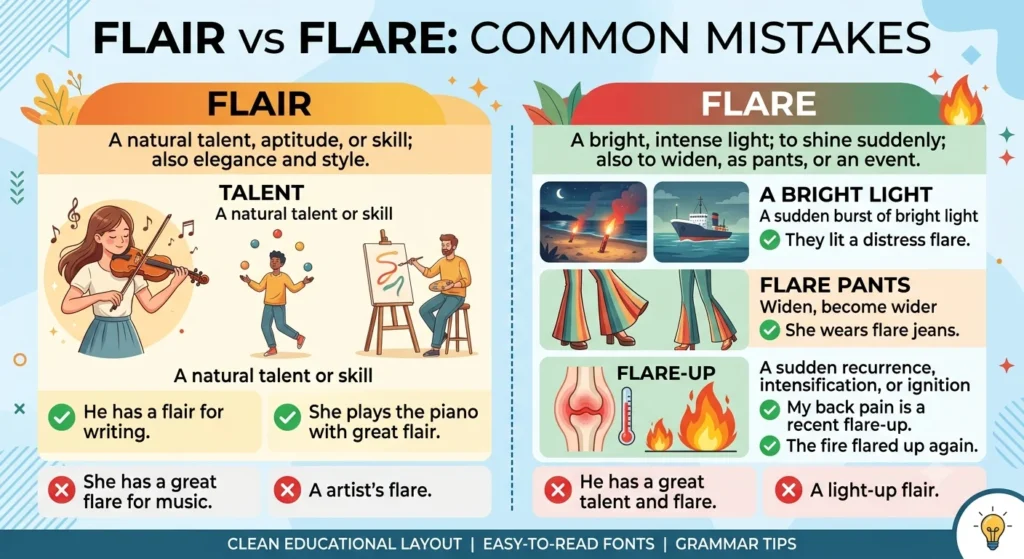
Common Mistakes with Flair vs Flare
Because flair and flare sound identical, people often type the wrong word without noticing. Spellcheck may not catch the mistake because both are real words.
Here are the most common errors.
| Incorrect | Correct | Why? |
|---|---|---|
| She has a flare for art. | She has a flair for art. | Talent uses flair. |
| His creative flare impressed everyone. | His creative flair impressed everyone. | Style uses flair. |
| My asthma had a flair up. | My asthma had a flare-up. | Medical conditions flare up. |
| Tempers showed great flair. | Tempers flared. | Anger uses flare. |
| The candle gave off beautiful flair. | The candle gave off a beautiful flare. | Light uses flare. |
Mistake 1: Using “flare” for talent
❌ She has a flare for singing.
✅ She has a flair for singing.
A person’s natural ability is always flair.
Mistake 2: Writing “flair up”
Many learners ask:
Is it flare up or flair up?
The correct phrase is:
✅ flare up
Never write:
❌ flair up
Examples:
- My eczema flared up again.
- Violence flared up overnight.
- His allergies flare up every spring.
This is why searches for flair vs flare up and flair vs flare medical are so common.
Mistake 3: Confusing dramatic flair or flare
Many writers wonder:
Dramatic flair or flare?
The answer depends on what you mean.
If you’re talking about acting skill or expressive style:
✅ dramatic flair
Example:
- She performs with dramatic flair.
If you’re talking about emotions becoming stronger:
✅ emotions flare
Example:
- Tempers flared during the meeting.
Mistake 4: Confusing fashion terms
People often ask:
Is it flair or flare in a dress?
It depends.
If you’re describing clothing that widens at the bottom:
✅ flare dress
✅ flared skirt
✅ flare pants
Examples:
- She wore elegant flare pants.
- The dress has a flared skirt.
If you’re talking about someone’s fashion style:
✅ She has great fashion flair.
One sentence can even use both words correctly:
She has a flair for designing flare dresses.
Flair vs Flare in Everyday Examples
Seeing these words in real situations makes them much easier to remember.
In Emails
Correct
Sarah has a real flair for customer service.
The disagreement began to flare after lunch.
In Business Writing
His leadership combines confidence with creative flair.
Costs may flare during peak demand.
In News Headlines
Examples:
- Wildfires flare across dry forests.
- Political tensions flare before elections.
- Local artist shows creative flair.
- Designer launches collection with vintage flair.
Notice that journalists use flare for events and flair for people.
On Social Media
Examples:
Your videos have so much flair!
My allergies are flaring up today.
Loving these retro flare pants.
The sunset made the sky flare with orange light.
In Medical Writing
A very common search is:
Flair vs flare medical
The correct medical word is always flare.
Doctors use expressions like:
- asthma flare
- arthritis flare
- eczema flare-up
- psoriasis flare
- lupus flare
- allergy flare
Examples:
- Her arthritis flared up after winter.
- The doctor treated an eczema flare.
Medical professionals do not use flair in this context.
In Fashion
Another popular search is:
Flair vs flare pants
The correct term is:
✅ flare pants
They are called flare pants because the legs flare outward below the knee.
Examples:
- Flare jeans
- Flare leggings
- Flared trousers
However:
- She has amazing fashion flair.
Here, flair describes style, not clothing shape.
Flair vs Flare – Google Trends & Usage Data
Search interest in flair vs flare remains steady because both words are frequently confused. Students, writers, bloggers, and English learners often look for quick explanations before publishing emails, articles, or social media posts.
Some of the most searched questions include:
- What is the difference between flair and flare?
- What does flair mean?
- Flare meaning
- Is it flare up or flair up?
- Flair vs flare pronunciation
- Flair vs flare medical
- Flair vs flare pants
- Dramatic flair or flare
- Flair vs flare Reddit
Discussion forums such as Reddit also show that many native English speakers pause to check which spelling fits the context, especially when writing about creativity, health, or fashion.
Where Each Word Is Most Common
| Word | Common Contexts |
|---|---|
| Flair | Talent, creativity, writing, cooking, art, design, fashion style |
| Flare | Fire, light, illness, emotions, emergencies, astronomy, clothing |
Country Usage
| Country | More Common Searches |
|---|---|
| United States | flair vs flare, flare up, flare pants |
| United Kingdom | flair vs flare, flared trousers |
| Canada | flair vs flare meaning |
| Australia | flare up, flair meaning |
| India & Pakistan | What is the difference between flair and flare? |
Although search wording differs slightly by country, the meanings remain exactly the same worldwide.
Frequently Asked Questions
1. What is the difference between flair and flare?
The main difference is their meaning. Flair means natural talent, creativity, or style, while flare means a sudden burst of light, fire, emotion, illness, or something that spreads outward. Although they sound the same, they are used in different situations.
Examples
- She has a flair for photography.
- The fire began to flare after the wind picked up.
2. What does flair mean?
Flair means a natural ability, special talent, or stylish way of doing something. It often describes creativity, confidence, or artistic skill.
Examples
- He has a flair for public speaking.
- The chef cooks with great flair.
- Her home is decorated with modern flair.
3. Is it flare up or flair up?
The correct phrase is flare up.
Use flare up when talking about:
- Medical conditions
- Fires
- Anger
- Violence
- Strong emotions
Examples
- My allergies flare up every spring.
- Tempers flared up during the debate.
- The flames flared up after more fuel was added.
Flair up is always incorrect.
4. Is it flair or flare in a dress?
When talking about clothing that becomes wider toward the bottom, the correct word is flare.
Examples include:
- flare dress
- flare jeans
- flare skirt
- flare pants
However, if you’re talking about someone’s fashion sense or creative style, use flair.
Example:
- She has a flair for fashion.
5. What does flare mean?
Flare means a sudden increase, bright light, fire, or outward spread. It is also used for medical symptoms that return or become worse.
Examples:
- The signal flare was easy to see.
- His asthma flared up yesterday.
- The flames continued to flare.
6. Do flair and flare have the same pronunciation?
Yes. Flair and flare are homophones, meaning they have the same pronunciation but different spellings and meanings.
Both are pronounced:
/fler/
This identical pronunciation is why many English learners and native speakers confuse them.
7. Which word should I use: flair or flare?
Choose the word based on its meaning:
- Use flair for talent, creativity, style, or natural ability.
- Use flare for fire, light, medical conditions, emotions, or clothing that widens.
A simple memory trick is:
- Flair = Talent
- Flare = Fire or Spread
Conclusion
Choosing between flair and flare becomes easy once you understand what each word means. Even though they sound exactly alike, they are never interchangeable. Flair refers to natural talent, creativity, personal style, or a special ability, while flare describes a sudden burst of light, fire, emotion, illness, or something that spreads outward. It is also the correct word in expressions like flare up, flare pants, and medical flare.
A helpful way to remember the difference is to connect flair with skill and flare with fire. This simple trick can prevent many common writing mistakes.
Whether you’re writing an email, school assignment, business document, blog post, or social media update, using the correct spelling makes your writing clearer and more professional. When you’re unsure, think about the context instead of the pronunciation. With practice, you’ll quickly know whether flair or flare is the right choice every time.

Betty Azar is a respected English language educator and author, known for clear grammar explanations and practical resources for learners worldwide.