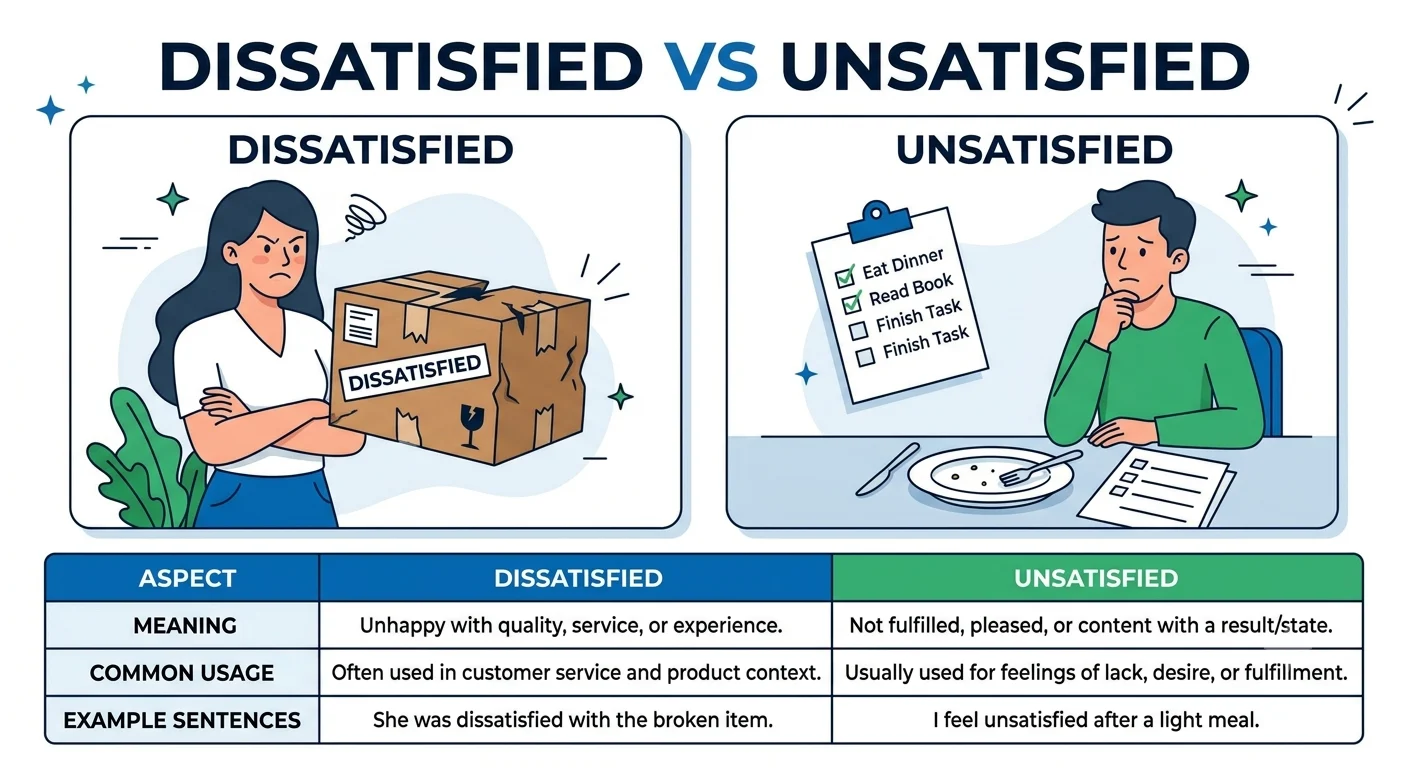
Have you ever paused while writing and wondered, “Do you say unsatisfied or dissatisfied?” You’re not alone. These two English words look similar, share the same root, and both describe a lack of satisfaction. Because of this, many students, writers, professionals, and English learners use them interchangeably. However, they do not mean exactly the same thing.
Understanding the difference between dissatisfied vs unsatisfied is important because choosing the wrong word can change the meaning of your sentence. A dissatisfied customer is unhappy with a product or service, while an unsatisfied need simply means something has not yet been fulfilled. This small distinction appears in business English, customer support, academic writing, legal documents, and everyday conversations.
In this guide, you’ll learn the dissatisfied vs unsatisfied meaning, pronunciation, word origins, real-life examples, grammar tips, and common mistakes. You’ll also discover when to use each word, how native English speakers use them, and an easy memory trick that helps you remember the difference every time.
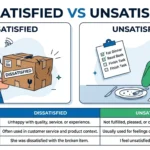
Dissatisfied vs Unsatisfied
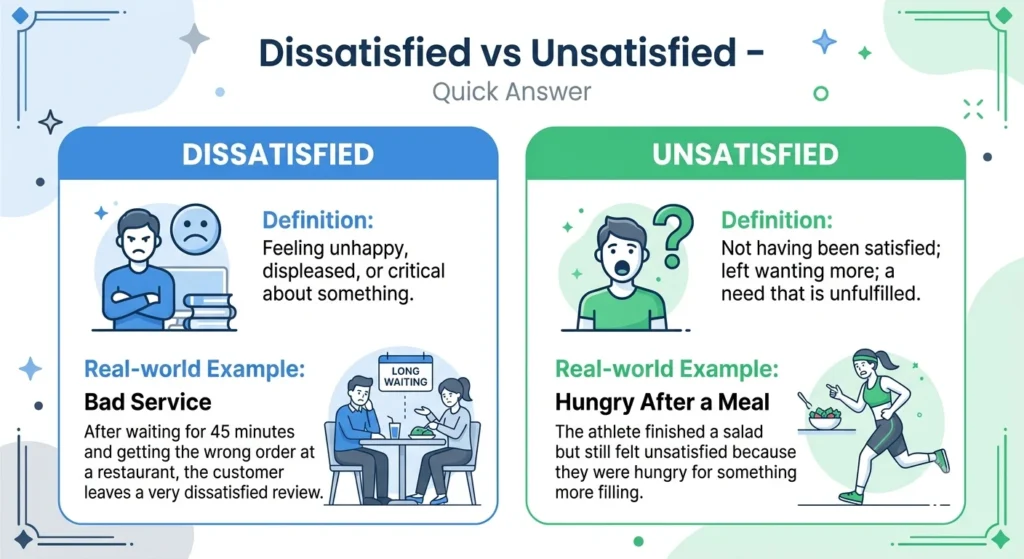
If you only need a quick answer, here it is:
| Dissatisfied | Unsatisfied |
|---|---|
| Means unhappy or disappointed because expectations were not met. | Means not fulfilled, incomplete, or still lacking something. |
| Describes emotions and opinions. | Describes needs, goals, curiosity, or requirements. |
| Common in customer reviews and complaints. | Common in academic, legal, and everyday contexts. |
Examples
✅ The customer was dissatisfied with the slow delivery.
✅ My curiosity is still unsatisfied after reading the article.
Simple Rule
- Unhappy person → Dissatisfied
- Unmet need or condition → Unsatisfied
If you remember this simple rule, you’ll choose the correct word almost every time.
Pronunciation
Although dissatisfied and unsatisfied have similar spellings, their pronunciation is slightly different.
| Word | Pronunciation |
|---|---|
| Dissatisfied | /ˌdɪsˈsætɪsfaɪd/ |
| Unsatisfied | /ʌnˈsætɪsfaɪd/ |
Learning the pronunciation can help you recognize these words in conversations, presentations, and English listening exercises.
Parts of Speech
Both words belong to the same word family but serve different grammatical roles.
| Word | Part of Speech | Meaning |
|---|---|---|
| Satisfy | Verb | To meet a need or expectation |
| Satisfaction | Noun | The feeling of being pleased or fulfilled |
| Dissatisfaction | Noun | The feeling of disappointment |
| Dissatisfied | Adjective | Unhappy because expectations were not met |
| Unsatisfied | Adjective | Not fulfilled or still lacking |
Knowing these related words makes it easier to expand your English vocabulary and improve your writing.
What Does Dissatisfied Mean?
Dissatisfied means unhappy, disappointed, or displeased because something did not meet expectations.
The feeling usually comes after receiving poor service, low-quality products, unfair treatment, or disappointing results. In other words, dissatisfied describes emotional dissatisfaction caused by unmet expectations.
Dissatisfied Meaning
When someone says they are dissatisfied, they are expressing a negative opinion about an experience, decision, product, or service.
Examples
- The customer was dissatisfied with the poor customer service.
- Many employees felt dissatisfied after the company changed its policy.
- She was dissatisfied with her exam score because she expected better results.
- Travelers became dissatisfied after repeated flight delays.
- The client was dissatisfied with the final design and requested revisions.
Common Situations
You will often see dissatisfied in:
- Customer complaints
- Product reviews
- Business reports
- Employee surveys
- Performance reviews
- Complaint letters
- Hotel and restaurant reviews
Dissatisfied Customer
The phrase dissatisfied customer is extremely common because customers become dissatisfied when a product or service fails to meet their expectations.
Examples include:
- A dissatisfied customer requested a refund after receiving a damaged product.
- Companies work hard to reduce customer dissatisfaction by improving service quality.
- Listening to dissatisfied customers helps businesses improve and build trust.
Language Tip: If someone is emotionally disappointed, dissatisfied is usually the best choice.
What Does Unsatisfied Mean?
Many people ask, “What does unsatisfied mean?”
Unsatisfied means not fulfilled, not completed, or still lacking something that is needed or wanted.
Unlike dissatisfied, unsatisfied does not always describe disappointment. Instead, it often refers to needs, goals, requirements, curiosity, or conditions that have not yet been fulfilled.
Unsatisfied Meaning
Use unsatisfied when talking about something that remains incomplete, unresolved, or unmet.
Examples
- My curiosity is still unsatisfied after reading only part of the report.
- Even after dinner, I felt unsatisfied because I was still hungry.
- Several legal requirements remain unsatisfied.
- The research left many questions unsatisfied.
- Demand for affordable housing remains unsatisfied in many cities.
Common Situations
You will often see unsatisfied in discussions about:
- Hunger
- Curiosity
- Needs
- Goals
- Conditions
- Legal requirements
- Academic research
- Economics (such as unsatisfied demand)
Notice that these examples describe something that still needs to be fulfilled, not necessarily someone who feels unhappy.
What Is the Difference Between Dissatisfied and Unsatisfied?
Although both words describe a lack of satisfaction, they are not interchangeable in every situation.
The easiest way to understand the dissatisfied vs unsatisfied meaning is to remember what each word focuses on.
- Dissatisfied focuses on feelings and disappointment.
- Unsatisfied focuses on needs, conditions, or goals that remain unmet.
At-a-Glance Comparison
| Feature | Dissatisfied | Unsatisfied |
|---|---|---|
| Main Meaning | Unhappy or disappointed | Not fulfilled or incomplete |
| Emotion | ✔ Yes | Usually No |
| Expectations Not Met | ✔ Yes | Sometimes |
| Needs Still Unmet | Rare | ✔ Yes |
| Customer Reviews | ✔ Very Common | Less Common |
| Business English | ✔ Common | Common |
| Academic Writing | Sometimes | ✔ Common |
| Legal Documents | Rare | ✔ Common |
Dissatisfied vs Unsatisfied Examples
✔ The passengers were dissatisfied with the airline’s customer service.
✔ Several project requirements remain unsatisfied.
✔ The students were dissatisfied with the grading policy.
✔ His desire to learn remained unsatisfied.
Each sentence shows how the correct word depends on the situation rather than the spelling.
Memory Trick
Still wondering how to remember the difference?
Use this simple trick:
D = Disappointed = Dissatisfied
U = Unfulfilled = Unsatisfied
If someone is disappointed, choose dissatisfied.
If something is unfulfilled, choose unsatisfied.
This memory trick works in customer service, business writing, academic English, and everyday conversations, making it easier to choose the correct word with confidence.
The Origin of Dissatisfied vs Unsatisfied
Understanding where these words come from makes their meanings easier to remember.
Both dissatisfied and unsatisfied come from the verb satisfy, which entered English through the Latin word satisfacere, meaning “to do enough,” “to fulfill,” or “to meet a need.” Over time, English added different prefixes to create new meanings.
Word Family
| Word | Meaning |
|---|---|
| Satisfy | To meet a need, desire, or expectation |
| Satisfied | Pleased because something met expectations |
| Satisfaction | The feeling of being pleased or fulfilled |
| Dissatisfied | Unhappy because expectations were not met |
| Dissatisfaction | A feeling of disappointment |
| Unsatisfied | Not fulfilled, incomplete, or still lacking |
The prefixes explain the difference:
- Dis- often expresses the opposite of a positive feeling or action. In dissatisfied, it shows active disappointment or displeasure.
- Un- simply means not. In unsatisfied, it indicates that something has not yet been fulfilled or completed.
Although both words share the same root, they developed different meanings over time. Today, native English speakers choose one or the other based on context rather than spelling.
British English vs American English Usage
Many people wonder whether dissatisfied and unsatisfied are British or American spellings.
The answer is simple: both words are spelled exactly the same in British English and American English.
Unlike colour/color or organise/organize, there is no regional spelling difference between these words. The difference is entirely about meaning, not spelling.
Usage Comparison
| Situation | British English | American English |
|---|---|---|
| Customer complaint | Dissatisfied | Dissatisfied |
| Employee feedback | Dissatisfied | Dissatisfied |
| Curiosity | Unsatisfied | Unsatisfied |
| Legal requirement | Unsatisfied | Unsatisfied |
| Business review | Dissatisfied | Dissatisfied |
Examples
British English
Many passengers were dissatisfied with the train delays.
Several planning conditions remain unsatisfied.
American English
Customers were dissatisfied with the restaurant’s service.
The contract cannot be approved because some legal requirements remain unsatisfied.
Whether you write for readers in the United States, the United Kingdom, Canada, Australia, New Zealand, or other English-speaking countries, the meanings remain the same.
Which Word Should You Use?
Choosing the correct word depends on what you want to express.
Use Dissatisfied When Someone Is Unhappy
Choose dissatisfied when a person feels disappointed because something failed to meet expectations.
Examples:
- dissatisfied customer
- dissatisfied employee
- dissatisfied client
- dissatisfied student
- dissatisfied voter
- dissatisfied with service
- dissatisfied with quality
- dissatisfied with the results
Example sentences:
- The customer was dissatisfied with the delayed delivery.
- Many employees felt dissatisfied after the policy change.
- Parents were dissatisfied with the school’s communication.
Use Unsatisfied When Something Is Unfulfilled
Choose unsatisfied when talking about needs, conditions, goals, or requirements that remain incomplete.
Examples:
- unsatisfied curiosity
- unsatisfied demand
- unsatisfied requirement
- unsatisfied condition
- unsatisfied need
- unsatisfied desire
Example sentences:
- His curiosity remained unsatisfied.
- Several legal requirements are still unsatisfied.
- Demand for affordable housing remains unsatisfied.
Quick Decision Guide
| Ask Yourself | Correct Word |
|---|---|
| Is someone unhappy or disappointed? | Dissatisfied |
| Is a need or condition still unmet? | Unsatisfied |
| Is it a customer complaint? | Dissatisfied |
| Is it about hunger, curiosity, or requirements? | Unsatisfied |
When you’re unsure, think about whether you’re describing a person’s feelings or an unmet need.
Expert Language Tip
Professional writers, editors, teachers, and business communicators distinguish these words because they express different ideas.
In formal English:
- Dissatisfied usually describes people’s emotions, opinions, and reactions.
- Unsatisfied usually describes requirements, conditions, curiosity, goals, or needs that have not been fulfilled.
Using the correct word makes your writing clearer, more precise, and more natural.
For example:
❌ The customer was unsatisfied with the poor service.
✅ The customer was dissatisfied with the poor service.
Likewise:
❌ His curiosity remained dissatisfied.
✅ His curiosity remained unsatisfied.
Making this distinction is especially important in business reports, complaint emails, legal writing, academic papers, and professional communication.
Dissatisfied vs Unsatisfied Customer
One of the most common search queries is “Dissatisfied or unsatisfied customer?”
The preferred phrase is dissatisfied customer.
A dissatisfied customer feels disappointed because the product, service, or overall experience failed to meet expectations.
Examples
- The company apologized to every dissatisfied customer.
- Good customer support helps reduce customer dissatisfaction.
- Dissatisfied customers often leave detailed online reviews.
- Businesses should listen carefully to dissatisfied customers and resolve their concerns.
Can You Say “Unsatisfied Customer”?
Yes, but it is much less common.
An unsatisfied customer suggests that the customer’s needs or expectations have not yet been fulfilled. While grammatically correct, native speakers and businesses almost always use dissatisfied customer when describing complaints or negative experiences.
Dissatisfied vs Unsatisfied Synonyms
Although these words are related, their synonyms are different because their meanings are different.
| Dissatisfied Synonyms | Unsatisfied Synonyms |
|---|---|
| disappointed | unfulfilled |
| unhappy | unmet |
| displeased | incomplete |
| frustrated | unresolved |
| discontent | lacking |
| discouraged | insufficient |
Choose a synonym that matches your intended meaning rather than replacing the words automatically.
Common Mistakes with Dissatisfied vs Unsatisfied
Many learners confuse these words because both are the opposite of satisfied. However, replacing one with the other can change the meaning of a sentence.
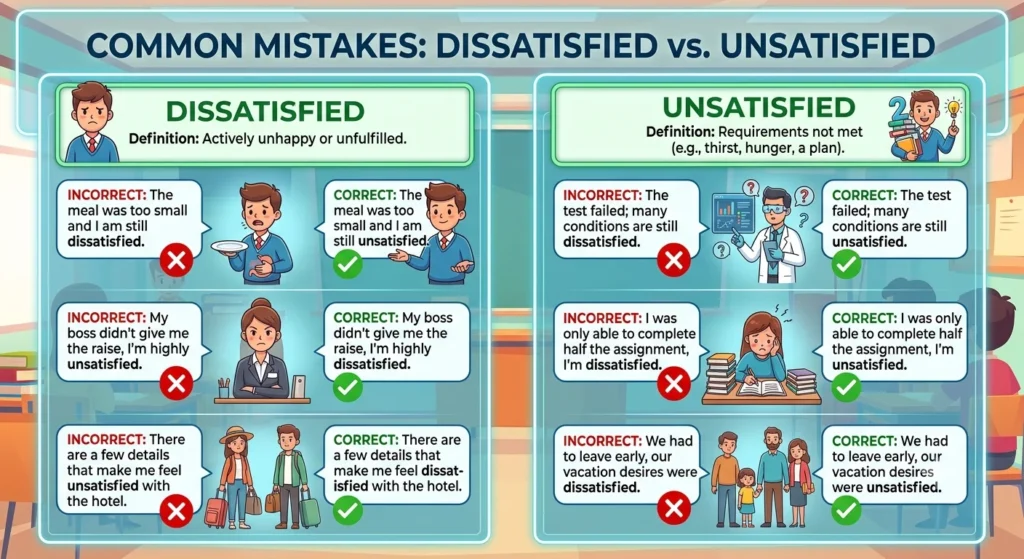
Common Errors
| ❌ Incorrect | ✅ Correct | Explanation |
|---|---|---|
| I am unsatisfied with your customer service. | I am dissatisfied with your customer service. | The speaker is unhappy. |
| My curiosity is dissatisfied. | My curiosity is unsatisfied. | Curiosity is an unmet need. |
| She felt unsatisfied with the restaurant. | She felt dissatisfied with the restaurant. | She is disappointed. |
| Several conditions are dissatisfied. | Several conditions are unsatisfied. | Conditions cannot feel emotions. |
| The legal requirements were dissatisfied. | The legal requirements were unsatisfied. | Requirements are unmet, not unhappy. |
Writing Tip
If the noun can feel emotions, dissatisfied is often the better choice.
If the noun cannot feel emotions and instead represents a need, condition, goal, or requirement, unsatisfied is usually the correct choice.
Dissatisfied vs Unsatisfied in Everyday Examples
Here are examples from real-life situations.
In Emails
Dissatisfied
I am dissatisfied with the product I received because it arrived damaged.
Unsatisfied
Several project requirements remain unsatisfied and must be completed before approval.
In Customer Reviews
Many buyers were dissatisfied with the delivery time.
Some customers remained dissatisfied even after receiving a refund.
In News Reports
Residents are dissatisfied with the city’s public transportation.
Officials confirmed that several safety conditions remain unsatisfied.
On Social Media
I’m really dissatisfied with this phone after only one month.
My curiosity is still unsatisfied after watching that movie ending.
In Academic Writing
The study found that many participants were dissatisfied with the available services.
Researchers noted that several questions remained unsatisfied and required further investigation.
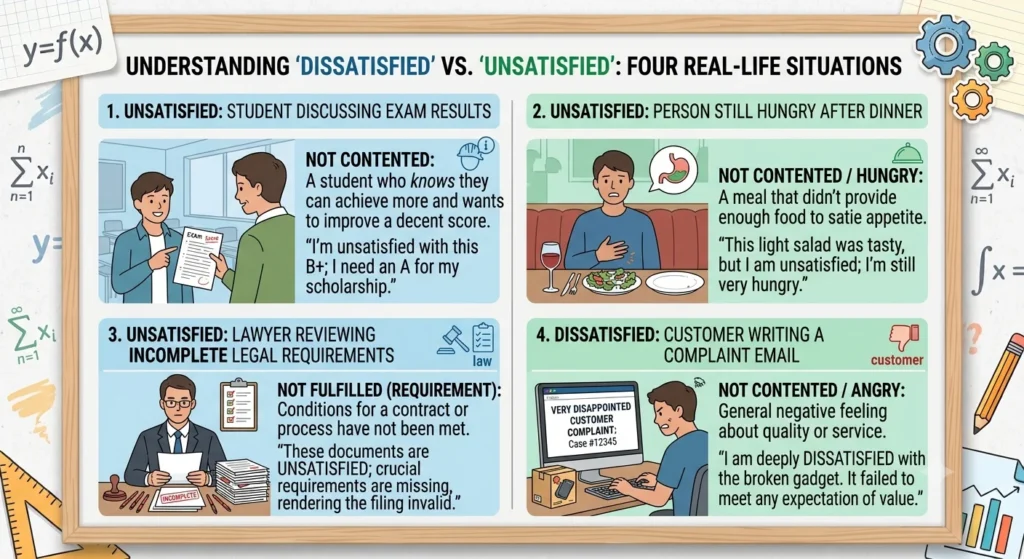
Dissatisfied vs Unsatisfied – Google Trends & Usage
Both words are widely used, but they appear in different contexts.
Dissatisfied
Most commonly appears in:
- Customer feedback
- Product reviews
- Employee satisfaction surveys
- Complaint letters
- Business reports
- Service quality discussions
Common phrases include:
- dissatisfied customer
- dissatisfied employee
- dissatisfied with service
- customer dissatisfaction
Unsatisfied
Frequently appears in:
- Academic writing
- Legal documents
- Psychology
- Economics
- Scientific research
Common phrases include:
- unsatisfied demand
- unsatisfied curiosity
- unsatisfied requirements
- unsatisfied conditions
- unsatisfied need
Usage Insight
In everyday English, dissatisfied is more common when discussing people, opinions, and experiences. Unsatisfied is more common when referring to unmet needs, goals, conditions, or requirements. Understanding this pattern helps you choose the most natural word for your audience and purpose.
Discrete vs Continuous: Easy Differences Explained
Key Takeaways
Before you leave, remember these simple points:
✅ Dissatisfied means unhappy or disappointed because expectations were not met.
✅ Unsatisfied means not fulfilled, incomplete, or still lacking.
✅ Use dissatisfied for people, opinions, experiences, and customer feedback.
✅ Use unsatisfied for needs, curiosity, goals, conditions, and requirements.
✅ If you’re talking about feelings, choose dissatisfied.
✅ If you’re talking about something that remains unmet, choose unsatisfied.
Quick Memory Rule
D = Disappointed = Dissatisfied
U = Unfulfilled = Unsatisfied
Commonly Confused Words
If you’re learning English, you may also confuse these related words.
| Words | Difference |
|---|---|
| Dissatisfied vs Unsatisfied | Dissatisfied describes disappointment, while unsatisfied describes something that remains unfulfilled. |
| Unsatisfactory vs Dissatisfactory | Unsatisfactory is the standard and much more common word for something that is not good enough. Dissatisfactory exists but is rare in modern English. |
| Satisfied vs Content | Satisfied means expectations or needs have been met. Content means feeling peaceful or happy with what you have. |
| Happy vs Satisfied | Happy describes a general emotional state. Satisfied refers to a specific need, goal, or expectation being fulfilled. |
| Fulfilled vs Satisfied | Fulfilled often relates to purpose or personal achievement, while satisfied usually refers to meeting a particular need or expectation. |
Learning these differences will help you build a stronger English vocabulary and avoid common grammar mistakes.
Frequently Asked Questions
1. Do you say unsatisfied or dissatisfied?
Both words are correct, but they are used in different situations. Use dissatisfied when someone is unhappy or disappointed. Use unsatisfied when a need, requirement, or desire has not been fulfilled.
2. What is the difference between dissatisfaction and satisfaction?
Satisfaction is the feeling of being pleased because expectations or needs have been met. Dissatisfaction is the feeling of disappointment when those expectations are not met.
3. What does “unsatisfied” mean?
Unsatisfied means something remains incomplete, unresolved, or unfulfilled. It often describes needs, curiosity, goals, requirements, or conditions rather than emotions.
4. What is the difference between unsatisfactory and dissatisfactory?
Unsatisfactory is the standard English word for something that is not good enough or does not meet expectations. Dissatisfactory is a valid but uncommon word and is rarely used in modern English.
5. What does dissatisfied mean?
Dissatisfied means unhappy, disappointed, or displeased because a product, service, experience, or result failed to meet expectations.
6. What is the opposite of satisfied: unsatisfied or dissatisfied?
Both words can be opposites of satisfied, but they express different ideas. Unsatisfied means “not fulfilled,” while dissatisfied means “unhappy or disappointed.”
7. Can you be unsatisfied without being dissatisfied?
Yes. For example, you may still feel unsatisfied after reading half of a book because your curiosity has not been fulfilled, even if you enjoyed what you read.
8. Is dissatisfied stronger than unsatisfied?
In many situations, yes. Dissatisfied usually expresses a clearer emotional reaction, while unsatisfied often describes an unmet need or condition without implying strong disappointment.
9. Which word is more common in business English?
Dissatisfied is more common in customer service, employee feedback, product reviews, and complaint handling. Unsatisfied is more common when discussing unmet requirements, goals, or conditions.
10. Can dissatisfied and unsatisfied be used interchangeably?
Sometimes, but not always. Using the correct word makes your writing more accurate and natural. When in doubt, think about whether you’re describing a person’s feelings or an unmet need.
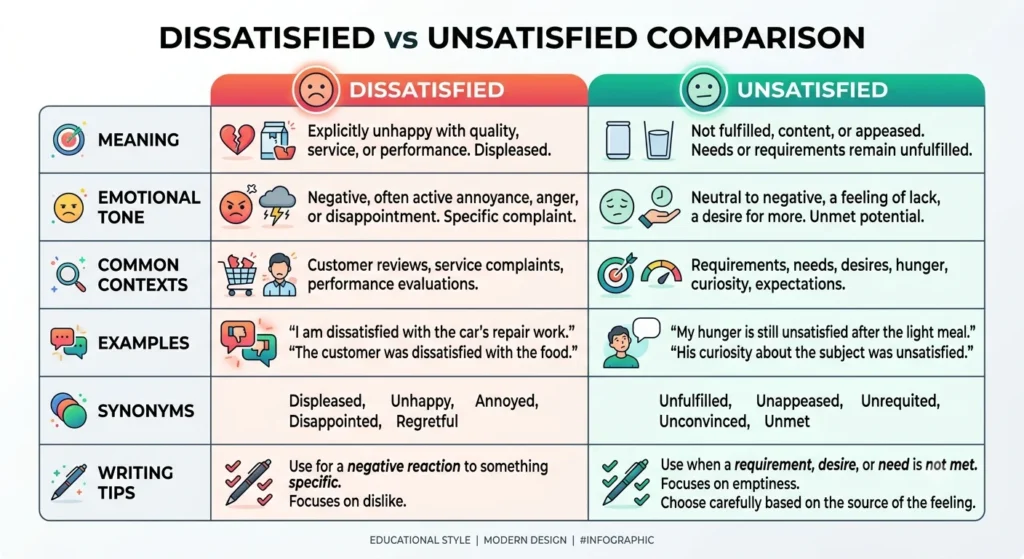
Final Comparison Table
| Feature | Dissatisfied | Unsatisfied |
|---|---|---|
| Meaning | Unhappy or disappointed | Not fulfilled or incomplete |
| Emotional Feeling | ✔ Yes | Usually No |
| Customer Service | ✔ Very Common | Rare |
| Product Reviews | ✔ Very Common | Rare |
| Needs | Rare | ✔ Common |
| Curiosity | Rare | ✔ Common |
| Goals | Sometimes | ✔ Common |
| Legal Requirements | Rare | ✔ Common |
| Academic Writing | Sometimes | ✔ Common |
| Business Writing | ✔ Common | ✔ Common |
Conclusion
Although dissatisfied and unsatisfied are closely related, they are not true synonyms. The key difference is simple: dissatisfied describes a person who feels unhappy because expectations were not met, while unsatisfied describes a need, desire, goal, or condition that remains unfulfilled.
Understanding this distinction will help you communicate more clearly in everyday conversations, emails, academic writing, customer service, business reports, and professional documents. Choosing the right word not only improves your grammar but also makes your message more precise and natural.
Whenever you feel uncertain, remember this easy rule: if someone is disappointed, use “dissatisfied.” If something is still lacking or incomplete, use “unsatisfied.” This simple memory trick works in most situations and will help you avoid one of the most common vocabulary mistakes in English.
By mastering the difference between dissatisfied vs unsatisfied, you’ll write with greater confidence, express your ideas more accurately, and sound more like a fluent English speaker.

David Crystal is a renowned English linguist and author, known for making English grammar, linguistics, and language history clear and engaging.