Should you use might or may? These two English modal verbs look similar, but choosing the wrong one can change the meaning and tone of your sentence. That’s why many students, English learners, writers, and professionals search for might vs may, might vs may grammar, may and might examples, might vs could, and where do we use may and might?
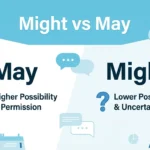
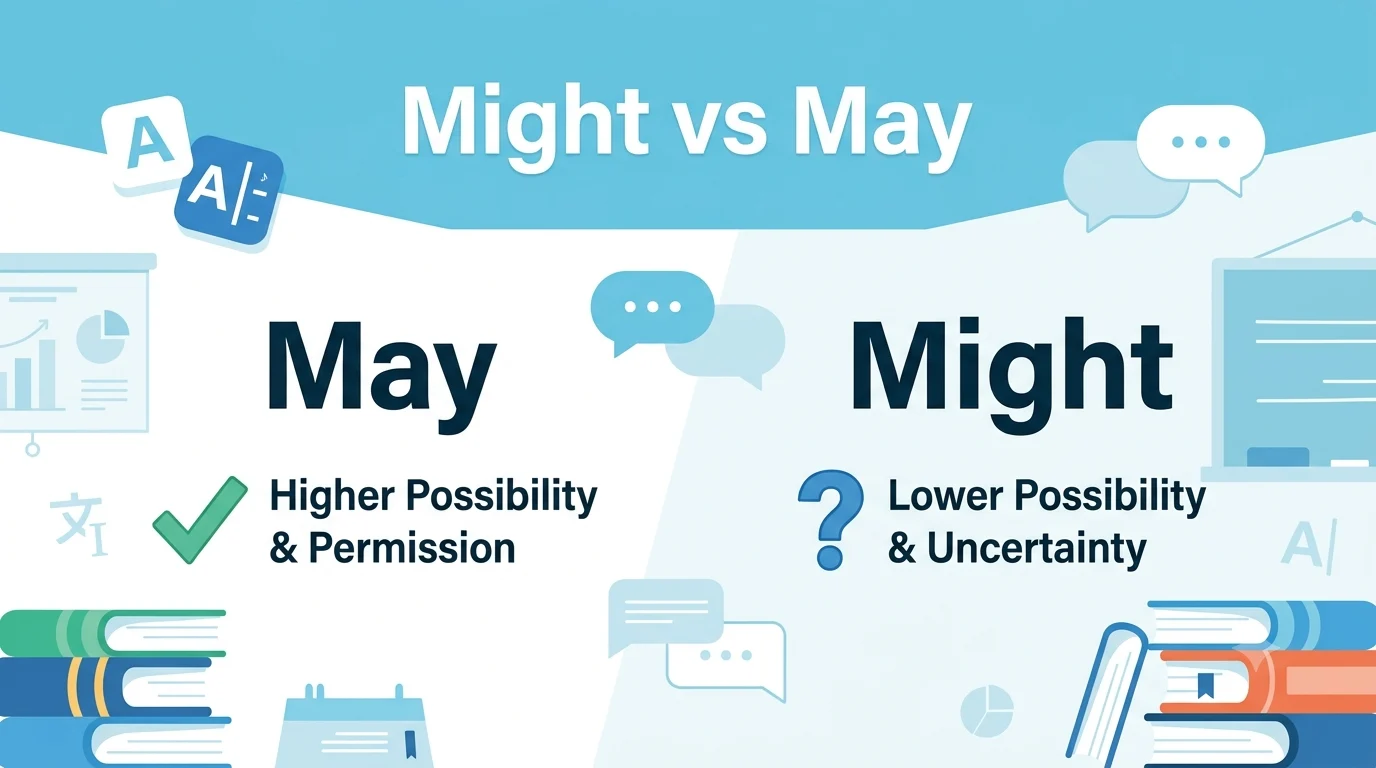
The good news is that the difference is easier than it seems. While both may and might express possibility, they do not always mean the same thing. In general, may suggests a stronger possibility or asks for permission, while might often shows greater uncertainty or describes a hypothetical situation.
This guide follows standard English grammar rules used by respected references such as Cambridge Grammar and Oxford English Grammar. You’ll learn simple grammar rules, real-life examples, comparison tables, common mistakes, might vs may sentences, may have vs might have, may or might for future, and practical exercises with answers. By the end, you’ll know exactly when to use may and might with confidence in both speaking and writing.
Key Takeaways
Need a quick answer? Here are the most important rules.
✅ May usually expresses a stronger possibility.
✅ Might usually expresses a weaker or less certain possibility.
✅ Use may when asking or giving permission.
✅ Use might for hypothetical or imaginary situations.
✅ Both may and might are followed by the base form of the main verb.
✅ Use may have and might have to talk about possible events in the past.
Quick Examples
- It may rain this afternoon. (Quite likely.)
- It might rain this afternoon. (Possible, but less certain.)
- May I come in? ✅
- If I had more money, I might buy a new car.
Might vs May
If you’re looking for a fast explanation, here’s the answer.
Both may and might are modal verbs used to express possibility. However, they are not always interchangeable.
- May usually suggests a higher chance that something will happen.
- Might usually suggests a lower or more uncertain chance.
- May is also the standard modal verb for asking or giving permission.
- Might is commonly used in hypothetical situations, polite suggestions, and less certain future events.
Quick Comparison
| Feature | May | Might |
|---|---|---|
| Main meaning | Possibility or permission | Possibility or uncertainty |
| Level of certainty | Higher | Lower |
| Asking permission | ✅ Yes | Rare in modern English |
| Hypothetical situations | Sometimes | Very common |
| Formal writing | Very common | Common |
| Everyday conversation | Common | Very common |
Examples
- We may travel to Japan next year.
- We might travel to Japan next year.
- May I ask a question?
- You might want to check your email before leaving.
Which One Should You Choose?
Choose may when something seems more likely or when you need to ask or give permission.
Choose might when you’re less certain or discussing an imagined or conditional situation.
Pronunciation
Although may and might have different meanings, their pronunciation is straightforward.
| Word | IPA | Pronunciation |
|---|---|---|
| May | /meɪ/ | Sounds like “day” |
| Might | /maɪt/ | Sounds like “kite” |
Pronunciation Tip
Many English learners confuse might with may because both describe possibility. Remember that might ends with a clear /t/ sound, while may ends with the /eɪ/ vowel sound.
Practice these aloud:
- I may call you later.
- I might call you later.
Grammar Formula
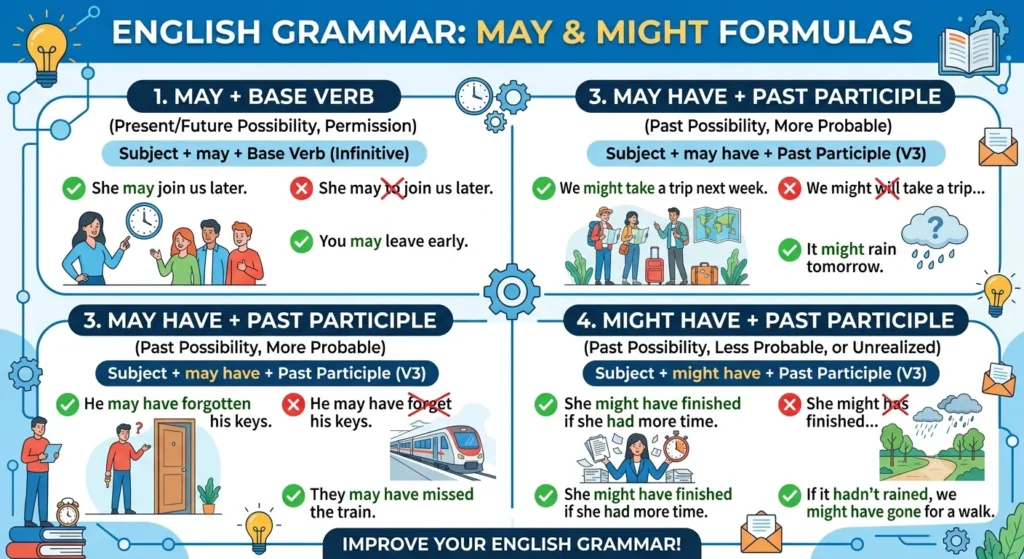
One of the easiest ways to avoid mistakes is to remember these simple sentence patterns.
1. May + Base Verb
Formula
May + Base Form of the Verb
Examples
- She may come tomorrow.
- We may travel next week.
- He may join the meeting.
2. Might + Base Verb
Formula
Might + Base Form of the Verb
Examples
- She might come tomorrow.
- We might travel next week.
- He might join the meeting.
3. May Have + Past Participle
Formula
May have + Past Participle
Use this structure for a possible event in the past.
Examples
- She may have forgotten her keys.
- They may have missed the bus.
- He may have left already.
4. Might Have + Past Participle
Formula
Might have + Past Participle
This structure also describes a possible past event but usually with a little more uncertainty.
Examples
- She might have forgotten her keys.
- They might have missed the bus.
- He might have left already.
Remember These Rules
✔ Always use the base form of the main verb after may and might.
✔ Never use to after a modal verb.
✔ Never add -s to the main verb.
Correct
- She may go home.
- They might arrive soon.
Incorrect
- She may to go home.
- They might arrives soon.
Origin and History of May and Might
Understanding the history of these words makes their modern usage much easier to remember.
The modal verb may comes from the Old English word mæg, which originally meant “to be able to” or “to have permission.” Over time, its meaning expanded to include possibility, permission, and probability. Today, may is commonly used in both spoken and written English to express possibility or to ask and give permission.
The word might developed as the past tense form of may in Old English. As English evolved, might gradually became an independent modal verb. In modern English, it is no longer used simply as the past tense of may. Instead, it usually expresses greater uncertainty, hypothetical situations, or polite suggestions.
Although both words share the same historical roots, their meanings have changed over time. Today, native English speakers often choose may when they feel something is more likely and might when they want to express less certainty or discuss an imagined situation.
Why This Matters
Knowing their history helps explain why may and might are closely related but not always interchangeable. This is one of the main reasons learners often confuse the two modal verbs.
What Is the Difference Between May and Might?
The difference between may and might is mainly the degree of possibility they express. While both modal verbs can describe something that is possible, may usually suggests a stronger chance that something will happen. Might often expresses more uncertainty or a weaker possibility.
Another important difference is that may is commonly used to ask for or give permission, while might is rarely used for permission in modern English. Instead, might is more common in hypothetical situations, polite suggestions, and uncertain future events.
According to standard English grammar used by Cambridge and Oxford, the difference between may and might is often one of meaning, tone, and context, rather than a strict grammar rule. In many everyday conversations, native speakers use both words interchangeably when the difference in certainty is very small.
Quick Visual Comparison
| Choose May When… | Choose Might When… |
|---|---|
| The possibility seems fairly likely. | The possibility is less certain. |
| Asking for permission. | Talking about imaginary situations. |
| Giving permission. | Making polite suggestions. |
| Writing formal emails or documents. | Speaking casually or discussing uncertain plans. |
| Expressing reasonable confidence. | Expressing doubt or hesitation. |
Side-by-Side Examples
Example 1: Possibility
May
It may rain this afternoon.
The speaker believes rain is quite possible.
Might
It might rain this afternoon.
The speaker thinks rain is possible but sounds less certain.
Example 2: Future Plans
May
We may visit our grandparents this weekend.
The visit seems likely.
Might
We might visit our grandparents this weekend.
The visit depends on other plans or circumstances.
Example 3: Permission
Correct
May I open the window?
Less Common
Might I open the window?
Although grammatically correct, might I sounds very formal and is rarely used in everyday English.
Which Is Stronger: “Might” or “May”?
One of the most common grammar questions is:
Which is stronger, “might” or “may”?
In most situations, may is considered stronger because it suggests a higher probability.
Think of it like this:
- May = “There is a good chance.”
- Might = “There is a chance, but I’m less sure.”
Examples
- She may accept the job offer.
- She might accept the job offer.
Both sentences are correct, but the first sounds more confident.
Remember: The difference is usually small. In many everyday conversations, native speakers use may and might interchangeably when the level of certainty isn’t important.
Might vs May Grammar Rules
Learning a few simple grammar rules will help you avoid the most common mistakes.
Rule 1: Both Are Modal Verbs
May and might are modal auxiliary verbs. They are always followed by the base form of the main verb.
✅ Correct
- She may come tomorrow.
- They might leave early.
- We may visit next week.
❌ Incorrect
- She may comes tomorrow.
- They might leaving early.
- We may to visit next week.
Rule 2: Never Use “To” After a Modal Verb
Modal verbs are always followed directly by the main verb.
✅ Correct
- He may leave now.
- We might travel next month.
❌ Incorrect
- He may to leave now.
- We might to travel next month.
Rule 3: Use “May Have” and “Might Have” for Past Possibility
To talk about something that possibly happened in the past, use:
- May have + past participle
- Might have + past participle
Examples
- She may have forgotten my email.
- They might have missed the train.
- He may have arrived already.
Rule 4: Don’t Add “-s” After May or Might
The main verb always stays in its base form.
✅ Correct
- She may work today.
- He might call later.
❌ Incorrect
- She may works today.
- He might calls later.
Rule 5: Negative Forms
The negative forms are easy to remember.
- May not
- Might not
Examples
- She may not attend the meeting.
- We might not finish on time.
The contraction mightn’t exists but is uncommon in modern American English. Most speakers simply say might not.
Common Collocations with May and Might
Learning common word combinations helps your English sound more natural.
Common Collocations with May
- may happen
- may occur
- may include
- may vary
- may depend
- may become
- may require
- may affect
- may result in
- may apply
Examples
- Prices may increase next month.
- The weather may change this evening.
- This policy may apply to all employees.
Common Collocations with Might
- might be
- might have
- might become
- might consider
- might want to
- might need
- might help
- might happen
- might improve
- might change
Examples
- You might want to save your work.
- We might need extra chairs.
- This update might improve performance.
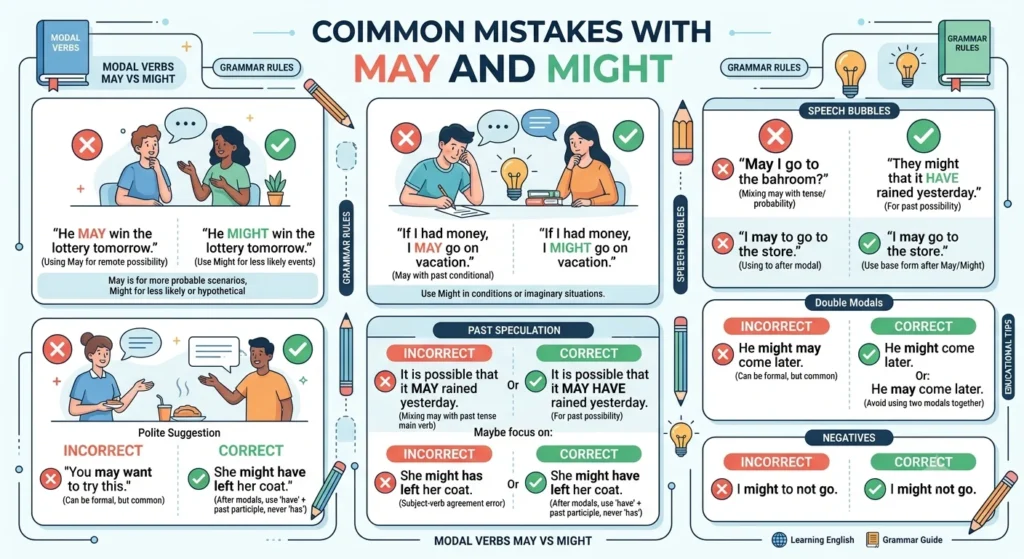
Expert Grammar Tips
These simple tips can help you choose the correct modal verb more confidently.
Tip 1
If you’re asking for permission, choose may.
✔ May I ask a question?
Tip 2
If you’re talking about something uncertain, might often sounds more natural.
✔ I might go to the gym after work.
Tip 3
If you’re writing a business email or formal document, may is usually the better choice.
✔ Employees may request additional leave.
Tip 4
If the sentence begins with if, might is often the better option.
✔ If I had more time, I might learn French.
Tip 5
Don’t focus only on grammar—think about how certain you feel.
Ask yourself:
“Am I fairly confident?” → Use may.
“Am I less sure?” → Use might.
Quick Decision Guide
Still not sure which word to choose? Use this simple checklist.
| Situation | Best Choice |
|---|---|
| Asking permission | May |
| Giving permission | May |
| Strong possibility | May |
| Weak possibility | Might |
| Hypothetical situation | Might |
| Polite suggestion | Might |
| Formal writing | May |
| Casual conversation | Might |
Quick Memory Trick
A simple way to remember the difference is:
- May = More likely
- Might = Maybe, but less certain
This isn’t a strict grammar rule, but it’s a helpful guideline for most everyday situations.
When to Use May
The modal verb may is used to express possibility, permission, and formal or polite communication. In many situations, may suggests that something has a reasonable or fairly strong chance of happening.
If you’re wondering “Where do we use may and might?”, remember this simple rule:
Use “may” when something seems more likely or when asking or giving permission.
Let’s explore each use in detail.
1. Use May to Express Possibility
The most common use of may is to talk about something that could happen.
Examples
- It may rain this afternoon.
- She may visit us this weekend.
- We may receive the package tomorrow.
- The train may arrive a few minutes late.
- He may accept the job offer.
In these examples, the speaker believes the event is possible and fairly likely.
More Examples
- Prices may increase next month.
- The weather may improve by evening.
- Our team may win the championship.
- The meeting may finish earlier than expected.
- She may call you after work.
2. Use May to Ask for Permission
In modern English, may is the standard modal verb for polite requests.
Examples
- May I come in?
- May I use your phone?
- May we begin the meeting?
- May I ask a question?
- May I sit here?
These questions sound polite, respectful, and professional.
Formal vs Informal
Formal
May I leave early today?
Informal
Can I leave early today?
Although can is common in everyday conversation, may is still preferred in formal writing, schools, interviews, and business settings.
3. Use May to Give Permission
May is also used when allowing someone to do something.
Examples
- You may leave now.
- Students may use calculators during the exam.
- Visitors may enter after 9:00 a.m.
- Employees may work from home on Fridays.
- Customers may return products within 30 days.
These sentences clearly give permission.
4. Use May in Formal Writing
Because may sounds professional and neutral, it appears frequently in official documents.
You will often see it in:
- Business emails
- School policies
- Government notices
- Legal documents
- User guides
- Company handbooks
Business Email
You may submit your report by Friday.
Office Memo
Employees may request flexible working hours.
School Notice
Students may borrow three library books at a time.
Website Policy
Users may change their password at any time.
5. Use May for Polite Suggestions
Sometimes may introduces a gentle suggestion.
Examples
- You may want to review your application before submitting it.
- We may need another meeting.
- You may find this guide helpful.
Although might is often more common for suggestions, may is perfectly acceptable in formal contexts.
Common Collocations with May
Learning common word combinations helps your English sound more natural.
| Common Collocation | Example Sentence |
|---|---|
| may happen | Accidents may happen at any time. |
| may occur | Delays may occur during bad weather. |
| may include | The package may include extra accessories. |
| may vary | Results may vary from person to person. |
| may depend | Success may depend on preparation. |
| may require | The project may require additional funding. |
| may become | This issue may become more serious. |
| may affect | Heavy rain may affect traffic. |
| may apply | Different rules may apply overseas. |
| may result in | Poor planning may result in delays. |
Using these collocations makes your writing sound more fluent and natural.
Everyday Examples of May
At Work
- We may hire two new employees next month.
- The manager may approve your request tomorrow.
At School
- Students may ask questions at the end of the lesson.
- You may use a dictionary during the test.
At Home
- We may order pizza tonight.
- Dad may come home late.
In the News
- Experts say inflation may slow next year.
- Scientists believe the discovery may improve healthcare.
When to Use Might
The modal verb might is used to express uncertainty, weaker possibility, hypothetical situations, and polite suggestions. Compared with may, it usually shows that the speaker is less confident about what will happen.
A simple way to remember it is:
Use “might” when something is possible, but you are not very sure.
Let’s look at the most common situations.
1. Use Might to Express Uncertainty
This is the most common use of might.
Examples
- It might rain tonight.
- She might visit us this weekend.
- We might miss the train.
- He might forget the meeting.
- They might move to another city.
These examples show that the event is possible but uncertain.
2. Use Might for Less Certain Future Plans
Both may and might can refer to the future, but might suggests less confidence.
Examples
- I might travel abroad next year.
- We might buy a new house.
- She might apply for the scholarship.
- They might open another store.
- He might change his mind.
The speaker is unsure whether these plans will happen.
3. Use Might in Hypothetical Situations
Might is very common in conditional sentences.
Examples
- If I had more money, I might buy a sports car.
- If she studied harder, she might pass the exam.
- If we left earlier, we might avoid traffic.
- Without your help, we might fail.
- If the weather improved, we might go hiking.
These situations are imaginary or depend on another condition.
4. Use Might for Polite Suggestions
Native English speakers often use might to make gentle suggestions.
Examples
- You might want to save your work.
- We might try another restaurant.
- You might enjoy this book.
- You might consider taking a break.
- We might ask the teacher for help.
Using might makes the suggestion sound softer and more polite.
Common Collocations with Might
| Common Collocation | Example Sentence |
|---|---|
| might be | She might be at home. |
| might have | They might have forgotten. |
| might become | This problem might become worse. |
| might need | We might need more time. |
| might help | Exercise might help reduce stress. |
| might happen | Anything might happen. |
| might change | The schedule might change tomorrow. |
| might improve | The update might improve performance. |
| might consider | You might consider another option. |
| might want to | You might want to read the instructions first. |
These combinations appear frequently in conversations, news articles, and professional writing.
Everyday Examples of Might
In Conversation
- I might stay home tonight.
- We might watch a movie later.
At Work
- The client might ask for more changes.
- We might need another meeting.
At School
- The teacher might postpone the test.
- I might join the study group.
In the News
- Fuel prices might rise next month.
- The storm might reach the coast tomorrow.
On Social Media
- I might upload a new video tonight.
- We might go live later—stay tuned!
Quick Tip for Using Might
Ask yourself:
“Am I unsure, or is this only a possibility?”
If the answer is yes, might is usually the better choice.
Quick Comparison
| Situation | Use May | Use Might |
|---|---|---|
| Stronger possibility | ✅ | ❌ |
| Weaker possibility | ❌ | ✅ |
| Asking permission | ✅ | Rare |
| Giving permission | ✅ | Rare |
| Hypothetical situations | Sometimes | ✅ |
| Polite suggestions | Sometimes | ✅ |
| Formal writing | ✅ | ✅ |
| Casual conversation | ✅ | ✅ |
Memory Tip: Think “May = More likely” and “Might = Maybe, but less certain.” This simple trick will help you choose the correct modal verb in most everyday situations.
When to Use May
Choose may when you believe something has a fairly good chance of happening or when asking for permission.
Examples
- It may rain this evening.
- She may accept the invitation.
- We may finish the project today.
- May I use your phone?
These examples suggest confidence or politeness.
When to Use Might
Choose might when something is possible but less certain.
Examples
- It might rain this evening.
- She might accept the invitation.
- We might finish the project today.
- I might visit my grandparents this weekend.
The speaker sounds less confident than when using may.
Side-by-Side Examples
Weather
- It may rain today. (Quite possible.)
- It might rain today. (Possible, but less certain.)
- It could rain today. (Rain is one possible outcome.)
Job Offer
- She may accept the job.
- She might accept the job.
- She could accept the job.
All three sentences are correct, but the speaker’s confidence changes slightly.
Travel Plans
- We may visit Dubai this summer.
- We might visit Dubai this summer.
- We could visit Dubai this summer.
May sounds more confident.
Might sounds more uncertain.
Could presents it as one possible option.
Which One Is More Formal?
| Modal Verb | Formality |
|---|---|
| May | ⭐⭐⭐⭐⭐ |
| Might | ⭐⭐⭐⭐ |
| Could | ⭐⭐⭐⭐ |
May is commonly used in:
- Business emails
- Official announcements
- School policies
- Legal writing
Could and might appear more often in everyday conversations.
Might vs Could
Another common grammar question is “What is the difference between might and could?”
Although both words express possibility, they are not always interchangeable.
Main Difference
Might focuses on uncertainty.
Could focuses on possibility or ability.
Comparison
| Might | Could |
|---|---|
| Shows uncertainty | Shows possibility or ability |
| Common in hypothetical situations | Common in suggestions |
| Cannot express ability | Can express ability |
Examples
Uncertainty
- She might arrive late because of traffic.
The speaker is unsure.
Possibility
- She could arrive late because of traffic.
The speaker simply states one possible outcome.
Ability
- When he was younger, he could run very fast.
Here, could expresses past ability.
You cannot replace could with might in this sentence.
Suggestions
Could is often used to make suggestions.
Examples
- We could watch a movie tonight.
- You could try another restaurant.
- They could ask the manager for help.
Although might can also introduce polite suggestions, could is generally more common when offering alternatives.
Quick Rule
Use might when you’re unsure.
Use could when talking about possibility, ability, or suggestions.
May or Might for Future
Many learners ask:
Should I use “may” or “might” when talking about the future?
The answer is simple:
Both are correct.
The difference is the level of certainty.
Use May for a More Likely Future Event
Examples
- We may move to another city next year.
- She may start a new job soon.
- They may visit us during the holidays.
- I may buy a new laptop this month.
These sentences suggest the speaker thinks the event is fairly likely.
Use Might for a Less Certain Future Event
Examples
- We might move to another city next year.
- She might start a new job soon.
- They might visit us during the holidays.
- I might buy a new laptop this month.
These examples express uncertainty.
Future Comparison Table
| Situation | May | Might |
|---|---|---|
| Travel plans | We may travel next month. | We might travel next month. |
| Career | She may change jobs. | She might change jobs. |
| Weather | It may snow tonight. | It might snow tonight. |
| Shopping | I may buy a new phone. | I might buy a new phone. |
Both versions are grammatically correct. The only difference is how confident the speaker feels.
Expert Usage Notes
Here are a few practical tips that native speakers follow:
✔ Use may when writing formally.
Example:
Customers may contact support for assistance.
✔ Use might when discussing uncertain plans.
Example:
I might go hiking this weekend if the weather is good.
✔ Use could when offering ideas or alternatives.
Example:
We could leave earlier to avoid traffic.
✔ Don’t Overthink the Difference
In everyday English, native speakers often use may and might interchangeably when the difference in certainty is very small. Focus on communicating your meaning clearly rather than worrying about tiny differences.
Quick Memory Trick
Remember this simple formula:
- May = More likely
- Might = Maybe, but less certain
- Could = Possible or able
Learning this rule will help you choose the correct modal verb in most everyday conversations, emails, school assignments, and professional writing.
How to Use “May Have” and “Might Have”
Many English learners ask, “How do you use ‘may have’ and ‘might have’?” These two expressions describe a possible event in the past. They tell us that something possibly happened, but the speaker is not completely sure.
Grammar Formula
| Structure | Formula | Example |
|---|---|---|
| May have | May + have + past participle | She may have forgotten her keys. |
| Might have | Might + have + past participle | She might have forgotten her keys. |
Remember: Always use have + past participle after may and might when talking about past possibility.
When to Use May Have
Use may have when you think something probably happened, but you do not have proof.
Examples
- She may have left the office already.
- They may have missed the train.
- He may have forgotten my message.
- The package may have arrived this morning.
- We may have taken the wrong road.
In these sentences, the speaker believes the event is fairly likely.
When to Use Might Have
Use might have when the past event seems less certain or when you are simply guessing.
Examples
- She might have left early.
- They might have missed the train because of traffic.
- He might have forgotten my email.
- We might have made a mistake.
- The children might have fallen asleep.
Here, the speaker is less confident than when using may have.
Side-by-Side Comparison
| May Have | Might Have |
|---|---|
| She may have called you. | She might have called you. |
| They may have finished the project. | They might have finished the project. |
| He may have lost his wallet. | He might have lost his wallet. |
Both are correct. The difference is the speaker’s level of certainty.
Common Mistakes with May Have and Might Have
Many learners make small grammar mistakes. Here are the most common ones.
| ❌ Incorrect | ✅ Correct | Why? |
|---|---|---|
| She may has forgotten. | She may have forgotten. | Use have, not has. |
| They might had left. | They might have left. | Use have + past participle. |
| He may have went home. | He may have gone home. | Use the past participle gone. |
| We might have took the bus. | We might have taken the bus. | Use the past participle taken. |
Advanced Usage Tips
As your English improves, you’ll notice that native speakers choose may and might based on tone and context rather than strict grammar rules.
In Business Emails
Formal
We may need additional information before approving your request.
Less Certain
We might need additional information depending on the review.
In Academic Writing
Researchers often use may because it sounds careful and objective.
Examples
- This study may provide useful insights.
- The results may indicate a change in consumer behavior.
In News Reports
Journalists often use may when reporting developing stories.
Examples
- Officials say the storm may reach the coast tonight.
- The company may announce new products next month.
In Everyday Conversation
Friends often prefer might when discussing uncertain plans.
Examples
- I might order pizza tonight.
- We might go shopping tomorrow.
- She might come with us after work.
Quick Reference Summary
| Situation | Best Choice |
|---|---|
| Strong possibility | May |
| Weak possibility | Might |
| Asking permission | May |
| Giving permission | May |
| Past possibility | May have / Might have |
| Hypothetical situation | Might |
| Suggestions | Could or Might |
| Ability | Could |
Remember These Golden Rules
- May usually expresses a stronger possibility.
- Might usually expresses a weaker possibility.
- Could often expresses possibility, ability, or suggestions.
- Use may have and might have for possible past events.
- After may and might, always use the base form of the verb.
- Never use to after a modal verb.
- Never add -s to the main verb after may or might.
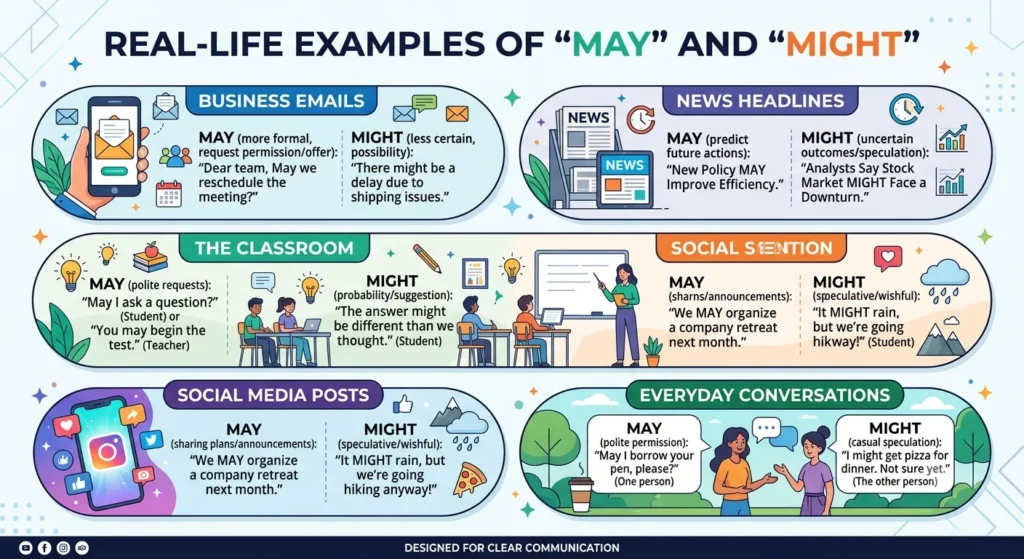
Might vs May in Everyday Examples
Learning grammar rules is important, but seeing may and might in real-life situations makes them much easier to understand. Below are examples from emails, business writing, news reports, social media, academic writing, and everyday conversations.
1. In Business Emails
Formal emails often use may because it sounds professional and polite.
Examples
We may schedule another meeting next week.
Your request may take up to three business days to process.
You may contact our support team if you need further assistance.
When the situation is uncertain, might is more natural.
Examples
We might need additional information before approving your application.
The delivery might be delayed due to weather conditions.
I might be unavailable on Friday afternoon.
2. In Workplace Communication
Employees and managers frequently use both modal verbs.
Examples with May
- The manager may approve your request tomorrow.
- Employees may work remotely on Fridays.
- We may hire two new team members next month.
Examples with Might
- We might need extra staff this weekend.
- The client might request additional changes.
- I might finish the report by this evening.
3. In School and Academic Writing
Teachers and researchers often prefer may because it sounds objective and formal.
Examples
- This study may help future researchers.
- The results may indicate a positive trend.
- Students may use calculators during the exam.
Might is used when discussing uncertain outcomes.
Examples
- These results might change with additional data.
- The experiment might produce different results.
- More research might be necessary.
4. In News Reports
News articles often use modal verbs because journalists cannot always report information with complete certainty.
Examples with May
- The government may announce new tax policies next week.
- Heavy rainfall may affect traffic across the city.
- Experts say inflation may slow later this year.
Examples with Might
- Fuel prices might increase if oil costs continue to rise.
- The storm might reach the coast by Friday.
- The company might launch a new product next month.
5. On Social Media
Social media posts are usually informal, so might appears more frequently.
Examples
- I might post a new video tonight.
- We might go live later—stay tuned!
- I might try this recipe tomorrow.
People also use may, especially when sharing plans.
Examples
- We may reach 50,000 followers this month!
- I may upload more travel photos soon.
6. In Everyday Conversations
Here are some natural conversations using may and might.
Conversation 1
A: Are you coming to the party?
B: I might come if I finish work early.
Conversation 2
A: Do you think it will rain?
B: It may rain this afternoon.
Conversation 3
A: Can I borrow your notebook?
B: Yes, you may.
Conversation 4
A: What are your weekend plans?
B: I might visit my grandparents.
Common Mistakes with Might vs May
Many English learners make the same grammar mistakes. Understanding these errors will help you write more accurate English.
Mistake 1: Using “to” After a Modal Verb
❌ Incorrect
- She may to visit us tomorrow.
- We might to leave early.
✅ Correct
- She may visit us tomorrow.
- We might leave early.
Rule: Never use to after may or might.
Mistake 2: Adding -s to the Main Verb
❌ Incorrect
- He may goes home.
- She might works late.
✅ Correct
- He may go home.
- She might work late.
Mistake 3: Using the Wrong Past Form
❌ Incorrect
- She may has forgotten.
- They might had left.
✅ Correct
- She may have forgotten.
- They might have left.
Mistake 4: Confusing May with Can
Many learners use can instead of may in formal situations.
Informal
Can I leave early?
Formal
May I leave early?
Both are common in conversation, but may is more polite and appropriate in formal English.
Mistake 5: Thinking May and Might Always Mean the Same
Although they are often interchangeable, may generally expresses more confidence than might.
Example
- She may come later. (More likely.)
- She might come later. (Less certain.)
Quick Comparison Table
| Situation | Use May | Use Might |
|---|---|---|
| Asking permission | ✅ | Rare |
| Giving permission | ✅ | Rare |
| Strong possibility | ✅ | ❌ |
| Weak possibility | ❌ | ✅ |
| Hypothetical situation | Sometimes | ✅ |
| Polite suggestion | Sometimes | ✅ |
| Formal writing | ✅ | ✅ |
| Casual conversation | ✅ | ✅ |
Might vs May – Google Trends & Usage Data
The keyword “might vs may” is searched throughout the year because it is one of the most common English grammar questions. Students, professionals, and English learners often look for quick explanations, examples, and grammar rules.
Search interest increases during school exam periods and English language test preparation because learners want to understand the difference between these two modal verbs.
Countries with High Search Interest
- India
- Pakistan
- Bangladesh
- Philippines
- United States
- United Kingdom
- Canada
- Australia
Why Do People Search for “Might vs May”?
Users usually want answers to questions such as:
- Where do we use may and might?
- Which is stronger, might or may?
- What is the difference between may, might, and could?
- How do you use may have and might have?
- Can may and might be used interchangeably?
- What are some easy may and might examples?
These related searches show that people are looking for both a quick explanation and practical examples they can use in everyday English.
Pro Writing Tips
Use these simple tips to make your English sound more natural.
✔ Think About Certainty
If the event seems fairly likely, choose may.
If you’re less sure, choose might.
✔ Match the Situation
- Formal writing → May
- Casual conversation → Might
- Suggestions → Could or Might
✔ Read Your Sentence Aloud
If the sentence sounds too confident, might may be a better choice. If it sounds too uncertain, may may fit better.
✔ Practice Every Day
The easiest way to master may and might is to read English articles, listen to native speakers, and write your own example sentences.
Frequently Asked Questions
1. What is the difference between may and might?
Both may and might express possibility, but may usually suggests a stronger chance that something will happen. Might expresses greater uncertainty or a weaker possibility. May is also commonly used to ask for or give permission.
2. Where do we use may and might?
Use may for:
- Possibility
- Asking permission
- Giving permission
- Formal writing
Use might for:
- Uncertain situations
- Hypothetical situations
- Polite suggestions
- Less certain future events
3. Which is stronger, might or may?
In most situations, may is stronger because it shows a higher level of confidence. Might usually indicates that the speaker is less certain.
Example
- She may come today. (More likely.)
- She might come today. (Less certain.)
4. Is it “might I say” or “may I say”?
Both are grammatically correct, but they are used differently.
- May I say is the normal and polite expression in modern English.
- Might I say sounds very formal, literary, or old-fashioned and is rarely used in everyday conversation.
5. How do you use “may have” and “might have”?
Use may have and might have to talk about something that possibly happened in the past.
Examples
- She may have forgotten the meeting.
- He might have missed the train.
6. Can may and might be used interchangeably?
Yes, in many everyday situations they can. However, may usually expresses more confidence, while might suggests greater uncertainty. Choosing the correct modal verb helps make your meaning clearer.
7. What is the difference between might and could?
Might expresses uncertainty, while could expresses possibility, ability, or suggestions.
Examples
- I might go to the concert. (I’m not sure.)
- I could go to the concert. (It is one possible option.)
8. Is may more formal than might?
Yes. May is generally more formal and appears frequently in business emails, academic writing, legal documents, and official notices. Might is more common in everyday conversations and informal situations.
9. Do native English speakers use may or might more often?
Both are common, but usage depends on the context. Native speakers often use might in casual conversations to express uncertainty and may in formal writing or when asking for permission.
10. Can may and might appear in the same paragraph?
Yes. Writers often use both modal verbs together because each conveys a different level of certainty.
Example
The weather may improve tomorrow, but it might remain cloudy in some areas.
Conclusion
Understanding the difference between might vs may becomes much easier once you focus on the speaker’s level of certainty and the context of the sentence. Although both modal verbs express possibility, they are not always interchangeable. In general, may suggests a stronger possibility and is the preferred choice for asking or giving permission, while might expresses greater uncertainty, hypothetical situations, or polite suggestions.
As you continue learning English, remember that grammar is about communicating clearly rather than memorizing complicated rules. If an event seems fairly likely, may is often the better choice. If you’re less certain or discussing an imagined situation, might usually sounds more natural. Also, use may have and might have when referring to possible events in the past.
The best way to master these modal verbs is through regular reading, listening, and practice. Review the examples, complete the exercises, and create your own sentences using may, might, and could. With consistent practice, you’ll use these modal verbs confidently in conversations, academic writing, business communication, and everyday English.

Scott Thornbury is a respected English language educator and author, known for practical grammar insights, teacher training, and clear learner-focused explanations.