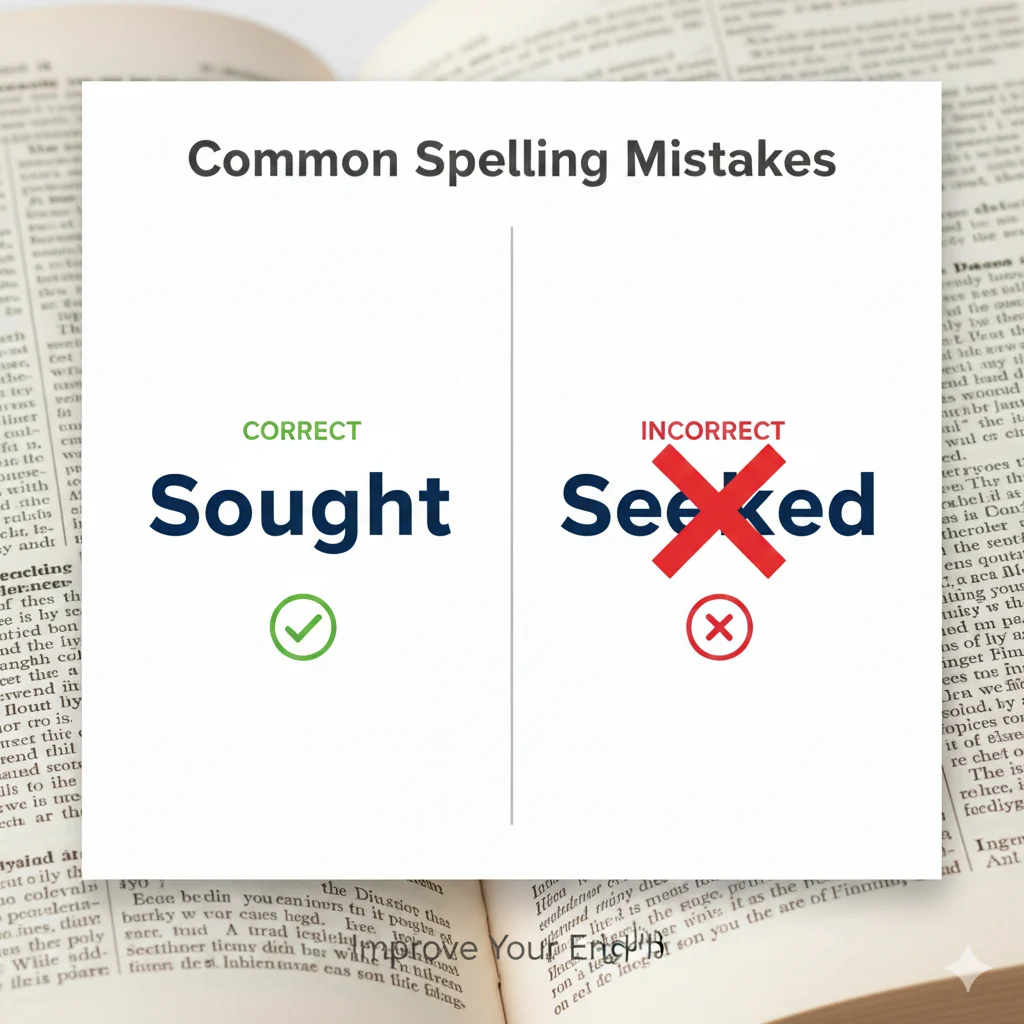
You type: “I seeked your advice.” A red line appears. But why? Most verbs add “-ed” for past tense.
You are not alone.
Every day, thousands search:
- “Is seeked correct?”
- “Is it sought advice or seeked advice?”
- “What is the past tense of seek?”
Why? Because English has regular and irregular verbs. “Seek” is irregular. It does NOT follow the “-ed” rule. Instead, it changes form – just like “think” becomes “thought” and “teach” becomes “taught.”
This guide solves one confusion: What is the correct past tense of seek?
The answer: Sought is correct. Seeked is a grammar mistake.
In this 2-minute guide, you will learn the rule, pronunciation, examples, and a memory trick you will never forget.
Let’s begin.
Sought vs Seeked
The correct past tense and past participle of “seek” is “sought.”
❌ “Seeked” is not correct in standard modern English.
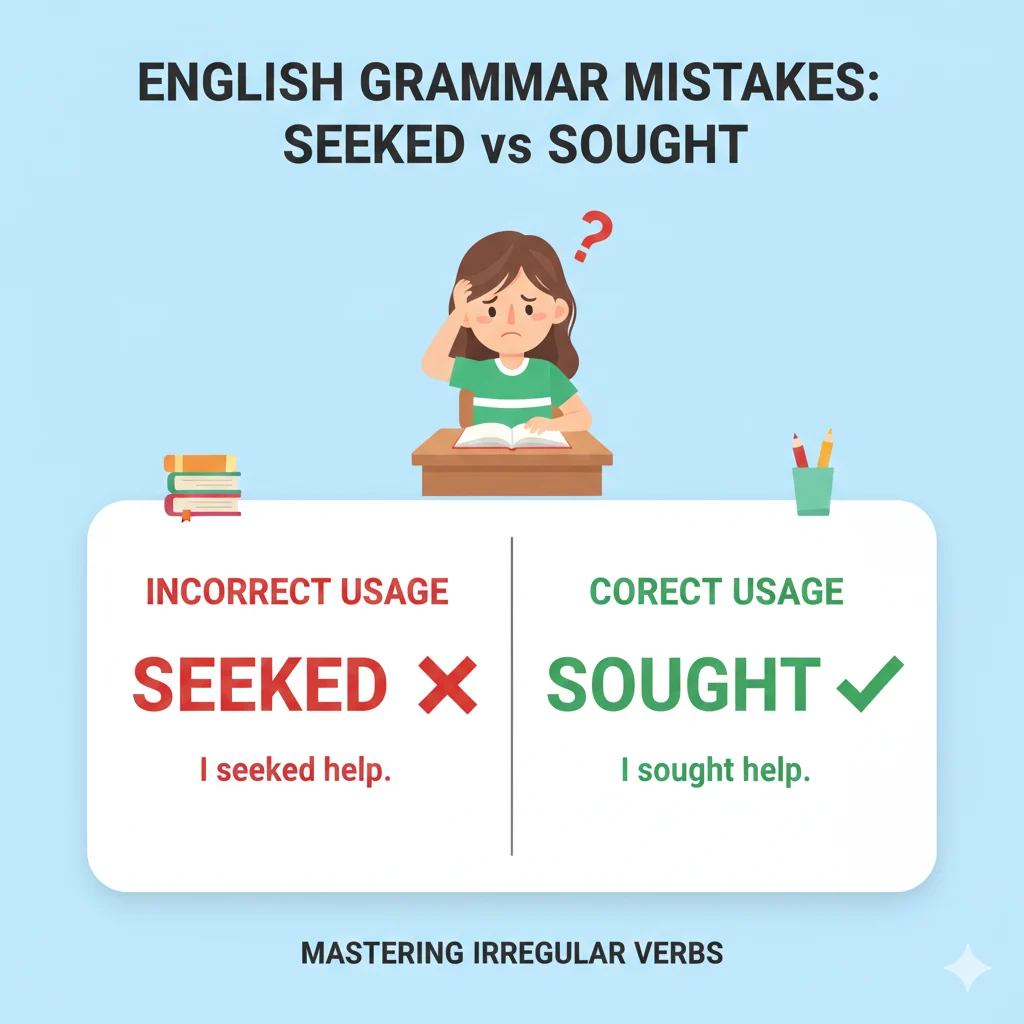
Correct Examples
- She sought help from a lawyer.
- They sought out better opportunities.
- He has sought advice before deciding.
- The company sought investor support.
Incorrect Examples
- She seeked help.
- They have seeked advice.
Is it correct to say “sought”?
Yes. It is grammatically correct in formal and informal English worldwide.
Is seeked correct?
No. It is considered a non-standard form and a grammar mistake in professional writing.
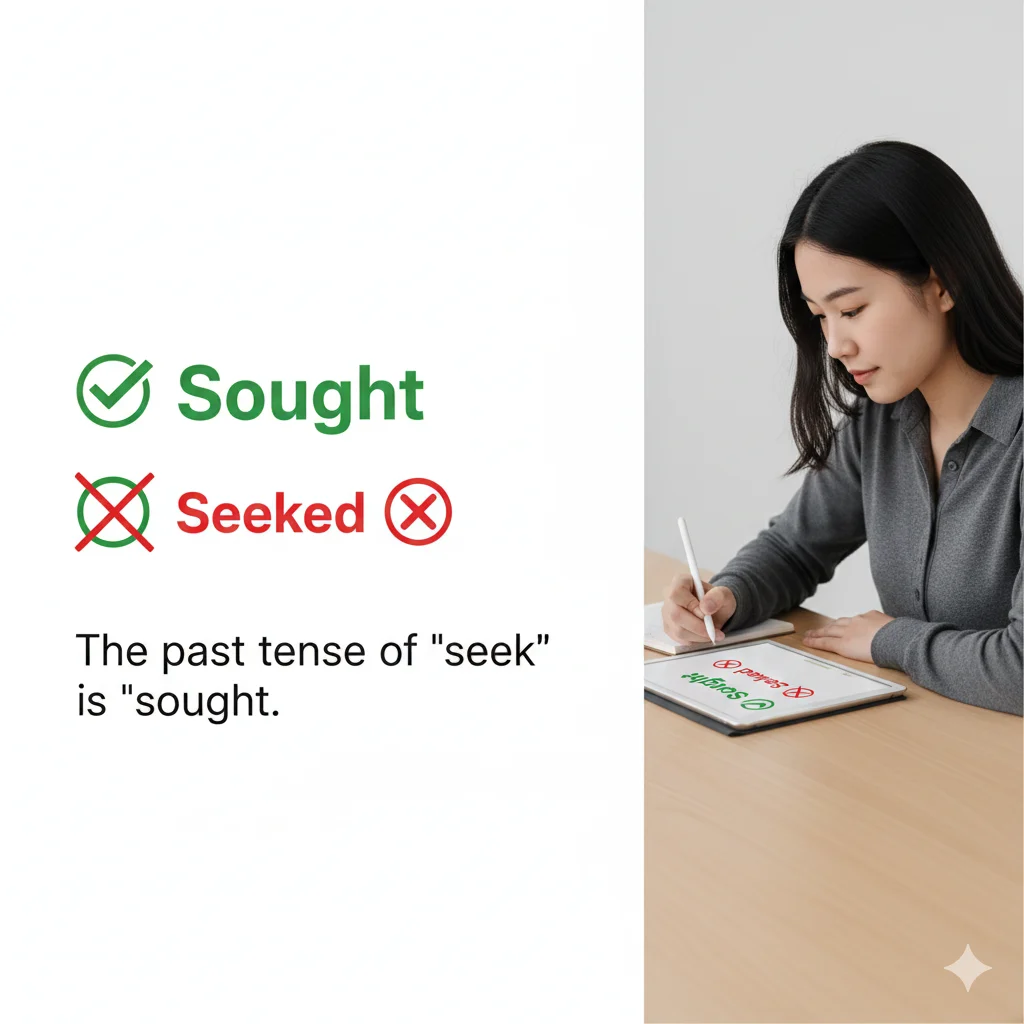
Why English Uses “Sought” Instead of “Seeked”
English verbs follow two systems:
1️⃣ Regular Verbs (Add -ed)
- Work → Worked
- Play → Played
- Call → Called
2️⃣ Irregular Verbs (Change Form)
- Think → Thought
- Teach → Taught
- Bring → Brought
- Buy → Bought
- Seek → Sought
Notice the -ought pattern. These verbs change the vowel sound instead of adding -ed.
Why Do Some Verbs Stay Irregular?
English developed from Old Germanic languages. In early English, many verbs changed vowels to show tense. Over time, most verbs became regular. But very common verbs stayed irregular.
“Seek” is a high-frequency verb. Because people used it often, its old form survived. That is why we still say:
Seek → Sought → Sought
Language evolution explains why “seeked” never replaced “sought.”
The Origin of “Sought”
The verb “seek” comes from Old English sēcan. Its past tense evolved into “sought” through historical sound changes.
This vowel shift pattern is over 1,000 years old. It appears in:
- Classic English literature
- Legal documents
- Academic research
- News writing
- Business communication
Modern English dictionaries confirm:
- Oxford English Dictionary: Seek → Sought → Sought
- Cambridge Dictionary: Seek → Sought → Sought
- Merriam-Webster: Seek → Sought → Sought
No major English dictionary lists “seeked” as correct. This confirms that sought is the accepted global form.

Sought Pronunciation
“Sought” is pronounced:
/sɔːt/
It rhymes with:
- Thought
- Taught
- Bought
Say it like: “sawt.”
Many learners struggle because the spelling does not clearly show pronunciation. This is one reason people search this word online.
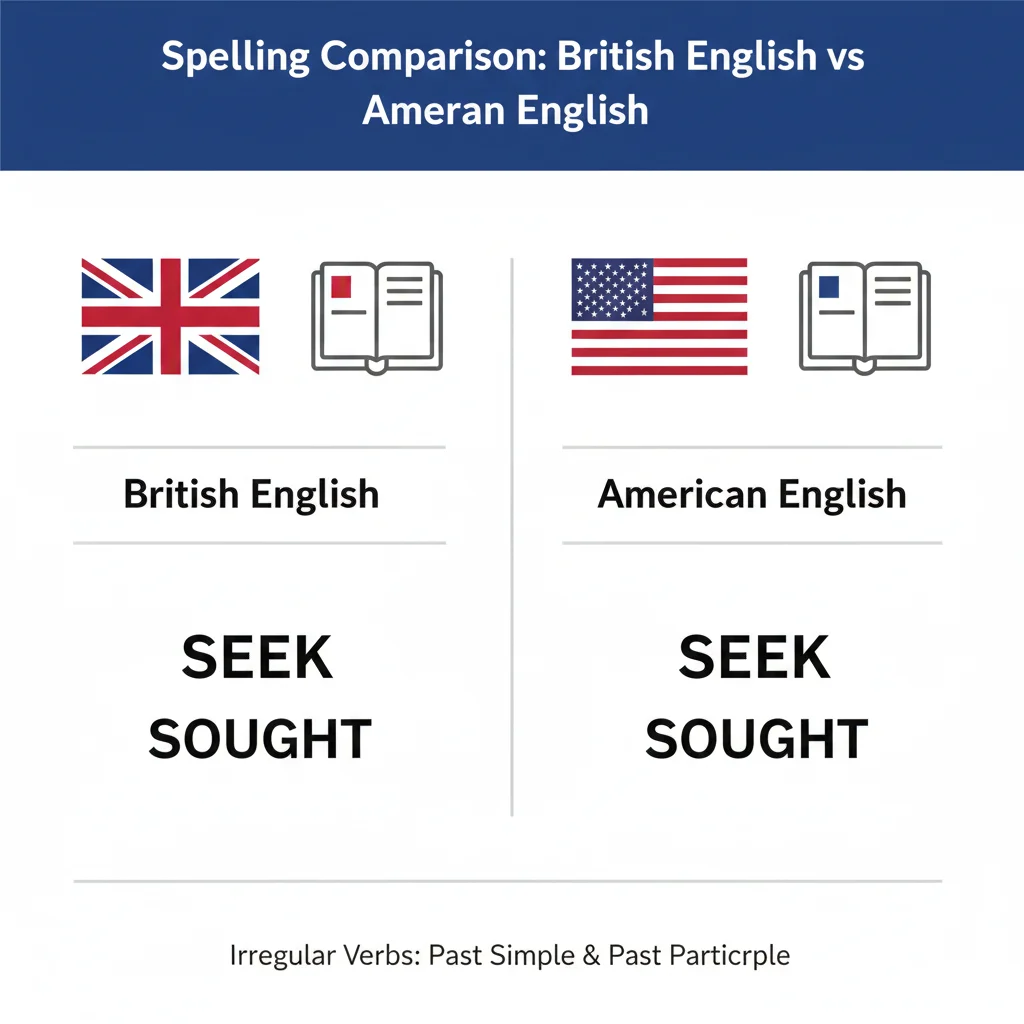
British English vs American English Spelling
There is no difference between British and American English for this verb.
Both use:
- Seek
- Sought
Unlike color/colour or organize/organise, this word does not change by region.
Comparison Table
| Form | American English | British English | Correct? |
|---|---|---|---|
| Seek | Seek | Seek | ✅ Yes |
| Sought | Sought | Sought | ✅ Yes |
| Seeked | Seeked | Seeked | ❌ No |
Whether your audience is in the US, UK, Canada, Australia, India, or Pakistan, always use sought.
Occurred vs Occured: Why One Form Is Incorrect
Which Spelling Should You Use?
Always use sought in:
- Academic essays
- IELTS or TOEFL exams
- Business emails
- Legal documents
- News articles
- Professional websites
Correct verb usage improves:
- Grammar accuracy
- Writing clarity
- Professional credibility
- Reader trust
Even in informal writing, “seeked” is considered incorrect.
Common Mistakes with Sought vs Seeked
1️⃣ Automatically Adding -ed
❌ He seeked a solution.
✅ He sought a solution.
2️⃣ Confusing Future Tense
Some people search “sought future tense.”
Future tense of seek:
- I will seek
- She will seek
“Sought” is only past tense.
3️⃣ Incorrect Present Perfect
❌ They have seeked help.
✅ They have sought help.
4️⃣ Wrong Phrase Usage
Correct expressions:
- Sought advice
- Sought help
- Sought permission
- Sought justice
- Sought out information
Sought Out Meaning
“Sought out” means actively tried to find something.
Example:
- She sought out expert guidance.
Sought vs Seeked – Detailed Comparison
| Base Verb | Past Tense | Past Participle | Meaning | Status |
|---|---|---|---|---|
| Seek | Sought | Sought | To look for or try to obtain | ✅ Standard |
| Seeked | Seeked | Seeked | Non-standard learner form | ❌ Incorrect |
Sought in Everyday Examples
In Professional Emails
“I sought clarification regarding your proposal.”
In News Reports
“The government sought international support.”
In Academic Writing
“The researchers sought additional evidence.”
In Social Media
“She sought out peace and happiness.”
Using correct grammar makes writing confident and polished.
Seems or Seams: The Correct Spelling Revealed
What Does “Sought” Mean?
“Sought” means:
- Tried to find
- Attempted to obtain
- Requested
- Looked for
Examples:
- They sought justice.
- He sought new career opportunities.
Sought Synonym
- Pursued
- Requested
- Desired
- Asked for
- Investigated
People sometimes search for “synonym for seeked,” but the correct word to replace is sought.
Why Learners Search “Seeked” – Search Insight
Search behavior shows:
- Error-Based Searches: People type “seeked” because they assume regular verb rules.
- Informational Searches: Queries like “is seeked correct?” or “sought pronunciation” indicate learners want confirmation.
Irregular verbs are one of the most searched grammar topics worldwide. High-frequency verbs like “seek” create confusion because learners expect simple -ed endings.
Professional books, academic journals, and newspapers consistently use sought. “Seeked” appears mainly in learner errors or informal discussion.
Top countries searching this topic: India, Pakistan, Philippines, USA, UK.
Mini Grammar Practice
Choose the correct word:
- She has ___ advice from a mentor.
- They ___ out new investment opportunities.
- The court ___ further evidence.
Correct answers:
- sought
- sought
- sought
Practice helps reinforce correct verb forms.
Memory Trick to Remember Forever
Think of this pattern:
Think → Thought
Teach → Taught
Bring → Brought
Buy → Bought
Seek → Sought
If the verb ends in a similar -ought sound, it often follows this irregular pattern.
This simple rule prevents mistakes.
FAQs
1. Is it sought or seeked?
It is sought. Seeked is incorrect.
2. Is it correct to say “sought”?
Yes. It is the proper past tense of seek.
3. What do you mean by “sought”?
It means tried to find or requested something.
4. Is it sought advice or seeked advice?
The correct phrase is sought advice.
5. Is seeked correct in any situation?
No. It is not correct in standard English grammar.
6. What is sought pronunciation?
It is pronounced /sɔːt/, like “thought.”
7. What is the future tense of seek?
Future tense is will seek.
8. What does sought out mean?
It means actively tried to find something.
Conclusion
The confusion between sought vs seeked is common but easy to solve. The correct form is sought, while “seeked” is not accepted in modern English.
“Seek” follows an old irregular vowel-change pattern that survived because it is a high-frequency verb. This rule applies in American English, British English, and global usage.
Correct grammar is more than a rule—it signals credibility, clarity, and professionalism. Writing:
- Sought advice
- Sought help
- Sought out opportunities
shows accuracy and confidence.
By understanding the history, pronunciation, usage, and search behavior, you can confidently use sought in emails, exams, academic work, and professional communication.
Now, you will never confuse sought and seeked again.

Scott Thornbury is a respected English language educator and author, known for practical grammar insights, teacher training, and clear learner-focused explanations.