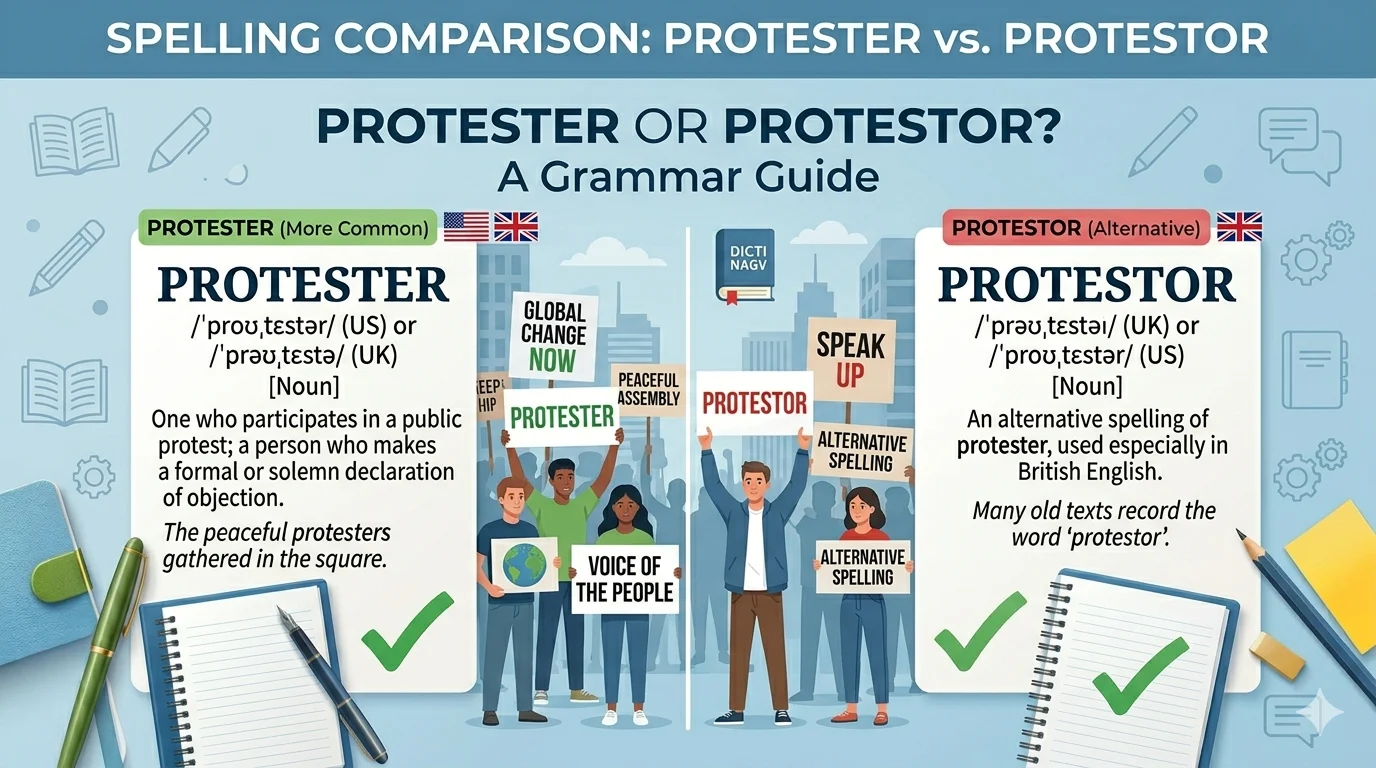
Have you ever wondered whether it should be protester or protestor? If so, you’re not alone. Many students, writers, journalists, bloggers, and English learners search for protester vs protestor because both spellings appear online, in newspapers, and across social media. This often leads people to ask: Is it spelled protestor or protester? Are they different words, or do they have the same meaning?
The confusion exists because English often uses both -er and -or endings to form nouns. As a result, many people assume that protester and protestor must have different definitions. However, the answer is much simpler than most people expect.
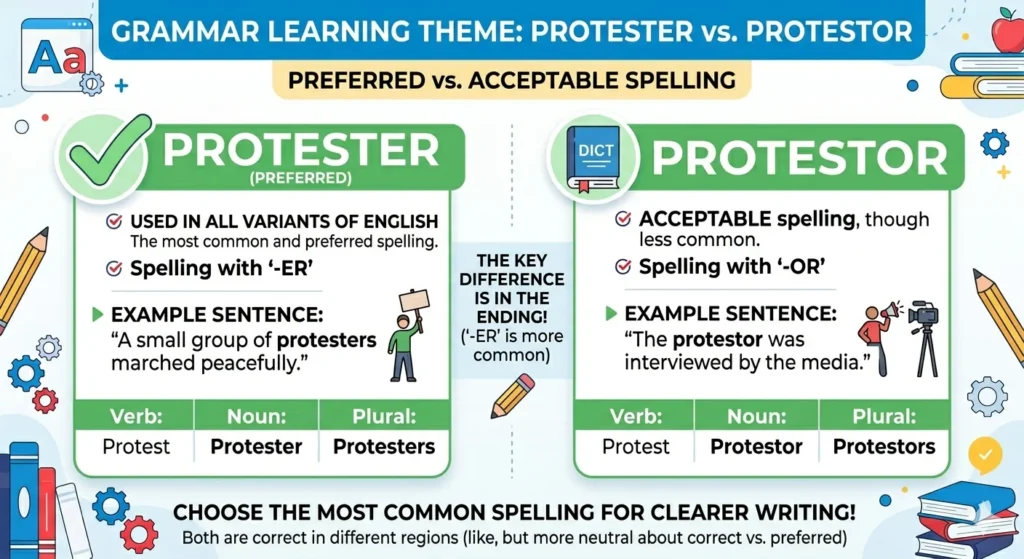
According to major dictionaries such as Merriam-Webster, Oxford English Dictionary, and Cambridge Dictionary, both spellings are accepted. However, protester is far more common in modern English. It is the preferred form in journalism, academic writing, business communication, and most style guides.
Protester vs Protestor
Both protester and protestor are correct English words. They mean exactly the same thing: a person who publicly expresses opposition to an issue, decision, policy, law, or event.
Examples
✅ Thousands of protesters gathered outside the city hall.
✅ Several protestors attended the demonstration.
Although both spellings are accepted, protester is much more common and widely preferred in modern English.
Quick Comparison Table
| Feature | Protester | Protestor |
|---|---|---|
| Correct Spelling | ✅ Yes | ✅ Yes |
| Same Meaning | ✅ Yes | ✅ Yes |
| Preferred by Editors | ✅ Yes | ❌ Usually No |
| AP Style Choice | ✅ Yes | ❌ Rare |
| Better for SEO | ✅ Yes | ❌ No |
| Common in News Media | ✅ Very Common | ⚠ Less Common |
Why Do People Confuse Protester and Protestor?
The confusion happens because English uses both -er and -or endings to create nouns. Words such as teacher, writer, actor, editor, and creator follow different spelling patterns.
Because both endings are common, many writers assume that protester and protestor must refer to different types of people. In reality, they do not.
Both words describe a person who participates in a protest or publicly expresses opposition to something. The difference is simply a matter of spelling preference. Over time, protester became the dominant form because the -er ending is more common for action-based nouns in English grammar.
The Origin of Protester vs Protestor
The word protest comes from the Latin word protestari, which means “to declare publicly” or “to testify openly.”
As English evolved, nouns were formed from verbs by adding suffixes such as -er and -or.
Examples
| Verb | Noun |
|---|---|
| Teach | Teacher |
| Write | Writer |
| Create | Creator |
| Edit | Editor |
| Protest | Protester |
Since the -er pattern is more common in English, protester gradually became the preferred spelling.
The alternative form protestor also entered the language and remains correct, but it is used less frequently.
Protester vs Protestor Meaning
There is no difference in meaning.
Both words mean:
A person who publicly expresses opposition to a policy, decision, action, law, organization, or social issue.
This is why dictionaries generally treat protestor as an alternative spelling rather than a separate word.
British English vs American English Spelling
Many people search for:
- Protestor or protester UK
- Protestor or protester AP Style
- Is it protesters or protestors in British English?
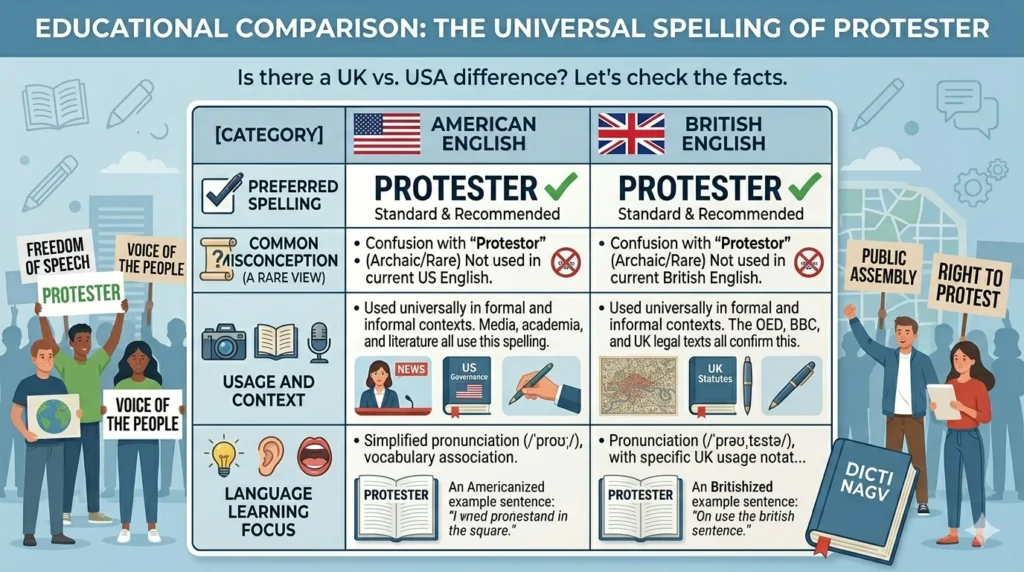
Unlike words such as colour/color or organise/organize, there is no major British-versus-American divide here.
British English
British publications generally prefer protester.
American English
American newspapers, magazines, and style guides overwhelmingly use protester.
Comparison Table
| Region | Preferred Form |
|---|---|
| United States | Protester |
| United Kingdom | Protester |
| Canada | Protester |
| Australia | Protester |
| New Zealand | Protester |
Protestor or Protester AP Style
The Associated Press (AP) Stylebook strongly favors protester.
Examples:
- Protesters marched through downtown streets.
- Climate protesters organized a rally.
- Student protesters demanded policy changes.
For journalism and professional content writing, protester is the safest choice.
Which Spelling Should You Use?
For most people, the answer is simple: use protester.
Use Protester If You Write:
- Blog posts
- SEO content
- News articles
- Academic papers
- Business reports
- Social media content
Use Protestor If:
- A specific style guide requires it.
- You are quoting a source that uses that spelling.
- Your organization consistently follows that variant.
Professional Advice
If your goal is clarity, consistency, and professionalism, choose protester and use it throughout your writing.
Common Mistakes with Protester vs Protestor
Many writers make the same mistakes.
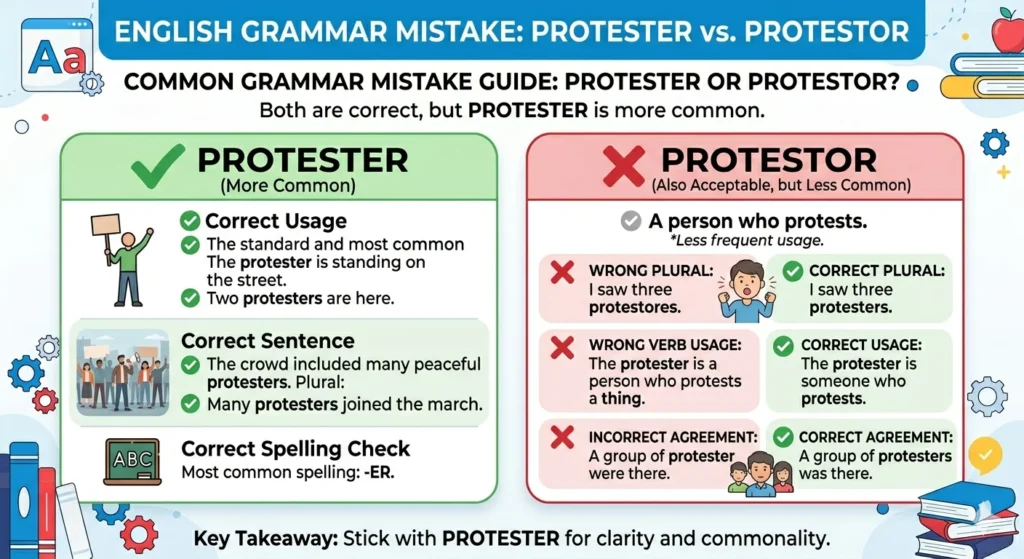
Mistake 1: Thinking Protestor Is Wrong
❌ Protestor is incorrect.
✅ Protestor is a valid alternative spelling.
Mistake 2: Mixing Both Spellings
❌ Protesters gathered outside while several protestors spoke later.
✅ Protesters gathered outside while several protesters spoke later.
Consistency matters.
Mistake 3: Assuming Different Meanings
❌ Protesters and protestors are different groups.
✅ They mean exactly the same thing.
Mistake 4: Ignoring Editorial Preferences
Most editors and style guides prefer protester.
Mistake 5: Using the Less Common Form for SEO
Although both are correct, protester performs better because it is more familiar to readers and appears more frequently in search results.
Protester vs Protestor in Everyday Examples
Understanding real-world usage makes the difference easier to remember.
In News Reports
“Thousands of protesters gathered in the capital.”
In Emails
“The protesters plan to attend next week’s public meeting.”
In Academic Writing
“Researchers interviewed protesters who participated in the demonstration.”
In Business Reports
“The report examined the impact of protesters on public events.”
In Social Media Posts
“Local protesters are organizing a peaceful rally this weekend.”
What’s the Difference Between Protesters and Protestors?
One of the most searched questions online is:
What’s the difference between protesters and protestors?
The answer is simple.
| Word | Meaning |
|---|---|
| Protesters | People who protest |
| Protestors | People who protest |
There is no difference in meaning, pronunciation, or grammar.
The difference is only spelling preference.
Protestor Meaning
Many users search for What is the meaning of protestor?
Definition
A protestor is a person who publicly expresses disagreement, concern, or opposition regarding an issue, policy, law, organization, or event.
Example
“The protestors gathered peacefully outside the courthouse.”
The meaning is identical to protester.
Protester Definition
A protester is a person who publicly expresses opposition to a decision, law, policy, event, or social issue. Protesters may participate in demonstrations, rallies, marches, petitions, or awareness campaigns.
Example
“The protesters gathered peacefully to raise awareness about environmental concerns.”
Dictionary definitions from major English dictionaries generally treat protester as the primary spelling and protestor as an alternative spelling.
Protestor Synonym
Depending on the context, these words may work as synonyms:
- Demonstrator
- Activist
- Campaigner
- Dissenter
- Advocate
- Opponent
- Organizer
- Marcher
Choose the synonym that best matches your context.
Protester Pronunciation
Protester
Pronunciation:
pruh-TES-ter
IPA:
/prəˈtɛstər/
Protestor
Pronunciation:
pruh-TES-ter
IPA:
/prəˈtɛstər/
Both spellings are pronounced the same way.
No Kings Protest and Modern Usage
Search interest in protest-related words often rises during major demonstrations such as the No Kings protest and other public events.
When covering these events, journalists overwhelmingly use protester rather than protestor.
Examples:
- Protesters gathered during the No Kings protest.
- Thousands of protesters attended the rally.
This widespread media usage helps explain why protester dominates modern English.
Paid Protesters and Online Discussions
Another frequently searched phrase is paid protesters.
The term is commonly used in political discussions and social media debates. Regardless of the context, major news organizations almost always use the spelling protesters.
Example:
“Critics alleged that the event included paid protesters.”
Again, protester remains the preferred form.
Protester vs Protestor – Google Trends & Usage Data
Search Trend Observation
Search trend data and publishing patterns clearly show that protester is significantly more popular than protestor.
Over the years, journalists, educators, bloggers, and professional writers have overwhelmingly chosen protester in articles, reports, and educational content. This trend is especially noticeable in the United States, United Kingdom, Canada, and Australia.
Relative Usage Comparison
| Keyword | Popularity |
|---|---|
| Protester | Very High |
| Protesters | Extremely High |
| Protestor | Low |
| Protestors | Very Low |
Why Protester Is More Popular
- Preferred by editors.
- Recommended by style guides.
- Matches common English grammar patterns.
- More familiar to readers.
For content creators, businesses, and bloggers, protester is usually the better choice.
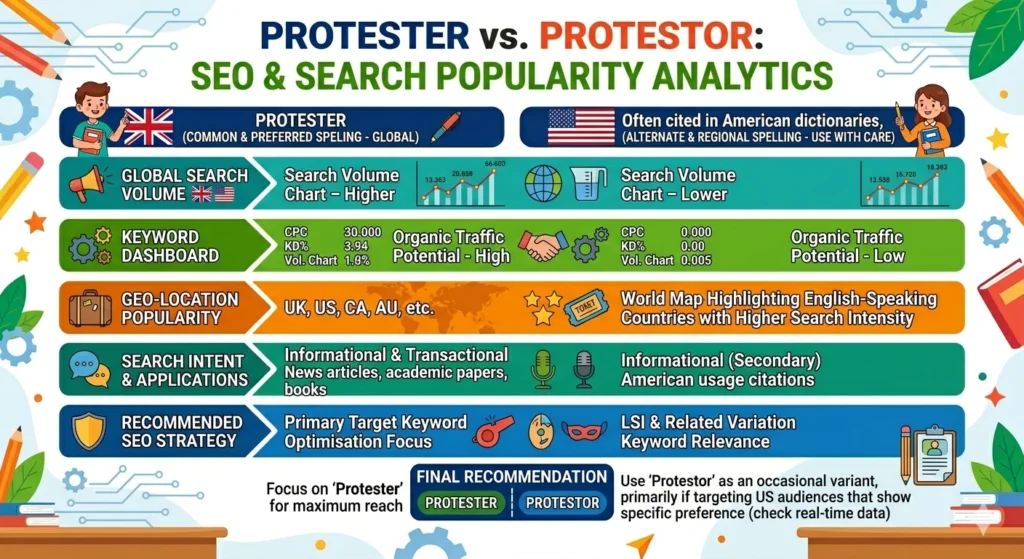
Final Recommendation
For most writing situations, use protester.
✅ Best for:
- Blog posts
- News reporting
- Academic writing
- Business communication
- Social media content
- Professional publishing
⚠ Use protestor only if:
- A style guide specifically requires it.
- You are quoting a source.
- Your organization consistently uses that spelling.
For clarity, consistency, reader familiarity, and search visibility, protester remains the recommended choice.
Frequently Asked Questions
Is it spelled protestor or protester?
Both are correct, but protester is far more common.
What is the meaning of protestor?
A protestor is a person who publicly expresses opposition or disagreement.
What’s the difference between protesters and protestors?
There is no difference in meaning. The difference is only spelling.
Is it protesters or protestors in British English?
Both are accepted, but protesters is the preferred form.
Does AP Style use protester or protestor?
AP Style strongly prefers protester.
Why is protester more common than protestor?
The -er ending follows common English noun-formation patterns and has become the standard choice.
Do dictionaries accept protestor?
Yes. Major dictionaries recognize protestor as an alternative spelling.
Which spelling do major dictionaries prefer?
Major dictionaries such as Merriam-Webster, Oxford, and Cambridge recognize both spellings, but protester is generally listed as the primary and more commonly used form.
Which spelling is better for SEO?
Protester is usually better because it appears more frequently in search results and published content.
Is protestor outdated?
No. It is still correct, but it is less common than protester.
Conclusion
The debate over protester vs protestor is much simpler than it first appears. Both spellings are correct, both are recognized by major dictionaries, and both refer to a person who publicly expresses opposition to an issue, policy, law, decision, or event. The key difference is not meaning but popularity and usage.
In modern English, protester is clearly the preferred spelling. It is favored by journalists, educators, editors, businesses, and style guides across the English-speaking world. It is also the spelling most readers expect to see, professional communication, academic writing, and content marketing.
If you want a spelling that aligns with modern language rules, editorial standards, and search engine best practices, choose protester. While protestor remains a valid alternative spelling, it appears far less often in everyday writing. By using protester consistently, you can improve clarity, maintain professionalism, and communicate more effectively with a global audience.
Meta Description: Protester vs protestor explained. Discover the correct spelling, meaning, AP Style preference, UK usage, pronunciation, examples, and writing tips.

Pam Peters is a linguist and grammar expert, known for clear explanations of modern English usage, style, and practical language rules.