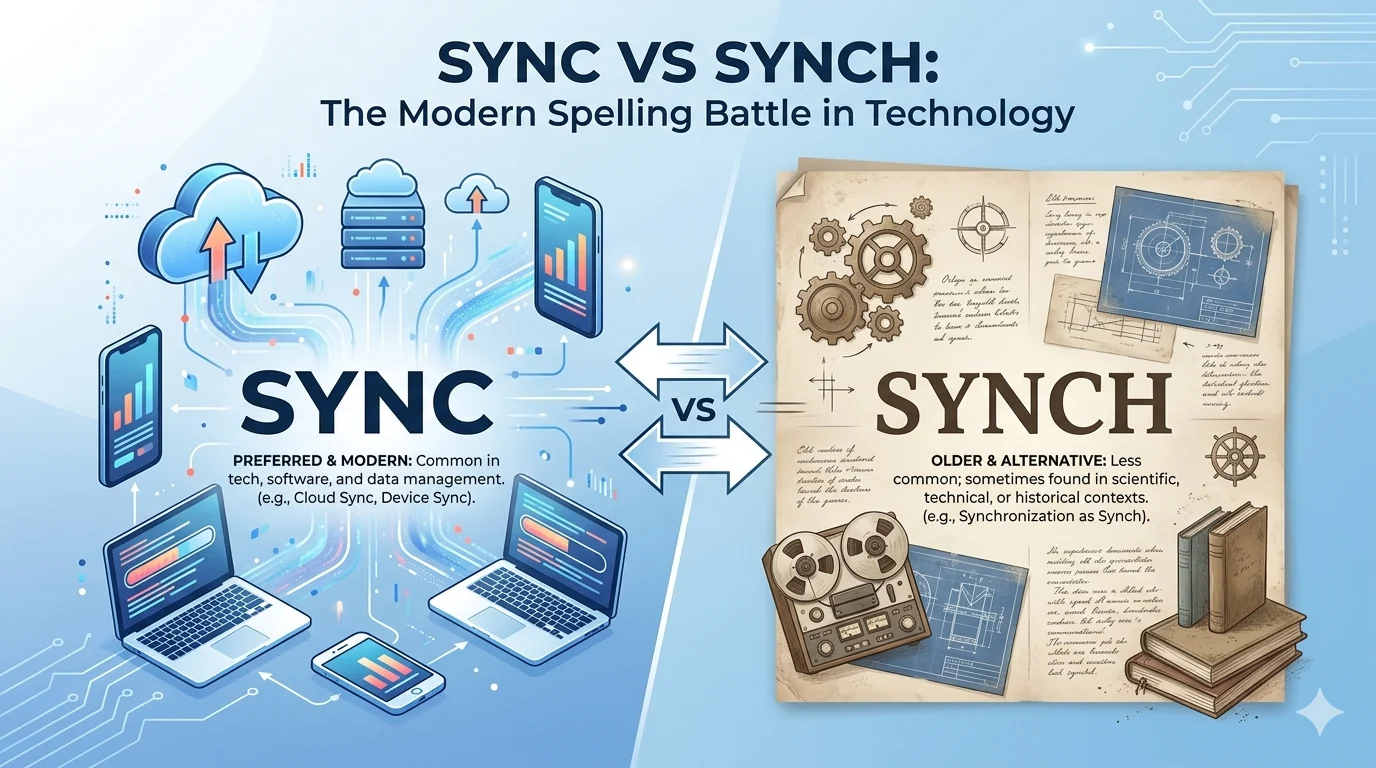
Have you ever written sync in an email, seen synch in a software guide, and wondered which spelling is correct? You are not alone. Many writers, students, professionals, and English learners search for sync vs synch because both spellings appear online. The confusion becomes even greater when people encounter phrases like sync up, synch up, in sync, out of synch, sync meeting, synced, and syncing.
The good news is that both words have the same meaning. They are shortened forms of synchronize or synchronise, which means making two or more things work together at the same time. However, one spelling has become much more popular in modern English.
Today, technology companies, software developers, businesses, and professional writers overwhelmingly prefer sync. While synch is still considered correct, it appears less often in modern writing.
In this complete guide, you’ll learn the meaning of sync and synch, their history, pronunciation, spelling differences, common usage, and which form you should use in 2026. By the end, you’ll know exactly which spelling fits your audience and writing style.
Sync vs Synch
Quick Verdict
✅ Sync is the preferred modern spelling.
✅ Synch is also correct but much less common.
✅ Both words mean “to synchronize.”
✅ Most technology companies, businesses, and style guides recommend sync.
Quick Comparison Table
| Word | Meaning | Correct? | Modern Usage |
|---|---|---|---|
| Sync | Short for synchronize | Yes | Very Common |
| Synch | Short for synchronize | Yes | Less Common |
Examples
- Please sync your files before the meeting.
- Let’s sync up tomorrow.
- The devices are in sync.
- Older documents may still use the spelling synch.
Is it in sync or insync?
✅ In sync
❌ Insync
Correct Example:
“The entire team is in sync on the project.”
Dictionary Definition of Sync
Understanding the dictionary meaning helps explain why both spellings exist.
Sync (Noun)
A state in which things happen together correctly or operate at the same time.
Example
“The audio is in sync with the video.”
Sync (Verb)
To synchronize devices, files, schedules, or activities.
Example
“Please sync your phone with your computer.”
Synch (Noun or Verb)
An alternative spelling of sync with the same meaning.
Example
“The manual uses the spelling synch.”
In modern dictionaries, both forms are recognized, but sync is usually the preferred version.
How to Pronounce Sync and Synch
One common question is whether the two spellings sound different.
The answer is no.
Pronunciation
Sync: /sɪŋk/
Synch: /sɪŋk/
Both words are pronounced exactly the same.
They rhyme with:
- Sink
- Think
- Link
- Blink
Even though the spellings differ slightly, there is no pronunciation difference between sync and synch.
Sync vs Synch – Detailed Explanation
Both sync and synch refer to the process of making things operate together correctly.
In modern life, synchronization happens everywhere:
- Data synchronization
- File synchronization
- Device synchronization
- Calendar synchronization
- Audio synchronization
- Video synchronization
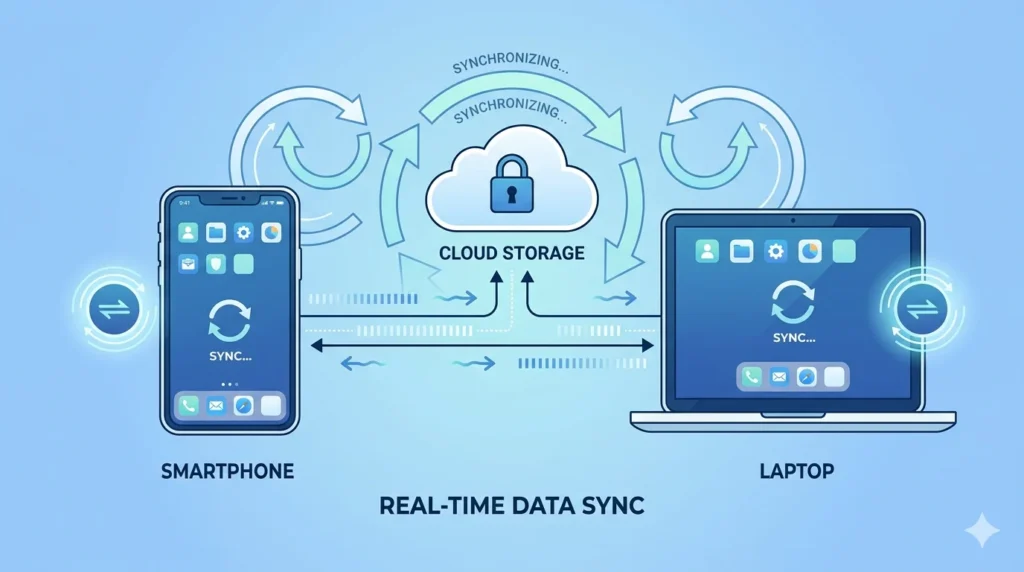
- Cloud synchronization
Technology Example
“The cloud service syncs files automatically.”
Business Example
“We need a sync meeting before the launch.”
Communication Example
“The marketing and sales teams are in sync.”
Project Management Example
“Weekly sync sessions help teams stay aligned.”
No matter which spelling you use, the meaning remains the same. The main difference is popularity and modern preference.
The Origin of Sync vs Synch
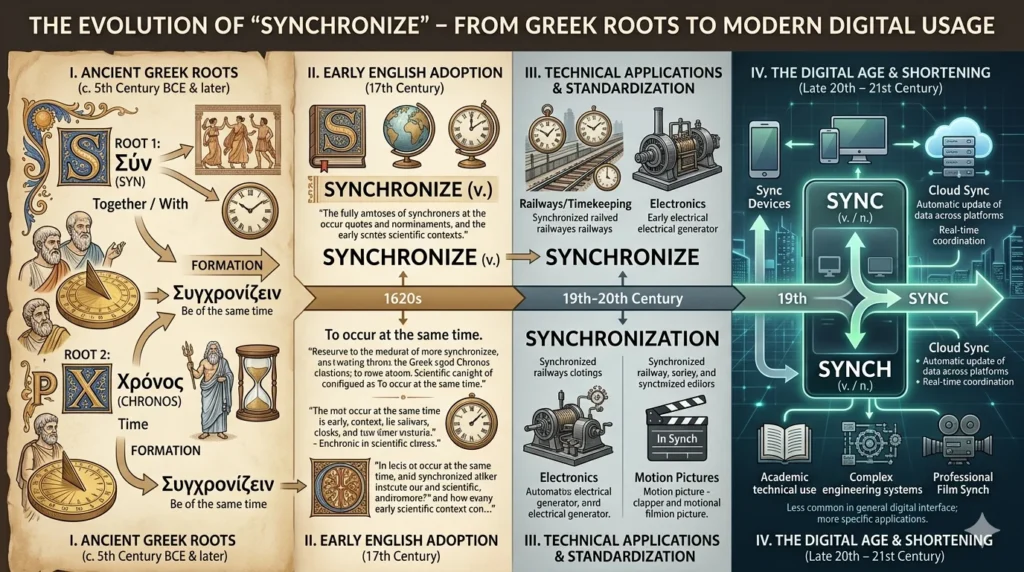
Both spellings come from the word synchronize.
The word has roots in ancient Greek:
- Syn = together
- Chronos = time
The original meaning was “happening together in time.”
As the word synchronize became widely used, people started shortening it for convenience.
This created two abbreviations:
- Sync
- Synch
For many years, both forms appeared in newspapers, books, technical manuals, and business writing.
However, the rise of computers, smartphones, cloud storage, synchronization software, and digital communication helped sync become the dominant spelling.
Today, modern interfaces typically use:
- Sync contacts
- Sync files
- Sync settings
- Sync status
- Sync calendar
instead of the longer spelling synch.
Synchronize vs Synchronise
Many people searching for sync vs synch also wonder about synchronize vs synchronise.
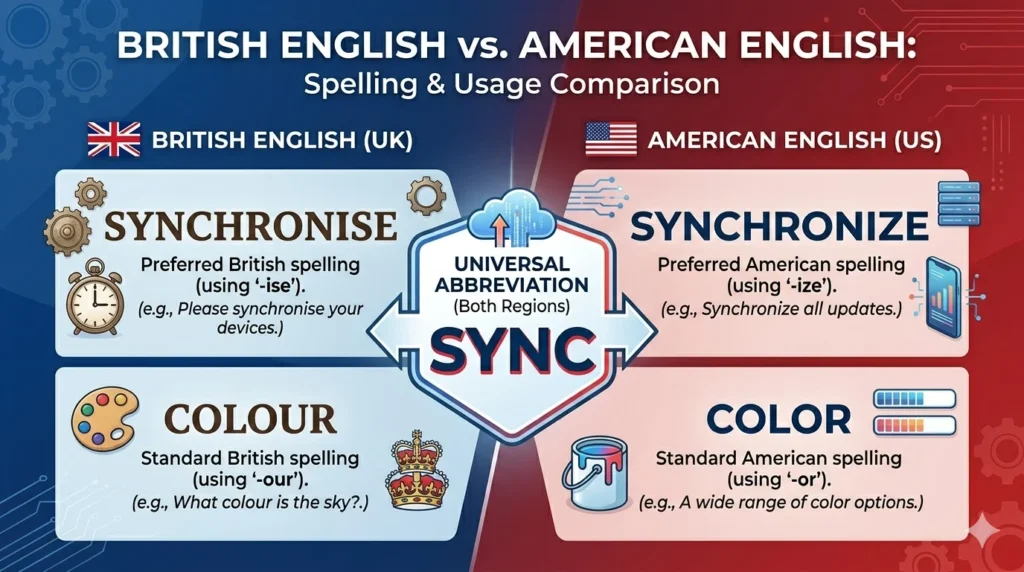
Unlike sync and synch, this difference is primarily based on regional spelling rules.
Comparison Table
| American English | British English |
|---|---|
| Synchronize | Synchronise |
| Synchronized | Synchronised |
| Synchronizing | Synchronising |
American English Example
“The software synchronizes automatically every hour.”
British English Example
“The software synchronises automatically every hour.”
Both forms are correct.
Interestingly, the abbreviation sync stays the same in both American and British English.
Whether you write synchronize or synchronise, the shortened form is usually sync.
British English vs American English Spelling
Unlike color vs colour or organize vs organise, sync vs synch is not mainly a British-versus-American debate.
Both countries understand both spellings.
However, modern usage strongly favors sync.
Comparison Table
| Feature | Sync | Synch |
|---|---|---|
| Meaning | Same | Same |
| American English | Preferred | Rare |
| British English | Preferred | Less Common |
| Technology Industry | Standard | Rare |
| Business Writing | Standard | Rare |
| Blogging Content | Recommended | Not Recommended |
| Search Popularity | Very High | Low |
| Reader Familiarity | Very High | Moderate |
American English Examples
- Sync your account.
- The files synced successfully.
British English Examples
- Sync your calendar.
- The application syncs every hour.
Even in British English, sync is now far more common than synch.
Why Technology Companies Prefer Sync
One of the biggest reasons sync became more popular is the technology industry.
Modern software companies prefer short, simple, and easy-to-read words.
Reasons Sync Became Standard
- Easier to read
- Easier to remember
- Takes less space in menus
- Looks cleaner in applications
- Better for user interfaces
- Fits modern branding styles
Common Technology Terms
- Cloud sync
- Data sync
- Device sync
- Calendar sync
- Real-time sync
- Automatic sync
- Manual sync
- Sync feature
- Sync status
- Data syncing
Examples
- Turn on automatic sync.
- Check your sync status.
- Enable cloud sync to back up files.
Because technology influences everyday language, sync became the standard spelling for most users.
Which Spelling Should You Use?
The best spelling depends on your audience and purpose.
Use Sync If:
- You write blog posts.
- You create SEO content.
- You work in technology.
- You write software documentation.
- You publish online articles.
- You communicate with an international audience.
- You write business emails.
Example
“Please sync the latest files before publishing.”
Use Synch If:
- You are quoting older material.
- You are referencing historical documents.
- You must follow a legacy company style guide.
Example
“The archived guide uses the spelling synch.”
For almost all modern situations, sync is the safer and more professional choice.
Expert Takeaway
After reviewing modern style guides, software documentation, technology websites, business communication standards, and digital marketing content, one pattern is clear:
Sync has become the dominant spelling in modern English.
While synch remains technically correct, it appears far less often than sync in professional writing, online content, cloud computing, synchronization software, and business communication.
If your goal is clarity, professionalism, and modern usage, choose sync.
Most readers expect to see sync, and using it helps your writing feel current and natural.
Sync vs Synch Cheat Sheet
| Situation | Best Choice |
|---|---|
| Blog Writing | Sync |
| SEO Articles | Sync |
| Business Emails | Sync |
| Technology Content | Sync |
| Software Documentation | Sync |
| Mobile Applications | Sync |
| User Guides | Sync |
| Historical References | Synch |
| Archived Documents | Synch |
| Modern Communication | Sync |
Quick Rule
If you’re unsure, use sync.
It is the preferred spelling for nearly all modern writing situations.
Common Mistakes with Sync vs Synch
Even experienced writers sometimes make mistakes when using sync and synch.
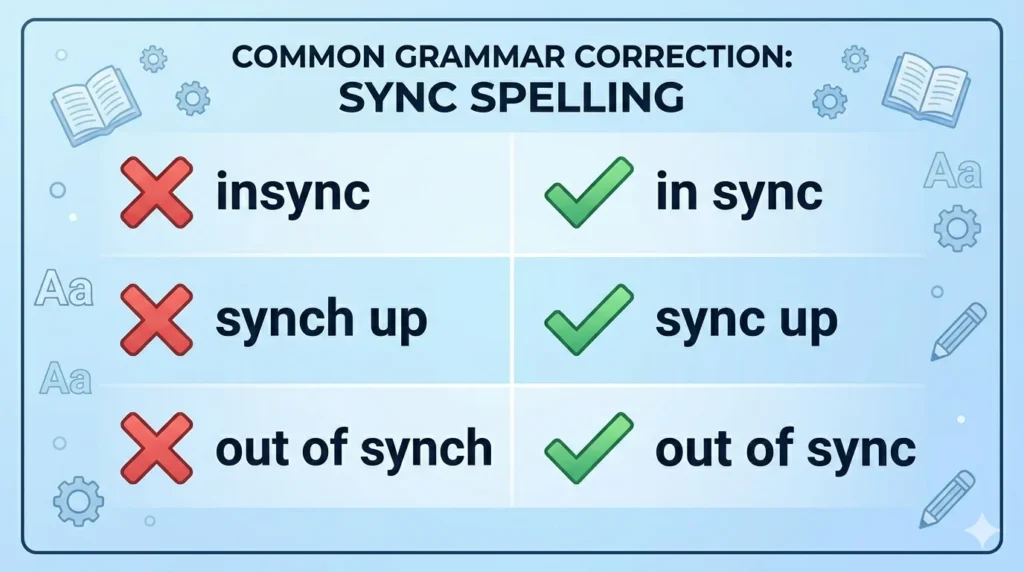
Mistake #1: Writing Insync Instead of In Sync
❌ Insync
✅ In sync
Correct:
“The team is in sync.”
Incorrect:
“The team is insync.”
Mistake #2: Confusing Sync and Synchronize
Some people think sync and synchronize have different meanings.
Actually:
- Synchronize = full form
- Sync = shortened form
Both mean the same thing.
Example
“The devices synchronize automatically.”
“The devices sync automatically.”
Both sentences are correct.
Mistake #3: Using Out of Synch in Modern Writing
Both spellings are technically correct.
✅ Out of sync
⚠️ Out of synch
However, out of sync is much more common today.
Example
“The subtitles are out of sync with the video.”
Mistake #4: Incorrect Syncing Spelling
Correct forms include:
- Sync
- Syncs
- Syncing
- Synced
Examples
✅ The application is syncing.
✅ The files synced successfully.
❌ The files syncheded successfully.
Mistake #5: Confusing Synch the Waist with Cinch the Waist
Many people search for “synch the waist.”
However, the correct phrase is:
✅ Cinch the waist
The verb cinch means to tighten.
The words sync and synch relate to synchronization and timing.
Example
“Use a belt to cinch the waist.”
Sync vs Synch in Everyday Examples
Understanding real-world usage makes the difference easier to remember.
In Emails
“Please sync the latest project files before noon.”
“Let’s sync up before the client call.”
In Meetings
Sync or Synch Meeting?
The preferred phrase is:
✅ Sync meeting
Example
“We have a weekly sync meeting every Monday.”
In News Articles
“The systems sync data across multiple regions.”
“The platform supports real-time synchronization.”
On Social Media
“We finally synced our calendars.”
“Our playlists are perfectly in sync.”
In Formal Writing
“The software supports automatic synchronization across devices.”
“The platform uses cloud synchronization to improve productivity.”
Is It Sync or SyncE?
The correct spelling is:
✅ Sync
There is no standard English word called SyncE.
If you see SyncE, it is usually:
- A brand name
- A company name
- A software product name
For normal writing, always use sync.
Is It Synch Up or Sync Up?
Both expressions exist, but one is clearly more popular.
Modern Preference
✅ Sync up
⚠️ Synch up
Examples
- Let’s sync up tomorrow.
- We need to sync up before launch.
- The teams synced up their schedules.
In modern business communication and project management, sync up is the preferred expression.
How Is Synch Different from Sync?
This is one of the most common questions.
The short answer is:
There is no difference in meaning.
Both words mean:
- Synchronize
- Coordinate
- Operate together
- Work at the same time
The only real difference is usage frequency.
| Feature | Sync | Synch |
|---|---|---|
| Meaning | Same | Same |
| Pronunciation | Same | Same |
| Modern Usage | Very High | Lower |
| Technology Industry | Preferred | Rare |
| SEO Writing | Preferred | Less Common |
Sync Meaning
The word sync means:
To make two or more systems, devices, files, schedules, or activities operate together correctly.
Common Types of Sync
- Data sync
- Device sync
- Calendar sync
- Cloud sync
- Real-time sync
- Manual sync
- Automatic sync
- Audio synchronization
- Video synchronization
Examples
- Sync your contacts.
- Sync your calendar.
- Sync your laptop and phone.
- Sync your files to the cloud.
Is Synch a Word?
Yes.
Synch is a real word and a recognized abbreviation of synchronize.
Many dictionaries include both spellings.
However, sync has become far more common in modern English.
Today, most technology companies, businesses, and publishers use sync instead of synch.
Synced and Syncing Spelling
Many users search for the correct verb forms.
Present Forms
- Sync
- Syncs
- Syncing
Past Form
- Synced
Examples
“The software syncs every hour.”
“The files synced overnight.”
“The application is syncing right now.”
These are the standard modern spellings.
Out of Sync vs Out of Synch
Both phrases are grammatically correct.
However, modern English strongly prefers:
✅ Out of sync
Examples
- The audio is out of sync.
- The team is out of sync.
- The animation is out of sync with the soundtrack.
Although out of synch still appears occasionally, it is much less common.
Sync vs Synch – Google Trends & Usage Data
Online search behavior clearly shows a preference for sync.
Relative Search Popularity
| Search Term | Popularity |
|---|---|
| Sync | Very High |
| Sync Up | High |
| Synced | High |
| Syncing | High |
| Synch | Low |
| Synch Up | Low |
Why Sync Dominates Search Results
Several factors explain why sync is more popular:
- Technology companies prefer sync.
- Mobile apps use sync.
- Cloud platforms use sync.
- Business teams use sync meetings.
- Modern style guides recommend sync.
Countries Where Sync Is Most Popular
- United States
- United Kingdom
- Canada
- Australia
- India
Common Search Contexts
- File synchronization
- Data syncing
- Cloud sync
- Device sync
- Calendar synchronization
- Real-time sync
- Synchronization software
For SEO and online publishing, sync is generally the better keyword target.
Frequently Asked Questions
1. What is the difference between sync and synch?
There is no difference in meaning. Both are abbreviations of synchronize.
2. Is synch a real word?
Yes. Synch is a valid word, although it is less common today.
3. Which spelling is more common?
Sync is significantly more common in modern English.
4. Is it in sync or insync?
The correct phrase is in sync.
5. Is it sync up or synch up?
Sync up is the preferred modern spelling.
6. What does synced mean?
Synced means successfully synchronized.
Example:
“The files synced overnight.”
7. Is sync a noun or a verb?
It can be both.
Noun: “The audio is in sync.”
Verb: “Please sync your devices.”
8. Is sync formal or informal?
Sync can be used in both formal and informal writing.
9. Can I use sync in business emails?
Yes. Sync is widely accepted in professional communication.
10. Why is sync more popular than synch?
Technology companies and software platforms helped make sync the standard spelling.
11. Is sync correct in academic writing?
Yes, especially when discussing technology or digital systems.
12. What is the opposite of sync?
Common opposites include:
- Out of sync
- Unsynchronized
- Uncoordinated
13. Is sync used in technology?
Yes. It is one of the most common technology terms today.
14. What is a sync meeting?
A sync meeting is a meeting held to align information, goals, and progress among team members.
15. Should I use sync or synch in SEO content?
Use sync because it is more popular with readers and search engines.
Conclusion
The debate between sync vs synch is simpler than it first appears. Both words are correct abbreviations of synchronize and carry the same meaning. They refer to making things operate together, whether that involves devices, files, schedules, teams, or digital systems.
However, modern usage clearly favors sync. It is the spelling used by technology companies, software developers, businesses, marketers, and professional writers around the world. You will see it in cloud synchronization, data syncing, sync meetings, mobile applications, and business communication.
While synch remains a legitimate alternative spelling, it appears less frequently and is often associated with older documents or legacy style guides. For most readers, sync looks more natural and familiar.
If you are writing a blog post, business email, website article, software guide, sync is the best choice. It is modern, widely recognized, easy to understand, and aligned with current language trends. When in doubt, choose sync and you will rarely be wrong.

Betty Azar is a respected English language educator and author, known for clear grammar explanations and practical resources for learners worldwide.