Have you ever stopped while writing and wondered, “Should I use themselves or themself?” You are not alone. This grammar question has become more common as singular they is now widely accepted in modern English. Many writers, students, bloggers, and professionals often struggle to decide whether themself or themselves is the correct choice.
The confusion usually happens when referring to one person whose gender is unknown, unspecified, or nonbinary. Traditional grammar rules favored themselves, while modern usage has increased the acceptance of themself in specific situations. As a result, many people search questions such as “Which is correct, themselves or themself?”, “Themself or themselves for one person”, and “Themself or themselves singular.”
This guide explains the difference in simple language. You will learn the meaning, history, grammar rules, examples, common mistakes, and professional writing recommendations. By the end, you will know exactly when to use themself and when themselves is the better choice.
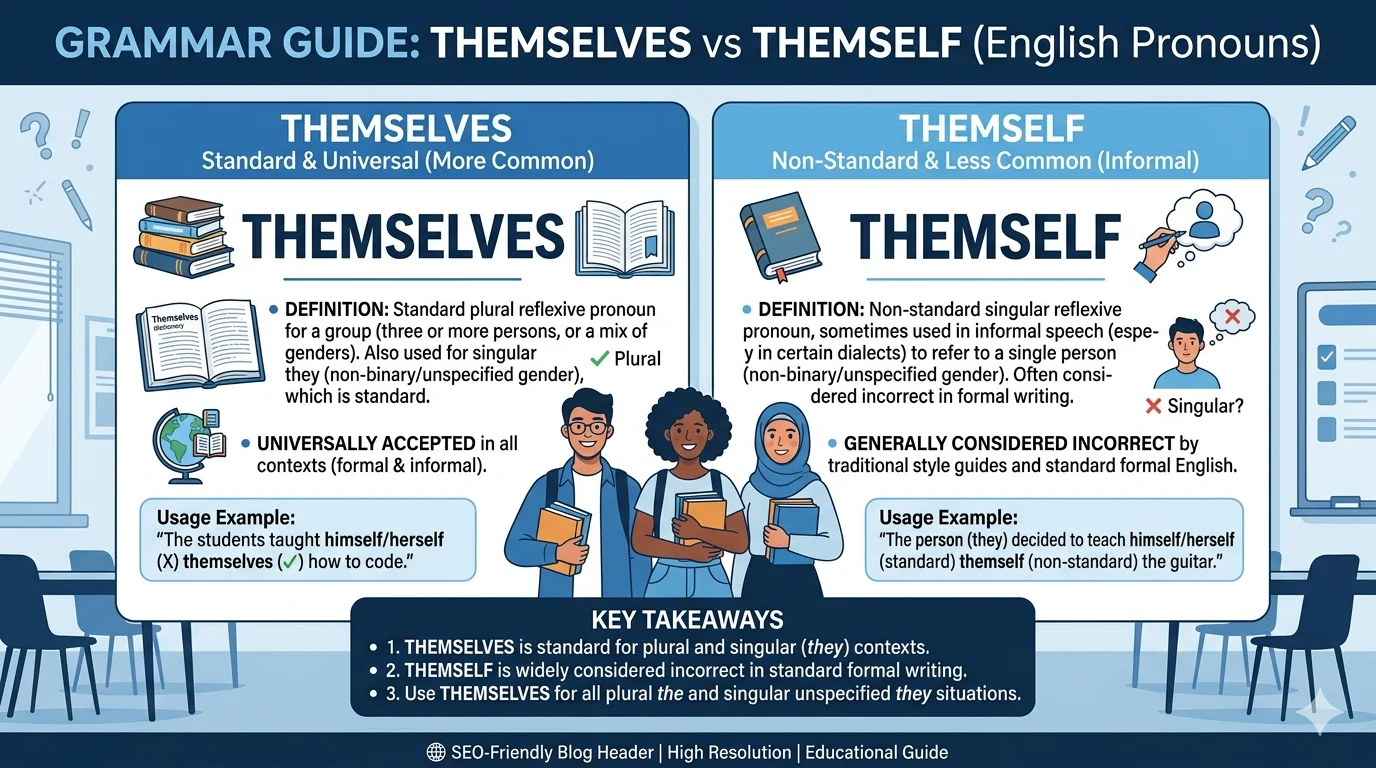
Themselves vs Themself
Quick Answer: Both themselves and themself are correct, but they are used in different situations.
- Themselves is the traditional and most widely accepted form.
- Themself is increasingly used when they refers to a single person, especially a nonbinary person or an individual of unknown gender.
Examples
✅ Every student should prepare themselves for the exam.
✅ Every student should prepare themself for the exam.
✅ Alex said they would complete the project by themself.
✅ The players congratulated themselves after the victory.
Key Rule
- Singular they → themself or themselves
- Plural they → themselves
For formal and traditional writing, themselves remains the safest choice.
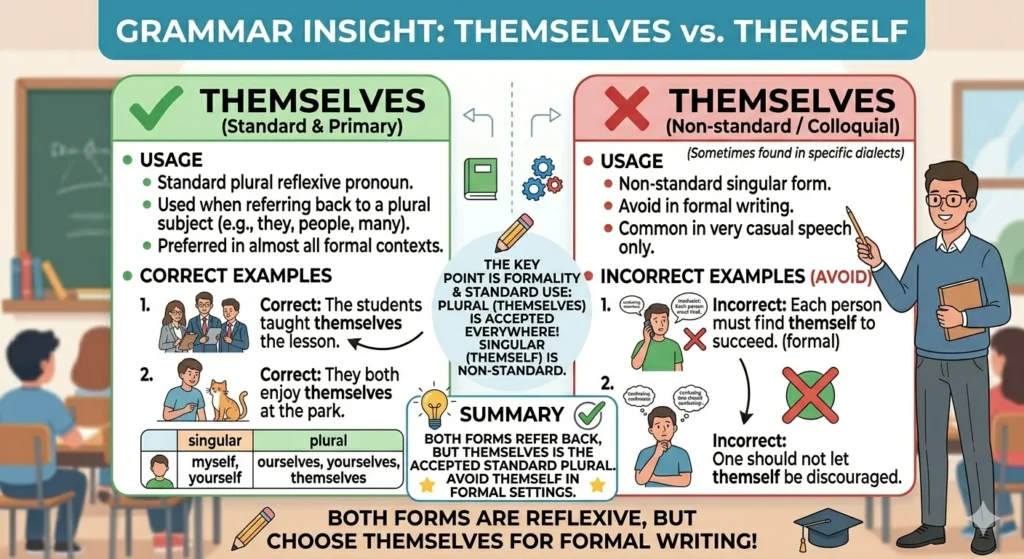
The Origin of Themselves vs Themself
The word themselves has existed in English for hundreds of years. It developed from the Old English pronouns used to create reflexive forms.
Interestingly, themself is not a new invention. Linguists have found examples dating back to the 14th and 15th centuries. Historically, writers sometimes used themself when referring to a singular person.
Over time, grammar books standardized themselves, making it the dominant form in schools and formal writing.
Today, language is changing again because singular they has become common and widely accepted. Since singular subjects often use singular reflexive pronouns, many people naturally prefer themself when referring to one person.
Why the Difference Exists
The spelling difference exists because English speakers are balancing two ideas:
- Traditional grammar favors themselves.
- Modern singular they encourages the singular form themself.
Both forms now appear in dictionaries and style guides, though usage varies.
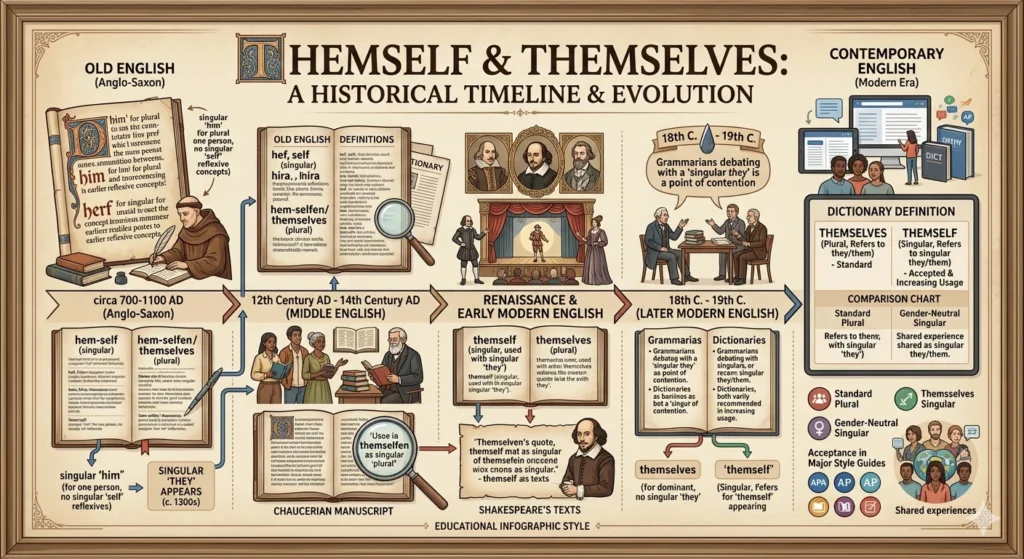
British English vs American English Usage
Unlike words such as colour/color or organise/organize, themself and themselves are not mainly a British versus American spelling issue.
Both forms appear in British and American English.
However, preferences differ slightly.
| Feature | Themselves | Themself |
|---|---|---|
| Traditional English | ✔ Common | ✖ Less common |
| Formal Writing | ✔ Preferred | Sometimes accepted |
| Singular They | ✔ Accepted | ✔ Accepted |
| Plural They | ✔ Correct | ✖ Incorrect |
| Academic Writing | ✔ Preferred | Depends on style guide |
| Nonbinary References | ✔ Used | ✔ Frequently used |
British English Examples
- Every passenger should protect themselves.
- Each applicant must identify themself if they wish.
American English Examples
- A student should prepare themselves for graduation.
- Taylor completed the assignment by themself.
Both countries recognize the forms, but themselves remains more common overall.
Which Form Should You Use?
Choosing between themself and themselves depends on your audience and purpose.
For US Audiences
Use themselves in formal documents, academic writing, and business communication.
Use themself when referring to a specific nonbinary individual if that matches their preference.
For UK Audiences
British publishers often prefer themselves, but themself is increasingly accepted in modern usage.
For Global Audiences
If you are writing for an international audience, themselves is usually the safest option because it is more familiar worldwide.
Professional Recommendation
| Situation | Recommended Form |
|---|---|
| Formal business writing | Themselves |
| Academic papers | Themselves |
| General website content | Themselves |
| Nonbinary individual preference | Themself |
| Singular they emphasis | Themself or Themselves |
| Plural subjects | Themselves |
Common Mistakes with Themselves vs Themself
Many writers make mistakes because they are unsure whether they is singular or plural.
Mistake #1: Using Themself for a Group
❌ The players celebrated themself.
✅ The players celebrated themselves.
Reason: Players is plural.
Mistake #2: Assuming Themself Is Always Wrong
❌ Themself is never correct.
✅ Themself is accepted when they refers to one person.
Mistake #3: Mixing Singular and Plural References
❌ Every student should prepare themselves and submit his work.
✅ Every student should prepare themselves and submit their work.
Mistake #4: Ignoring Personal Preference
When referring to a nonbinary person, their preferred language should be respected.
✅ Jordan completed the project by themself.
Mistake #5: Using Themself in Clearly Plural Contexts
❌ The employees introduced themself.
✅ The employees introduced themselves.
Themselves vs Themself in Everyday Examples
Understanding real-life examples makes the rule easier.
In Emails
✅ Every employee should familiarize themselves with the policy.
✅ Each team member should introduce themself during orientation.
In News Articles
✅ A witness identified themself to authorities.
✅ Residents prepared themselves for the storm.
On Social Media
✅ Someone left themself a reminder.
✅ Fans congratulated themselves after the win.
In Formal Writing
✅ Each participant should position themselves near the entrance.
✅ The candidate described themself as experienced and motivated.
Themself in a Sentence
- Sam introduced themself to the audience.
- The author described themself in the biography.
- Every applicant should prepare themself for the interview.
Themselves in a Sentence
- The children enjoyed themselves.
- The workers organized themselves efficiently.
- The athletes challenged themselves every day.
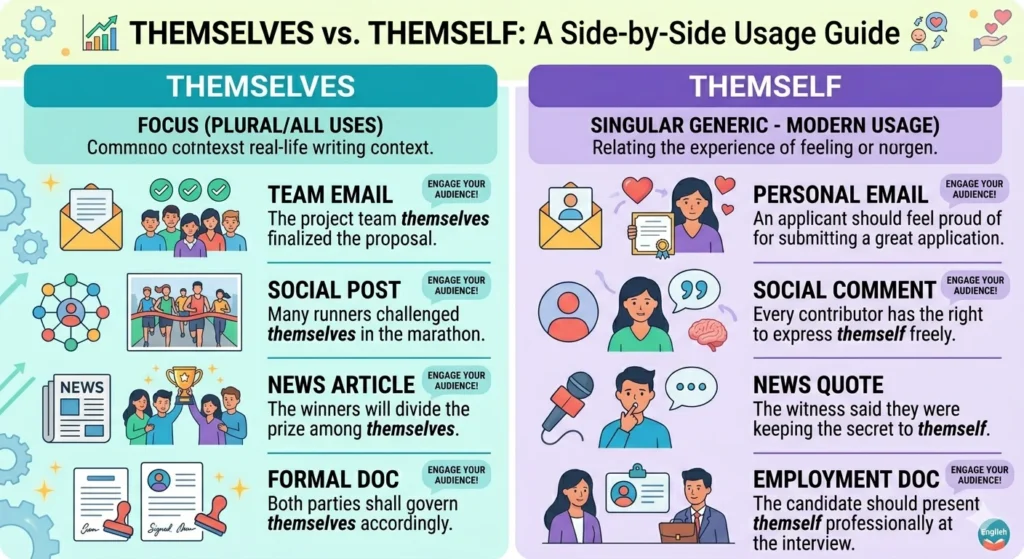
Themselves vs Themself Comparison Table
| Feature | Themself | Themselves |
|---|---|---|
| Meaning | Reflexive pronoun | Reflexive pronoun |
| Singular They | ✔ Yes | ✔ Yes |
| Plural They | ✖ No | ✔ Yes |
| Traditional Usage | Less common | Very common |
| Formal Writing | Limited | Preferred |
| Nonbinary Usage | Common | Common |
| Dictionaries Recognize It | ✔ Yes | ✔ Yes |
| Best Known Form | No | Yes |
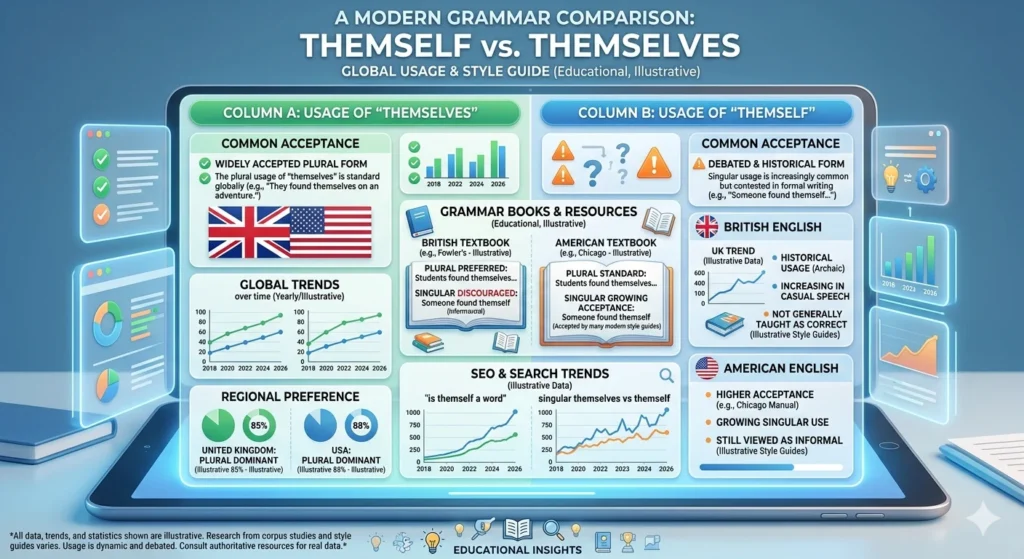
Themselves vs Themself – Google Trends & Usage Data
Search interest in themself has grown significantly in recent years. This increase is largely connected to the rise of singular they and greater awareness of gender-inclusive language.
Countries Where Searches Are Common
- United States
- United Kingdom
- Canada
- Australia
- New Zealand
Common Search Queries
- Which is correct, themselves or themself?
- Themself or themselves examples
- Themself or themselves for one person
- Themself or themselves singular
- Themself meaning
- Themself or themselves for nonbinary
- They themself or themselves
- Themself or themselves plural
- Themself in a sentence
- What are the rules for using themselves?
Language experts generally agree that both forms have a place in modern English, though themselves remains more common overall.
FAQs About Themselves vs Themself
Which is correct, themselves or themself?
Both are correct. Themselves is traditional and more common. Themself is often used with singular they.
What are the rules for using themselves?
Use themselves when they refers to multiple people. It can also be used with singular they in many contexts.
Themself or themselves for one person?
Both may be correct. Themself emphasizes singular reference, while themselves remains widely accepted.
Themself or themselves singular?
When they refers to one person, either form may be used depending on style and preference.
Themself meaning?
Themself is a reflexive pronoun used when a singular they performs an action on the same person.
Themself or themselves for nonbinary people?
Many nonbinary individuals use themself, though some prefer themselves. Personal preference should guide usage.
They themself or themselves?
If they refers to one person, both are possible. If they refers to multiple people, use themselves.
Themself or themselves plural?
For plural subjects, themselves is the correct choice.
Conclusion
The debate between themselves vs themself reflects the natural evolution of the English language. While themselves remains the traditional, widely accepted, and most common reflexive pronoun, themself has gained recognition as a useful option when they refers to a single person. This is especially true in modern inclusive language and when referring to nonbinary individuals.
For most formal, academic, and business writing, themselves is still the safest choice because it is familiar to readers around the world. However, themself is no longer considered incorrect in many modern style guides and dictionaries. It serves an important role when singular they is intended and when an individual prefers that form.
The best approach is to consider your audience, writing style, and context. If clarity is your goal, use themselves for plural subjects and choose either themself or themselves carefully when referring to one person. Understanding the difference helps you write with confidence, accuracy, and respect for modern English usage.

Pam Peters is a linguist and grammar expert, known for clear explanations of modern English usage, style, and practical language rules.