You submit a thesis, publish a blog post, write a research paper, or prepare a business report—and suddenly your spell checker highlights either defense or defence. Which spelling is actually correct? If you’ve ever searched “Are defences or defenses correct?” or “Is defense with an S or C?”, you’re not alone.
The confusion between defenses vs defences is one of the most common spelling questions in the English language. Both words appear in books, academic writing, government documents, sports articles, military reports, and online content. Because American English and British English follow different spelling conventions, many writers are unsure which version they should use.
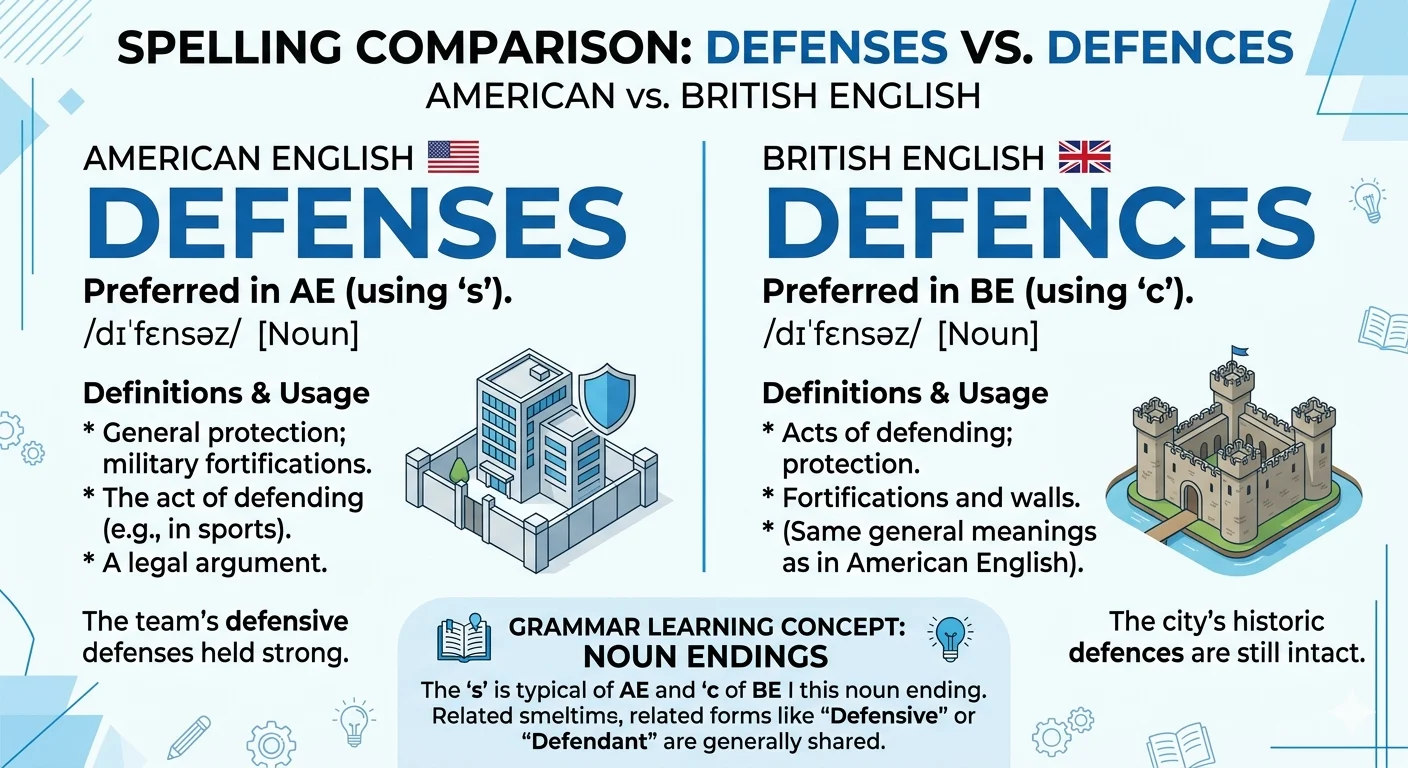
The good news is that both spellings are correct. The difference is not in meaning but in regional usage. In this guide, you’ll learn the meaning of defense, the origin of both spellings, British vs American spelling rules, usage in research and formal writing, common mistakes, real-world examples, and professional advice for choosing the right spelling. Whether you’re writing for a US audience, a UK audience, or a global readership, this article will help you use the correct spelling confidently.
Defenses vs Defences
Quick Answer Table
| Question | Answer |
|---|---|
| Are defenses and defences correct? | Yes |
| American spelling | Defense / Defenses |
| British spelling | Defence / Defences |
| Meaning different? | No |
| Which should I use? | Depends on your audience |
| Used in research? | Yes |
| Used in sports? | Yes |
Short Answer
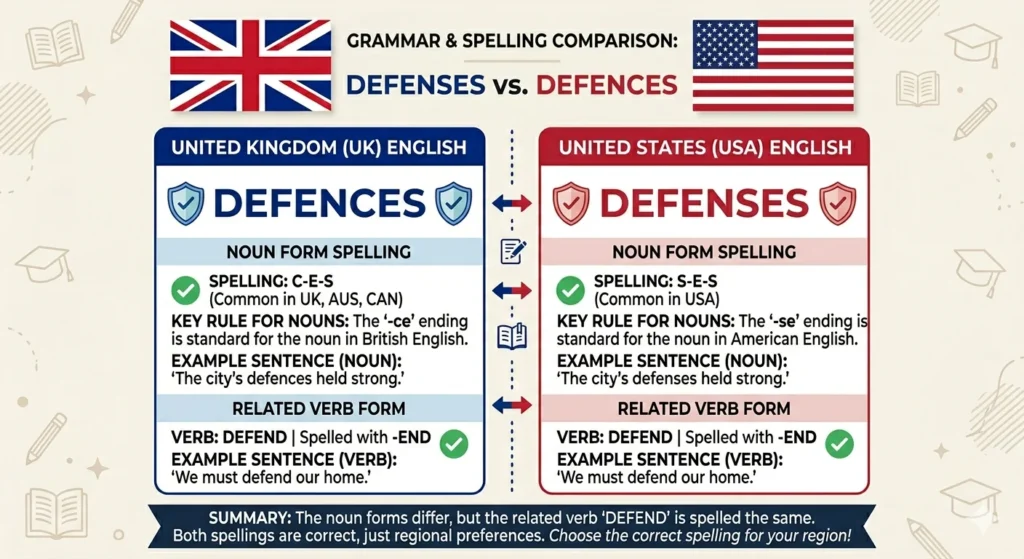
Defenses and defences mean exactly the same thing.
- Defenses is the American English spelling.
- Defences is the British English spelling.
Both words refer to protection, safeguards, resistance, security measures, legal arguments, or strategies used to defend something.
Examples
American English:
- The team improved its defenses before the season.
- The lawyer presented several defenses in court.
British English:
- The nation strengthened its coastal defences.
- New cyber defences were introduced.
The meaning never changes. Only the spelling does.
The Origin of Defenses vs Defences
The word comes from the Latin term defendere, meaning “to protect,” “to guard,” or “to ward off.”
The word later passed through Old French before becoming part of Middle English. For centuries, English spelling was not standardized, and writers often used multiple variations of the same word.
The modern difference appeared when spelling conventions began to separate British English from American English.
Why the Spelling Difference Exists
In the early 19th century, American dictionary writer Noah Webster introduced simplified spelling rules in the United States.
As a result:
| Traditional British Form | American Form |
|---|---|
| Defence | Defense |
| Offence | Offense |
| Pretence | Pretense |
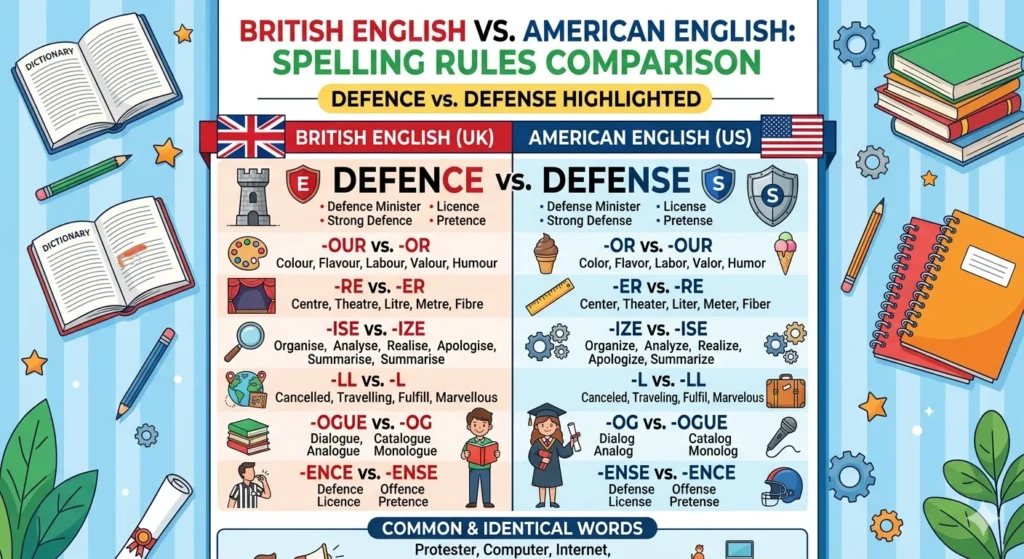
Britain retained many traditional spellings, while the United States adopted simplified forms. This created the modern distinction between defenses and defences.
British English vs American English Spelling
Many people ask:
Is Defense with an S or C?
The answer depends on the variety of English you are using.
American English Rule
American English typically prefers -se endings.
Examples:
| British English | American English |
|---|---|
| Defence | Defense |
| Offence | Offense |
| Pretence | Pretense |
| Licence | License |
British English Rule
British English generally keeps -ce endings.
Examples:
| British English Word | Meaning |
|---|---|
| Defence | Protection |
| Offence | Violation or attack |
| Pretence | False appearance |
| Licence | Official permission |
Defenses vs Defences Comparison Table
| Feature | Defenses | Defences |
|---|---|---|
| Region | United States | United Kingdom |
| Correct? | Yes | Yes |
| Meaning | Protection | Protection |
| Academic Use | US institutions | UK institutions |
| Government Use | US government | UK government |
| Preferred Audience | American readers | British/Commonwealth readers |
Which Spelling Should You Use?
One of the most searched questions is:
When Should I Use Defense vs Defence?
The answer depends entirely on your audience.
Use “Defenses” If:
- Your audience is in the United States.
- You follow American spelling conventions.
- Your publication uses US English.
- You write for American businesses.
Use “Defences” If:
- Your audience is in the United Kingdom.
- You write for Australia, New Zealand, or other Commonwealth countries.
- Your organization follows British English style guides.
For Global Audiences
Choose one style and remain consistent throughout the document.
Avoid:
❌ defenses and defences mixed together
Use:
✅ defenses throughout
OR
✅ defences throughout
Consistency is a key part of professional communication, content writing, and academic writing.
Common Mistakes with Defenses vs Defences
Because both spellings are correct, writers often make avoidable mistakes.
Mistake #1: Mixing Both Spellings
Incorrect:
The country’s defenses were upgraded and its defences became stronger.
Correct:
The country’s defenses were upgraded.
OR
The country’s defences were upgraded.
Mistake #2: Using the Wrong Regional Style
A UK publication should normally use:
✅ defence
Not:
❌ defense
Similarly, American publications generally prefer:
✅ defense
Mistake #3: Thinking One Version Is Wrong
Many learners assume one spelling is incorrect.
This is false.
Both spellings are accepted in modern English.
Mistake #4: Confusing Defensive and Defencive
Many users search:
Defensive or defencive?
Correct:
✅ Defensive
Incorrect:
❌ Defencive
The adjective remains defensive in both British and American English.
Mistake #5: Inconsistent Academic Writing
Research papers, theses, and dissertations should follow one spelling style throughout.
Defenses vs Defences in Everyday Examples
In Emails
American:
We have improved our cybersecurity defenses.
British:
We have improved our cybersecurity defences.
In News Articles
American:
New defense measures were announced.
British:
New defence measures were announced.
In Social Media Posts
American:
Great defenses win championships.
British:
Great defences win championships.
In Formal Business Writing
American English:
- defense strategy
- defense policy
- defense industry
British English:
- defence strategy
- defence policy
- defence industry
Defence or Defense in Research?
Students frequently ask:
Defence or Defense in Research?
Both are correct.
The spelling depends on your institution’s language style guide.
Thesis Defense or Defence?
United States:
✅ Thesis Defense
United Kingdom:
✅ Thesis Defence
PhD Defence or Defense?
Again, both are correct.
American universities generally use:
✅ PhD Defense
British universities generally use:
✅ PhD Defence
Always follow your university’s official guidelines.
Ministry of Defence or Defense?
Government institutions follow regional spelling standards.
United Kingdom
The official name is:
Ministry of Defence
United States
The official name is:
Department of Defense
This is one of the clearest examples of British and American spelling differences.
Defence or Defense in Basketball?
Sports fans often search:
Defence or Defense in Basketball?
Both are correct.
American sports coverage uses:
- defense
- defensive strategy
- defensive player
British sports coverage uses:
- defence
- defensive tactics
- defensive performance
Example:
American:
The team’s defense stopped the offense.
British:
The team’s defence stopped the attack.
Defenses vs Defences – Google Trends & Usage Data
Search behavior shows clear regional preferences.
Countries Preferring “Defense”
- United States
- American universities
- US government agencies
- American sports media
Countries Preferring “Defence”
- United Kingdom
- Australia
- New Zealand
- South Africa
- Other Commonwealth nations
Online Usage Trends
- Defense generally receives higher global search volume.
- Defence dominates in British English publications.
- Both spellings are widely used in academic writing, military contexts, sports reporting, and legal defense discussions.
For SEO, targeting the spelling your audience uses can improve relevance and engagement.

Expert Writing Tip
If you are writing for an international audience, choose one spelling style and use it consistently throughout your document.
Mixing defense and defence in the same article, thesis, research paper, or business report can appear unprofessional and may confuse readers. Consistency matters more than choosing one version over the other.
Frequently Asked Questions
Are defences or defenses correct?
Yes. Both spellings are correct. Defenses is American English, while defences is British English.
What does defense mean?
Defense means protection, resistance, safeguarding, or the act of defending against attack, criticism, or danger.
Is defense with an S or C?
American English uses defense with an S. British English uses defence with a C.
When should I use defense vs defence?
Use defense for American audiences and defence for British or Commonwealth audiences.
Is thesis defense or thesis defence correct?
Both are correct. The preferred spelling depends on the university’s language style.
Is PhD defence or defense correct?
Yes. American universities usually use PhD Defense, while British universities use PhD Defence.
Is defensive or defencive correct?
Defensive is correct. Defencive is incorrect.
Which spelling is more common globally?
Defense appears more frequently worldwide because American English has a strong online presence. However, defence remains the standard British spelling.
Conclusion
The difference between defenses vs defences is a matter of regional spelling, not meaning. Both words refer to protection, safeguards, resistance, legal arguments, military systems, and defensive strategies. American English uses defense and defenses, while British English uses defence and defences.
Whether you are writing a research paper, preparing a thesis defense, discussing basketball tactics, creating professional content, or following a style guide, the best choice depends on your audience. American readers expect the -se spelling, while British and Commonwealth readers expect the -ce version.
The most important rule is consistency. Choose one spelling style and use it throughout your document. This improves readability, professionalism, and credibility.
A simple way to remember the difference is this: Americans usually write defense with an S, while British writers use defence with a C. The meaning never changes—only the spelling does. Choose the version that matches your audience, stay consistent, and your writing will always look polished and trustworthy.

Pam Peters is a linguist and grammar expert, known for clear explanations of modern English usage, style, and practical language rules.