Should you write the farthest city or the furthest city? If you’ve ever stopped while writing and wondered which word is correct, you’re not alone. The confusion between farthest vs furthest is one of the most common English grammar questions. Students, writers, bloggers, professionals, and English learners frequently search for answers because both words appear similar and are often used interchangeably.
Traditionally, grammar experts used farthest for physical distance and furthest for figurative or abstract distance. However, modern English has blurred this distinction, causing uncertainty about which form to use in emails, essays, business writing, and everyday conversations.
Many people search questions such as What is the difference between farthest and furthest?, Is farthest grammatically correct?, Is it farthest or furthest date?, and What are some farthest vs furthest examples? This guide provides a quick answer, detailed grammar explanations, pronunciation tips, real-world examples, usage trends, and expert recommendations. By the end, you’ll know exactly when to use each word and how to avoid common mistakes.
Farthest vs Furthest in One Sentence
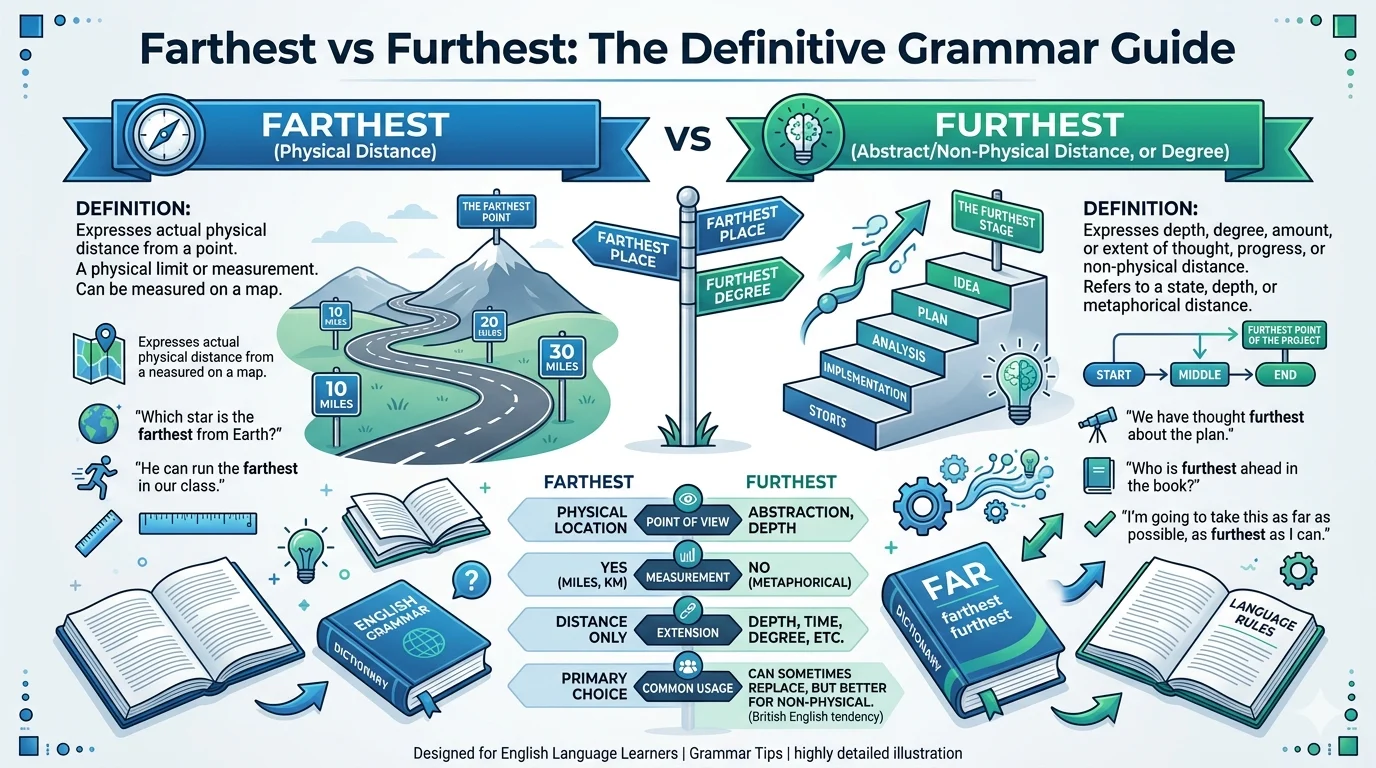
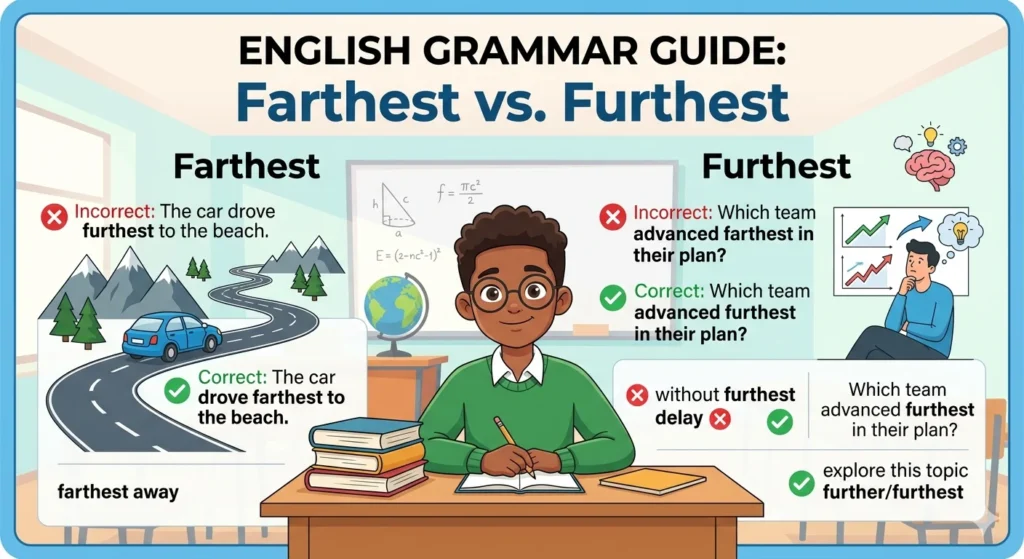
Farthest is traditionally used for physical distance, while furthest is often used for figurative or abstract distance, although both are accepted in modern English.
Farthest vs Furthest
The simplest way to remember the difference is:
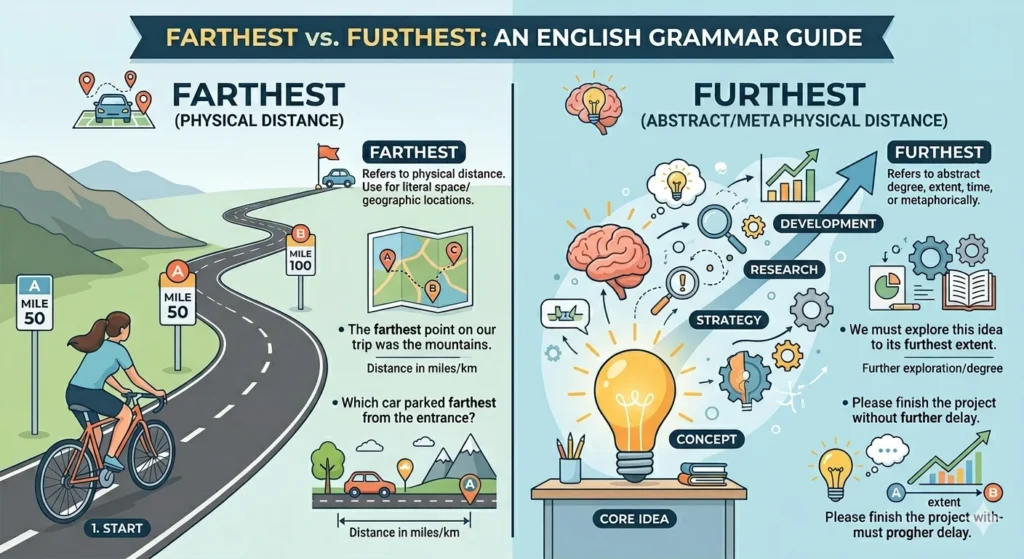
- Farthest = greatest physical distance.
- Furthest = greatest figurative, metaphorical, or abstract distance.
Examples
✅ The desert is the farthest place from our town.
✅ This proposal goes the furthest toward solving the problem.
✅ She ran the farthest in the race.
✅ We have reached the furthest stage of the project.
Modern dictionaries, including Oxford and Merriam-Webster, accept both words in many situations. However, following the traditional distinction can make your writing clearer and more professional.
The Origin of Farthest vs Furthest
The words farthest and furthest both come from the Old English word feor, meaning “far away.” Over centuries, English developed two comparative forms and two superlative forms:
| Base Form | Comparative | Superlative |
|---|---|---|
| Far | Farther | Farthest |
| Far | Further | Furthest |
Historically, farther and farthest described measurable distance, while further and furthest described additional progress, degree, or abstract distance.
As English evolved, speakers began using the forms interchangeably. Today, the distinction still exists in grammar guides, but everyday usage is much more flexible.
This historical overlap explains why so many people search for farthest vs furthest grammar rules.
Far, Farther, Farthest Meaning
Understanding the complete word family makes the distinction easier.
| Word | Function | Meaning |
|---|---|---|
| Far | Adjective/Adverb | At a great distance |
| Farther | Comparative | More distant physically |
| Farthest | Superlative | Most distant physically |
| Further | Comparative | Additional or more advanced |
| Furthest | Superlative | Most advanced or greatest degree |
Examples
- My school is far from home.
- The airport is farther than the station.
- The beach is the farthest destination.
- We need further information.
- This plan takes the idea the furthest.
British English vs American English Usage
Regional preferences influence which word people choose.
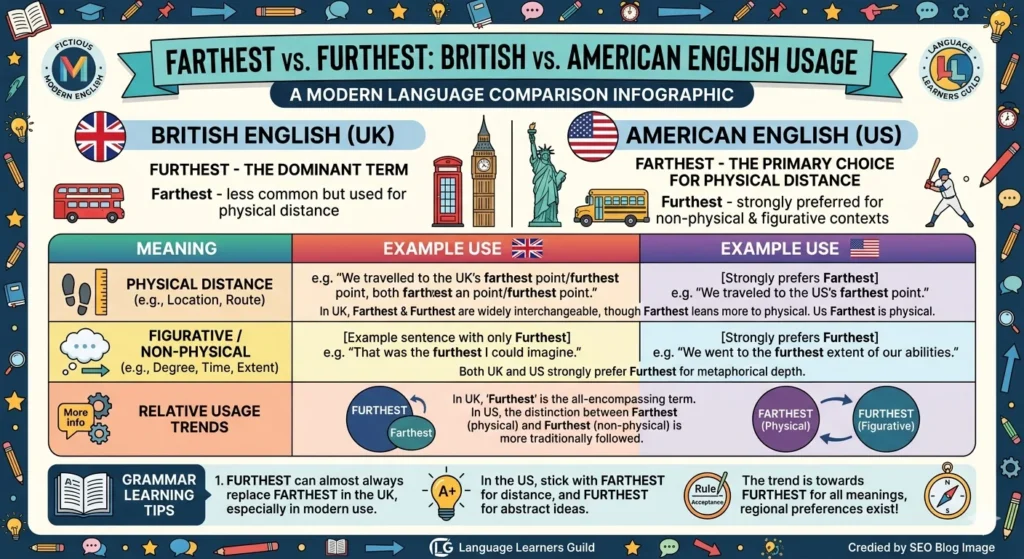
American English
American writers generally prefer:
- Farther
- Farthest
especially when discussing measurable distances.
British English
British English speakers more commonly use:
- Further
- Furthest
for both literal and figurative meanings.
Comparison Table
| Situation | American English | British English |
|---|---|---|
| Physical distance | Farthest | Furthest or Farthest |
| Abstract distance | Furthest | Furthest |
| Preferred style | Farthest | Furthest |
| Academic writing | Either | Either |
| Daily conversation | Farthest | Furthest |
Examples
American English:
- Alaska is the farthest state from Florida.
British English:
- Scotland is the furthest point on our journey.
Both forms are correct.
Which Spelling Should You Use?
Your audience should guide your choice.
Use “Farthest” When:
- Writing for American readers.
- Discussing measurable distance.
- Following traditional grammar rules.
Examples:
- Which planet is farthest from the Sun?
- She threw the ball the farthest.
Use “Furthest” When:
- Writing for British audiences.
- Discussing progress, ideas, or time.
- Following modern British style.
Examples:
- This project has reached its furthest stage.
- We explored the furthest implications of the theory.
Editor’s Recommendation
For the clearest writing:
- Use farthest for physical distance.
- Use furthest for abstract ideas.
- Stay consistent throughout your article.
- Match the style to your audience.
This approach satisfies both grammar experts and modern readers.
Common Mistakes with Farthest vs Furthest
Mistake #1: Thinking One Is Incorrect
❌ Farthest is wrong.
✅ Farthest and furthest are both correct.
Mistake #2: Ignoring Context
❌ This is the farthest stage of negotiations.
✅ This is the furthest stage of negotiations.
Mistake #3: Confusing Further and Farther
Many learners also ask:
Is there any difference between further and farther?
Traditional rule:
- Farther = physical distance.
- Further = additional distance or degree.
Further vs Farther Example
✅ The hotel is farther away.
✅ We need further research.
This pattern also helps explain farthest vs furthest.
Farthest vs Furthest in Everyday Examples
In Emails
- We have reached the furthest stage of discussions.
- The warehouse is the farthest office location.
In News Reports
- The storm reached the farthest northern region.
- Scientists explored the furthest limits of technology.
On Social Media
- This is the furthest I’ve pushed myself.
- We drove to the farthest point on the map.
In Academic Writing
- Researchers examined the furthest implications of the study.
In Business Writing
- The company expanded to its farthest international market.
Farthest vs Furthest Examples
| Farthest Examples | Furthest Examples |
|---|---|
| He lives the farthest away. | We have come the furthest in development. |
| Which city is farthest from here? | This solution goes furthest toward solving the issue. |
| She traveled the farthest distance. | The project reached its furthest stage. |
| That island is the farthest destination. | This theory takes the idea furthest. |
| The farthest mountain is visible today. | We explored the furthest possibilities. |
Farthest vs Furthest Exercises
Fill in the Blank
- She ran the ______ distance.
Answer: farthest
- This idea goes the ______.
Answer: furthest
- Which city is the ______ from here?
Answer: farthest
- We reached the ______ stage of planning.
Answer: furthest
Farthest or Furthest Date?
One of the most searched questions is:
Is it farthest or furthest date?
Because dates refer to time rather than physical space, furthest date is generally preferred.
Examples:
✅ The furthest date available is December 31.
✅ We cannot schedule beyond the furthest date listed.
While farthest date is occasionally used, furthest date sounds more natural to most English speakers.
Farthest or Furthest Pronunciation
| Word | IPA Pronunciation |
|---|---|
| Farthest | /ˈfɑːrðɪst/ |
| Furthest | /ˈfɜːrðɪst/ |
Examples
Furthest = FUR-thest
Farthest = FAR-thest
Google Trends & Usage Data
Usage varies by country.
| Country | More Common Form |
|---|---|
| United States | Farthest |
| Canada | Farthest |
| United Kingdom | Furthest |
| Australia | Furthest |
| New Zealand | Furthest |
Usage Patterns
- Farthest is common in travel, geography, maps, and distance-related topics.
- Furthest is common in education, business, science, and abstract discussions.
- Both words continue to receive strong search interest because learners frequently compare their meanings and grammar rules.
FAQs
What is the difference between farthest and furthest?
Traditionally, farthest refers to physical distance, while furthest refers to abstract or figurative distance.
Is farthest grammatically correct?
Yes. Farthest is a correct and widely accepted English word.
Is there any difference between further and farther?
Traditionally, farther relates to measurable distance, while further relates to degree, progress, or additional information.
Is it farthest or furthest date?
Furthest date is usually preferred because dates represent time rather than physical distance.
Can I use farthest and furthest interchangeably?
In many modern contexts, yes. However, following the traditional distinction often improves clarity.
Which form is more common in American English?
American English generally prefers farther and farthest.
Which form is more common in British English?
British English generally prefers further and furthest.
Conclusion
The debate over farthest vs furthest continues because both words are correct and widely used. Traditionally, farthest referred to physical distance, while furthest described abstract distance, progress, or degree. Although modern English often treats them as interchangeable, understanding the traditional rule can improve your grammar and make your writing more precise.
If you write for American audiences, farthest is usually the preferred choice for measurable distances. If you write for British or international audiences, furthest often appears more naturally, especially in figurative contexts. For global websites and blogs, consistency matters more than choosing one form over the other.
The easiest rule to remember is simple: use farthest for places and measurable distances, and use furthest for ideas, progress, dates, and abstract concepts. Following this guideline will help you write with greater confidence, accuracy, and professionalism.